
📅 Last updated: 17.11.2026
The Spanish Armada failure of 1588 was not the product of a single catastrophe but of a chain of interlocking weaknesses—strategic confusion, inadequate communications, inferior gunnery doctrine, and merciless weather—that together destroyed the largest fleet Europe had yet seen. Philip II of Spain intended his armada to rendezvous with the Duke of Parma’s invasion army in the Spanish Netherlands, escort it across the English Channel, and land it on English soil. Instead, the fleet was harried out of the Channel by the English navy, scattered by fireships off Calais, mauled at Gravelines, and finally broken by Atlantic storms that drove its surviving ships onto the rocks of Ireland and Scotland.
The Spanish Armada failed because it was a hastily assembled, poorly coordinated fleet tasked with an impossible dual mission: fighting a superior English battle fleet while simultaneously escorting a cross-Channel invasion. England’s faster, more maneuverable ships and long-range cannon, combined with the Armada’s inability to link up with Parma’s army, forced the Spanish into a disastrous retreat around the British Isles, where storms destroyed much of the fleet.
- What Was the Spanish Armada and Why Was It Launched?
- How Did the Spanish Armada Failure Unfold?
- Why Was the Spanish Armada Defeated? The Core Factors
- Did Weather or English Guns Decide the Spanish Armada Failure?
- What Were the Consequences of the Spanish Armada Failure?
- Why Does the Spanish Armada Failure Still Matter?
What Was the Spanish Armada and Why Was It Launched?
By the mid-1580s, Philip II of Spain governed the largest empire on earth, stretching from the Americas to the Philippines, and drew immense wealth from the silver mines of Potosí and Zacatecas. Yet his authority in the Netherlands was in open revolt. Since 1568, Dutch Protestants had fought a brutal war of independence against Spanish rule, and England under Elizabeth I had quietly—and then openly—supported them.
The flashpoints multiplied. English privateers such as Francis Drake plundered Spanish treasure fleets and ports, most spectacularly at Cádiz in 1587. Elizabeth had executed the Catholic Mary, Queen of Scots in February 1587, removing the heir around whom Philip might have built a Catholic restoration in England. And Philip, who had briefly been King of England through his marriage to Mary I, regarded Elizabeth as a heretic usurper. Pope Sixtus V gave the enterprise his blessing, promising a subsidy once Spanish troops actually landed on English soil—a conditional promise that would matter enormously later.
The plan, finalized in 1587, called for the Marquis of Santa Cruz, Spain’s most experienced admiral, to sail the Armada up the Channel, defeat or neutralize the English fleet, and secure the narrow waters between Calais and Dover. There, the Duke of Parma would embark his veteran Army of Flanders—roughly 30,000 hardened soldiers—on flat-bottomed barges and cross to England under the Armada’s protective screen. Santa Cruz died in February 1588, and Philip replaced him with the Duke of Medina Sidonia, a capable administrator with no experience of naval command—a decision that has been second-guessed for four centuries.
How Did the Spanish Armada Failure Unfold?
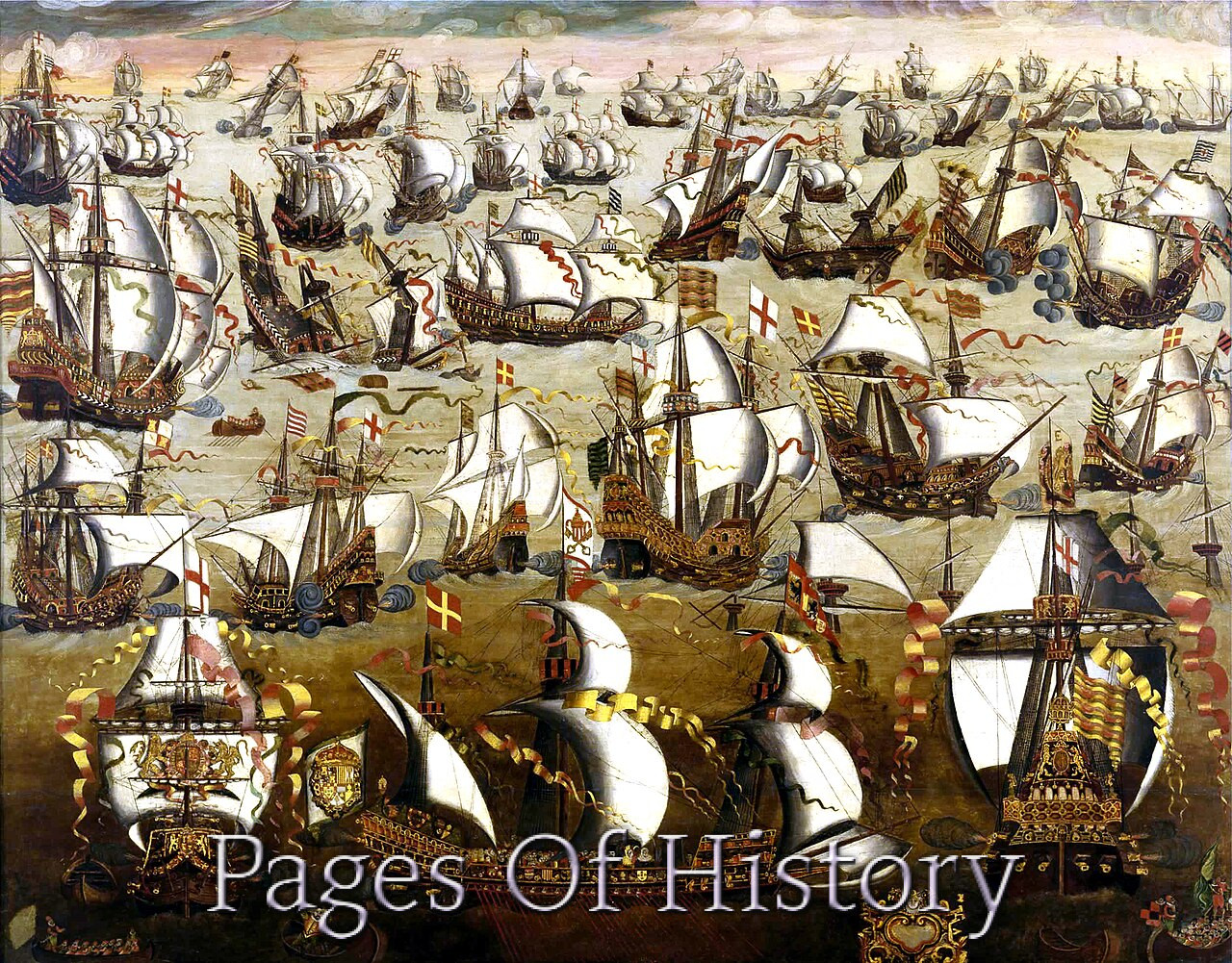
The Armada that sailed from Lisbon on 28 May 1588 numbered about 130 ships, carrying roughly 19,000 soldiers and 8,000 sailors, plus some 2,500 guns of varying quality. It was delayed, dispersed by storms off Corunna, and reassembled only in late July. It entered the English Channel on 30 July, sailing in a tight, crescent-shaped formation designed for defense—a floating fortress that could not easily be broken.
The English fleet, commanded overall by Charles Howard, Lord High Admiral, with Drake, John Hawkins, and Martin Frobisher as squadron leaders, numbered around 200 vessels, including purpose-built race-built galleons such as the *Revenge* and *Ark Royal*. These ships were longer, lower, faster, and carried more long-range culverins than the Spanish galleons, whose design emphasized boarding actions and heavy short-range guns.
The Running Fight Up the Channel
From Plymouth to Calais, the English shadowed the Armada and harried its flanks. The Spanish formation held, but the English consistently refused to close to boarding range, firing from beyond the reach of Spanish heavy artillery. On 2 August, the English attacked off Portland Bill; on 4 August, off the Isle of Wight. The engagements were inconclusive but wore down Spanish cohesion and consumed ammunition. The Armada anchored off Calais on 6 August, expecting Parma’s army to be ready—but Parma’s barges were blockaded by Dutch flyboats under Justin of Nassau, and Parma’s veterans were dispersed across the Netherlands suppressing Dutch resistance. The rendezvous was impossible.
Fireships at Calais and the Battle of Gravelines
On the night of 7–8 August, the English sent eight fireships, stripped and loaded with pitch and powder, drifting into the anchored Armada on the tide. Panic broke the Spanish formation as captains cut cables and scattered. The next morning, 8 August, the English fell on the disorganized Spanish off Gravelines, in what is now Belgian waters. In a day-long cannonade the English, now able to close range against a broken enemy, inflicted severe damage. Spanish accounts describe decks swept by English fire; English accounts describe the frustration of watching Spanish ships absorb punishment without sinking—Spanish hulls were thick, and English gunnery, while faster, was not consistently lethal.
Gravelines was not a decisive annihilation. No major Spanish galleon went down there. But the Armada had been driven out of its defensive formation, its ammunition was running low, and the wind had turned. The Spanish council of war decided to abandon the plan and return home by sailing north around Scotland and Ireland—a route its pilots barely knew.
Why Was the Spanish Armada Defeated? The Core Factors
The Spanish Armada failure can be attributed to five interlocking causes, each of which compounded the others.
– Strategic overreach: The Armada was asked to do two incompatible jobs—fight the English fleet and escort an invasion—without a unified command structure linking it to Parma’s army. There was no secure deep-water port for the rendezvous, and Parma had no way to signal his readiness or coordinate timing.
– Command and communication failures: Medina Sidonia commanded the fleet, but Parma commanded the army; neither had authority over the other, and Philip’s instructions, written in Madrid with no knowledge of conditions at sea, were rigid and often impossible to follow.
– Technological and doctrinal inferiority at sea: English race-built galleons and long-range culverins outmatched Spanish boarding tactics and heavy short guns in the Channel’s confined waters.
– Logistical fragility: The Armada carried too much siege equipment and too little food and water for a long campaign, and it had no friendly port to resupply once it left Spain.
– Weather: The Atlantic storms of August–September 1588, the “Protestant Wind” of English legend, wrecked dozens of ships on the Scottish and Irish coasts, turning a retreat into a catastrophe.
Ships, Guns, and Doctrine: Why the English Held the Advantage
| Factor | Spanish Armada | English Fleet |
|—|—|—|
| Ship design | High-sided galleons built for boarding; heavy short-range guns | Race-built galleons: lower, longer, faster; more long-range culverins |
| Tactics | Close, grapple, and board | Stand off and bombard from distance |
| Command | Medina Sidonia (no naval command experience) | Howard, Drake, Hawkins, Frobisher (veteran privateers) |
| Logistics | No friendly port in the Channel; limited supplies | Home waters; could resupply at will |
| Objective | Escort Parma’s invasion army across the Channel | Prevent invasion; harass and break the Armada |
| Outcome | Driven from the Channel; wrecked in retreat | Strategic victory without a decisive fleet battle |
The table reveals the central asymmetry: the Spanish needed to control the Channel long enough for a slow, vulnerable barge crossing, while the English needed only to deny that control. The English could lose every engagement and still win the campaign; the Spanish had to win decisively and quickly. They did neither.
Did Weather or English Guns Decide the Spanish Armada Failure?
Historians have long debated whether the Armada was beaten by English cannon or by the weather. The honest answer is that both mattered, and in a specific sequence. English gunnery at Gravelines broke Spanish formation and forced the fleet out of the Channel; the weather then destroyed what the guns had not. Of roughly 130 ships that sailed, around 60 were lost—many wrecked on the coasts of Scotland and Ireland in September 1588, where thousands of Spanish soldiers and sailors drowned or were killed ashore by local authorities. Medina Sidonia himself returned to Spain with perhaps half his fleet.
Contemporary sources capture the scale of the disaster. The Spanish survivor Captain Francisco de Cuéllar left a vivid account of the wrecks on the Irish coast, describing men clinging to spars and being stripped and killed by local clans. English propaganda, meanwhile, framed the deliverance as divine. Elizabeth’s speech to her troops at Tilbury—”I know I have the body but of a weak and feeble woman; but I have the heart and stomach of a king”—became a founding myth of English national identity, though the Armada had already been broken by the time she spoke.
It is worth noting that the “Protestant Wind” narrative, while politically potent, oversimplifies. The Armada was already a defeated force when the storms struck; weather turned a strategic failure into a human catastrophe. Both the English and the Spanish recognized that the outcome reflected a deeper imbalance in naval doctrine and strategic planning, not merely Providence.
What Were the Consequences of the Spanish Armada Failure?
The immediate military consequences were modest. Spain rebuilt its fleet within a decade, and the Anglo-Spanish War dragged on until 1604. A second, smaller Armada in 1596 was also scattered by storms, and a third in 1597 came close to landing but was driven back. English counter-armadas against Spain in 1589 and 1596 fared poorly. Neither side achieved a knockout blow.
The longer-term consequences were profound. The Spanish Armada failure marked the beginning of the end of Spanish naval supremacy in the Atlantic. It accelerated the shift of maritime power toward England and the Dutch Republic, whose flyboats had helped blockade Parma’s barges. It entrenched the legend of English sea power and fed a century of English and later British naval confidence. And it demonstrated that a global empire’s strategic reach could exceed its logistical grasp—a lesson later imperial powers would relearn repeatedly.
The failure also shaped religion and politics. Protestant England survived, and the Armada’s defeat became a cornerstone of English national identity and of the “black legend” of Spanish cruelty and incompetence. Spain’s finances, already strained by the Dutch war and the costs of empire, were further burdened by the expense of rebuilding. Philip II reportedly received the news of the disaster with resignation: “I sent my ships to fight against men, not against the winds and waves.”
Why Does the Spanish Armada Failure Still Matter?
The Spanish Armada failure remains a case study in how great powers fail: not through a single weakness but through the compounding of strategic confusion, institutional rigidity, technological complacency, and bad luck. The Armada was not a rabble; it was a formidable fleet with brave crews and experienced officers. It failed because it was asked to do too much, coordinated too little, and fought an enemy whose doctrine and ships were better suited to the waters in which the battle was fought.
For historians, the episode is a reminder that decisive battles are often less decisive than they appear, and that campaigns are shaped by logistics, command, and the environment as much as by courage. For everyone else, it is a story of how the mightiest empire of its age sent a fleet to conquer England and lost it to a combination of English guns, Dutch blockades, and the Atlantic weather.
“I sent my ships to fight against men, not against the winds and waves.” — attributed to Philip II of Spain on hearing of the Armada’s fate
The Spanish Armada failure thus stands as one of history’s great turning points—less because it ended Spanish power than because it announced that sea power, doctrine, and adaptability would decide the next century of Atlantic history.