
📅 Last updated: 23.10.2026
The Spanish Armada failure of 1588 remains one of history’s most consequential naval reversals — a moment when the mightiest empire in Europe sent 130 ships against England and returned with roughly half of them. The defeat did not end Spain’s power overnight, but it shattered the myth of invincibility that had surrounded Philip II’s monarchy and opened the door to English and Dutch maritime expansion.
The Spanish Armada failed because of a fatal combination of strategic overreach, flawed communications, inferior naval tactics, and devastating weather. Philip II’s plan required the Armada to rendezvous with the Duke of Parma’s army in the Spanish Netherlands, but no safe deep-water port existed for that link-up, and the Spanish galleons could not match the speed and maneuverability of English ships. English fireships at Calais broke the Armada’s formation on 7 August 1588, the Battle of Gravelines scattered it, and the return voyage around Scotland and Ireland destroyed dozens of ships in storms. Of roughly 130 vessels that sailed, only about 67 returned to Spain.
- What Was the Spanish Armada and Why Was It Launched?
- How Was the Armada Supposed to Work?
- Why Did the Spanish Armada Failure Come Down to Ships and Guns?
- What Happened at Calais and Gravelines?
- Why Did Weather and the Return Voyage Matter So Much?
- Why Did the Spanish Armada Failure Have Such Lasting Consequences?
- Conclusion: What Does the Spanish Armada Failure Teach Us?
What Was the Spanish Armada and Why Was It Launched?
The Armada was the largest fleet Europe had ever assembled for a single operation. Philip II of Spain — ruler of Spain, Portugal, the Spanish Netherlands, much of Italy, and a vast American empire — ordered its construction in the mid-1580s as a direct instrument of religious and political policy. His stated aim was to overthrow Elizabeth I, restore Catholicism in England, and end English support for Dutch rebels and English privateering against Spanish treasure fleets.
The proximate trigger was the 1587 execution of Mary, Queen of Scots. Mary had been the Catholic claimant to the English throne, and her death removed the last viable alternative to Elizabeth. Philip, who had once been married to Mary I of England and had briefly been king consort, now claimed the English crown for himself through descent from John of Gaunt. Pope Sixtus V endorsed the enterprise, promising a subsidy once Spanish troops actually landed on English soil — a conditional promise that mattered enormously to Philip’s finances.
The Strategic Context: A War on Three Fronts
By 1588 Spain was fighting the Eighty Years’ War in the Netherlands, defending against English raids on its Atlantic shipping, and managing an enormous global empire. The Duke of Parma, Spain’s brilliant commander in the Netherlands, had taken Dunkirk and Sluys but could not break the Dutch sea blockade. English privateers such as Francis Drake had raided Cadiz in April 1587 — “singeing the King of Spain’s beard” — destroying shipping and delaying the Armada by a year. That raid was a preview of the operational mismatch to come.
How Was the Armada Supposed to Work?
The plan was elegant on paper and brittle in practice. The Armada, commanded by the Duke of Medina Sidonia after the death of the experienced Marquis of Santa Cruz, would sail up the English Channel to the Spanish Netherlands. There it would escort Parma’s veteran army of roughly 30,000 men across the narrow strait to Kent. Once ashore, the army would march on London.
The plan’s fatal flaw was logistical. Parma’s army needed flat-bottomed transports to cross the shallow waters off Dunkirk, and those transports could not venture into open sea where the Armada’s deep-draft galleons waited. The Armada had to secure a deep-water anchorage near Parma’s embarkation point — but the Dutch fleet under Justin of Nassau controlled the shallows, and no such anchorage existed. The two commanders could not communicate reliably in real time. The rendezvous depended on coordination that sixteenth-century communications could not deliver.
Why Did the Spanish Armada Failure Come Down to Ships and Guns?
Naval warfare in 1588 was in transition. Spain favored the galleon and the galley, designed for boarding actions and close-quarters fighting — the Mediterranean model, where soldiers with pikes and arquebuses seized enemy decks. England favored faster, lower, more maneuverable ships with longer-range culverins mounted on specialized carriages. English captains like Drake, Howard of Effingham, and Hawkins had learned from decades of privateering that the Atlantic demanded seamanship and gunnery, not boarding.
Tactical Mismatch in the Channel
When the fleets met in the Channel in late July 1588, the English exploited their advantage. They kept upwind of the Armada, refused to close for boarding, and fired long-range cannonades that damaged Spanish rigging and hulls without exposing themselves to Spanish infantry. The Spanish formation — the crescent-shaped media luna — was defensively sound but slow. English ships could dart in, fire, and withdraw. Spanish gunnery, constrained by heavy guns on cumbersome carriages and a shortage of trained gunners, was largely ineffective.
- Ship design: English race-built galleons were lighter, faster, and mounted more long-range culverins.
- Gunnery doctrine: English crews aimed to disable ships at distance; Spanish crews aimed to board and capture.
- Seamanship: English crews, seasoned by Atlantic privateering, handled wind and tide better in the Channel.
- Logistics: Spanish supplies were poor, water fouled, and the fleet carried too many soldiers relative to sailors.
What Happened at Calais and Gravelines?
The decisive moment came on the night of 7–8 August 1588. The Armada had anchored off Calais, waiting for Parma’s army. The English sent eight fireships — stripped, tarred, and loaded with combustibles — drifting downwind into the Spanish anchorage. Panic broke the Spanish formation as captains cut cables and scattered to avoid the burning hulls. The Armada never fully recovered its order.
The next morning, 8 August, the English attacked at Gravelines off the Flemish coast. In a running fight that lasted hours, English ships raked the Spanish rear, inflicting serious damage. The Spanish fought bravely but could not close the distance for boarding. Wind and tide pushed the Armada northward, away from Parma and out of the Channel. The rendezvous was now impossible.
| Date (1588) | Event | Significance |
|---|---|---|
| 30 May | Armada sails from Lisbon | Fleet of roughly 130 ships departs; delayed by storms and provisioning |
| 21 July | Armada sighted off the Lizard | English beacon system alerts the country; fleet mobilizes |
| 31 July | Battle of Portland Bill | English harry the Spanish rear; no decisive result |
| 2 August | Battle of the Isle of Wight | English prevent Spanish from seizing a sheltered anchorage |
| 6–7 August | Armada anchors off Calais | Waiting for Parma; Dutch blockade prevents link-up |
| 7–8 August | Fireships and Battle of Gravelines | Spanish formation broken; Armada driven north |
| Aug–Sept | Return voyage around Scotland and Ireland | Storms and shipwrecks destroy dozens of ships |
Why Did Weather and the Return Voyage Matter So Much?
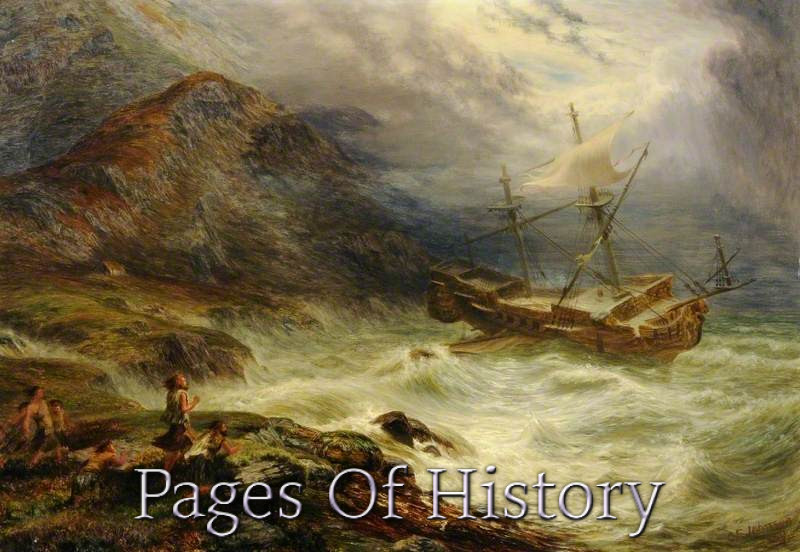
The Spanish Armada failure was sealed not in battle but in the North Atlantic. With the Channel route closed and Parma unreachable, Medina Sidonia had no choice but to sail north around Scotland and Ireland to return home. The fleet was battered, short of water and food, and its crews were sick. In September 1588, violent storms — remembered in Ireland as part of a season of exceptional weather — drove ships onto the rocky coasts of Scotland and Ireland. Dozens foundered. Survivors who reached Irish shores were often killed by English authorities or local forces.
Of the roughly 130 ships that sailed, only about 67 returned to Spain, and many of those were unfit for service. Perhaps 15,000 men died. The human cost was staggering, and the strategic cost was worse: Spain lost experienced officers, ships, and the aura of invincibility that had sustained its diplomacy.
Why Did the Spanish Armada Failure Have Such Lasting Consequences?
The defeat did not end Spanish power. Spain remained a formidable empire for decades and won notable victories afterward. But the Armada’s failure changed the psychology of European politics. Protestant England and the Dutch Republic gained confidence; Spain’s enemies saw that the colossus could be wounded. English and Dutch maritime expansion accelerated, and the myth of Spanish naval supremacy never fully recovered.
Legacy and Historical Debate
Historians continue to debate the relative weight of causes. Some emphasize Philip’s strategic error in attempting a combined operation without a secure port. Others stress English tactical innovation. Still others point to weather and logistics as decisive. Most modern accounts agree that the Spanish Armada failure was overdetermined — multiple failures reinforcing one another. The plan required perfect coordination; the sixteenth century could not supply it.
- Strategic lesson: Amphibious operations demand secure ports and reliable communications.
- Naval lesson: Speed, maneuverability, and gunnery can defeat larger, slower formations.
- Political lesson: A single defeat can reshape the balance of power and the psychology of an era.
Conclusion: What Does the Spanish Armada Failure Teach Us?
The Spanish Armada failure stands as a case study in how great powers can be undone by the gap between plan and reality. Philip II assembled the largest fleet Europe had seen, backed by the wealth of the Americas and the blessing of the Church, and still could not overcome the constraints of wind, tide, distance, and the tactical ingenuity of his opponents. The Armada was not destroyed by a single battle but by a chain of failures — strategic, logistical, tactical, and environmental — that compounded until the fleet could not complete its mission.
For England, the deliverance became a founding national myth, commemorated in medals and sermons. For Spain, it was a sobering lesson in the limits of imperial reach. For historians, the Spanish Armada failure remains a reminder that in war, as in all great enterprises, the most elaborate plans are only as strong as their weakest link — and in 1588, that link was the sea itself.