
📅 Last updated: 16.07.2026
- The Historical Context: Napoleon’s Egyptian Gamble
- The Moment of Unearthing: Pierre-François Bouchard’s Find
- A Prize of War: The Stone’s Journey to England
- The Genius of Jean-François Champollion
- The Aftermath and Lasting Impact
- The Rosetta Stone as a Historical Document
- Conclusion: The Enduring Legacy of a Single Stone
The Rosetta Stone discovery in July 1799 by a French soldier of the *Corps de Génie* near the small Egyptian town of Rashid (Rosetta) did not merely unearth an ancient slab of black granite; it handed historians the key to unlock over three thousand years of lost human civilization. Found during the chaotic backdrop of Napoleon Bonaparte’s failed Egyptian campaign, this single artifact—inscribed with a decree in three scripts—became the most famous philological puzzle in history. Its decipherment by Jean-François Champollion would transform Egyptology from a speculative hobby into a rigorous science, forever changing our understanding of the ancient world.
The Historical Context: Napoleon’s Egyptian Gamble
To understand the significance of the Rosetta Stone discovery, one must first grasp the volatile geopolitical climate of the late 18th century. In 1798, the French Directory, seeking to disrupt British trade routes to India and to curb British imperial expansion, authorized a bold and secretive military expedition to Egypt. General Napoleon Bonaparte, a rising star fresh from his Italian campaigns, was placed in command. His fleet, carrying over 30,000 soldiers and a remarkable contingent of 167 scholars, scientists, and artists—known as the *savants*—set sail from Toulon in May 1798.
The military objective was clear: seize Egypt from the crumbling Ottoman Mamluk regime and threaten British India. However, Napoleon harbored a second, equally ambitious goal: to document and study Egypt’s ancient past. He founded the *Institut d’Égypte* in Cairo in August 1798, a learned society dedicated to advancing science, art, and literature in the newly occupied territory. The *savants* fanned out across the country, surveying, sketching, and collecting antiquities. They published their findings in the monumental *Description de l’Égypte*, a multi-volume work that ignited a European fascination with all things Egyptian. It was within this environment of military tension and intellectual fervor that the Rosetta Stone discovery would occur.
The Battle of the Nile and French Entrenchment
The French military position in Egypt was precarious from the start. Just weeks after landing, on August 1, 1798, Admiral Horatio Nelson annihilated the French fleet at the Battle of the Nile (Aboukir Bay). This decisive British victory stranded the French army in Egypt, cutting off supply lines and communication with France. The campaign became a desperate struggle for survival, not a swift conquest. The French army, under constant threat from British naval power, Ottoman counterattacks, and local uprisings, was forced to consolidate its hold along the Nile Delta.
It was while strengthening these defensive positions, specifically repairing and expanding the fortifications of Fort St. Julien near the port city of Rosetta (Rashid), that the Rosetta Stone discovery was made. The fort, named after a 15th-century French crusader, was a key strategic point guarding the western mouth of the Nile. French soldiers, many of whom were engineers of the *Corps de Génie*, were digging the foundations for a new wall when their picks struck something hard and unusual.
The Moment of Unearthing: Pierre-François Bouchard’s Find
The date was July 15, 1799 (some sources cite July 19, but the 15th is more widely accepted by historians). A French officer, Lieutenant Pierre-François Bouchard (1771-1822), was supervising the demolition of an older wall within Fort St. Julien when his men uncovered a large, dark-colored stone slab. It was lying face down, about three feet below the surface, partially embedded in mud and rubble. Bouchard, a man of some education and curiosity, immediately recognized that the stone was covered in carved inscriptions.
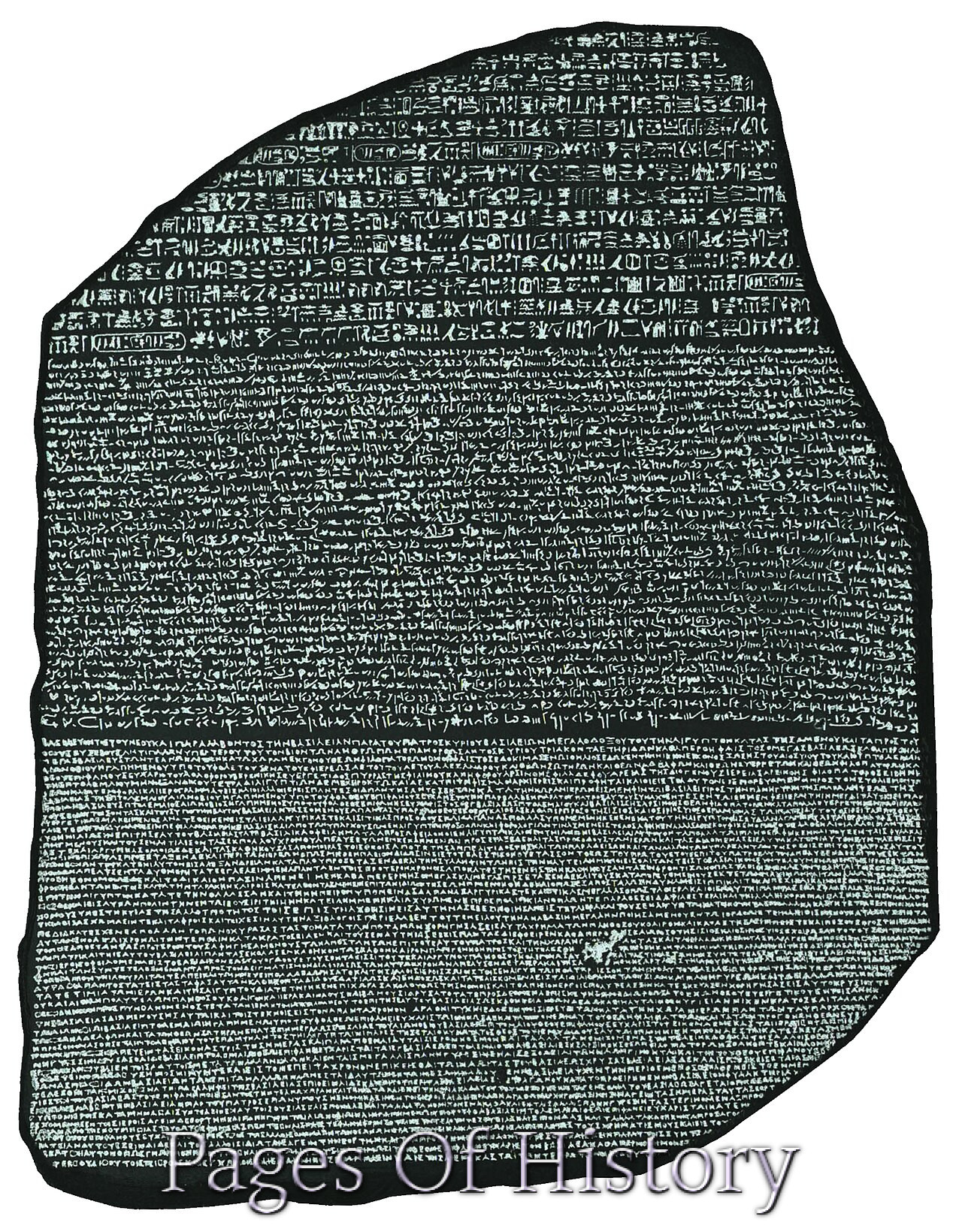
The stone was not the pristine monument we see in museums today. It was a broken slab of granodiorite (not basalt, as often misstated), measuring approximately 112.3 cm (44.4 inches) high, 75.7 cm (29.8 inches) wide, and 28.4 cm (11.2 inches) thick. Its top left corner and a significant portion of its right side were missing, broken off in antiquity. The inscriptions, however, were remarkably clear. Bouchard saw three distinct bands of text. The top band was in hieroglyphs, the sacred writing of the ancient Egyptian priests. The middle band was in Demotic, the cursive script used for everyday business and administration in Ptolemaic Egypt. The bottom band was in Ancient Greek, the administrative language of the Ptolemaic rulers.
Bouchard understood the potential importance of his find. He immediately reported it to his commanding officer, General Jacques-François Menou, who was stationed in nearby Alexandria. Menou, a man with a genuine interest in antiquity, ordered the stone to be carefully extracted, cleaned, and transported to the *Institut d’Égypte* in Cairo. The Rosetta Stone discovery was now officially a matter of state and science.
Initial Reactions and the Greek Text
Upon its arrival in Cairo in August 1799, the stone caused a sensation among the *savants*. The first and most obvious breakthrough was the Greek text. It was easily readable by the scholars, and its translation was completed within a matter of weeks. The Greek text revealed that the stone was a decree issued in 196 BC, during the reign of the thirteen-year-old Pharaoh Ptolemy V Epiphanes. The decree, issued by a council of Egyptian priests at Memphis, celebrated the king’s good deeds, including tax remissions, temple endowments, and victories in battle. It also established a royal cult in his honor.
The crucial line in the Greek text was the final instruction: that the decree was to be inscribed on a stele of hard stone “in sacred, and native, and Greek characters.” This was the Rosetta Stone’s gift. It was a trilingual translation. For the first time, scholars had a known text in a known language (Greek) that they could compare directly with the unknown scripts of Egyptian hieroglyphs and Demotic. The Rosetta Stone discovery was not just a lucky find; it was a perfectly designed key.
A Prize of War: The Stone’s Journey to England
The French triumph of discovery was short-lived. Napoleon’s position in Egypt deteriorated. After a failed siege of Acre in 1799, he abandoned his army and secretly returned to France. The French forces in Egypt, now under General Menou, were besieged by the British and Ottoman armies. In March 1801, a British force landed at Aboukir, and after a series of hard-fought battles, the French were forced to surrender.
The terms of the Treaty of Alexandria (signed August 30, 1801) included a contentious clause: all antiquities collected by the French *savants* were to be handed over to the British as spoils of war. General Menou, who had personally taken the Rosetta Stone to his home in Alexandria, tried to hide it. He claimed it was his personal property. The British, led by General John Hely-Hutchinson, were not fooled. A British officer, Major-General William George Keith Elphinstone, was sent to Menou’s residence, where the stone was discovered under a pile of carpets and packing materials.
The Rosetta Stone was then loaded onto the captured French frigate *HMS L’Égyptienne* and transported to England. It arrived in Portsmouth in February 1802. King George III ordered it to be placed in the British Museum, where it has remained ever since, barring a brief period of shelter during World War I and World War II. This transfer was a bitter blow to French national pride, but it ensured the stone’s safety and accessibility for the international scholarly community.
The First Attempts at Decipherment
With the stone safely in London, a race began to decipher the hieroglyphs. The initial work was slow and full of errors. The key insight came from analyzing the Demotic script. The Swedish diplomat and scholar Johan David Åkerblad made early progress by identifying proper names in the Demotic text, matching them to the Greek. He correctly identified the Demotic word for “love” and “temple,” but he mistakenly believed Demotic was a purely alphabetic script.
The most famous early attempt was by the brilliant English physicist Thomas Young. In 1814, Young applied his formidable intellect to the problem. He correctly deduced that the hieroglyphic text contained a cartouche (an oval ring) enclosing the name “Ptolemy.” By comparing the position of the Greek name *Ptolemaios* with the hieroglyphs inside the cartouche, Young identified the phonetic values for several hieroglyphic signs. He also made the crucial observation that Demotic was not a purely alphabetic script but contained both phonetic and ideographic elements. However, Young’s method was inconsistent. He believed that all hieroglyphs were essentially symbolic and that only foreign names were phonetic. He stopped short of the full breakthrough.
| Key Figure | Nationality | Main Contribution | Method / Insight | Outcome |
| :— | :— | :— | :— | :— |
| Johan David Åkerblad | Swedish | Deciphered many Demotic signs | Matched proper names to Greek; assumed Demotic was alphabetic | Partial success; incorrect core assumption |
| Thomas Young | English | Identified the cartouche of Ptolemy | Phonetic value for royal names; distinguished Demotic from pure alphabet | Major step, but believed hieroglyphs were mostly symbolic |
| Jean-François Champollion | French | Full decipherment of hieroglyphs | Combined phonetic and ideographic systems; used Coptic language | Complete, verifiable system for reading ancient Egyptian |
| Sacy (Silvestre de Sacy) | French | Early work on Demotic | Guided Åkerblad; recognized the trilingual nature | Laid groundwork, but did not solve the script |
The Genius of Jean-François Champollion
The true hero of the Rosetta Stone story is the French philologist Jean-François Champollion (1790-1832). A child prodigy who knew a dozen ancient languages by age 16, Champollion dedicated his life to the single, obsessive goal of reading Egyptian hieroglyphs. He was the first scholar to fully understand the nature of the writing system.
Champollion’s breakthrough came in 1822, building on Young’s work but going far deeper. He had a secret weapon: a deep knowledge of Coptic, the liturgical language of the Egyptian Christian Church. Coptic is the direct descendant of the ancient Egyptian language, written in a modified Greek alphabet. Champollion realized that if he could assign phonetic values to hieroglyphic signs, he could then read them as words in a language akin to Coptic.
His masterstroke involved the cartouche of King Ptolemy V and a second cartouche from an obelisk at Philae, which contained the name “Cleopatra.” By comparing the two, he was able to confirm the phonetic values of several hieroglyphs. The crucial test came with the cartouche of the Greek Pharaoh “Ramesses.” Young had read it as “Rameses” but had no proof. Champollion, using his Coptic knowledge, read the same signs and recognized the word for “Ra” (the sun god) and “ms” (to give birth). He was reading a real Egyptian word, not just a foreign name.
On September 27, 1822, Champollion delivered his famous *Lettre à M. Dacier* to the French Academy of Inscriptions and Belles-Lettres. In this paper, he outlined his system for deciphering hieroglyphs. He demonstrated that the script was a complex mixture of phonetic signs (alphabetic and syllabic) and logograms (symbols representing whole words or concepts). The Rosetta Stone discovery had finally yielded its greatest secret. Champollion had unlocked the voice of ancient Egypt.
Champollion’s Method: Phonetic and Ideographic Systems
Champollion’s genius lay in recognizing that hieroglyphs were not purely symbolic (as most ancient writers believed) nor purely phonetic (as Young had partly guessed). He showed they were both, simultaneously. A single text could use:
– Phonograms: Signs representing sounds, like an alphabet (e.g., a lion for “L,” a hand for “D”).
– Logograms: Signs representing entire words or ideas (e.g., a sun disk for “Ra” or “day”).
– Determinatives: Silent signs placed at the end of a word to clarify its meaning (e.g., a walking man after a verb of motion, a roll of papyrus after an abstract idea).
This was a revolutionary insight. It meant that the ancient Egyptian writing system was not a primitive picture language but a sophisticated, fully functional script capable of expressing complex abstract ideas, poetry, and history. Champollion proved this by reading entire passages of the Rosetta Stone and other texts, translating them into Coptic, and showing that they made grammatical and historical sense. The Rosetta Stone discovery was the cornerstone of this entire edifice, but Champollion was the architect who built the house.
The Aftermath and Lasting Impact
The Rosetta Stone discovery did not end with its decipherment. It fundamentally reshaped the study of history. Before Champollion, knowledge of ancient Egypt came from a few scattered Greek and Roman accounts, the Bible, and the wild speculation of Renaissance mystics. After Champollion, a vast, untapped library of human experience was opened. Temples, tombs, papyri, and statues could now speak directly to modern scholars.
The stone itself became a global icon. Its name is synonymous with a crucial clue that solves a complex puzzle. The term “Rosetta Stone” is now used metaphorically in fields from linguistics to computer science to describe any key piece of evidence that unlocks a wider understanding.
Controversies and Modern Scholarship
The story of the Rosetta Stone is not without its controversies. The French have long argued for its repatriation. Egypt has officially requested the return of the stone, viewing it as a symbol of colonial plunder. The British Museum maintains that it was legally acquired under the Treaty of Alexandria, but the ethical debate continues. Many scholars and activists argue that it should be housed in the Grand Egyptian Museum in Giza, near its original context.
Furthermore, modern scholarship has refined Champollion’s work. While his core system was correct, subsequent generations of Egyptologists have corrected minor errors and expanded our understanding of the language’s grammar and vocabulary. The Rosetta Stone remains the single most important text for this ongoing work. It is not a perfect text—it is a priestly decree, full of propaganda and flattery—but it is the anchor for the entire field of Egyptian philology.
The Rosetta Stone as a Historical Document
Beyond its linguistic importance, the Rosetta Stone is a valuable historical document in its own right. The decree it contains, the *Decree of Memphis*, provides a snapshot of Ptolemaic Egypt in 196 BC. It reveals the political and religious tensions of the time. The Greek Pharaohs, descended from Alexander the Great’s general Ptolemy I Soter, ruled a country where the native Egyptian population was deeply traditional and the powerful priesthood was resistant to Hellenistic influence.
The decree was a clever piece of statecraft. It was issued by the priests, not the king, but it celebrated the king’s piety towards the gods and the temples. By inscribing it in hieroglyphs (for the priests), Demotic (for the people), and Greek (for the administration), the rulers were trying to speak to all segments of society. The Rosetta Stone discovery, therefore, is not just the key to a language; it is a key to a complex, multicultural, and politically volatile world.
The Physical Stone: What It Tells Us
The stone itself is a fragment. It is missing its top and right side. Based on the Greek text, which is almost complete, scholars estimate that the original stele was about 1.5 meters (5 feet) tall. The missing hieroglyphic section at the top would have contained the first 14 or 15 lines of the decree. The original stone was likely displayed in a temple, possibly at Sais, before being moved to Rosetta for use as building material. The fact that it was broken and reused is a stark reminder of how much of the ancient world was lost before modern archaeology.
The stone’s dark gray color, with a pinkish veining of feldspar, is characteristic of granodiorite from the Aswan region in southern Egypt. Its surface is polished, and the inscriptions are carved in a clear, formal script. The Rosetta Stone discovery gives us a direct physical link to the ancient scribes who carved it, the priests who authorized it, and the king it glorified. It is a tangible artifact of a vanished empire.
Conclusion: The Enduring Legacy of a Single Stone
The Rosetta Stone discovery is a powerful reminder that history is often found in the most unexpected places—in the rubble of a fort being built for a war that was already lost. It is a story of military ambition, intellectual rivalry, and the relentless human drive to understand the past. The stone itself is an object of immense beauty and historical weight, but its true value lies in what it enabled: the resurrection of a silent civilization.
Without the Rosetta Stone discovery, the great works of Egyptian literature, the religious texts of the Book of the Dead, the administrative records of the Pharaohs, and the personal letters of ordinary men and women would remain locked in mute symbols. Today, thanks to the work of Bouchard, Young, and especially Champollion, we can walk through the Valley of the Kings and read the names of the kings buried there. We can sit in the British Museum and read the thoughts of a priest from 2,200 years ago. The Rosetta Stone is more than a museum piece; it is a bridge across millennia, a testament to the power of language, and a symbol of how a single discovery can illuminate the entirety of human history.