
📅 Last updated: 17.11.2026
The Antikythera mechanism is the most sophisticated geared device to survive from antiquity, and the question of who built it has vexed scholars since its recovery in 1901. Recovered from a Roman-era shipwreck off the Greek island of Antikythera, the corroded bronze lump was initially dismissed as debris; a century of X-ray imaging and inscription study has since revealed a mechanical cosmos of at least thirty interlocking gears that tracked the sun, moon, and planets and predicted eclipses decades in advance.
The Antikythera mechanism was almost certainly built by craftsmen working in the tradition of Hellenistic Greek astronomy, most likely on Rhodes or in Syracuse-influenced Sicily, in the second century BCE. No single named inventor can be confirmed, but the device’s eclipse mathematics descend from Babylonian records filtered through Greek science, and its design philosophy points to a workshop connected to the astronomer Hipparchus or his immediate intellectual heirs.
- What Exactly Is the Antikythera Mechanism?
- Who Built the Antikythera Mechanism? The Candidates
- How Did the Antikythera Mechanism Encode the Cosmos?
- Why Did This Technology Vanish?
- What the Antikythera Mechanism Tells Us About Ancient Science
- Frequently Asked Questions About the Antikythera Mechanism
- Conclusion: The Antikythera Mechanism and the Limits of Attribution
What Exactly Is the Antikythera Mechanism?
In the spring of 1900, sponge divers from Symi sheltering from a storm off Antikythera, a barren rock between Crete and the Peloponnese, found a wreck loaded with marble statues, glassware, and bronze fittings. Among the haul brought up in 1901 was a calcified mass roughly the size of a shoebox. When it cracked open at the National Archaeological Museum in Athens, curators saw gear teeth—an impossibility for a “primitive” antiquity in the minds of early twentieth-century scholars. The device became known as the Antikythera mechanism, and it has been quietly dismantling assumptions about ancient technology ever since.
The surviving fragments preserve at least thirty bronze gears (estimates run as high as thirty-seven), mounted in a wooden case roughly 34 by 18 by 9 centimeters with a front dial and a rear dial. The front face displayed the position of the sun and moon in the zodiac, the phase of the moon on a rotating half-silvered ball, and the dates of the Egyptian calendar. The rear carried two spiral dials: a 19-year Metonic calendar reconciling lunar months with solar years, and a 223-month Saros dial predicting eclipses, with glyphs marking whether each eclipse would be solar or lunar and the expected time of day. A small subsidiary dial tracked the 76-year Callippic cycle. Later reconstructions, notably by Michael Wright and the 2006 Antikythera Mechanism Research Project using CT scanning, showed the device also modeled planetary motion and even the irregular speed of the moon across the sky.
Dating is anchored by the wreck itself, which carried coins and pottery placing the sinking around 70–60 BCE, and by the mechanism’s own inscriptions, whose letterforms and astronomical content point to construction around 150–100 BCE, with the latest observational datum—an eclipse of 205 BCE—providing a terminus post quem.
Who Built the Antikythera Mechanism? The Candidates
No ancient author names the device. Cicero, writing in the first century BCE, describes two geared planetaria—one built by Archimedes and taken to Rome by Marcellus after the sack of Syracuse in 212 BCE, and another owned by his friend Pompey—but neither survives and neither is certainly the Antikythera device. The attribution question therefore rests on internal evidence: the astronomy encoded in the gears, the dialect of the inscriptions, and the engineering tradition required to cut triangular teeth by hand.
Archimedes of Syracuse (c. 287–212 BCE)
The romantic favorite. Cicero (De Re Publica I.14) describes a bronze sphere made by Archimedes “on which were depicted the motions of the sun and moon and those five wandering stars,” and says Marcellus kept it as a prize of war. But the Antikythera mechanism’s astronomy is more advanced than anything Archimedes could plausibly have encoded: its lunar anomaly model matches the eccentric theory associated with Hipparchus, who worked a generation after Archimedes died at the hands of a Roman soldier in 212 BCE. The inscriptions also use a Corinthian-Epirote script with Rhodian calendrical features, not Syracusan ones. Archimedes may have inspired the genre; he almost certainly did not build this object.
Hipparchus of Rhodes (c. 190–120 BCE)
The strongest scientific case points to Hipparchus, the greatest observational astronomer of antiquity, who compiled a star catalog, discovered the precession of the equinoxes around 127 BCE, and built a refined model of lunar motion. The mechanism’s lunar gear train reproduces Hipparchus’s lunar anomaly with striking fidelity, and its eclipse prediction draws on the Saros cycle refined by Babylonian astronomers and transmitted to the Greek world—exactly the synthesis Hipparchus worked in. The Rhodian month names in the inscriptions and Rhodes’s status as a major astronomical center under the Attalids strengthen the link. Whether Hipparchus personally cut the gears or merely supplied the mathematics to a workshop is unknowable; the leading scholarly consensus, articulated by researchers including Tony Freeth and Alexander Jones, treats the device as a product of his intellectual circle.
Rhodes, Pergamon, or Syracuse? The Workshop Question
The inscriptions are the best forensic clue. They use a Doric dialect with month names matching the Rhodian calendar, and the eclipse predictions align with a latitude consistent with Rhodes. Rhodes in the second century BCE was a wealthy maritime power, home to Hipparchus and to a celebrated school of mechanics; its port trade with Rome explains how a device built there could end up on an Italian-bound grain ship that sank off Antikythera. Pergamon, the Attalid capital with its great library, is a plausible alternative patron. Syracuse, Archimedes’ city, remains the popular guess but fits the epigraphic evidence least well.
- Epigraphic evidence: Doric letterforms and Rhodian month names point to the eastern Aegean.
- Astronomical evidence: The lunar theory matches Hipparchus of Rhodes; the eclipse cycle descends from Babylonian records.
- Archaeological context: The wreck’s cargo of luxury goods and coins indicates a ship carrying elite Roman-bound merchandise around 70–60 BCE.
How Did the Antikythera Mechanism Encode the Cosmos?
The genius of the device lies in analog computation: physical gears performing arithmetic that would otherwise require years of table work. A single input—turning a handle or dial—drove every display through a train of bronze gears with carefully counted teeth. The Metonic dial’s 19-year cycle (235 lunar months) and the Saros dial’s 223-month eclipse cycle were engraved as spirals so that a pointer could track multi-year patterns on a compact face. The pin-and-slot device that produced the moon’s variable speed is the earliest known mechanical implementation of an astronomical inequality—a mechanism scholars call a “differential” precursor.
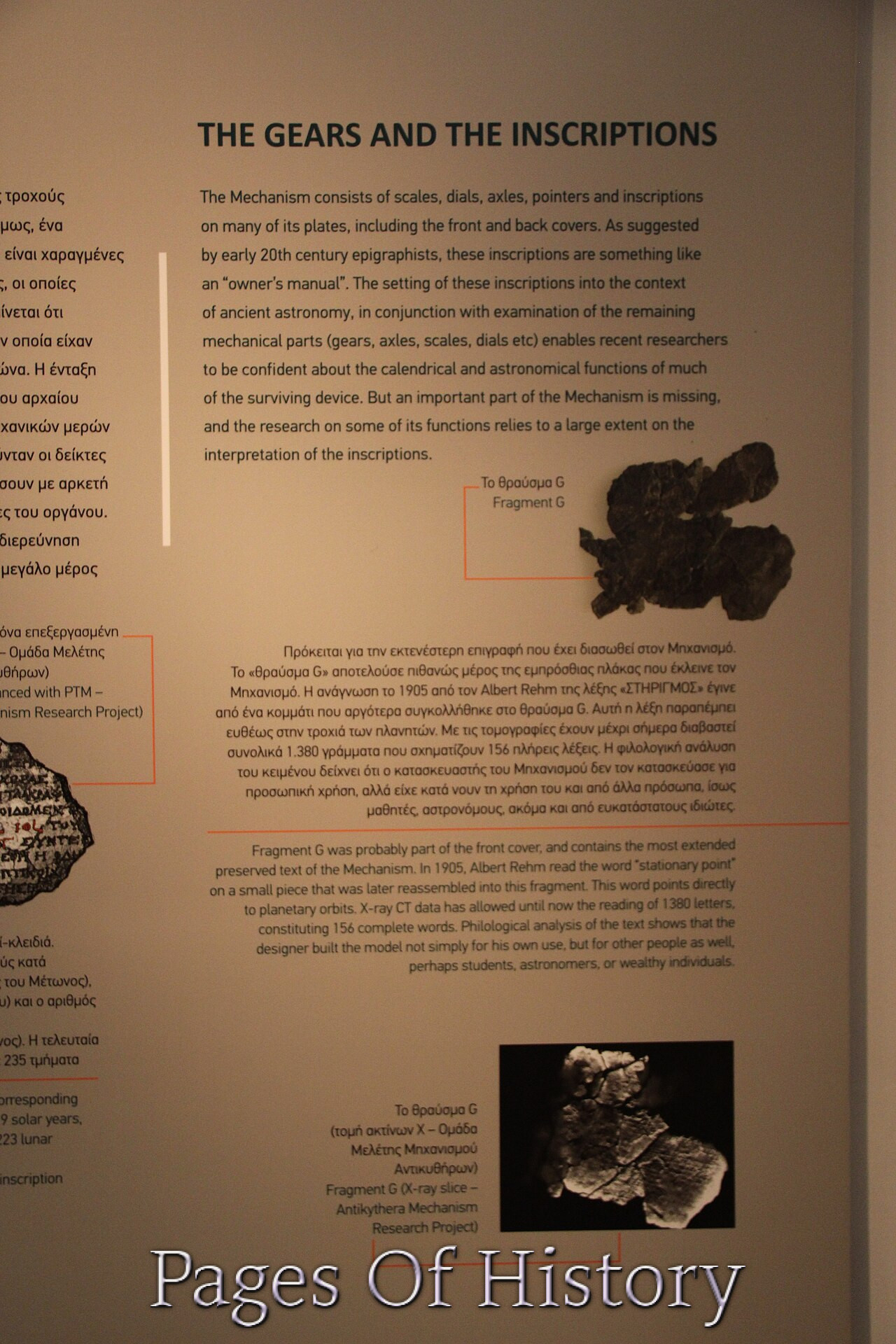
The inscriptions, deciphered through CT imaging published in 2006–2008, function as an operating manual and astronomical encyclopedia: they describe the motions of the planets, the meaning of the dial pointers, and the colors of eclipse predictions. This is not a toy or a prestige ornament alone; it is a working scientific instrument, the kind of object a Hellenistic king or a wealthy Roman collector would prize.
| Date | Event | Significance |
|---|---|---|
| c. 300 BCE | Babylonian astronomers systematize the Saros eclipse cycle | Provides the predictive mathematics later embedded in the mechanism |
| c. 150–100 BCE | Antikythera mechanism constructed | Probable window based on inscriptions and astronomical content |
| 212 BCE | Archimedes killed at Syracuse; his planetarium taken to Rome | Establishes the tradition of geared celestial spheres |
| c. 70–60 BCE | Shipwreck off Antikythera | Dating anchor from coins and cargo |
| 1901 | Device recovered by Symian sponge divers | Begins modern study of the mechanism |
| 2006 | CT scans reveal inscriptions and gear counts | Confirms planetary display and operating manual |
Why Did This Technology Vanish?
The Antikythera mechanism is often called an “ancient computer,” but the more revealing fact is that nothing comparable survives for over a thousand years. The device required extraordinary craft: hand-cut triangular gear teeth, precisely fitted arbors, and a mathematical model accurate enough to justify the labor. Such objects were luxury commissions, not manufactured goods. When the Roman world’s elite demand for Greek science faded and the political economy that supported Hellenistic courts collapsed, the workshops that could build such machines disappeared with them.
There is also a transmission problem. The knowledge was encoded in metal and inscription rather than in widely copied texts; a broken gear rendered the whole instrument mute. Byzantine and Islamic scholars preserved and extended Greek astronomy—al-Biruni and others worked on geared calendars—but the specific tradition of the Antikythera mechanism did not survive intact. Its rediscovery in 1901, and the century of imaging that followed, restored a lost chapter of engineering history.
What the Antikythera Mechanism Tells Us About Ancient Science
The device demolishes the notion that ancient Greek science was purely theoretical. Hellenistic astronomers did not merely speculate about epicycles; they built them in bronze. The Antikythera mechanism demonstrates a working knowledge of kinematic modeling—converting mathematical relationships into gear ratios—that anticipates principles later formalized in the medieval Islamic world and Renaissance Europe. It also shows the integration of Babylonian predictive astronomy with Greek geometric modeling, a cross-cultural synthesis that produced one of history’s most remarkable artifacts.
For historians of technology, the object raises a counterfactual: had such devices been reproduced and disseminated rather than confined to elite workshops, the trajectory of mechanical computation might have begun two millennia earlier. They were not, and the reason is instructive—precision engineering in antiquity depended on patronage, not markets, and patronage is fragile.
Frequently Asked Questions About the Antikythera Mechanism
Did the ancient Greeks really build a computer?
They built an analog computer in the specific sense of a geared device that performed astronomical calculations mechanically. It could not be programmed, but it modeled celestial cycles with a sophistication unmatched until the medieval astrolabe tradition and the geared calendars of al-Biruni’s era.
Is the Antikythera mechanism on display?
The original fragments are held by the National Archaeological Museum in Athens, where they are displayed alongside reconstructions. Working replicas exist in several museums worldwide, including the American Computer Science Museum and the National Museum of Scotland.
Could the Antikythera mechanism have been built by Romans?
Unlikely. The inscriptions are Greek, the astronomy is Greek, and Roman literary sources describe such devices as Greek curiosities acquired as booty or gifts. Romans admired and collected the technology but did not originate it.
Conclusion: The Antikythera Mechanism and the Limits of Attribution
The honest answer to “who built it” is that we know the tradition, the likely place, and the intellectual lineage, but not the hand. The evidence converges on a Hellenistic Greek workshop—most plausibly on Rhodes, in the orbit of Hipparchus—operating in the second century BCE, drawing on Babylonian eclipse records and Greek geometric astronomy, and serving an elite market that included Roman collectors. The Antikythera mechanism is therefore less a single inventor’s masterpiece than a civilization’s compressed knowledge: the practical genius of Hellenistic science, preserved by accident on the seabed and recovered to remind us that ancient minds built machines as ambitious as our own.