
📅 Last updated: 21.11.2026
The invention of the compass is one of humanity’s most consequential technological achievements, yet it has no single inventor, no eureka moment, and no patent. Instead, the compass emerged over centuries, evolving from a mysterious lodestone toy in ancient China into the navigational instrument that carried European ships across the Atlantic and around the globe. Understanding who invented the compass requires untangling a long chain of Chinese, Arab, and European contributions—each building on the last.
The compass was not invented by one person. The earliest recorded use of magnetism for direction appears in China during the Han dynasty (roughly 2nd century BCE to 1st century CE), where lodestone compasses served divination and feng shui before navigation. The first written description of a magnetized needle used for seafaring comes from the Chinese text Pingzhou Ketan (1119 CE). Knowledge of the compass reached Europe by the late 12th century, where it was adapted for Mediterranean navigation.
- What Was the Invention of the Compass, and Why Does It Matter?
- Who Invented the Compass? The Chinese Origins
- The Invention of the Compass Travels West: Arab and Islamic Intermediaries
- When Did the Compass Reach Europe?
- Key Milestones in the Invention of the Compass
- How Did the Compass Transform Navigation and Exploration?
- What About the Compass in the Islamic World and Indian Ocean?
- Why the "Who Invented the Compass" Question Has No Single Answer
- What Was the Lasting Legacy of the Compass?
- The Truth About the Invention of the Compass
What Was the Invention of the Compass, and Why Does It Matter?
The compass is a device that indicates direction relative to Earth’s magnetic poles, allowing travelers to hold a course even when the sun, stars, and coastline are hidden. Its significance lies not in any single artifact but in what it enabled: reliable open-water navigation, the expansion of maritime trade, the Age of Discovery, and ultimately the mapping of the entire planet.
The story is complicated by the fact that “compass” meant different things at different times. Early Chinese instruments were lodestone spoons or magnetized needles floated in water, used first for fortune-telling and only later for wayfinding. The dry-card compass with a pivoting needle—the recognizable ancestor of the modern instrument—appeared in Europe and the Islamic world in the medieval period. Tracing the invention of the compass therefore means following a technology as it crossed cultures and changed functions.
Why Magnetism Confounded the Ancient World
Lodestone, a naturally magnetized form of magnetite, fascinated observers long before anyone understood why it attracted iron. The Roman author Pliny the Elder, writing in the 1st century CE in his Naturalis Historia, described a “stone that draws iron” and repeated legends about a magnetic mountain that could pull nails from ships—a myth that persisted for centuries. Neither Greek nor Roman writers recorded using magnetism for direction, which is a key reason historians credit China with the earliest directional applications.
Who Invented the Compass? The Chinese Origins
The strongest evidence for the earliest compass points to China. The first references to lodestone’s directional properties appear in Han dynasty texts, including the philosophical work Lunheng by Wang Chong, written around 80 CE. Wang Chong noted that a lodestone spoon, when placed on a bronze plate, would align itself to point south—an observation rooted in the properties of magnetite rather than any deliberate navigational purpose.
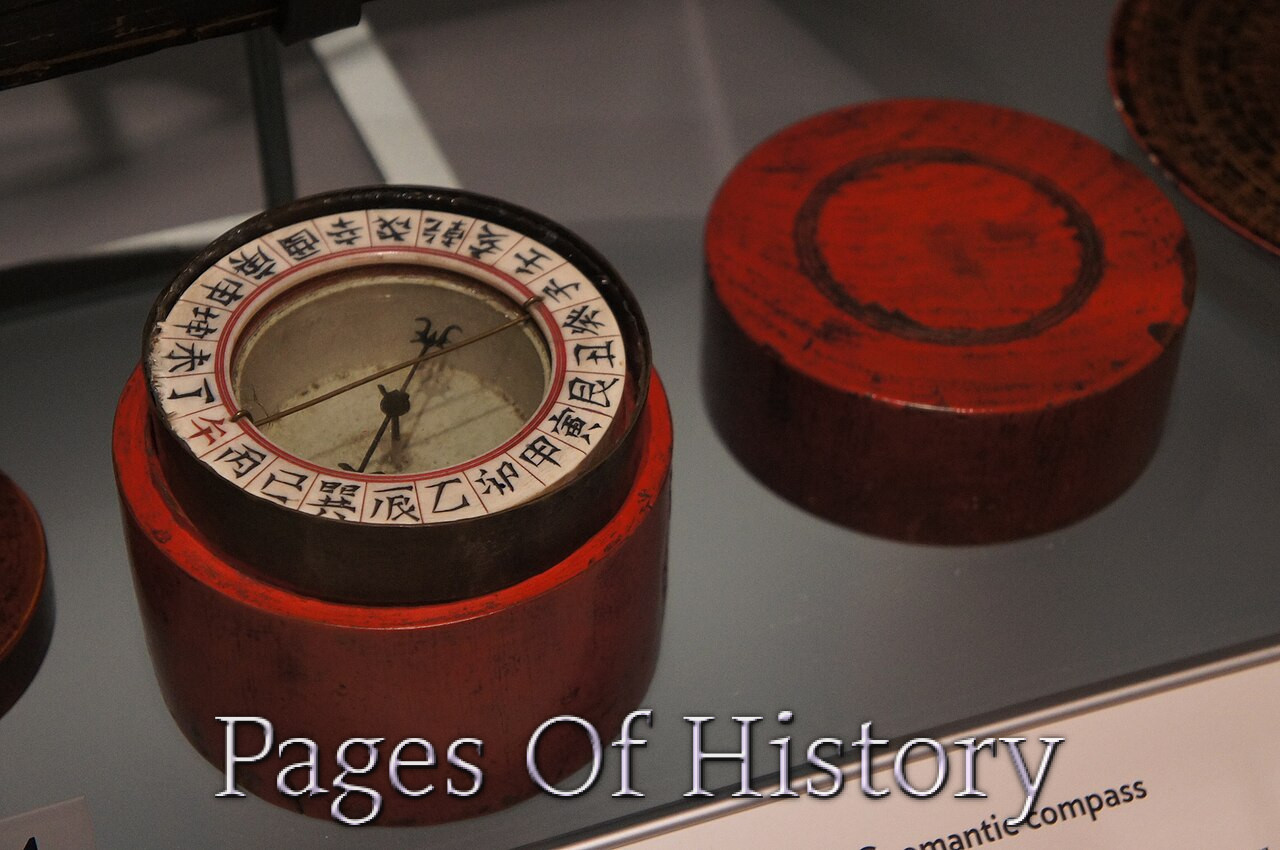
These early “south-pointing” devices were instruments of divination and geomancy. Feng shui practitioners used them to orient buildings, tombs, and altars according to favorable directions. The famous “south-pointing spoon” (sinan) described in Song dynasty texts was a polished lodestone carved into a spoon shape that rotated on a smooth bronze plate, its handle settling toward the south. The primacy of south in Chinese cosmology—the emperor faced south—explains why Chinese compasses pointed south rather than north.
From Divination to Navigation: The Song Dynasty Breakthrough
The decisive shift came during the Song dynasty (960–1279 CE), an era of explosive growth in Chinese maritime trade. The first unambiguous written account of a magnetized needle used for navigation appears in Pingzhou Ketan (“Notes from the Pingzhou Table Talks”), written by the official Shen Kuo in 1119 CE—though Shen Kuo’s earlier Dream Pool Essays (1088 CE) already described magnetized needles and the technique of rubbing iron against lodestone to magnetize it.
Shen Kuo recorded a crucial observation: a magnetized needle does not point exactly toward true south but deviates slightly. This is the first known description of magnetic declination, the angle between magnetic north and true north—a phenomenon that would bedevil navigators for centuries and that demonstrates genuine empirical investigation rather than folklore.
By the early 12th century, Chinese ships were using the compass routinely. The scholar Zhu Yu, writing in 1119 CE, described pilots navigating “by watching the stars and the sun” and, when skies were overcast, “using the south-pointing needle.” The Chinese compass of this period typically used a magnetized needle floated on water or balanced on a straw, a design suited to the pitching decks of ships.
The Invention of the Compass Travels West: Arab and Islamic Intermediaries
How the compass reached Europe remains debated, but the leading theory credits Arab and Persian sailors and traders who plied the Indian Ocean and connected China to the Mediterranean world. The Arabic word for compass, al-ibrāh or the more common al-būsulah, and the use of the term al-khann for the magnetic needle, suggest a transmission through Islamic maritime culture.
Persian and Arab texts from the 13th century describe the use of a floating needle to determine direction. The Persian author Muhammad al-Aufi, writing around 1232 CE, recorded sailors using a magnetized fish-shaped iron piece floated on water to find direction—a detail that echoes Chinese practice and suggests direct borrowing. The Arab navigator Ibn Majid, writing in the 15th century, referenced the khann (needle) as standard equipment, though by then the compass was well established across the Indian Ocean.
The transmission was likely gradual and multidirectional. Indian Ocean sailors may have learned of the needle from Chinese merchants; Arab traders carried the knowledge westward through the Red Sea and Mediterranean; and European sailors encountered it in the ports of the Levant and Italy. No single document records the handoff, which is why the compass’s journey remains one of the more contested episodes in the history of technology.
When Did the Compass Reach Europe?
The first European references to the magnetic compass appear in the late 12th and early 13th centuries. The English scholar Alexander Neckam, in his De Naturis Rerum (c. 1190 CE), described sailors using a needle rubbed with lodestone and pivoted on a straw floating in water to find the north when the stars were obscured. This is the earliest known European description of the navigational compass.
By the early 14th century, the compass had become standard equipment on Mediterranean ships. The Italian city-states—Genoa, Venice, Pisa, and Amalfi—were the great maritime powers of the era, and their sailors needed reliable direction-finding for trade with the Levant, North Africa, and the Black Sea. A legend arose that Flavio Gioia of Amalfi invented the compass around 1300 CE, but this story is almost certainly apocryphal, invented centuries later to give Italy a national hero. The compass was already in use before Gioia’s supposed invention.
The Pivoting Needle and the Dry Card
The crucial European innovation was mechanical rather than conceptual. Chinese and early Arab compasses floated a needle on water, which was awkward on a moving ship. European instrument-makers mounted the magnetized needle on a pivot and attached it to a circular card marked with the cardinal and intermediate directions. This “dry compass” or “compass card” allowed a helmsman to read a heading at a glance without handling a floating needle.
The Italian navigator and writer Flavio Biondo, in the mid-15th century, described the compass as a pivoted needle on a card—the familiar form. By the 16th century, compasses were being mounted in gimbals (pivoting rings) to keep the card level regardless of the ship’s motion, a refinement that made the instrument genuinely reliable at sea.
Key Milestones in the Invention of the Compass
| Date | Development | Location / Source |
|---|---|---|
| c. 80 CE | Wang Chong describes lodestone spoon aligning to south | China, Lunheng |
| 1088 CE | Shen Kuo describes magnetized needles and magnetic declination | China, Dream Pool Essays |
| 1119 CE | First clear account of compass used for navigation at sea | China, Pingzhou Ketan |
| c. 1190 CE | Earliest European description of a floating compass needle | England, Alexander Neckam |
| c. 1232 CE | Persian account of magnetized fish-shaped iron floated to find direction | Islamic world, Muhammad al-Aufi |
| 14th century | Pivoted needle and compass card become standard on Mediterranean ships | Italy and Iberia |
How Did the Compass Transform Navigation and Exploration?
The compass did not replace older methods; it supplemented them. Medieval and early modern navigators still relied on the sun, stars, coastline, and lead lines for depth. But the compass allowed them to hold a course when skies were overcast and to sail confidently out of sight of land. This was transformative for the Atlantic and Indian Oceans, where long stretches of open water offered no landmarks.
The Portuguese were among the first Europeans to exploit the compass systematically. Under Prince Henry the Navigator (1394–1460), Portuguese mariners pushed down the African coast, using the compass alongside improved charts and the astrolabe. Bartolomeu Dias rounded the Cape of Good Hope in 1488; Vasco da Gama reached India in 1498. Christopher Columbus crossed the Atlantic in 1492 with a compass—and famously noted that the needle’s declination changed with longitude, an observation that puzzled him and later helped scientists understand Earth’s magnetic field.
Compass, Cartography, and the Portolan Chart
The compass reshaped mapmaking. Mediterranean chart-makers produced “portolan charts”—navigation maps crisscrossed with rhumb lines radiating from compass roses—that allowed sailors to plot courses by compass bearing. These charts, which first appeared in the late 13th century, were among the most accurate maps of their era and reflected the practical needs of compass-based navigation.
- Reliable course-holding: Sailors could maintain a heading through fog, clouds, and darkness.
- Open-water voyaging: The compass made transoceanic crossings feasible by providing a constant directional reference.
- Standardized charts: Compass roses and rhumb lines became standard features of maritime maps.
- Global exploration: The instrument underpinned the Age of Discovery and the expansion of European trade networks.
What About the Compass in the Islamic World and Indian Ocean?
The compass was not a purely European or Chinese story. Arab, Persian, and Indian sailors used magnetic needles extensively in the Indian Ocean, where monsoon winds dictated sailing seasons and long open-water passages demanded reliable direction-finding. The Arab navigator Ahmad ibn Majid, whose writings in the late 15th century are among the most detailed surviving accounts of Indian Ocean navigation, described the use of the khann alongside star altitudes and wind patterns.
Some historians argue that Islamic navigators developed their own compass traditions independently or in parallel with Chinese developments, while others emphasize transmission from China through trade routes. The evidence is fragmentary, but the consensus is that the compass spread across the maritime world through trade and shared practical knowledge rather than a single act of invention.
Why the “Who Invented the Compass” Question Has No Single Answer
The invention of the compass was a cumulative process rather than a discrete event. The Chinese discovered the directional properties of magnetized iron and applied them first to divination and then to navigation. Arab and Persian sailors carried the technology across the Indian Ocean and into the Mediterranean. European instrument-makers refined the design into the pivoted, gimbaled compass card that became standard equipment on ships. Each culture contributed a piece, and no single individual can claim the whole.
This pattern is common in the history of technology. The printing press, the steam engine, and the telephone all had multiple contributors and predecessors. The compass is unusual only in how long its development took—roughly a millennium from the first lodestone observations to the reliable ship’s compass of the 16th century.
Debunking the Flavio Gioia Myth
The legend that Flavio Gioia of Amalfi invented the compass in 1300 CE persists in popular accounts and even in some Italian civic pride. The story first appeared in the 16th century, centuries after Gioia’s supposed lifetime, and no contemporary evidence supports it. The compass was already described in Europe a century before Gioia, and the pivoted needle likely emerged gradually among Mediterranean instrument-makers rather than from a single inventor. The myth is a useful reminder that national legends often attach themselves to technologies whose true origins are diffuse.
What Was the Lasting Legacy of the Compass?
The compass’s legacy extends far beyond navigation. It reshaped global trade, enabling European powers to establish sea routes to Asia and the Americas that bypassed overland routes controlled by intermediaries. It contributed to the mapping of the world, the growth of empires, and the exchange of goods, people, and ideas across oceans. It also posed a scientific puzzle—why does the needle deviate from true north, and why does that deviation change with location?—that helped drive the study of magnetism and, eventually, the understanding of Earth’s magnetic field.
In the 19th and 20th centuries, the magnetic compass was supplemented by gyrocompasses, which use the rotation of the Earth rather than magnetism, and by satellite navigation. Yet the magnetic compass remains standard equipment on ships and in aircraft as a backup, and the principles it embodies—using a natural force to establish direction—continue to inform modern navigation technology.
The Truth About the Invention of the Compass
The truth is that the compass was not invented; it evolved. The Chinese first noticed that magnetized iron aligns itself with the Earth’s magnetic field and used that property for divination. Song dynasty sailors adapted the magnetized needle to navigation, and Shen Kuo’s 11th-century observations of magnetic declination show genuine scientific curiosity at work. Arab and Persian mariners carried the technology across the Indian Ocean. European instrument-makers added the pivoted needle, the compass card, and the gimbal, turning a floating needle into a reliable shipboard instrument.
No single name belongs at the top of the compass’s patent application because there was no patent office, no single inventor, and no single moment of discovery. What we have instead is a long chain of observation, adaptation, and refinement stretching from Han dynasty China to the shipyards of Genoa and Lisbon. The invention of the compass is a story of cumulative human ingenuity—and a reminder that the technologies we take for granted often have origins as scattered and gradual as the winds that once guided sailors before the needle pointed the way.