
📅 Last updated: 02.10.2026
The 1918 flu pandemic killed somewhere between 50 and 100 million people worldwide — more than the First World War that was still raging as it spread — and it did so with a demographic signature that stunned the doctors and scientists who watched it unfold. In most influenza outbreaks, the very young and the very old bear the brunt of the mortality. But in 1918, the virus disproportionately killed healthy adults in the prime of life, roughly ages 20 to 40, and it did so with terrifying speed. A person could feel fine at breakfast and be dead by nightfall. Understanding why that happened requires pulling apart a knot of biology, history, and circumstance — one that still shapes how we think about pandemics today.
- The Strange Mortality Curve of the 1918 Flu Pandemic
- Why the Young Died: The Cytokine Storm Hypothesis
- Was the Virus Itself Unusually Deadly? The Role of Viral Genetics
- The 1918 Flu Pandemic and the First World War: A Deadly Synergy
- Key Dates and Events of the 1918 Flu Pandemic
- Environmental and Social Factors That Hit Young Adults Hardest
- Why the Elderly Were Spared: The Immunity Hypothesis
- How the 1918 Flu Pandemic Changed Medicine and Public Health
- What the 1918 Flu Pandemic Teaches Us About Future Pandemics
- The Legacy of a Virus That Killed the Young
The Strange Mortality Curve of the 1918 Flu Pandemic
Epidemiologists describe the usual pattern of influenza deaths as a U-shaped curve: high mortality at the extremes of life — infants and the elderly — with a low, flat valley in between. The 1918 pandemic broke that pattern. Instead, it produced a W-shaped curve, with a third deadly peak rising in the middle of the age distribution, centered on people between about 20 and 40 years old.
The numbers are stark. In the United States, roughly 675,000 people died of influenza and its complications during the pandemic. According to later analyses, including work by epidemiologists such as Jeffery Taubenberger and David Morens at the National Institutes of Health, nearly half of all influenza deaths in 1918 occurred among adults aged 20 to 40. In some military camps, the death rate among young recruits was ten times what physicians had seen in previous flu seasons.
This was not a subtle statistical anomaly. It was the defining feature of the catastrophe. Newspaper columns filled with obituaries of soldiers, nurses, and young parents. Life insurance companies reported that their payouts spiked among policyholders in their twenties and thirties. A virus that should have threatened the frail was instead cutting down the strong.
Why the Young Died: The Cytokine Storm Hypothesis
The leading biological explanation for the 1918 mortality pattern is the cytokine storm — an overreaction of the body’s own immune system.
When a virus invades the lungs, the immune system releases signaling proteins called cytokines to coordinate the attack. In a normal response, this inflammation is controlled and targeted. But with certain virulent influenza strains, the immune system can flood the lungs with cytokines, triggering runaway inflammation. The result is that the body’s defenses destroy its own tissue. The alveoli — the tiny air sacs where oxygen enters the blood — fill with fluid and immune cells, and the patient essentially drowns from the inside. Autopsies of 1918 victims, performed by pathologists like William Henry Welch and others, revealed lungs that were “wet” with hemorrhagic fluid, sometimes described as resembling “beef broth.”
This is where age becomes crucial. A healthy 25-year-old has a robust, aggressive immune system. A healthy 65-year-old has a slower, more measured one. In a cytokine storm, the young person’s stronger immune response becomes a liability — it attacks harder and causes more collateral damage. The very vigor that should protect them instead accelerates their death.
This hypothesis helps explain the W-shaped curve, but it is not the whole story. Not every young victim died of a cytokine storm, and the virus itself was unusually lethal in ways that are still being studied.
Was the Virus Itself Unusually Deadly? The Role of Viral Genetics
The 1918 virus was an H1N1 influenza strain, but it was not a typical one. In 2005, a team led by Taubenberger reconstructed the virus from preserved lung tissue of victims, including a woman buried in permafrost in Alaska and a soldier who died at Fort Jackson, South Carolina. When scientists at the CDC and Mount Sinai tested the reconstructed virus in mice and primates, it proved exceptionally virulent — far more so than ordinary seasonal flu strains.
Key genetic features set it apart:
- Hemagglutinin (HA) gene: The 1918 strain’s HA protein allowed it to infect cells deep in the lower respiratory tract, not just the upper airways. This meant it could cause primary viral pneumonia, not just the secondary bacterial pneumonia that typically kills flu patients.
- PB1-F2 protein: This protein, encoded by a gene in the virus, appears to suppress the early immune response, giving the virus time to replicate to high levels before the immune system reacts — and then reacting with overwhelming force.
- NS1 protein: The 1918 NS1 protein was particularly effective at blocking interferon, a key antiviral signal, further delaying a controlled immune response.
Together, these features created a virus that could go deep, replicate fast, and provoke a massive, delayed immune explosion. The young, with their potent immune systems, were uniquely vulnerable to that explosion.
The 1918 Flu Pandemic and the First World War: A Deadly Synergy
The pandemic did not emerge in a vacuum. It erupted in the final, brutal year of World War I, and the war shaped both its spread and its mortality.
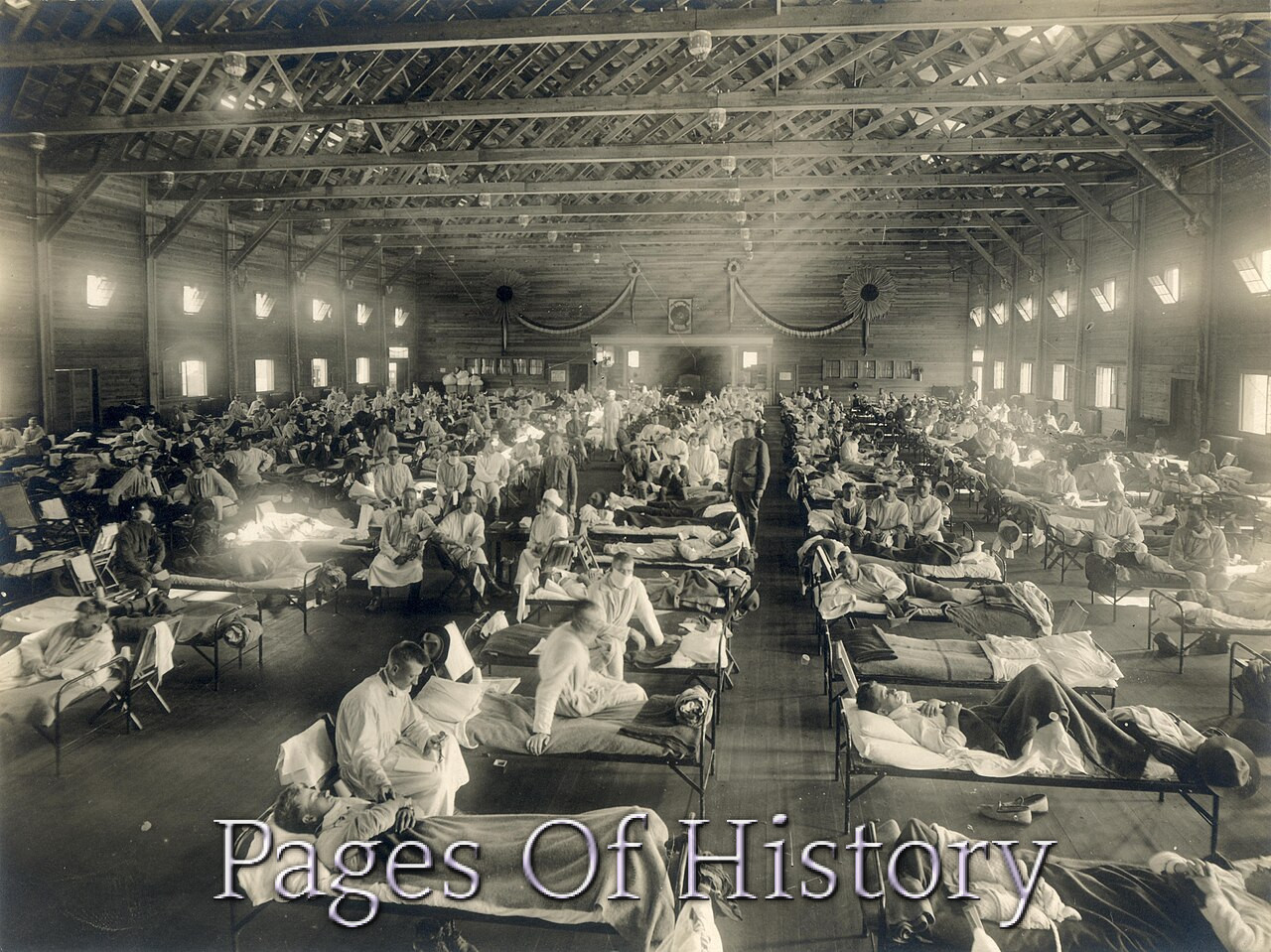
The first wave, in the spring of 1918, was relatively mild. It appeared in Kansas in March — the first major outbreak was at Camp Funston, a U.S. Army training camp — and spread to Europe with American troops. Soldiers called it the “three-day fever.” But by August, a second, far deadlier wave emerged almost simultaneously in three distant places: Brest, France; Freetown, Sierra Leone; and Boston, Massachusetts. This wave was lethal.
The war effort concentrated millions of young men in crowded barracks, troop ships, and trenches — ideal conditions for a respiratory virus. The British medical officer Colonel Charles Howard and others documented outbreaks aboard troopships where dozens died during the crossing. The virus moved along rail lines and shipping routes, reaching every continent, including remote Pacific islands and the Arctic.
Wartime censorship also played a role. Governments, focused on morale, initially downplayed the outbreak. Spain, neutral in the war, reported freely on the illness — which is why the pandemic became known as the “Spanish flu,” a misnomer that stuck. The name itself reflects how information control distorted public understanding.
Key Dates and Events of the 1918 Flu Pandemic
The following table summarizes the major waves and turning points of the pandemic.
| Date | Event | Significance |
|---|---|---|
| March 1918 | First outbreak at Camp Funston, Kansas | Beginning of the mild “spring wave” |
| August–September 1918 | Deadly second wave appears in France, Sierra Leone, and the U.S. | Highest mortality, especially among young adults |
| October 1918 | Peak mortality in the United States; 195,000 Americans die this month alone | Cities like Philadelphia overwhelmed; mass graves dug |
| November 11, 1918 | Armistice ends World War I | Troop demobilization accelerates global spread |
| Early 1919 | Third wave strikes | Continued mortality, though less severe than second wave |
Environmental and Social Factors That Hit Young Adults Hardest
Biology alone does not explain the full picture. Social and environmental conditions of 1918 amplified the toll on young adults.
Military Camps and Crowded Housing
Army camps were perfect incubators. At Camp Devens, Massachusetts, in September 1918, a physician named Dr. Roy Grist wrote a harrowing letter describing the scene: “The influenza … hits the young men who have just been inducted. They come in with a slight cold, and within a few hours they are dead.” The camp hospital overflowed; bodies piled up. Similar scenes played out at Camp Grant, Illinois, and Camp Lee, Virginia.
Young soldiers were not only exposed but also stressed, sleep-deprived, and sometimes malnourished — all factors that can dysregulate the immune system and worsen outcomes.
Wartime Working Conditions
On the home front, young adults — especially women — worked in factories, shipyards, and hospitals. Nurses and doctors, many in their twenties, faced constant exposure. The Red Cross and military nursing corps lost hundreds of young women. Their deaths were not just from immune overreaction but from repeated, high-dose exposure to the virus in overcrowded wards.
The Role of Bacterial Co-Infection
Many 1918 deaths were caused not by the virus alone but by secondary bacterial pneumonia. Before antibiotics, a bacterial infection on top of viral damage was often fatal. Young adults, with their active immune systems, may have been more prone to severe inflammatory responses to these co-infections as well. The lack of antibiotics — penicillin was not available until the 1940s — meant that even a treatable complication became a death sentence.
Why the Elderly Were Spared: The Immunity Hypothesis
One of the most intriguing clues to the 1918 mystery is that older adults, particularly those over 65, had unusually low mortality compared to younger people. Why?
The leading explanation is pre-existing immunity. An H1N1 influenza strain similar to the 1918 virus may have circulated in the 1830s or 1840s. People who survived that earlier outbreak would have been in their 70s or older by 1918 — and their immune systems retained some memory of the virus. Younger adults, born after that earlier strain faded, had no such protection.
This hypothesis, supported by serological studies and historical epidemiology, helps explain why the elderly were relatively spared. It also underscores a key point: the 1918 virus was not universally deadly to all young people, but it was especially deadly to those without prior exposure to a related strain.
“The 1918 influenza pandemic was the most severe pandemic in recent history. It was caused by an H1N1 virus with genes of avian origin. Although there is not universal consensus regarding where the virus originated, it spread worldwide during 1918–1919.” — Centers for Disease Control and Prevention
How the 1918 Flu Pandemic Changed Medicine and Public Health
The pandemic’s carnage forced lasting changes in public health and virology.
- Surveillance and reporting: The chaos of 1918 revealed the need for international disease monitoring. The League of Nations Health Organization, a precursor to the World Health Organization, was established in the 1920s partly in response.
- Vaccine research: Although no effective vaccine was developed in time, the pandemic spurred influenza research. The virus was first isolated in 1933 by Patrick Laidlaw and colleagues, leading to the first flu vaccines in the 1940s.
- Antibiotics: The high death rate from secondary bacterial pneumonia highlighted the need for antibiotics, which became widely available after World War II.
- Public health messaging: Cities that acted early with social distancing — such as St. Louis, which banned gatherings — had lower death rates than cities that delayed, like Philadelphia. This lesson remains central to pandemic planning today.
The 1918 pandemic also left a demographic scar. In the United States, average life expectancy dropped by about 12 years in 1918. Birth rates fell. Orphans filled institutions. The psychological toll on communities was immense.
What the 1918 Flu Pandemic Teaches Us About Future Pandemics
The 1918 experience is not just history — it is a warning and a guide. When COVID-19 emerged in 2019–2020, scientists and policymakers immediately looked back to 1918. The parallels were clear: a novel virus, no existing immunity, global spread, and the challenge of balancing public health with economic and social pressures.
But there are also differences. The 1918 virus was uniquely lethal to young adults in a way COVID-19 was not. The cytokine storm mechanism, while present in some severe COVID cases, did not produce the same W-shaped mortality curve. Antibiotics, antivirals, and vaccines — all absent in 1918 — changed the equation.
Still, the core lessons endure. Early action saves lives. Crowded conditions fuel outbreaks. And the immune system, for all its power, can sometimes be the deadliest weapon of all.
The Legacy of a Virus That Killed the Young
The 1918 flu pandemic killed more young adults than any other infectious disease event in modern history. The reasons were multiple and intertwined: a virus that reached deep into the lungs, an immune system that overreacted, a world war that crowded millions of young people together, and a lack of antibiotics and vaccines to blunt the damage.
It was a perfect storm — one that scientists are still unpacking more than a century later. The reconstruction of the virus in 2005, the ongoing study of cytokine storms, and the global surveillance systems built in its wake all trace back to the lessons of 1918. The young died not because they were weak, but because they were strong — and because the world they lived in gave the virus every advantage. Remembering that paradox is essential, not only for understanding the past but for preparing for the next pandemic.