
📅 Last updated: 17.10.2026
The Ottoman Empire entered World War I not as a passive bystander swept up in a European quarrel, but as a calculating, wounded power seeking survival against the encroaching empires that had spent the previous century carving pieces from its territory. When the Ottoman Empire joined World War I in late October 1914 by bombarding Russian Black Sea ports, it set in motion the final, decisive chain of events that would dissolve a dynasty six centuries old and redraw the map of the modern Middle East.
The real reason the Ottoman Empire entered World War I was a defensive-strategic gamble: the Committee of Union and Progress leadership under Enver Pasha, Talaat Pasha, and Djemal Pasha allied with Germany to break the empire’s diplomatic isolation, escape partition by Britain, France, and Russia, and recover lost prestige. The empire’s collapse in 1918 was the result less of one battle than of four years of attrition, Arab revolt, and the failure of that gamble to hold the empire together.
- Why Did the Ottoman Empire Enter World War I at All?
- The Road to War: From Secret Treaty to the Black Sea
- Ottoman Empire World War I Strategy: Enver Pasha's Grand Gamble
- What Happened on the Battlefields of the Ottoman Empire in World War I?
- How Did the Home Front and Economy Shape the Ottoman War Effort?
- Why Did the Ottoman Empire Collapse in 1918?
- What Was the Legacy of the Ottoman Empire in World War I?
- The Real Reason the Ottoman Empire Entered—and Lost—the Great War
Why Did the Ottoman Empire Enter World War I at All?
By 1914 the Ottoman Empire was the “Sick Man of Europe” in the phrase popularized by Tsar Nicholas I—a diagnosis that was both condescending and, in strategic terms, roughly accurate. The empire had lost Greece in 1830, most of its European holdings after the Russo-Turkish War of 1877–78, Tunisia to France in 1881, and Egypt to British occupation in 1882. The Balkan Wars of 1912–13 stripped away nearly all remaining European territory, including Salonika and Adrianople’s hinterland, and triggered a refugee crisis that pushed hundreds of thousands of Muslims into Anatolia. That trauma radicalized Ottoman politics and brought the Committee of Union and Progress (CUP)—the “Young Turks”—to decisive power.
The CUP’s leaders saw the coming European war as a narrow window. Neutrality risked the empire’s piecemeal dismemberment by the Entente; alliance with one great power bloc offered the chance to secure borders, cancel the hated Capitulations (the extraterritorial privileges that let European powers meddle in Ottoman finance and law), and perhaps recover lost provinces. The Ottoman Empire in World War I was therefore not dragged in—it chose a side, and it chose Germany.
The German Connection
Germany had cultivated Ottoman ties since Kaiser Wilhelm II’s 1898 visit to Constantinople and the 1903 concession for the Baghdad Railway. German officers under Colmar Freiherr von der Goltz had modernized the Ottoman army; in 1913, General Otto Liman von Sanders arrived to reorganize the Straits defenses. Germany wanted the Ottomans to threaten British communications with India and Russia’s southern flank. The Ottomans wanted German gold, guns, and protection. On August 2, 1914, the day after Germany declared war on Russia, the two empires signed a secret alliance treaty—before most of Europe understood the scale of the coming war.
The Road to War: From Secret Treaty to the Black Sea
The alliance did not immediately produce belligerency. The Ottoman government declared armed neutrality while mobilizing. Then came the episode that tipped the balance: the German battlecruisers Goeben and Breslau escaped British pursuit in the Mediterranean and arrived at the Dardanelles in August 1914. The Ottomans “purchased” the ships and renamed them Yavuz Sultan Selim and Midilli, but German crews and Admiral Wilhelm Souchon remained aboard.
On 29 October 1914, Souchon—now nominal commander of the Ottoman navy—led a raid that shelled the Russian ports of Odessa, Sevastopol, and Novorossiysk. Russia declared war on 2 November; Britain and France followed on 5 November. Enver Pasha, the war minister, had engineered a fait accompli that committed the empire before the more cautious factions in the cabinet could stop it. The Ottoman Empire’s World War I had begun in earnest.
Ottoman Empire World War I Strategy: Enver Pasha’s Grand Gamble
The strategic logic of Ottoman belligerency rested on several assumptions that proved partly correct and catastrophically wrong.
- Break the ring of isolation: An alliance with a great power would give the empire leverage at any peace conference and end its diplomatic vulnerability.
- Strike at Russia: War with Russia offered a chance to recover Kars and Batum, lost in 1878, and to mobilize pan-Islamic and pan-Turkic sentiment in the Caucasus and Central Asia.
- Threaten the Suez Canal: An offensive against British Egypt could disrupt the lifeline of the British Empire and rally Arab support.
- Exploit the Straits: Control of the Dardanelles gave the Ottomans the power to strangle Russian grain exports and force the Entente to fight on a new front.
These were not fantasies of a dying state—they were the calculations of leaders who understood that in a total war among empires, neutrality meant slow suffocation.
What Happened on the Battlefields of the Ottoman Empire in World War I?
The Ottoman Empire fought on four principal fronts: the Caucasus against Russia, the Sinai and Palestine against Britain, Mesopotamia (Iraq) against Britain and India, and the Dardanelles against the Entente landings at Gallipoli. Each front produced a different verdict on Ottoman military capacity.
The Caucasus: Sarikamish and the Armenian Catastrophe
In December 1914, Enver Pasha personally commanded an offensive at Sarikamish in the Caucasus. The plan called for a flanking maneuver in deep winter; the reality was that thousands of Ottoman soldiers froze to death in the mountains, and the Russians counterattacked. The defeat was a humiliation and a strategic disaster.
It also set the stage for the Armenian Genocide. Ottoman authorities blamed Armenian communities for the defeat and for collaboration with Russia. On 24 April 1915, Ottoman security forces arrested Armenian intellectuals and community leaders in Constantinople. Deportations and massacres followed across Anatolia, killing an estimated 1.5 million Armenians. The genocide was one of the defining crimes of the war, and it occurred under the cover of the Ottoman Empire’s World War I mobilization. The Turkish government has contested the “genocide” label, but historians overwhelmingly recognize the events as genocide.
Gallipoli: The Defense That Saved the Capital
In February 1915, British and French warships attempted to force the Dardanelles. Mines and shore batteries repulsed them on 18 March, sinking several Allied ships. On 25 April, Allied troops landed at Cape Helles and at what became known as Anzac Cove. The campaign bogged down in trench warfare on a narrow peninsula. Ottoman defenders under Mustafa Kemal—later Atatürk—held the heights at Chunuk Bair and elsewhere. The Allies evacuated in December 1915 and January 1916.
Gallipoli mattered enormously. It saved Constantinople, boosted Ottoman morale, and made Mustafa Kemal a national hero. It also delayed the collapse of the empire by two years and cost the Allies nearly 250,000 casualties on each side.
Mesopotamia and Palestine: The Long Retreat
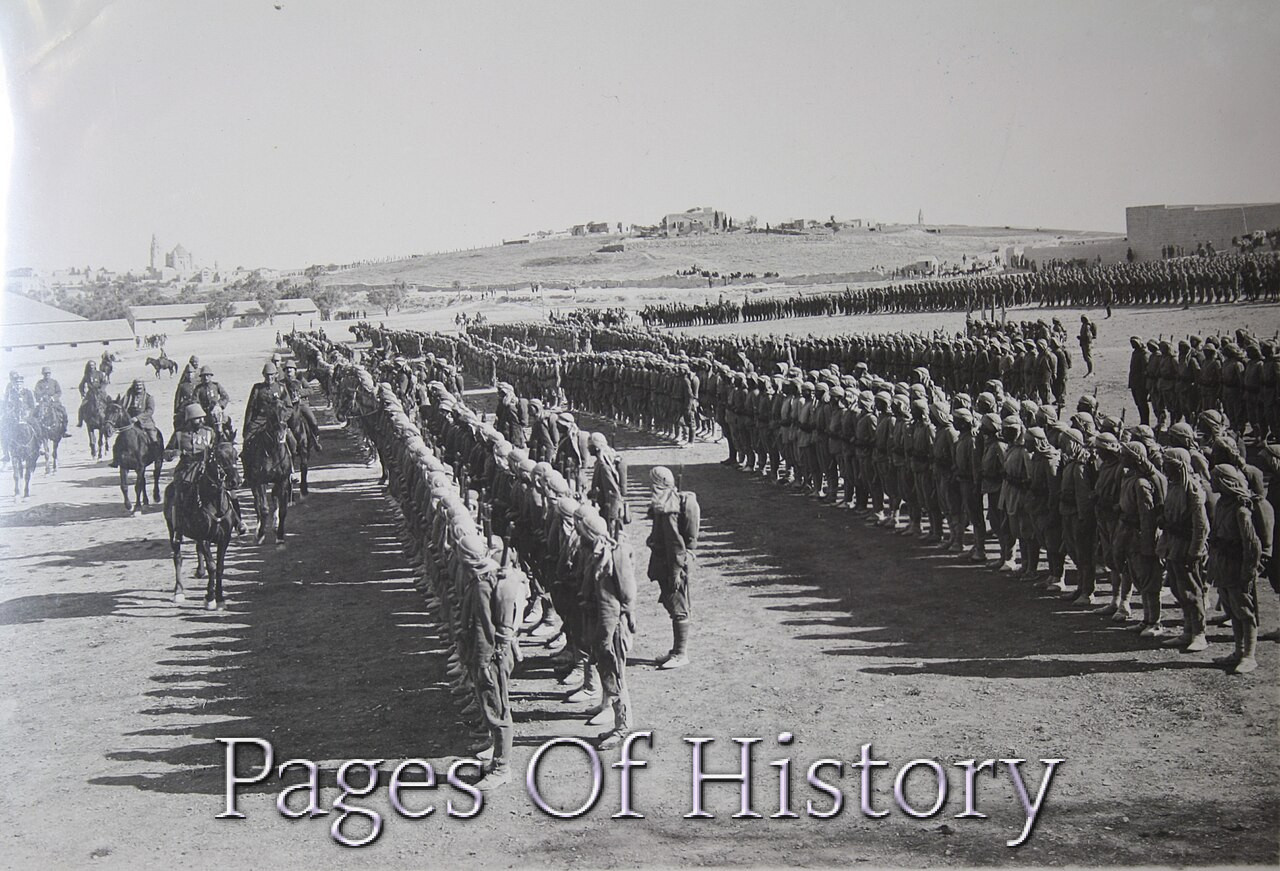
In Mesopotamia, a British-Indian force advanced toward Baghdad but was surrounded at Kut al-Amara in 1916 and forced to surrender—a humiliating defeat for Britain. The British regrouped, took Baghdad in March 1917, and pushed north. In Palestine, Ottoman forces under Djemal Pasha and German General Erich von Falkenhayn defended Gaza through two battles in 1917 before British General Edmund Allenby broke through at the Third Battle of Gaza (October–November 1917) and entered Jerusalem on 11 December 1917.
The Arab Revolt
In June 1916, Sharif Hussein of Mecca launched the Arab Revolt against Ottoman rule, encouraged by British promises of postwar independence—promises later compromised by the secret Sykes-Picot Agreement of 1916 and the Balfour Declaration of 1917. Arab forces under Hussein’s son Faisal and the British officer T. E. Lawrence attacked the Hejaz Railway and Ottoman garrisons, tying down Ottoman troops and eroding the empire’s legitimacy in the Arab provinces.
| Date | Event | Front | Significance |
|---|---|---|---|
| 2 August 1914 | Secret German-Ottoman alliance | Diplomatic | Committed the empire to the Central Powers |
| 29 October 1914 | Black Sea raid by Goeben/Breslau | Naval | Triggered Ottoman entry into the war |
| Dec 1914–Jan 1915 | Battle of Sarikamish | Caucasus | Ottoman defeat; pretext for Armenian persecution |
| Apr 1915–Jan 1916 | Gallipoli Campaign | Dardanelles | Ottoman victory; saved Constantinople |
| Jun 1916 | Arab Revolt begins | Hejaz | Weakened Ottoman control of Arab provinces |
| Dec 1917 | British capture Jerusalem | Palestine | Symbolic blow to Ottoman prestige |
| 30 October 1918 | Armistice of Mudros | Diplomatic | Ended Ottoman participation in the war |
How Did the Home Front and Economy Shape the Ottoman War Effort?
The Ottoman Empire’s war was not only fought at the front. The empire mobilized roughly 2.8 million men, a staggering proportion of its population. Food shortages, inflation, and requisitions devastated Anatolian villages. The Entente blockade cut off imports, and the empire’s agricultural economy strained under the demands of feeding armies and cities.
The CUP government used the war to radicalize domestic policy. It pursued “national economy” policies that favored Muslim Turkish merchants over Greek, Armenian, and Jewish ones. It deported Armenians. It also enacted the temporary Law of Family Rights in 1917, a modest but symbolically important step in codifying personal status law. The war accelerated the demographic engineering that would shape the Turkish Republic.
Why Did the Ottoman Empire Collapse in 1918?
By 1918, the empire was exhausted. The Russian Revolution of 1917 removed Russia from the war and allowed the Ottomans to recover territory in the Caucasus, but it also freed Entente resources for other fronts. The British advance in Palestine and Mesopotamia, the Arab Revolt, and the collapse of Bulgaria in September 1918 cut the rail link to Berlin and left Constantinople exposed.
On 30 October 1918, the Ottoman government signed the Armistice of Mudros aboard the British battleship Agamemnon at Mudros harbor. The terms were harsh: demobilization, surrender of garrisons, Allied occupation of the Straits, and the right to occupy “any strategic points” in case of disorder. The CUP leadership fled aboard a German torpedo boat days later. In November 1918, Allied warships anchored in the Bosphorus.
What Was the Legacy of the Ottoman Empire in World War I?
The war’s aftermath destroyed the empire and created the modern Middle East. The Treaty of Sèvres (1920) imposed partition and foreign zones of influence, but it was never fully implemented. Turkish nationalists under Mustafa Kemal fought the Turkish War of Independence (1919–1923), defeated Greek forces, and forced a renegotiation at Lausanne in 1923. The Sultanate was abolished in 1922; the Republic of Turkey was proclaimed in 1923.
In the Arab provinces, Britain and France divided the region into mandates under the League of Nations—Iraq and Palestine (including Transjordan) to Britain, Syria and Lebanon to France. The borders drawn in those years still shape the politics of the region, from the Sykes-Picot line to the unresolved status of Palestine.
The Ottoman Empire’s World War I experience also left a profound cultural and political legacy. The Armenian Genocide remains a wound in international relations and a central issue in Armenian diaspora politics. The war’s memory shaped Turkish nationalism and the secular republic’s founding myths. Gallipoli is commemorated in Turkey, Australia, and New Zealand as a defining national moment.
The Real Reason the Ottoman Empire Entered—and Lost—the Great War
The real reason the Ottoman Empire entered World War I was survival. Its leaders believed that neutrality meant partition and that alliance with Germany offered the only path to security, prestige, and territorial recovery. That calculation was not irrational—it reflected a century of defeats and the genuine threat posed by Russia and Britain. But the gamble failed because the empire could not sustain a multi-front war against industrial powers, because its domestic policies alienated and destroyed communities it needed, and because the Entente’s postwar plans were already drawn before the guns fell silent.
The story of the Ottoman Empire in World War I is therefore not a simple tale of decline. It is a story of choices made under extreme pressure by leaders who understood their state was in danger and who chose a path that ended the empire but also produced the Turkish Republic and the modern Middle East. The war’s consequences—from the borders of Iraq and Syria to the memory of Gallipoli and the Armenian Genocide—remain with us today.