
📅 Last updated: 17.10.2026
The story of the Ottoman Empire World War I entry is one of the most consequential and least understood chapters of the twentieth century. For centuries the empire had balanced between Europe’s great powers, but by 1914 its leaders faced a choice that would destroy the state and redraw the map of the Middle East. The decision to side with Germany and Austria-Hungary was not inevitable—it emerged from fear, opportunity, and a series of diplomatic miscalculations.
The Ottoman Empire entered World War I on the side of the Central Powers through a secret alliance with Germany signed on August 2, 1914, followed by the provocative arrival of the German warships Goeben and Breslau at Constantinople. Formal hostilities with the Entente began in late October 1914 when Ottoman warships, under German command, bombarded Russian Black Sea ports. The decision was driven by fear of Russian expansion, British and French territorial ambitions, and a desire to escape the empire’s status as the “sick man of Europe.”
- What Was the State of the Ottoman Empire on the Eve of War?
- Why Did the Ottomans Sign a Secret Alliance with Germany?
- The Ottoman Empire World War I Entry: The Black Sea Incident and the Path to Hostilities
- What Did the Ottomans Hope to Gain from the War?
- Key Events of the Ottoman Empire World War I Campaigns
- How Did the War Transform the Ottoman Empire and the Middle East?
- Why Did the Ottoman Empire Enter World War I? A Balanced Assessment
- What Was the Lasting Legacy of the Ottoman Empire World War I Experience?
- The Enduring Lessons of Ottoman Intervention in World War I
What Was the State of the Ottoman Empire on the Eve of War?
By 1914 the Ottoman Empire—often called the Sublime Porte after the gate of the Grand Vizier’s office—was a diminished but still sprawling state. It governed Anatolia, the Levantine coast, Mesopotamia, the Arabian Peninsula, and, most strategically, the Turkish Straits connecting the Black Sea to the Mediterranean. Sultan Mehmed V reigned as caliph, but real power had shifted after the 1908 Young Turk Revolution to the Committee of Union and Progress (CUP), a nationalist reform movement. By 1913 a triumvirate dominated the government: Enver Pasha (Minister of War), Talaat Pasha (Minister of the Interior), and Djemal Pasha (Minister of the Navy).
The preceding years had been brutal. Italy seized Libya in the Italo-Turkish War of 1911–1912, and the First Balkan War of 1912–1913 stripped the empire of nearly all its European territory, including Salonika and most of Thrace. Hundreds of thousands of Muslim refugees flooded into Anatolia. The loss of Rumelia shattered the CUP’s faith in collective security and convinced its leaders that only a powerful European ally could protect the empire from further dismemberment. The Second Balkan War of 1913 recovered Edirne and eastern Thrace, but the damage to Ottoman prestige was severe.
The empire’s weaknesses were structural. Its economy was largely agrarian and dependent on foreign loans, its railway network was sparse and partly foreign-owned, and its army had been reorganized by German officers, most notably General Otto Liman von Sanders, whose military mission arrived in December 1913. These German advisers gave Berlin considerable influence in Constantinople—and made Britain and Russia deeply suspicious.
Why Did the Ottomans Sign a Secret Alliance with Germany?
The road to war began with diplomacy. On August 2, 1914—the same day Germany declared war on Russia—the Ottoman government signed a secret treaty with Berlin. The agreement promised Ottoman neutrality unless Russia intervened in the Austro-Serbian conflict, in which case the empire would join Germany. Grand Vizier Said Halim Pasha and Talaat Pasha negotiated the pact without informing most of the cabinet. The rationale was straightforward: Germany was Europe’s strongest military power, it had no apparent designs on Ottoman territory, and it could shield the empire from Russia, the historic enemy to the north.
Yet the Ottomans were not yet at war. Britain, France, and Russia were still trying to keep Constantinople neutral, and many Ottoman ministers favored caution. The decisive moment came with the escape of two German warships, the battlecruiser Goeben and the light cruiser Breslau, from the Mediterranean. Pursued by the Royal Navy, they slipped through the Dardanelles in early August 1914. The Ottoman government “purchased” the ships and renamed them Yavuz Sultan Selim and Midilli, but they retained German crews and Admiral Wilhelm Souchon as commander. This was a diplomatic triumph for Berlin and a humiliation for London.
Britain’s seizure of two Ottoman dreadnoughts under construction in British shipyards—the Sultan Osman I and Reshadieh—had already inflamed Ottoman opinion. The ships had been paid for by public subscription, and their confiscation in August 1914 convinced many Turks that Britain could not be trusted. When German cruisers arrived to fill the naval gap, the CUP leadership saw a clearer path forward.
The Ottoman Empire World War I Entry: The Black Sea Incident and the Path to Hostilities
Formal entry came in stages. On September 27, 1914, Ottoman authorities closed the Dardanelles to shipping, strangling Russian grain exports and signaling alignment with the Central Powers. Then, on October 29, 1914, Admiral Souchon led a flotilla—including the former Goeben—into the Black Sea and bombarded the Russian ports of Odessa, Sevastopol, and Novorossiysk. Russia declared war on November 2, followed by Britain and France on November 5. The Ottoman Empire was now a belligerent in the Ottoman Empire World War I theater, fighting on four fronts: the Caucasus against Russia, Sinai and Palestine against Britain, Mesopotamia against British-Indian forces, and the Dardanelles against the Entente.
The strategic logic was clear to the CUP. Russia was the empire’s most dangerous neighbor and had long coveted Constantinople and the Straits. Germany offered modern weapons, officers, and the prospect of territorial gain—perhaps in the Caucasus or Egypt. But there was also a defensive calculation: by joining Germany, the Ottomans hoped to avoid being carved up by the Entente powers, who had already discussed partition plans in secret.
What Did the Ottomans Hope to Gain from the War?
Ottoman war aims were a mixture of defensive necessity and expansionist ambition. The primary goal was survival—preserving the empire’s territorial integrity against Russian and British encroachment. A secondary aim was the recovery of lost provinces and the extension of influence into the Caucasus, where a Muslim population could serve as a buffer against Russia. Enver Pasha, in particular, dreamed of a pan-Turkic sphere stretching into Central Asia.
Djemal Pasha, commanding the Fourth Army in Syria, planned an invasion of Egypt, which had been under British occupation since 1882. The Ottomans hoped that a strike across the Sinai could spark an anti-British uprising and reopen the Suez Canal route to the Central Powers. The first Suez offensive in February 1915 failed, but it forced Britain to divert troops to Egypt and Palestine—a strategic diversion that mattered.
Berlin, for its part, wanted the Ottomans to tie down Entente forces, threaten British communications with India, and open a route toward the Caucasus and Persia. The alliance was never equal. Germany provided money, arms, and advisers, but the Ottomans bore the human cost. By war’s end, the empire had mobilized roughly 2.9 million men, and hundreds of thousands died from combat, disease, and starvation.
Key Events of the Ottoman Empire World War I Campaigns
The Ottoman war unfolded across a vast geography, and its battles shaped the modern Middle East. The most famous was the Gallipoli campaign of 1915, when British, French, Australian, New Zealand, and Indian forces attempted to force the Dardanelles and capture Constantinople. The naval assault on March 18, 1915, failed after mines sank several Allied ships, and the landings on the Gallipoli peninsula in April 1915 bogged down into trench warfare. Ottoman defenders under Mustafa Kemal—later Atatürk—held the heights, and the Allies withdrew in January 1916. Gallipoli became a founding myth for both Australia and Turkey.
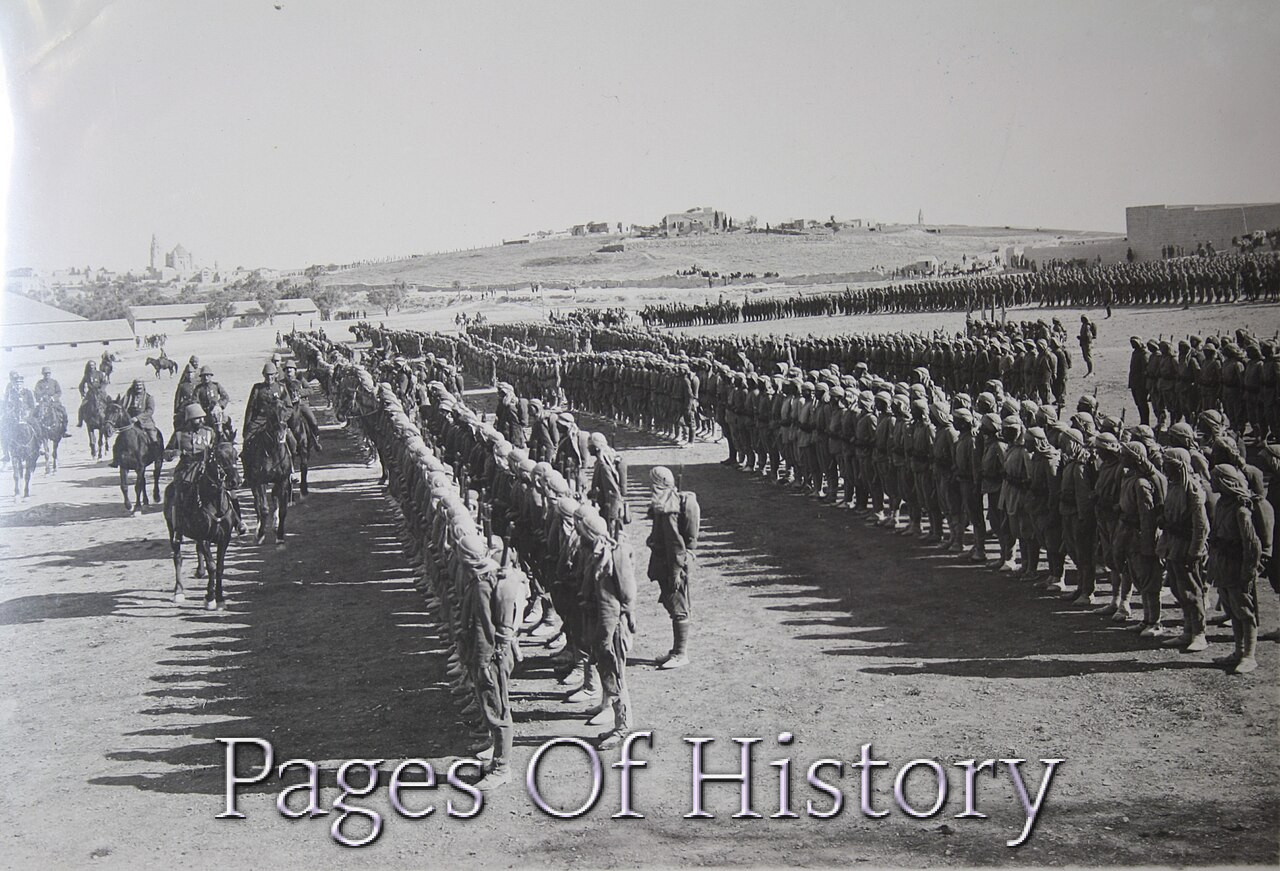
On the Caucasus front, Enver Pasha launched a disastrous winter offensive at Sarikamish in December 1914 and January 1915. Ottoman troops, unprepared for the cold, suffered catastrophic losses—tens of thousands dead or frozen. The defeat weakened Enver’s prestige and set the stage for the Armenian deportations and massacres of 1915–1916, one of the war’s greatest tragedies. In Mesopotamia, British-Indian forces advanced toward Baghdad but were surrounded and forced to surrender at Kut al-Amara in April 1916; the British retook Kut and captured Baghdad in March 1917. In Palestine, the British pushed north from Egypt, capturing Jerusalem in December 1917 and defeating Ottoman forces at Megiddo in September 1918.
| Date | Event | Significance |
|---|---|---|
| August 2, 1914 | Secret Ottoman-German alliance signed | Committed the empire to the Central Powers |
| October 29, 1914 | German-led Ottoman ships bombard Russian Black Sea ports | Triggered formal war with the Entente |
| March 18, 1915 | Naval assault on the Dardanelles fails | Forced the Allies into the costly Gallipoli land campaign |
| April 1916 | Siege of Kut al-Amara ends in British surrender | Ottoman strategic high point in Mesopotamia |
| December 1917 | British capture Jerusalem | Signaled Ottoman collapse in Palestine |
| October 30, 1918 | Armistice of Mudros signed | Ended Ottoman participation in World War I |
How Did the War Transform the Ottoman Empire and the Middle East?
The human and material costs were staggering. The empire lost territory, treasure, and population on an enormous scale. The Arab Revolt of 1916, encouraged by Britain and led by Sharif Hussein of Mecca, weakened Ottoman control over the Hejaz and contributed to the postwar fragmentation of the Arab provinces. The British and French had already divided the region in the secret Sykes-Picot Agreement of 1916, and the Balfour Declaration of 1917 promised a Jewish homeland in Palestine. These agreements contradicted promises made to Arab leaders, sowing seeds of decades of conflict.
The war also accelerated the radicalization of Ottoman policy toward minorities. The Armenian deportations and killings of 1915–1916, which killed an estimated 600,000 to 1.5 million people, remain a central and contested historical issue. The Ottoman government justified the measures as security against a pro-Russian fifth column, but historians widely regard them as genocide. The war years also saw famine, epidemic disease, and the flight of refugees, which reshaped the demographics of Anatolia and the Levant.
- Territorial collapse: The empire lost all its Arab provinces, and the Armistice of Mudros in October 1918 opened the way for Allied occupation of Constantinople and Anatolia.
- Political transformation: The CUP leadership fled, and the sultanate was abolished in 1922; the Republic of Turkey was proclaimed in 1923 under Mustafa Kemal.
- Regional reordering: Mandates in Iraq, Syria, Lebanon, and Palestine were created under British and French control, shaping modern borders and conflicts.
Why Did the Ottoman Empire Enter World War I? A Balanced Assessment
The question of why the empire entered the war has no single answer. Fear of Russia was paramount. Russia had been the empire’s principal adversary for centuries, and the Straits were vulnerable to Russian pressure. Britain’s confiscation of the dreadnoughts and its growing presence in the Persian Gulf suggested that London, too, might carve up Ottoman territory. Germany, by contrast, appeared to offer protection without immediate territorial demands.
Opportunity also mattered. The CUP leadership believed that a victorious Germany would reward the empire with territorial gains and that the war could reverse the humiliations of the Balkan Wars. Enver Pasha’s ambitions in the Caucasus and Djemal’s plans for Egypt reflected a desire to restore Ottoman power. Yet the decision was also shaped by the momentum of events: the secret alliance, the arrival of the German cruisers, and the Black Sea raid created a path from which it was difficult to retreat.
Diplomatic miscalculation played a role as well. The Entente powers assumed the Ottomans would remain neutral or could be bought off. Britain and France underestimated the depth of Ottoman grievances and the influence of Berlin. By the time London and Paris recognized the danger, the empire was already committed.
What Was the Lasting Legacy of the Ottoman Empire World War I Experience?
The Ottoman Empire World War I experience ended with the empire’s dissolution and the birth of the modern Middle East. The Treaty of Sèvres in 1920 imposed harsh terms, including territorial losses and foreign control, but it was never fully implemented. The Turkish War of Independence, led by Mustafa Kemal, rejected Sèvres and produced the Treaty of Lausanne in 1923, which recognized the Republic of Turkey and settled many of the region’s borders.
The war’s legacy extends far beyond Turkey. The mandates created after 1918 produced states with contested borders and unresolved ethnic and sectarian tensions. The Armenian question, the Kurdish question, and the Arab-Israeli conflict all have roots in the wartime and postwar settlements. The Ottoman decision to join the Central Powers also illustrates how smaller states can be drawn into great-power conflicts by security fears, alliance commitments, and the pressure of events.
For historians, the Ottoman entry into World War I is a case study in the diplomacy of decline. An empire that had survived for six centuries was undone in four years of total war. The choices made in Constantinople in the summer and autumn of 1914—the secret alliance, the German ships, the Black Sea raid—set in motion a chain of events that destroyed the old order and created the modern Middle East.
The Enduring Lessons of Ottoman Intervention in World War I
The Ottoman Empire’s decision to enter World War I was neither irrational nor inevitable. It was the product of a government facing existential threats, seeking security through a powerful ally, and hoping to reverse a generation of defeats. The result was catastrophic: the empire collapsed, millions died, and the region was remade by treaties and mandates that still shape its politics. The Ottoman Empire World War I story remains a warning about the costs of alliance politics, the dangers of underestimating weaker states, and the long shadows cast by decisions made in moments of crisis.