
📅 Last updated: 11.10.2026
The Great Wall of China is the largest military construction project in human history, a 21,000-kilometer network of walls, trenches, and fortresses that snakes across mountains, deserts, and grasslands. It was built to keep out the mounted nomads of the steppe — and for all its staggering scale, it failed at that job repeatedly. The question is not whether the Wall was impressive; it is why, again and again, it did not do what it was built to do.
- What the Great Wall of China Was Actually Built For
- Why the Great Wall of China Couldn't Stop the Mongols
- The Ming Rebuild and Its Strategic Blind Spots
- Key Dates in the Great Wall's Rise and Failures
- The Manchu Conquest: When the Wall Was Opened from Within
- Why the Wall Failed: Five Structural Reasons
- What the Wall's Failure Teaches Us About Defense
- The Lasting Legacy of a Failed Barrier
To answer that, we have to separate myth from history. The Wall was never a single continuous barrier built by one emperor. It was a patchwork of dynastic projects, rebuilt and abandoned over some two thousand years, and its failures were as much political and strategic as they were architectural. Understanding why it failed means understanding what it was actually for, who it was supposed to stop, and why the people it was meant to protect kept finding ways around it.
What the Great Wall of China Was Actually Built For
The popular image of the Wall as an impenetrable stone curtain is a modern invention. In reality, the earliest walls were rammed-earth ridges, and their purpose was rarely to physically block an entire army. They functioned as what military historians call a force multiplier: a way for a smaller garrison to detect, delay, and channel attackers, and to control the movement of people, goods, and information across a frontier.
China’s first true Great Wall was ordered by Qin Shi Huang, the First Emperor, around 221–210 BCE, after he unified the warring states. He connected and extended earlier walls built by states like Qin, Zhao, and Yan, which had already learned that cavalry from the northern steppe could raid and vanish before infantry could respond. The Qin wall ran roughly 5,000 kilometers and was built largely with conscripted labor — a fact that fueled resentment and, according to tradition, the emperor’s own paranoia about dissent.
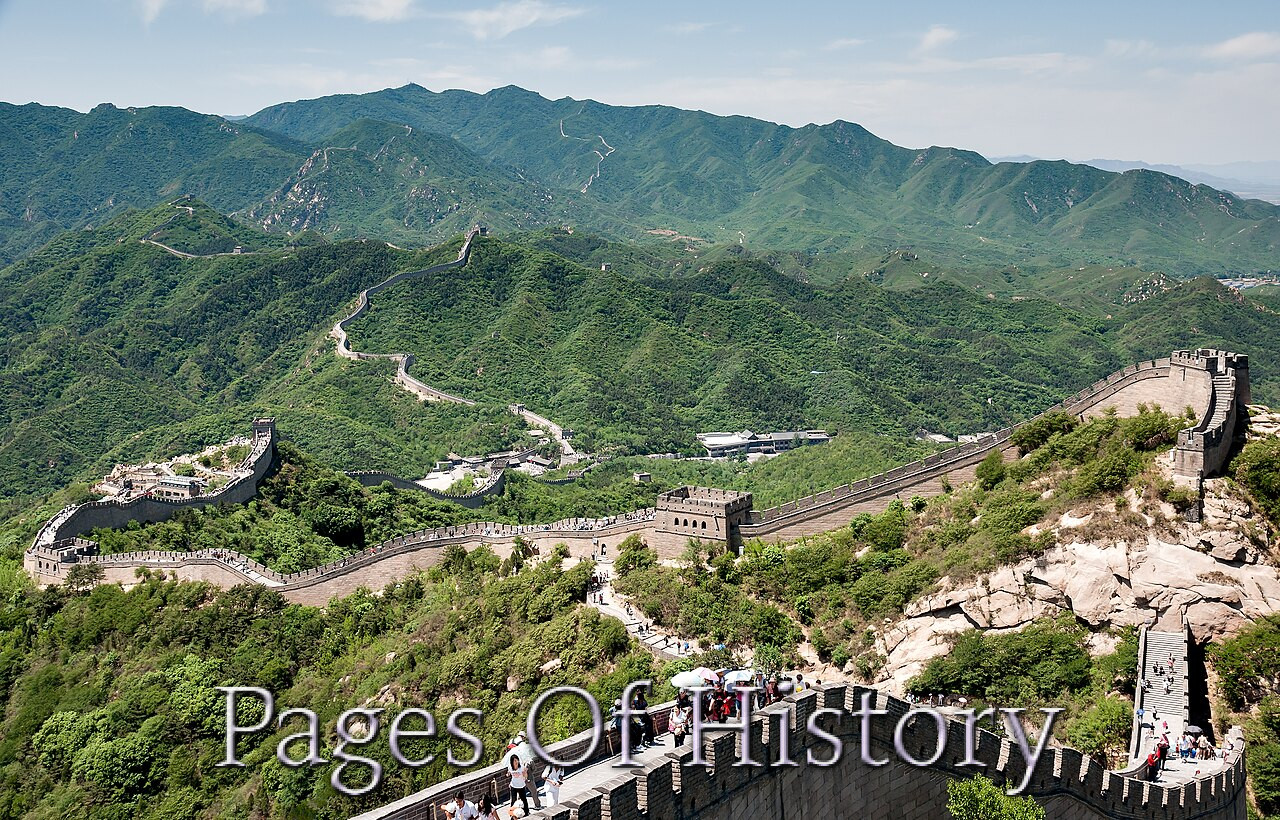
Later dynasties rebuilt the concept. The Han Dynasty (206 BCE–220 CE) extended walls and watchtowers deep into the Gobi Desert to protect the Silk Road. The Ming Dynasty (1368–1644) built the most famous version — the brick-and-stone ramparts near Beijing, including Badaling and Mutianyu — starting in the late 14th century and continuing for nearly 200 years.
So the Wall was never one thing. It was a layered system of walls, ditches, beacon towers, and garrison towns, each generation adapting to the threat of its own era. And that threat — mobile, mounted, and politically fragmented — was the key to its eventual failure.
Why the Great Wall of China Couldn’t Stop the Mongols
The most famous failure of the Wall came in the 13th century, when Genghis Khan united the Mongol tribes and turned them into the most effective cavalry force in the world. The Wall of that era — a mix of Jin Dynasty fortifications in the north — was designed to stop small raiding parties, not a coordinated empire on horseback.
Mongol strategy exploited the Wall’s weaknesses with brutal efficiency:
- Mobility over mass. Mongol horsemen could cover 100 kilometers a day, far outpacing the slow-moving garrisons that manned the Wall. They could feint at one section, draw defenders, then strike 200 kilometers away.
- Local knowledge. The Mongols recruited or coerced local guides, traders, and even disaffected Chinese officials who knew where the Wall was weakest or where gates could be bribed open.
- Siege adaptation. Contrary to the myth that Mongols only raided, they learned siege warfare from captured engineers and Chinese defectors. They could take fortified cities — and walls — when they needed to.
- Political fragmentation. The Wall was only as strong as the dynasty that manned it. When the Jin Dynasty was weakened by internal revolt and famine, the Wall’s garrisons thinned, and the Mongols poured through.
By 1215, Genghis Khan had captured the Jin capital of Zhongdu (modern Beijing). By 1279, his grandson Kublai Khan had conquered all of China and founded the Yuan Dynasty. The Wall, for all its length, had not saved the Jin — or anyone else.
The lesson was clear: a static wall cannot stop a mobile enemy who can choose when and where to cross. The Wall was a filter, not a seal. And filters can be overwhelmed.
The Ming Rebuild and Its Strategic Blind Spots
After the Mongols were expelled in 1368, the Ming Dynasty faced the same problem: how to keep the steppe nomads out. The answer was a massive rebuilding program, especially under the Yongle Emperor (r. 1402–1424) and later Wanli Emperor (r. 1572–1620). The Ming Wall was the most sophisticated version ever built — brick-faced, stone-cored, with thousands of watchtowers and cannon emplacements.
But the Ming made a fateful strategic choice. Instead of relying on offensive cavalry patrols deep into the steppe (as the Han had done), they doubled down on static defense. This wall-first doctrine had two fatal consequences:
- It ceded the initiative. The Ming could not strike preemptively at nomadic confederations before they formed. They could only react.
- It was ruinously expensive. Maintaining 8,000+ kilometers of wall, with hundreds of thousands of soldiers, drained the treasury and bred corruption. Garrison troops were often unpaid, underfed, and unmotivated.
Meanwhile, the nomads adapted. The Oirat Mongols and later the Manchus learned to avoid the strongest sections and probe for weak points. They also used trade and diplomacy to divide the Ming court, bribing officials and exploiting factional disputes.
The Tumu Crisis: A Wall That Couldn’t Protect the Emperor
In 1449, the Oirat leader Esen Taishi shattered the Ming army at the Battle of Tumu, capturing the Zhengtong Emperor himself. The Wall did not prevent this catastrophe — Esen simply bypassed the main defenses and struck where the Ming were unprepared. The emperor’s capture plunged the dynasty into crisis and proved that even a fortified frontier could not compensate for poor leadership and overconfidence.
The Tumu disaster is a perfect case study in why the Wall failed: it was never a substitute for a competent army, intelligent diplomacy, or political unity. A wall is a tool, not a strategy.
Key Dates in the Great Wall’s Rise and Failures
The table below summarizes the major dynastic phases of the Wall and the invasions it failed to stop. Note how often the Wall was breached or bypassed during periods of internal weakness.
| Period | Dynasty / Ruler | Key Event | Outcome |
|---|---|---|---|
| 221–210 BCE | Qin Shi Huang | First unified Wall built | Protected against small raids; fell into disrepair after Qin collapse |
| 1211–1215 CE | Genghis Khan (Mongols) | Mongol invasion of Jin Dynasty | Wall bypassed; Beijing captured; Jin eventually destroyed |
| 1449 CE | Esen Taishi (Oirats) | Battle of Tumu | Ming army destroyed; emperor captured; Wall proved ineffective |
| 1644 CE | Li Zicheng & Manchus | Fall of Ming Dynasty | Wall gates opened by defectors; Manchus founded Qing Dynasty |
This pattern is unmistakable: the Wall held when the dynasty was strong, united, and well-led. It failed when the dynasty was weak, divided, or caught off guard. The Wall was a mirror of the state that built it.
The Manchu Conquest: When the Wall Was Opened from Within
The final and most dramatic failure of the Ming Wall came in 1644. By then, the Ming Dynasty was collapsing under the weight of famine, peasant rebellion, and fiscal collapse. A rebel leader named Li Zicheng captured Beijing in April 1644, and the Chongzhen Emperor hanged himself on a hill behind the Forbidden City.
The Ming general Wu Sangui, commanding the crucial Shanhai Pass — the main gate between China and Manchuria — faced a choice. Rather than submit to Li Zicheng, he opened the pass to the Manchu army under Dorgon. The Manchus swept through, defeated Li Zicheng, and founded the Qing Dynasty, which ruled China until 1912.
The Wall did not fall to a siege. It was opened — by a Chinese general who decided his personal and political survival mattered more than the barrier he was sworn to defend. This is perhaps the deepest truth about the Wall’s failure: it was only as reliable as the loyalty of the people guarding it. And loyalty, unlike brick and stone, can crack.
“The Great Wall was never a single wall, and it was never impenetrable. It was a system — and systems fail when their weakest link is human.”
After 1644, the Qing Dynasty actually stopped maintaining the Wall. Why? Because the Manchus had conquered China and now controlled both sides of the frontier. The Wall became obsolete — a relic of a rivalry that no longer existed. The Qing instead used diplomacy, marriage alliances, and military campaigns to manage the steppe. The Wall, in other words, was abandoned not because it was too strong, but because it was no longer needed.
Why the Wall Failed: Five Structural Reasons
Pulling the threads together, the Great Wall’s failures were not accidents. They were built into its design and the way it was used. Here are the five core reasons:
- Static defense vs. mobile offense. Nomadic cavalry could choose the time and place of attack. A wall, by definition, cannot be everywhere at once.
- Length and cost. Maintaining thousands of kilometers of fortifications required enormous resources. When the treasury ran dry, garrisons thinned and morale collapsed.
- Political disunity. The Wall was only as strong as the dynasty behind it. Civil wars, corruption, and factionalism repeatedly undermined frontier defense.
- Human factor. Guards could be bribed, gates could be opened, and generals could defect. The Wall’s weakest points were often the people manning it.
- Strategic myopia. By focusing on defense, Chinese dynasties often neglected diplomacy, trade, and offensive deterrence — the very tools that might have prevented invasions before they started.
None of this means the Wall was useless. It deterred small raids, regulated trade, and provided early warning. But it was never the invincible shield of legend. It was a tool that worked when used wisely — and failed when relied on blindly.
What the Wall’s Failure Teaches Us About Defense
The history of the Great Wall of China is a cautionary tale about the limits of fortification. Walls can buy time, shape behavior, and signal resolve. But they cannot substitute for strategy, unity, or adaptability. The Mongols, the Oirats, and the Manchus all found ways through or around the Wall — not because the Wall was badly built, but because the societies behind it were vulnerable.
Modern parallels abound. The Maginot Line, the Atlantic Wall, and countless border fences have all promised security that they could not fully deliver. The lesson is not that walls are pointless — it is that walls are only one part of a larger system. Without diplomacy, intelligence, economic strength, and political cohesion, even the mightiest barrier will eventually be breached.
The Great Wall remains a symbol of Chinese civilization’s ambition and endurance. But it is also a monument to a hard truth: no wall, however long or thick, can protect a society from its own internal weaknesses — or from an enemy who refuses to play by the rules the wall was built to enforce.
The Lasting Legacy of a Failed Barrier
Today, the Great Wall of China draws millions of tourists, and its image adorns everything from postcards to political rhetoric. But the real story is more interesting than the myth. It is a story of emperors and nomads, of engineers and defectors, of walls built and walls abandoned. It is a story of how even the most colossal human effort can be undone by mobility, politics, and time.
The Wall failed because it was asked to do something no wall can do: replace the messy, human work of statecraft with stone. It failed because the steppe was too vast, the nomads too fast, and the dynasties too flawed. And it failed because the people it was meant to protect sometimes opened the gates themselves.
That is the real lesson of the Great Wall. Not that walls never work — but that they only work as part of a larger, living strategy. When that strategy fails, the wall becomes what it always was: a very long, very expensive line in the sand.