
📅 Last updated: 23.11.2026
The Battle of Leuctra, fought in the summer of 371 BC on the Boeotian plain of central Greece, shattered the myth of Spartan invincibility and ended three centuries of Lacedaemonian dominance over the Hellenic world. In a single afternoon, a Theban army under Epaminondas and Pelopidas destroyed the aura that Sparta had cultivated since the age of Lycurgus—and with it, the political order that had governed Greece since the Persian Wars.
The Battle of Leuctra (371 BC) was a decisive Theban victory over Sparta in which Epaminondas used an unprecedented oblique formation and a deepened left wing—the Sacred Band and massed infantry fifty shields deep—to break the Spartan right and kill King Cleombrotus I. The defeat destroyed Spartan military prestige, triggered the liberation of Messenia, and ended Sparta’s hegemony over Greece.
- What Caused the Battle of Leuctra? The Road from Antalcidas to Boeotia
- How Did Epaminondas Prepare the Battle of Leuctra?
- Where Was the Battle of Leuctra Fought, and What Happened on the Day?
- Why Did the Spartans Lose at Leuctra?
- What Were the Immediate Aftermath and Consequences of the Battle of Leuctra?
- How Did the Battle of Leuctra Change Greek Warfare and Politics?
- Why Does the Battle of Leuctra Still Matter?
What Caused the Battle of Leuctra? The Road from Antalcidas to Boeotia
The road to Leuctra began not on a battlefield but at a negotiating table. The King’s Peace of 387/386 BC—brokered by the Persian king Artaxerxes II and championed by the Spartan diplomat Antalcidas—ended the Corinthian War by dissolving the Athenian-led alliances and, crucially, by declaring all Greek cities autonomous. Sparta, as the peace’s enforcer, used that autonomy clause as a weapon: it broke up the Boeotian League in 386 and dismantled the Chalcidian League at Olynthus in 379, all while claiming to defend the very principle of city-state independence.
The hypocrisy did not go unnoticed. In December 379 BC, a group of Theban exiles led by Pelopidas and Mellon slipped back into their city and assassinated the pro-Spartan oligarchs installed after the Spartan general Phoebidas had seized the Cadmea (Thebes’ acropolis) three years earlier. Thebes regained its freedom and rebuilt the Boeotian League on a broader, more federal basis. Sparta’s response—a series of punitive invasions of Boeotia under King Agesilaus II and others—failed to break Theban resistance, and in 375 BC the Theban general Pelopidas annihilated a Spartan mora (regiment) at Tegyra, an omen few Spartans wished to read.
The final trigger was the peace conference at Sparta in 371 BC. When the Theban envoy Epaminondas insisted on signing the peace on behalf of the Boeotian League as a whole—rather than for each Boeotian city individually—Agesilaus struck Thebes’ name from the treaty and ordered an immediate mobilization. King Cleombrotus I, then campaigning in Phocis with the main Spartan field army, was instructed to march south into Boeotia. The terms of the peace, ironically, gave Sparta the pretext it wanted: the autonomy clause, which Sparta had once wielded against others, now became the grounds for war against Thebes.
How Did Epaminondas Prepare the Battle of Leuctra?
When Cleombrotus entered Boeotia in the summer of 371, he commanded roughly 10,000 hoplites and 1,000 cavalry. The Theban force under Epaminondas was smaller—perhaps 6,000 to 7,000 hoplites and about 1,000 cavalry—but it was deployed on ground of its own choosing, near the village of Leuctra in the territory of Thespiae, and it was fighting for its political existence.
Epaminondas had spent the preceding years studying Spartan tactics with unusual care. The Spartan phalanx was the most feared infantry formation in Greece, but it was also rigidly conventional: it deployed in a line of files typically eight to twelve shields deep, placed its best troops on the right wing, and relied on the slow, grinding push of the othismos—the massed shove of shields—to break the enemy line from that side. Spartan commanders expected their opponents to mirror this arrangement.
Epaminondas did not. His plan, as the historian Xenophon (an eyewitness to the era, albeit a pro-Spartan one) and later Diodorus Siculus and Plutarch describe it, inverted nearly every convention of Greek hoplite warfare:
- Massed left wing: He stacked his Theban hoplites on the left wing fifty shields deep—an unprecedented density—rather than the usual eight to twelve, concentrating overwhelming pushing power at a single point.
- The Sacred Band at the tip: The elite 300-strong Sacred Band of Thebes, a corps of paired male lovers commanded by Pelopidas, was placed at the front of the left wing to spearhead the assault.
- Refused right wing: He deliberately thinned and pulled back his right and center, refusing to engage the Spartan center and left in a general melee, and using his cavalry screen to keep the enemy’s cavalry occupied.
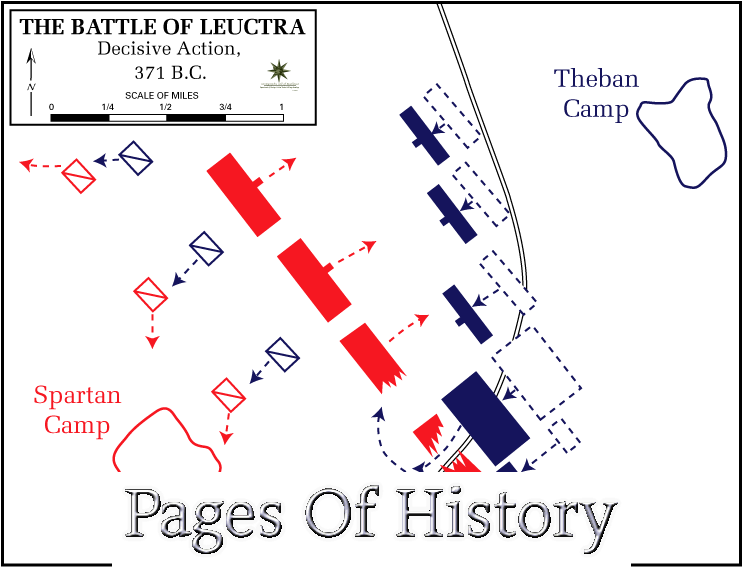
- Oblique advance: Instead of advancing in a level line, the Theban left advanced aggressively while the rest of the line hung back—an oblique order that allowed the massed wing to strike the Spartan right before the rest of the Spartan line could close.
This was a calculated gamble. By concentrating his strength against the Spartan right, Epaminondas aimed to kill or rout the Spartan king and his elite hippeis (the royal guard) at the very start of the battle—knowing that Spartan morale and command structure depended heavily on the king’s presence. If the Spartan right broke, the rest of the line would likely follow.
Where Was the Battle of Leuctra Fought, and What Happened on the Day?
The battlefield lay on a small plain near Leuctra, in the territory of Thespiae, roughly a dozen kilometers southwest of Thebes. The ground was flat enough for hoplite combat but hemmed in by hills, which limited the room for maneuver and forced a frontal clash. Spartan commanders, confident in their superiority, accepted battle without hesitation.
The engagement itself was brief and brutal. The Theban left, led by the massed Boeotian infantry and the Sacred Band, advanced at a run and crashed into the Spartan right. The Spartan cavalry, deployed in front of the infantry, was quickly driven back—and in the confusion, the retreating horsemen rode into their own infantry, disrupting the Spartan line before the hoplites could even form properly. Xenophon, in his Hellenica (6.4.10–15), describes the Spartan cavalry as “in a bad state” and notes that the Spartans had drawn up their cavalry in front of the phalanx, a fatal arrangement given the weakness of Spartan horsemanship.
The massed Theban wing, fifty shields deep against the Spartan right’s twelve, overwhelmed the Spartan line. Cleombrotus I was struck down early in the fighting—according to Plutarch, by a javelin or spear thrust from the Theban line—and with the king dead and the royal guard shattered, the Spartan right collapsed. The Spartan center and left, seeing the rout on their right, withdrew in reasonably good order, but the battle was lost. Casualty figures vary among the sources: Xenophon and Diodorus give Spartan losses of around 1,000 dead, including 400 of the 700 Spartiate full citizens present—a demographic catastrophe for a state whose citizen body was already shrinking. The Thebans lost perhaps 300 men.
| Element | Sparta at Leuctra | Thebes at Leuctra |
|---|---|---|
| Commander | King Cleombrotus I (killed) | Epaminondas, with Pelopidas leading the Sacred Band |
| Approximate strength | ~10,000 hoplites, ~1,000 cavalry | ~6,000–7,000 hoplites, ~1,000 cavalry |
| Formation | Traditional line, 8–12 shields deep, best troops on the right | Oblique order; left wing 50 shields deep, refused right |
| Casualties (approx.) | ~1,000 dead, including 400 Spartiates and the king | ~300 dead |
| Strategic result | Hegemony broken; Messenia liberated within a year | Boeotian League ascendant; Thebes becomes the leading Greek power |
Why Did the Spartans Lose at Leuctra?
The Spartan defeat was not a fluke of terrain or luck. It was the product of structural weaknesses that Epaminondas understood and exploited with precision. The causes fall into several interlocking categories.
1. Tactical rigidity and an outdated playbook
Spartan commanders had won battles for two centuries by doing the same thing: deploying a deep, disciplined phalanx, putting the best troops on the right, and grinding the enemy down. Against opponents who fought the same way, this worked. Against Epaminondas, who refused to fight the same way, it failed catastrophically. The Spartans had no answer to the oblique attack because their entire tactical doctrine assumed a symmetrical clash of lines.
2. The demographic crisis of Spartiate manpower
Sparta’s citizen body—the Spartiates, full citizens who alone could serve in the phalanx—had been shrinking for generations. The earthquake of 464 BC, the long attrition of the Peloponnesian War, the losses at Sphacteria in 425 BC, and the steady concentration of land in fewer hands had reduced the number of full citizens from perhaps 8,000 in the sixth century to fewer than 1,500 by the 370s. At Leuctra, 400 Spartiates died—a loss Sparta could not replace. The state had already begun relying on perioikoi (free non-citizens) and hypomeiones (inferior citizens) to fill its ranks, diluting the quality of its infantry.
3. The death of the king and the collapse of command
Spartan battle command depended heavily on the king, who led the right wing in person. Cleombrotus’ death early in the engagement decapitated the Spartan command structure. The royal guard, the hippeis, was shattered around him. Without a king to issue orders and without a clear chain of command, the Spartan line could not reorganize.
4. Cavalry weakness and the disruption of the line
Sparta was never a cavalry power; its horsemen were drawn from the least distinguished citizens and were poorly trained. At Leuctra, the Spartan cavalry was routed by the Theban horse and fell back into its own infantry, throwing the phalanx into disorder before the hoplites could engage. The Thebans, by contrast, had developed a competent cavalry arm and used it to screen and disrupt.
5. Epaminondas’ concentration of force
The fifty-deep left wing was the decisive innovation. In hoplite warfare, depth mattered: a deeper formation could push harder and resist longer. By concentrating his best troops at fifty shields deep against the Spartan right’s twelve, Epaminondas created overwhelming local superiority at the point of decision—a principle that military theorists from Frederick the Great to Napoleon would later call concentration of force. The refused right wing prevented the Spartan center and left from coming to the aid of the embattled right.
What Were the Immediate Aftermath and Consequences of the Battle of Leuctra?
The news of Leuctra reached Sparta on the last day of the Carneia, a major religious festival, and the ephors—Sparta’s elected magistrates—reportedly allowed the games to continue, sending the names of the dead to their families while the festival went on. It was a gesture of stoic discipline, but it could not hide the magnitude of the disaster. Sparta’s army had been beaten in a pitched battle by a smaller force, and its king was dead.
The strategic consequences unfolded with astonishing speed. In the winter of 370/369 BC, Epaminondas led a massive allied army—Thebans, Boeotians, Arcadians, Argives, and others—into the Peloponnese itself. He invaded Laconia, ravaged the Eurotas valley, and, crucially, liberated Messenia, the fertile region in the southwest that Sparta had enslaved for centuries. The Messenian helots, whose labor sustained the Spartan system, were freed and the city of Messene was founded as a fortified capital. This was the death blow: without Messenian grain and helot labor, Sparta could never again field a large army or sustain its unique social system.
Thebes, meanwhile, became the dominant power in Greece. The Boeotian League was reorganized on a federal basis, and Thebes built a naval alliance and intervened across the Greek world. The Spartan hegemony that had followed the Peloponnesian War (404–371 BC) was over, replaced by a brief Theban hegemony (371–362 BC).
How Did the Battle of Leuctra Change Greek Warfare and Politics?
Leuctra is one of the great turning points in ancient military history. Its lessons were studied and applied by Philip II of Macedon and his son Alexander the Great, who built the sarissa-armed Macedonian phalanx and the Companion cavalry that would conquer the Persian Empire. The principle of concentrating force at a decisive point, the use of an oblique order, and the integration of cavalry with infantry all became hallmarks of Macedonian warfare—and, through them, of Western military tradition.
Politically, the battle ended the Spartan state’s ability to project power beyond the Peloponnese. It also exposed the fragility of the King’s Peace system, which had relied on Spartan enforcement. In the decades that followed, Greek city-states exhausted themselves in the Corinthian War’s aftermath and the Theban-Spartan conflicts, creating the vacuum that Macedon would fill at Chaeronea in 338 BC.
The battle also had a human dimension that the sources record with unusual poignancy. The 400 Spartiate dead at Leuctra represented a significant fraction of the remaining full-citizen population. Spartan society, already strained by the concentration of land and the decline of the citizen body, never recovered. By the time of Aristotle’s Politics, written a generation later, Sparta was described as a state that had lost its hegemony and was struggling with internal decay.
Why Does the Battle of Leuctra Still Matter?
The Battle of Leuctra is remembered less for its scale—it was a small engagement by later standards—than for what it revealed about the nature of military and political power. Sparta’s defeat was not caused by a single mistake but by the collision of a rigid, tradition-bound system with an innovative commander who understood its weaknesses. Epaminondas did not invent a new weapon; he reorganized the way existing weapons were used, and in doing so he demonstrated that tactical imagination could overcome numerical and reputational disadvantage.
The battle also carries a broader lesson about hegemony and its costs. Sparta’s dominance had rested on the Messenian helot economy, a unique social system, and a reputation for invincibility. Leuctra destroyed the reputation, and the liberation of Messenia destroyed the economy. The lesson—that a power built on a single vulnerable foundation can collapse quickly when that foundation is challenged—has resonated through history, from the fall of empires to the strategic calculations of modern states.
For historians, Leuctra remains a case study in how primary sources shape our understanding. Xenophon, a Spartan sympathizer, gives a terse and somewhat defensive account; Diodorus Siculus and Plutarch, writing centuries later, add detail and interpretation. The exact numbers, the precise deployment, and even the location of the battlefield have been debated by scholars for centuries. Yet the essential facts are clear: on a summer day in 371 BC, a smaller Theban army under Epaminondas defeated the finest infantry in Greece, killed its king, and ended the Spartan hegemony. The world that followed—the rise of Macedon, the Hellenistic kingdoms, and eventually Rome—was built on the foundation that Leuctra laid.