
📅 Last updated: 22.11.2026
The Library of Alexandria remains the most famous vanished archive in human history, and the question of what was actually lost when it disappeared has haunted scholars for over two millennia. Founded in the early third century BCE within the intellectual hothouse of Ptolemaic Egypt, it was less a single building than a sprawling research institution—the Mouseion—where librarians compiled, corrected, and hoarded Greek, Egyptian, and Near Eastern knowledge on an industrial scale. The story of its destruction is not a single catastrophic fire but a slow, centuries-long unraveling driven by war, budget cuts, religious conflict, and simple neglect.
The Library of Alexandria was never destroyed in a single catastrophic fire. Its holdings were eroded over roughly 400 years by a series of disasters: Julius Caesar’s accidental fire in 48 BCE, systemic budget cuts under later Ptolemaic kings, the destruction of the Brucheion quarter during the Aurelian and Diocletian wars in the late third century CE, and finally the collapse of classical patronage in late antiquity. No single culprit—neither Caesar, nor the Christians, nor the Arabs—is solely responsible.
- What Exactly Was the Library of Alexandria?
- Did Julius Caesar Burn the Library of Alexandria in 48 BCE?
- The Slow Decline: Budget Cuts and Political Neglect
- What Happened to the Library of Alexandria in the Third Century CE?
- Was the Library Destroyed by Christians in 391 CE?
- The Myth of the Arab Destruction
- The Evidence at a Glance
- Why Does the Loss Matter So Much?
- What Was Really Burned?
- The Lasting Lesson of the Library of Alexandria
What Exactly Was the Library of Alexandria?
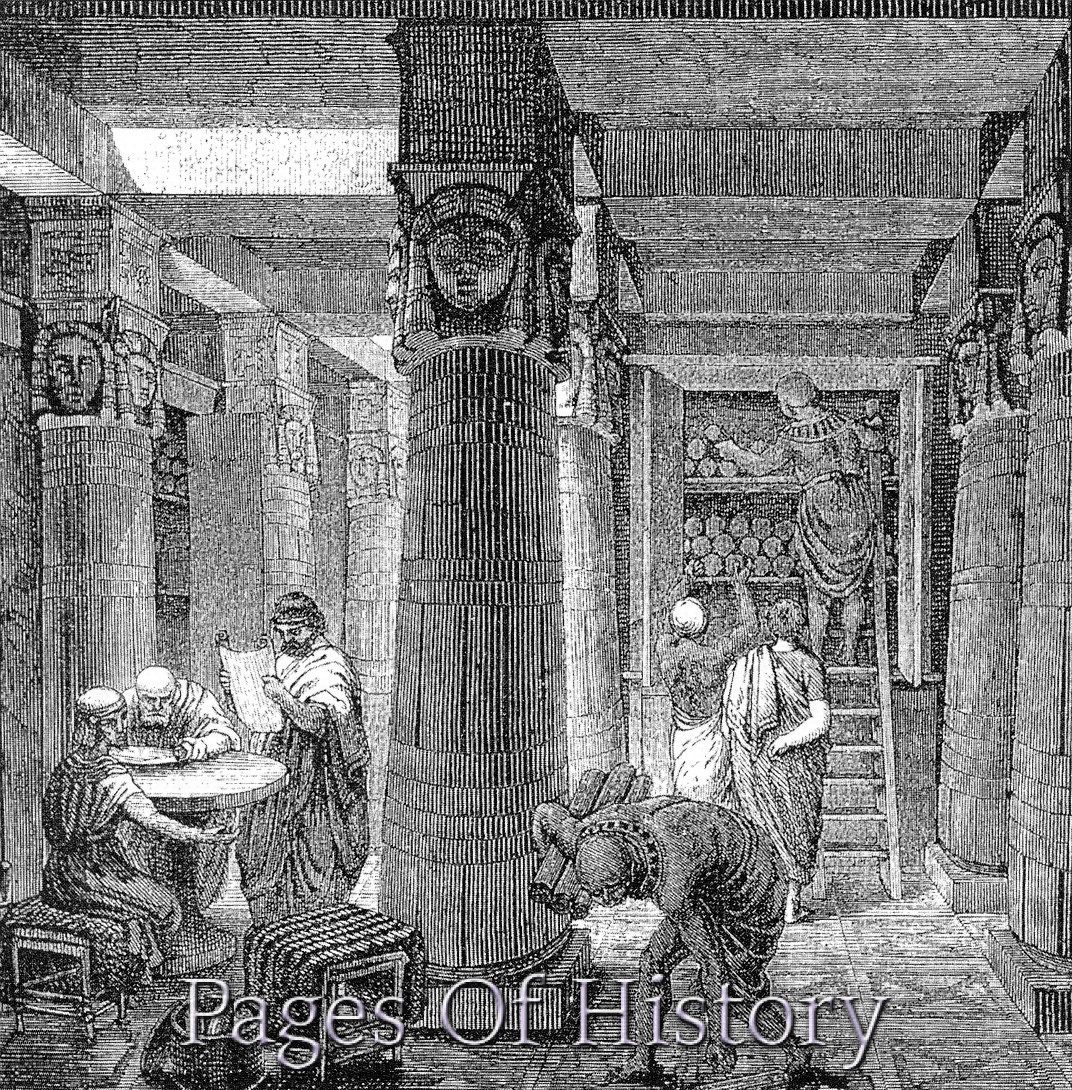
To understand what was burned, we must first understand what was collected. The Library of Alexandria was established around 285 BCE, either by Ptolemy I Soter or his son Ptolemy II Philadelphus, as part of a larger institution called the Mouseion—literally a “shrine of the Muses,” from which we derive the modern word “museum.” The Mouseion was a state-funded research campus with salaried scholars, a communal dining hall, gardens, and lecture spaces. The library itself may have been organized into two branches: the main Brucheion library in the palace district, and a smaller daughter library at the Serapeum, a temple to Serapis in the Egyptian quarter of Rhakotis.
The scale of the collection is difficult to verify and almost certainly exaggerated in ancient sources. Estimates range wildly, from 40,000 to 700,000 “books”—but these were papyrus rolls, not modern volumes. A single long work like Homer’s Iliad might occupy several rolls. A more defensible figure for the library’s peak holdings is somewhere between 100,000 and 200,000 rolls. What matters more than raw numbers is the collection’s character: the Ptolemies pursued acquisition with aggressive, almost pathological zeal.
The Acquisition Obsession
Ancient authors preserve several anecdotes about how the Ptolemies stocked the shelves. One story, recorded by the physician Galen, claims that Ptolemy III Euergetes borrowed the official Athenian state copies of Aeschylus, Sophocles, and Euripides, paid a massive silver deposit, then kept the originals and forfeited the deposit. Another tradition holds that ships docking in Alexandria were searched for books, which were copied and returned—or sometimes not returned. The library’s librarians also pioneered critical scholarship: Callimachus of Cyrene produced the Pinakes, a 120-roll catalog of the collection organized by genre and author, often called the first library catalog in history. Eratosthenes calculated the circumference of the Earth there. Aristarchus of Samothrace edited Homer. Euclid wrote the Elements. This was the intellectual capital at stake.
Did Julius Caesar Burn the Library of Alexandria in 48 BCE?
The most persistent culprit in popular memory is Julius Caesar. During the Roman civil war, Caesar was trapped in Alexandria in 48 BCE, besieged by forces loyal to the deposed queen Cleopatra’s brother, Ptolemy XIII. To prevent the Egyptian fleet from escaping the harbor and cutting off his naval supply line, Caesar ordered fire ships into the harbor. The fire spread to the docks and, according to several ancient sources, to nearby buildings.
The key primary source is Plutarch, who writes in his Life of Caesar that the fire spread from the dockyards and destroyed “the great library.” But Plutarch was writing roughly 150 years after the event, and his account is imprecise. The geographer Strabo, who visited Alexandria around 25 BCE—just two decades after Caesar’s fire—describes the Mouseion as still functioning. Cassius Dio, writing even later, says warehouses of grain and books near the harbor burned. The most careful modern reading is that Caesar’s fire destroyed a substantial quantity of books stored in dockside warehouses—possibly grain-adjacent storage for the library’s overflow—but did not annihilate the institution.
The geographer and historian Seneca, writing in the first century CE, records that 40,000 books burned in Alexandria during this episode. Whether that figure refers to the Caesar fire or another event is debated. What is clear is that the library survived into the Roman period, diminished but alive. The Roman poet and scholar Didymus Chalcenterus worked there in the first century BCE, and the geographer Ptolemy used its resources in the second century CE.
The Slow Decline: Budget Cuts and Political Neglect
Caesar’s fire was a wound, not a deathblow. The deeper damage came from institutional decay. When Octavian (later Augustus) annexed Egypt in 30 BCE after the death of Cleopatra VII, Alexandria ceased to be a royal capital and became a Roman province. The Ptolemies had funded the Mouseion lavishly as a symbol of dynastic prestige. Roman emperors treated it as a curiosity. Suetonius records that the emperor Claudius (r. 41–54 CE) wrote a history of the Etruscans and Carthaginians and established a new museum at Alexandria—suggesting the old one needed supplementing. The emperor Hadrian visited in 130 CE and patronized Alexandrian scholars, but the institutional momentum was gone.
Papyrus is a fragile medium. Without constant recopying, rolls rot, crumble, and become unreadable within a century or two in Egypt’s humid coastal climate. Maintaining a library of 100,000+ rolls required a permanent scriptorium of scribes—an enormous recurring expense. As imperial patronage shrank, so did the copying program. Books were lost not to fire but to mold, insects, and the simple failure to reproduce them.
- Loss of royal patronage: After 30 BCE, no Ptolemaic king funded the Mouseion’s acquisition and copying programs.
- Material fragility: Papyrus rolls required recopying every few generations; neglected rolls disintegrated.
- Brain drain: Scholars migrated to Rome, Pergamon, and Athens as Alexandrian prestige declined.
- Political instability: Roman-era Alexandria saw repeated riots, sieges, and imperial reprisals that damaged the palace quarter.
What Happened to the Library of Alexandria in the Third Century CE?
The third century CE was catastrophic for Alexandria. In 215 CE, the emperor Caracalla, furious at Alexandrian mockery of his supposed murder of his brother Geta, ordered a massacre of the city’s young men and the looting of temples. The historian Cassius Dio says he “destroyed” the city’s intellectual life. In 272 CE, the emperor Aurelian besieged Alexandria to crush the revolt of the Palmyrene queen Zenobia’s forces and fought street battles in the Brucheion—the very palace district that housed the main library. The quarter was largely destroyed. Then in 297 CE, Diocletian besieged the city again after a usurper’s revolt, and the Brucheion was further devastated.
By the late third century, the main library in the palace quarter was effectively gone. What survived was the daughter library at the Serapeum, the temple of Serapis. This is the crucial point often lost in popular accounts: by the time of the famous Christian destruction of the Serapeum in 391 CE, the “Library of Alexandria” as a unified institution no longer existed. The Serapeum’s collection, if it still held books, was a remnant.
Was the Library Destroyed by Christians in 391 CE?
The Serapeum was destroyed in 391 CE under the emperor Theodosius I, who had issued decrees banning pagan sacrifices and closing pagan temples. The bishop of Alexandria, Theophilus, led a campaign against the city’s pagan temples, and a mob—or imperial troops, depending on the source—demolished the Serapeum. The event is well attested by church historians like Rufinus and Sozomen, and by the pagan writer Eunapius, who lamented the destruction of statues.
But did the Serapeum still contain a library? The evidence is thin and contradictory. The Christian historian Socrates Scholasticus mentions that the Serapeum had once contained a library, but he does not say books were destroyed in 391. The pagan philosopher Ammianus Marcellinus, writing in the 380s, describes the Serapeum’s library as having been destroyed long before, during the civil wars of the third century. The most rigorous modern scholarship—notably work by Diana Delia and Roger Bagnall—concludes that the Serapeum’s library was likely already gone by 391, and that the temple’s destruction was primarily about ending a pagan cult site, not burning books.
The Christian destruction of 391 mattered enormously for the city’s intellectual culture—it signaled the end of institutional paganism—but it did not destroy a functioning great library, because that library had already ceased to function.
The Myth of the Arab Destruction
A later legend, popular in medieval Arabic and later European sources, holds that the library was finally destroyed by the Muslim general Amr ibn al-As after he conquered Alexandria in 642 CE, on the orders of the caliph Umar, who supposedly said: “If the books agree with the Quran, they are redundant; if they disagree, they are heretical.” This story appears first in the writings of Bar Hebraeus (13th century) and Abd al-Latif al-Baghdadi (12th–13th century), some 500 years after the conquest. No contemporary or near-contemporary source—neither the Muslim chroniclers al-Tabari and al-Baladhuri, nor the Christian writers—mentions the library’s destruction by the Arabs. The story is almost certainly a later invention, likely shaped by polemical motives.
By 642 CE, Alexandria had been through centuries of decline, plague (the Justinianic plague of the 540s hit Egypt hard), and the loss of its classical scholarly class. There was no great library left to burn.
The Evidence at a Glance
| Date | Event | Impact on the Library | Source Reliability |
|---|---|---|---|
| 48 BCE | Julius Caesar’s harbor fire during Alexandrian War | Destroyed dockside book warehouses; main library survived | Plutarch, Cassius Dio, Seneca (all later, imprecise) |
| 30 BCE | Octavian annexes Egypt; end of Ptolemaic patronage | Began long institutional decline and loss of funding | Strabo (contemporary visitor) |
| 215 CE | Caracalla’s massacre and looting of Alexandria | Severe damage to city’s intellectual life | Cassius Dio (near-contemporary) |
| 272 & 297 CE | Aurelian and Diocletian sieges of the Brucheion | Main palace library destroyed | Ammianus Marcellinus (later but detailed) |
| 391 CE | Theodosius I’s anti-pagan decrees; Serapeum destroyed | Daughter library likely already gone; temple destroyed | Socrates Scholasticus, Rufinus, Eunapius |
| 642 CE | Arab conquest of Alexandria | No contemporary evidence of book destruction | Legend only, 12th–13th century sources |
Why Does the Loss Matter So Much?
The tragedy of the Library of Alexandria is not that one fire consumed a treasure. It is that a civilization allowed its memory to erode. Of the works of the great Alexandrian scholars—Callimachus’s Pinakes, Eratosthenes’s geographical treatises, the critical editions of the tragedians—almost nothing survives except fragments quoted by later writers. We know the names of dozens of Alexandrian librarians and scholars, but we possess only a fraction of their output. The Pinakes, the library’s own catalog, is lost; we know it existed only because later authors cite it.
The loss shaped what we call “classical literature.” The works that survived did so because they were copied in medieval monasteries and, later, in the Islamic world. The canon we inherit—Homer, Plato, Virgil, Cicero—represents a tiny, arbitrary sample of what once existed. Entire genres vanished: pre-Socratic philosophy, Hellenistic drama, technical treatises, and much of ancient science. The library’s disappearance is a reminder that knowledge is not self-preserving. It requires institutions, funding, and people who care enough to copy.
What Was Really Burned?
The honest answer is: no single fire burned the Library of Alexandria. What burned, over four centuries, was a series of collections, in a series of disasters, each less dramatic than the myth and each more revealing of how civilizations actually lose knowledge. Caesar’s fire in 48 BCE burned dockside stores. The Brucheion library was destroyed in the third-century sieges. The Serapeum’s remnant was likely gone before 391. The Arab legend is fiction.
The deeper loss was not physical but institutional. The Ptolemies created a machine for preserving and expanding knowledge—salaried scholars, a scriptorium, an acquisition program, a catalog. When the funding stopped, the machine stopped. Papyrus rotted. Scribes found other work. Scholars moved away. The books did not need to burn; they simply stopped being copied, and within a few generations they were gone.
The Lasting Lesson of the Library of Alexandria
The Library of Alexandria has become a symbol of civilizational loss, invoked whenever a culture fears its memory is fragile. That symbolism is useful, but it can obscure the real lesson. The library did not die from a single act of barbarism by a single villain. It died from neglect, from political instability, from the withdrawal of patronage, and from the ordinary entropy that afflicts all human institutions. The myth of the great fire is comforting because it gives us a culprit. The truth is harder: the library was lost because no one—not the Ptolemies’ successors, not the Roman emperors, not the Christian bishops, not the Arab conquerors—considered it worth the enormous cost of maintaining.
What survives of Alexandria’s intellectual legacy reaches us in fragments: a few scientific treatises, some geographical knowledge, the memory of a catalog we can never read. The rest is silence. That silence is the real answer to the question of what was burned—not a building, but a centuries-long conversation that simply stopped.