
📅 Last updated: 19.10.2026
Boudica was the queen of the Iceni, a Celtic tribe in what is now eastern England, who led a massive uprising against Roman rule in 60–61 CE. After Roman officials flogged her and raped her daughters, she raised an army that destroyed three Roman settlements—Camulodunum, Londinium, and Verulamium—and killed tens of thousands before her final defeat at the Battle of Watling Street. Her revolt nearly drove the Romans from Britain and remains one of history’s most famous acts of resistance against imperial power.
Boudica (also spelled Boadicea) was a first-century CE queen of the Iceni tribe in Britain who led a major revolt against Roman occupation in 60–61 CE. Following her husband Prasutagus’s death, Roman officials seized his lands, flogged Boudica, and raped her daughters, prompting her to unite multiple tribes in rebellion. Her forces destroyed Camulodunum, Londinium, and Verulamium and killed an estimated 70,000–80,000 people before the Roman governor Gaius Suetonius Paulinus defeated her army at the Battle of Watling Street.
Who Was Boudica Before the Revolt?
Boudica enters the historical record only at the moment of catastrophe. Everything we know about her comes from two Roman authors writing decades after her death: the historian Tacitus, whose Annals and Agricola provide the most detailed account, and the Greek writer Cassius Dio, whose Roman History was composed more than a century later and diverges in significant details. No British or Celtic source survives. This asymmetry matters: the woman who became a symbol of resistance is known almost entirely through the pens of her enemies.
What the sources agree on is her status. Boudica was the wife of Prasutagus, king of the Iceni, a tribe occupying the flatlands of modern Norfolk and Suffolk in eastern Britain. The Iceni had struck a deal with Rome during the invasion of 43 CE under Emperor Claudius: they became a client kingdom, nominally independent but subordinate to Roman interests. Prasutagus, according to Tacitus, was allowed to retain his kingdom as a client ruler and grew wealthy—archaeological evidence from hoards such as the Snettisham treasure suggests genuine prosperity in the region.
When Prasutagus died around 60 CE, he made a fatal miscalculation. His will divided his estate between Emperor Nero and his two daughters, a bid to secure Roman protection for his family. Roman law, however, did not recognize client kingdoms as inheritable property in the way Prasutagus imagined. The imperial procurator Catus Decianus, responsible for provincial finances, treated the Iceni as a conquered people whose lands and wealth now belonged to Rome. The result was swift and brutal.
The Catalyst: Flogging, Confiscation, and Rape
Tacitus records the sequence with chilling brevity: “His kingdom was plundered by centurions, his house by slaves, as if they were spoils of war. His wife Boudica was flogged, his daughters were ravished, and the chiefs of the tribe were stripped of their ancestral possessions” (Annals 14.31). Roman officials also demanded repayment of loans that had allegedly been forced on the Iceni by earlier administrators—a debt trap that Cassius Dio describes in detail, noting that the philosopher Seneca had recalled large sums he had lent to British chieftains at high interest.
These were not abstract grievances. Flogging a queen and assaulting her daughters violated every norm of client-kingdom diplomacy and Celtic notions of honor and kinship. The confiscation of aristocratic lands destroyed the tribal elite’s economic base. Roman arrogance converted a compliant client kingdom into a nucleus of revolt, and Boudica became its focal point.
Why Did Boudica’s Revolt Erupt in 60–61 CE?
Timing explains much of the revolt’s ferocity. In 60 CE, the Roman governor Gaius Suetonius Paulinus was campaigning in North Wales, assaulting the druid stronghold on the island of Mona (Anglesey). His forces were far from the southeast, and the legions were stretched thin. Meanwhile, the provincial administration under Catus Decianus had alienated not only the Iceni but also the Trinovantes, a neighboring tribe whose capital, Camulodunum (modern Colchester), had been turned into a colonia—a settlement for retired Roman soldiers who had seized tribal lands.
The Trinovantes nursed their own grievances: the veterans of Camulodunum treated them as slaves, and the great Temple of Claudius, built to honor the deified emperor, stood as a symbol of foreign domination funded by local taxation. When Boudica raised her standard, the Trinovantes joined her, along with elements of other tribes. Tacitus notes that the rebels were inspired by a prophecy: the statue of Victory at Camulodunum had toppled and turned its back on the temple, and the sea had turned blood-red—omens that the gods had abandoned Rome.
- Financial predation: Confiscation of Icenian lands and forced loan repayments under Catus Decianus.
- Personal outrage: The flogging of Boudica and rape of her daughters, which transformed a political dispute into a blood feud.
- Military overextension: Suetonius’s campaign on Mona left the southeast undefended.
- Colonial resentment: The Trinovantes’ dispossession and mistreatment by Roman veterans at Camulodunum.
How Did Boudica’s Army Destroy Three Roman Cities?
The rebels struck first at Camulodunum. The town had no substantial garrison—Suetonius had stripped it of troops—and its inhabitants appealed desperately to Catus Decianus, who sent only about 200 ill-equipped men. Boudica’s forces overwhelmed them. Tacitus describes the sack in vivid terms: the Temple of Claudius, where the last defenders held out for two days, was stormed, and the town was burned to the ground. Archaeological excavation at Colchester has revealed a thick layer of burned debris dating to this period, corroborating the literary account.
News of the massacre reached Suetonius, who marched his legions south with remarkable speed along Watling Street. But Boudica had already moved on Londinium (London), a thriving trading settlement on the Thames. Suetonius, realizing he lacked the manpower to defend it, abandoned the city to its fate. The rebels burned Londinium as well; excavations in the City of London have uncovered a distinctive red burnt layer from this period, confirming the destruction.
The same fate befell Verulamium (St Albans), a town of the Catuvellauni tribe. Tacitus estimates the total dead at 70,000—a figure that likely includes civilians, Roman citizens, and provincials alike. Cassius Dio gives a far higher figure of 240,000, but his numbers are generally considered inflated. The rebels’ methods were not restrained: Dio describes the slaughter of women and children and the desecration of Roman and provincial bodies, acts that reflect the scale of accumulated rage as much as military strategy.
The Strategic Dilemma
Boudica’s campaign was devastating but strategically vulnerable. She had no siege train, no professional officer corps, and no supply system capable of sustaining a vast tribal host in the field for long. Her army swelled with volunteers, but its cohesion depended on momentum and plunder. Suetonius, by contrast, commanded disciplined legionaries and understood that time favored him—if he could avoid battle until he chose his ground.
What Happened at the Battle of Watling Street?
Suetonius regrouped his forces, reportedly gathering around 10,000 men—Legio XIV Gemina, detachments of the XX Valeria Victrix, and auxiliary troops. Boudica’s army, according to Tacitus, numbered some 230,000, though this figure is almost certainly exaggerated. The precise location of the Battle of Watling Street remains unknown; candidates range from sites in the West Midlands to the southeast, but the archaeological evidence is inconclusive.
Suetonius chose a battlefield with a narrow defile at his back, protected by woods on the flanks. This negated the rebels’ numerical advantage, forcing them to attack frontally in a confined space. Tacitus puts a speech in Boudica’s mouth—a rhetorical set-piece, but one that reflects the themes of her revolt: “We British are used to women commanders in war; I am descended from mighty men. But I am not fighting for my kingdom and wealth now. I am fighting as an ordinary person for my lost freedom, my bruised body, and my outraged daughters” (Annals 14.35).
Boudica reportedly drove her army forward in a war chariot, positioning her forces with their families and wagons at the rear—a decision that proved catastrophic. The legions held their ground, then advanced in wedge formation, cutting down the rebels. The wagons blocked the rout, trapping thousands of Britons against the Roman line. Tacitus claims 80,000 Britons died against 400 Roman losses. The figures are unreliable, but the outcome was decisive.
| Event | Date (CE) | Location | Key Figure(s) | Outcome |
|---|---|---|---|---|
| Roman invasion of Britain | 43 | Kent and southeast | Claudius, Aulus Plautius | Client kingdom established for Iceni |
| Death of Prasutagus | c. 60 | Iceni territory (Norfolk) | Prasutagus, Catus Decianus | Will contested; Iceni plundered |
| Boudica flogged; daughters raped | c. 60 | Iceni territory | Boudica, Roman officials | Revolt ignited |
| Destruction of Camulodunum | 60/61 | Colchester | Boudica, Trinovantes | Town burned; temple destroyed |
| Destruction of Londinium and Verulamium | 60/61 | London, St Albans | Boudica | Cities destroyed; ~70,000 dead |
| Battle of Watling Street | 60/61 | Unknown (likely Midlands) | Boudica, Suetonius Paulinus | Rebel defeat; Boudica dies |
How Did Boudica Die, and What Happened to Her Legacy?
Tacitus records that Boudica poisoned herself after the defeat, while Cassius Dio says she fell ill and died. Both agree she did not survive to be paraded in a Roman triumph. The fate of her daughters is unknown. Suetonius, meanwhile, faced his own reckoning: he retaliated with ruthless severity, and the new procurator Gaius Julius Classicianus complained to Rome that the governor’s reprisals were prolonging the war. Nero eventually recalled Suetonius and replaced him with Publius Petronius Turpilianus, who pursued a policy of conciliation.
The revolt had lasting consequences. Rome learned that client kingdoms required careful management; the Iceni were eventually incorporated into the province, and the frontier was pushed westward over the following decades. The destruction of Camulodunum, Londinium, and Verulamium prompted rebuilding programs, and Londinium soon emerged as the province’s commercial capital. Yet the revolt also demonstrated the fragility of Roman control and the depth of resentment that imperial taxation and land seizure could generate.
Boudica in History and Memory
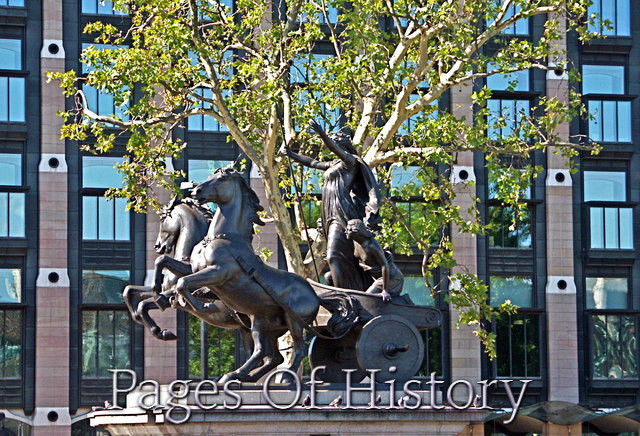
Boudica’s reputation has been reinvented repeatedly. Medieval chroniclers, including Geoffrey of Monmouth, turned her into a legendary figure. The Victorians, especially under Queen Victoria, adopted her as a symbol of British imperial womanhood—a paradoxical appropriation for a queen who fought an empire. The statue of Boadicea and Her Daughters by Thomas Thornycroft, installed near Westminster Bridge in 1902, depicts her in a chariot with a spear, a martial icon far removed from Tacitus’s account of a wronged queen seeking justice.
Modern historians treat the sources with caution. Tacitus and Dio wrote for Roman audiences and had their own rhetorical purposes—Tacitus in particular used Boudica’s speech to critique Roman corruption. Archaeological evidence, including the burned layers at Colchester and London, corroborates the scale of destruction but cannot confirm the literary details. What remains certain is that Boudica’s revolt was a genuine crisis for Roman Britain, and that her name has become a durable emblem of resistance to oppression.
Why Does Boudica Still Matter?
Boudica matters because her story exposes the mechanics of empire: the confiscation of land, the manipulation of debt, the violence that underpins colonial administration, and the explosive consequences when those pressures meet a leader willing to resist. Her revolt did not end Roman rule in Britain—that would take another three and a half centuries—but it forced Rome to reckon with the limits of coercion. The image of a queen flogged and her daughters assaulted, then rising to burn three cities, has retained its power precisely because it dramatizes a universal pattern: the abused subject who turns the instruments of humiliation into a call to arms.
For historians, Boudica also serves as a case study in source criticism. The two primary accounts disagree on key details, and both are shaped by Roman assumptions about gender, barbarism, and imperial legitimacy. Reading her story requires holding the literary evidence and the archaeological record in tension—recognizing that the woman behind the texts is partly unknowable, but that the revolt she led was real, devastating, and consequential.
Her legacy endures in place names, literature, and popular culture, from Shakespeare’s Cymbeline to modern novels and films. Yet the most honest tribute is not the myth of the warrior queen but the historical record of a woman who, stripped of her dignity and her kingdom, chose to fight—and came closer than any other British leader to breaking Rome’s hold on the island.