
📅 Last updated: 15.11.2026
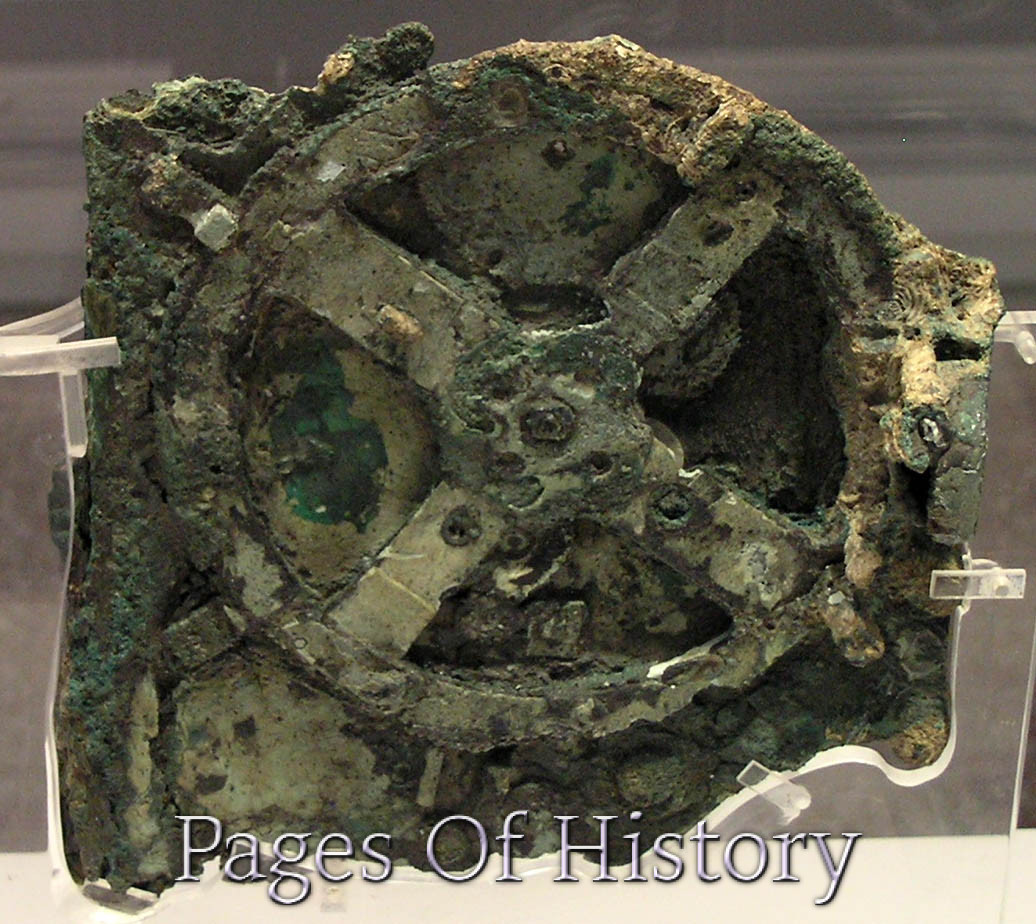
Few artifacts in the history of technology force us to rewrite our assumptions about the ancient world as thoroughly as the Antikythera Mechanism, a corroded bronze device recovered from a shipwreck in 1901 that has since been shown to be a functioning analog computer built more than 2,000 years ago. Its gears, dials, and inscriptions reveal that Greek astronomers and craftsmen had achieved a level of mechanical sophistication that historians once believed impossible before the medieval period. The object is not merely a curiosity of archaeology; it is a document of ancient science written in bronze.
The Antikythera Mechanism is a Hellenistic-era geared astronomical calculator, probably built between 150 and 100 BCE, that modeled the movements of the Sun and Moon, predicted eclipses, tracked the Metonic and Saros cycles, and displayed the positions of the planets on a system of interlocking bronze gears. Discovered in a Roman-era shipwreck off the Greek island of Antikythera in 1901, it is often described as the world’s first known analog computer.
- The Shipwreck That Rewrote the History of Technology
- What the Antikythera Mechanism Actually Did
- The Antikythera Mechanism and the Science of Its Age
- Key Facts and Timeline
- How Was Such a Device Built—and Why Was It Lost?
- What the Inscriptions Reveal
- Why the Antikythera Mechanism Still Matters
- The Lasting Legacy of a Bronze Cosmos
The Shipwreck That Rewrote the History of Technology
In the autumn of 1900, a group of Greek sponge divers sheltering from a storm off the island of Antikythera, between Crete and the Peloponnese, surfaced with a story that would change classical archaeology. At a depth of roughly 45 meters they had found a wreck loaded with bronze and marble statues, glassware, coins, and furniture. The Greek government, working with the Hellenic Navy, mounted a salvage operation between 1900 and 1901 that recovered an extraordinary cargo: bronze and marble figures, including the so-called Antikythera Ephebe and a bronze philosopher’s head, along with pottery, jewelry, and coins that dated the wreck to around 60–70 BCE. The ship was almost certainly a Roman freighter carrying loot or trade goods westward, probably toward Italy.
Among the recovered material was a lump of corroded bronze and wood that no one initially recognized. In 1902, the archaeologist Valerios Stais noticed a gear wheel embedded in the mass. The find was puzzling: nothing remotely like it existed in the known record of ancient mechanics. The artifact was catalogued, displayed in the National Archaeological Museum in Athens, and largely ignored for decades. The wooden casing and much of the bronze had been destroyed by seawater and time, leaving a calcified, fragmented shell that seemed to offer little.
From Curiosity to Machine
The turning point came in 1959, when the physicist Derek J. de Solla Price began a systematic study of the fragments. Working with the Greek scholar Charalambos Karakalos, Price used X-rays to reveal hidden gear trains inside the corroded mass. His 1974 paper in Scientific American, “Gears from the Greeks,” argued that the device was an astronomical calculator—an interpretation that transformed the object from an oddity into a central problem in the history of science. Later work by Michael Wright, a curator at the Science Museum in London, used linear X-ray tomography and direct examination to reconstruct the gear trains more precisely. The Antikythera Mechanism Research Project, a collaboration involving Greek and British institutions, then deployed high-resolution X-ray computed tomography and reflectance imaging between 2005 and 2008, reading inscriptions and gear teeth that had been invisible for two millennia.
What the Antikythera Mechanism Actually Did
The mechanism was housed in a wooden case roughly the size of a shoebox, with bronze plates on the front and back and a crank on the side. Turning the crank drove a complex train of at least thirty interlocking gears—estimates range from thirty to thirty-seven, depending on reconstruction—cut by hand from bronze sheet. The device was not a general-purpose computer in the modern sense; it was a specialized analog model of the cosmos, designed to compute and display astronomical cycles with remarkable precision.
The Front Dial: A Moving Map of the Sky
The front face carried a circular zodiac calendar and a second ring marked with the 365-day Egyptian solar year. A pointer showed the Sun’s position against the stars, while a second pointer, tipped with a small silvered sphere representing the Moon, tracked the lunar position. The Moon pointer incorporated the so-called pin-and-slot mechanism, an ingenious device that modeled the Moon’s variable speed across the sky—the first known mechanical implementation of a theory of irregular celestial motion. A rotating ball, half black and half white, displayed the Moon’s phase. Around the edge, a parapegma—a calendar of stellar risings and settings—linked the display to seasonal weather predictions and agricultural advice.
The Back Dials: Eclipses and Calendars
The rear of the device carried two large spiral dials. The upper one displayed the Metonic cycle, a 19-year period after which the phases of the Moon recur on the same dates of the solar year, together with the Callippic cycle, a 76-year refinement. The lower spiral displayed the Saros cycle, an 18-year, 11-day period that predicts eclipses, along with the Exeligmos, a triple-Saros cycle that corrects for the time of day. Glyphs on the Saros dial indicated whether an eclipse would be solar or lunar and at what hour it would occur. In other words, the Antikythera Mechanism could forecast eclipses years in advance—a capability of enormous practical and religious significance in the ancient world.
The Antikythera Mechanism and the Science of Its Age
The device did not emerge from nowhere. It sits at the intersection of Greek astronomy, Babylonian observation, and Hellenistic engineering. The zodiac and solar calendar reflect Greek practice; the Metonic cycle is named for the Athenian astronomer Meton, who proposed it in 432 BCE; the Saros cycle and the use of eclipse prediction derive from Babylonian astronomy, which had been accumulating records for centuries. The pin-and-slot mechanism embodies a geometrical model of lunar motion associated with the astronomer Hipparchus of Rhodes, who worked in the second century BCE and whose solar and lunar theories are reflected in the device’s parameters.
The identity of the maker remains unknown. The inscriptions on the device are written in Koine Greek, and the month names used point to a Corinthian calendar, suggesting a connection to northwestern Greece or a colony such as Syracuse. Cicero, writing in the first century BCE, described bronze spheres constructed by Archimedes and later by Posidonius that modeled the motions of the heavens. The Antikythera Mechanism is the physical realization of the tradition those texts describe—though no surviving source names its creator.
Why the Device Matters for the History of Science
The mechanism demonstrates that Hellenistic engineers possessed precision gear-cutting skills, metallurgical knowledge, and mathematical sophistication far beyond what the surviving literary record suggests. It also shows that astronomical theory was not confined to texts and tables; it was embodied in machines. That combination—theoretical astronomy plus precision mechanics—is precisely the combination that historians once dated to the medieval Islamic world or to Renaissance Europe. The Antikythera Mechanism pushes that convergence back by more than a millennium.
Key Facts and Timeline
| Date | Event or Fact |
|---|---|
| c. 150–100 BCE | Probable construction of the Antikythera Mechanism, based on inscriptions and astronomical parameters |
| c. 70–60 BCE | Ship carrying the mechanism and other cargo wrecks off Antikythera |
| 1900–1901 | Sponge divers discover the wreck; salvage recovers the corroded fragments |
| 1902 | Valerios Stais identifies a gear wheel inside the corroded mass |
| 1959–1974 | Derek J. de Solla Price uses X-rays to reveal internal gear trains and publishes “Gears from the Greeks” |
| 2005–2008 | Antikythera Mechanism Research Project uses CT scanning and imaging to read inscriptions and reconstruct gears |
How Was Such a Device Built—and Why Was It Lost?
The craftsmanship required to build the Antikythera Mechanism is itself a historical problem. The gears were cut from bronze sheet with triangular teeth, some only a millimeter or two across, and assembled on axles within a wooden frame. The maker needed to calculate gear ratios that encoded astronomical cycles—such as the 19-year Metonic cycle or the 223-month Saros—and then translate those ratios into physical teeth. Errors of a single tooth would compound over time. The surviving fragments show that the work was done with extraordinary care, and the inscriptions suggest the device was accompanied by a user’s manual explaining its displays.
What Happened to the Tradition?
If such machines existed, why do we have only one? The answer lies partly in materials and partly in history. Bronze is valuable and recyclable; a damaged or obsolete mechanism would likely be melted down. The Antikythera shipwreck preserved this example precisely because it sank. Literary references to geared celestial spheres in Cicero and elsewhere hint that such devices were known among the elite, but none survive. The Roman world’s practical engineering tradition favored large-scale infrastructure—aqueducts, roads, siege engines—over delicate astronomical instruments, and the political disruptions of the late Republic and early Empire may have interrupted the specialized craft networks that produced them.
- Material fragility: Bronze corrodes and is easily recycled, so few precision instruments survive.
- Elite patronage: Complex astronomical devices were likely commissioned by wealthy individuals or rulers, not mass-produced.
- Knowledge transmission: The mathematical and mechanical skills required were concentrated in a small number of workshops, vulnerable to disruption.
What the Inscriptions Reveal
The CT imaging campaign of 2005–2008 recovered thousands of characters of text from the device’s plates, much of it previously unreadable. The inscriptions include a description of the front dial’s displays, a catalog of eclipse predictions, and references to the colors and motions of the planets. They also confirm the device’s connection to specific astronomical traditions: the use of the Egyptian calendar, the incorporation of the Callippic cycle, and the mention of planetary motions that suggest a lost tradition of mechanical planetary modeling.
The inscriptions are not decorative. They function as operating instructions, telling the user what each pointer and glyph means—evidence that the device was meant to be used, not merely admired. That practical orientation is one of the most striking features of the Antikythera Mechanism: it was a working instrument, calibrated to real astronomical cycles, designed to answer questions about the sky.
Why the Antikythera Mechanism Still Matters
The device’s significance extends beyond its own era. It challenges a narrative of linear technological progress in which complex machinery emerges only in the medieval and early modern periods. It shows that the ancient world possessed the conceptual and technical tools to build precision instruments, and that those tools were applied to astronomy. It also illustrates how much of ancient science has been lost—not because it did not exist, but because its material embodiments did not survive.
For modern researchers, the mechanism remains an active subject. Reconstructions, including working models built by Michael Wright and by the Antikythera Mechanism Research Project, have tested hypotheses about the gear trains and displays. Debates continue over the exact number of gears, the nature of the planetary display, and the identity of the maker. Each new imaging technique and each new fragment of inscription adds detail to a picture that is still incomplete.
The Lasting Legacy of a Bronze Cosmos
The Antikythera Mechanism is a reminder that the history of technology is not a straight line. A Greek craftsman, working with bronze and hand-cut gears, built a machine that modeled the heavens with a precision that would not be matched in the West for more than a thousand years. The device sank with its ship, lay on the seabed for two millennia, and then, through the patience of divers, physicists, and imaging specialists, began to speak again. Its gears encode a vision of the cosmos as a system of cycles—solar, lunar, and planetary—that could be calculated, predicted, and displayed. That vision, and the skill that gave it physical form, remain the Antikythera Mechanism’s enduring contribution to the history of science.