
📅 Last updated: 12.11.2026
The story of the Boudica warrior queen is one of the most dramatic and violent episodes in the history of Roman Britain, a revolt that nearly tore the province from the Empire’s grasp. In 60 or 61 CE, this queen of the Iceni tribe led a coalition of Britons in a ferocious uprising against their Roman occupiers. Her forces destroyed three major settlements, slaughtered tens of thousands, and humbled a Roman army before meeting their end in a final, decisive battle.
Boudica was a queen of the Iceni tribe in Roman-occupied Britain who, after being flogged and seeing her daughters raped by Roman officials, led a massive uprising in 60–61 CE. Her forces destroyed the Roman settlements of Camulodunum (Colchester), Londinium (London), and Verulamium (St Albans) before her army was ultimately defeated by the Roman governor Gaius Suetonius Paulinus.
- Who Was the Boudica Warrior Queen? The Iceni and the Spark of Rebellion
- The First Blow: The Destruction of Camulodunum
- Total War: The Burning of Londinium and Verulamium
- The Battle of Watling Street: The Boudica Warrior Queen's Last Stand
- Key Figures and Factions in the Revolt
- The Aftermath: A Province on a Knife-Edge
- Why Did the Boudica Revolt Fail?
- The Legacy of the Boudica Warrior Queen
Who Was the Boudica Warrior Queen? The Iceni and the Spark of Rebellion
To understand the revolt, one must first understand the fragile and often brutal nature of Roman rule in Britain. The Iceni were a powerful and wealthy tribe inhabiting what is now Norfolk and Suffolk in eastern England. Unlike some tribes, they had initially submitted to Rome, likely becoming a client kingdom after the Claudian invasion of 43 CE. Their king, Prasutagus, was permitted to rule as a nominal ally, a common Roman strategy for managing conquered territories. Prasutagus, hoping to secure his family’s future, made a fatal miscalculation in his will. He named the Roman Emperor Nero as co-heir alongside his two daughters, believing this act of loyalty would protect his kingdom and lineage.
His death, around 60 CE, triggered the events that would forge the legend of the Boudica warrior queen. The Roman administration, however, saw the client kingdom not as an allied state but as a territory ripe for plunder. The local Roman procurator, Catus Decianus, acted with astonishing greed and brutality. He ordered the Iceni’s lands to be seized as if they were a conquered people. When Boudica’s people protested this illegal annexation, the Roman response was swift and savage. According to the Roman historian Tacitus, Boudica was publicly flogged, and her two young daughters were raped by Roman soldiers. The Iceni nobility were stripped of their ancestral property, and Roman financiers, who had likely lent money to the Britons, called in their debts with crushing force.
This combination of personal violation, economic ruin, and political betrayal was the catalyst. The outrage was not confined to the Iceni. The neighboring Trinovantes, who had suffered under Roman rule for nearly two decades, were also seething with resentment. They had been forced from their lands to make way for the Roman colony at Camulodunum (modern Colchester), a settlement populated by retired Roman soldiers who treated the local Britons with contempt. They were also burdened by the cost of building a massive temple to the deified Emperor Claudius, a symbol of their subjugation. The stage was set for a conflagration, and Boudica, driven by a desire for vengeance and justice, emerged as its leader.
The First Blow: The Destruction of Camulodunum
The revolt began with a lightning-fast assault on the most potent symbol of Roman power in the region: the colonia at Camulodunum. The city was a hub of Roman administration and a settlement for veteran soldiers, making it a prime target for the rebels’ fury. The timing was opportune. The Roman governor, Gaius Suetonius Paulinus, was hundreds of miles away in the west, leading a campaign to destroy the druid stronghold on the island of Mona (Anglesey). This left the province’s eastern heartland dangerously exposed.
The Iceni and Trinovantes, now united under Boudica’s leadership, descended upon Camulodunum with overwhelming force. The city’s inhabitants, largely retired soldiers and merchants, had little warning. They sent desperate pleas for help to Catus Decianus, the procurator whose greed had sparked the fire. He dispatched a mere two hundred poorly armed men, a token force that was easily swept aside. The rebels overwhelmed the city’s meager defenses. The temple of Claudius, where the remaining defenders made a final stand, held out for two days before it was stormed. The city was then subjected to total annihilation. Tacitus records the grim details: the settlement was razed to the ground, and its population was massacred without distinction. The Ninth Legion, commanded by Quintus Petillius Cerialis, marched to relieve the city but was ambushed and nearly annihilated in a devastating defeat. Its infantry was destroyed, and only Cerialis and a small contingent of cavalry managed to escape. The province of Britannia was now in open revolt, and the Boudica warrior queen had drawn first blood.
Total War: The Burning of Londinium and Verulamium
News of the catastrophe at Camulodunum and the destruction of the Ninth Legion sent shockwaves through the Roman world. Catus Decianus, the procurator whose actions had ignited the rebellion, fled to Gaul, abandoning the province he was meant to govern. Suetonius Paulinus, receiving frantic reports of the disaster, rushed back from Anglesey with his legions. He faced a stark strategic dilemma. He could attempt to defend the province’s major settlements, or he could abandon them to save his army for a decisive battle.
Suetonius chose the latter, a brutal but militarily sound decision. He marched his troops to Londinium (London), a bustling commercial settlement that had grown rapidly as a center of trade. It was not a military stronghold, but it had become a significant population center. Upon arriving, he realized he lacked the numbers to defend it against the vast horde approaching. To stay and fight would mean the destruction of his entire army. In a move that demonstrated cold-blooded pragmatism, he ordered the city’s abandonment, prioritizing the survival of his legions over the lives of the city’s inhabitants. Those who could not flee—the old, the sick, the poor—were left to their fate.
The rebels fell upon Londinium with the same ferocity they had shown at Camulodunum. The city was systematically burned; archaeologists have found a distinct, thick layer of red ash across the city, evidence of the conflagration. The slaughter was immense. The same fate then befell Verulamium (St Albans), another town that had grown prosperous under Roman rule but was not a military site. The rebels’ strategy was clear: to erase every trace of Roman civilization from the land. By the time the wave of destruction had passed, an estimated 70,000 to 80,000 people—Romans and Romanized Britons—had been killed, according to the figures given by Tacitus. The Boudica warrior queen had become the most feared name in Britannia.
The Battle of Watling Street: The Boudica Warrior Queen’s Last Stand
Despite the overwhelming success of the revolt, a crucial strategic error would seal the fate of the Britons. Suetonius gathered his forces—Legio XIV Gemina, parts of Legio XX Valeria Victrix, and a contingent of auxiliaries—and chose his ground for the final confrontation. He found it in a narrow, defile-like position, likely somewhere along the Roman road now known as Watling Street, with a forest behind him to protect his flanks and rear. This terrain would negate the Britons’ massive advantage in numbers, forcing them to attack head-on against a disciplined Roman line.
Boudica’s army, swollen with tens of thousands of warriors, their families, and wagons, pursued the Romans. Their confidence was sky-high after their string of victories. According to Tacitus, Boudica addressed her troops from a chariot, reminding them of the floggings, the rapes, and the slavery that awaited them if they failed. She framed the coming battle not just as a fight for freedom, but as a war of vengeance against Roman arrogance and cruelty. Suetonius, in his pre-battle speech, urged his men to ignore the din of the barbarian horde and trust in their discipline and training. He promised them that this day would be a glorious victory that would erase the shame of the burning cities.
The battle itself was a textbook demonstration of Roman military superiority. The Britons surged forward, but their initial charge was met with a volley of javelins from the Roman legionaries. The disciplined Roman line then advanced in a wedge formation, breaking the British front. The Britons, fighting in a disorganized mass, could not withstand the coordinated assault. They began to fall back, but their retreat was blocked by the ring of wagons they had placed around the battlefield to act as a grandstand for their families. The Romans showed no mercy, cutting down the trapped warriors and then turning their swords on the women and children. It was a massacre. Tacitus claims that nearly 80,000 Britons were killed, while only 400 Romans fell. Boudica herself, according to the most common account, poisoned herself to avoid capture and humiliation. The revolt was over.
Key Figures and Factions in the Revolt
Understanding the Boudica revolt requires knowing the key players and the forces they commanded. The conflict was a clash not just of armies, but of cultures and personalities.
- Boudica: Queen of the Iceni, the charismatic and vengeful leader of the rebellion. Her personal grievance became the catalyst for a province-wide uprising.
- Gaius Suetonius Paulinus: The Roman governor of Britannia. An experienced and ruthless military commander, his decision to abandon London and sacrifice its population to save his army proved decisive.
- Catus Decianus: The Roman procurator whose greed and brutality directly triggered the revolt. His flight to Gaul left the province leaderless in its hour of crisis.
- Quintus Petillius Cerialis: The commander of Legio IX Hispana, whose disastrous defeat at Camulodunum emboldened the rebels and shocked Rome.
- The Iceni and Trinovantes: The two primary tribes of the rebellion, united by shared grievances against Roman rule and economic exploitation.
The Aftermath: A Province on a Knife-Edge
The Battle of Watling Street did not immediately bring peace. The province was in ruins, its economy shattered, and its population traumatized. Suetonius, fearing a resurgence of rebellion, implemented a brutal policy of reprisals against the tribes that had joined Boudica. This harshness was so severe that it threatened to provoke another uprising. The new procurator, Gaius Julius Alpinus Classicianus, wrote to Rome complaining that Suetonius’s policies were alienating the province. This led to the famous intervention of Nero’s freedman, Polyclitus, who was sent to Britain to assess the situation. The outcome was a compromise: Suetonius was recalled to Rome, and a more conciliatory governor, Publius Petronius Turpilianus, was appointed. The rebellion, though crushed, had demonstrated the fragility of Roman power in Britain and forced a change in imperial policy.
The revolt also had a profound psychological impact on Rome. The Emperor Nero allegedly considered abandoning Britain entirely. The sheer scale of the destruction and the loss of life were a stark reminder that the island was not yet fully pacified. The Boudica warrior queen had shown that Roman military might could be challenged by a determined and united native population.
| Date (approx.) | Event | Location | Key Figures |
|---|---|---|---|
| 43 CE | Claudian invasion of Britain begins | Rutupiae (Richborough) | Emperor Claudius, Aulus Plautius |
| c. 60 CE | Death of King Prasutagus; Iceni lands seized, Boudica flogged, daughters raped | Iceni territory (East Anglia) | Boudica, Catus Decianus |
| 60/61 CE | Rebels destroy Camulodunum (Colchester) | Camulodunum | Boudica, Quintus Petillius Cerialis |
| 60/61 CE | Rebels burn Londinium (London) and Verulamium (St Albans) | Londinium, Verulamium | Boudica, Gaius Suetonius Paulinus |
| 60/61 CE | Battle of Watling Street; decisive Roman victory | Watling Street (location unknown) | Boudica, Gaius Suetonius Paulinus |
Why Did the Boudica Revolt Fail?
The failure of the Boudica revolt can be attributed to a combination of strategic miscalculations and the inherent strengths of the Roman military machine.
- Roman Military Discipline: The core of the Roman army was its professional, disciplined legionary. The Britons, though numerous and ferocious, were primarily a warrior society, not a standing army. They lacked the training, equipment, and tactical cohesion to break a well-positioned Roman line.
- Suetonius’s Strategic Sacrifice: The Roman governor’s decision to abandon Londinium and Verulamium was a devastating blow to the province, but it preserved his army. This allowed him to choose the battlefield and fight on his own terms, a crucial advantage.
- The Choice of Battlefield: Suetonius chose a narrow, enclosed space that neutralized the Britons’ numerical superiority. The wagons placed behind the British lines, intended as a grandstand, instead trapped them, turning a retreat into a slaughter.
- Lack of a Long-Term Strategy: The revolt was fueled by vengeance and was incredibly effective in its initial phase of destruction. However, it lacked the logistical infrastructure and unified command needed to sustain a prolonged war against a determined empire.
The Legacy of the Boudica Warrior Queen
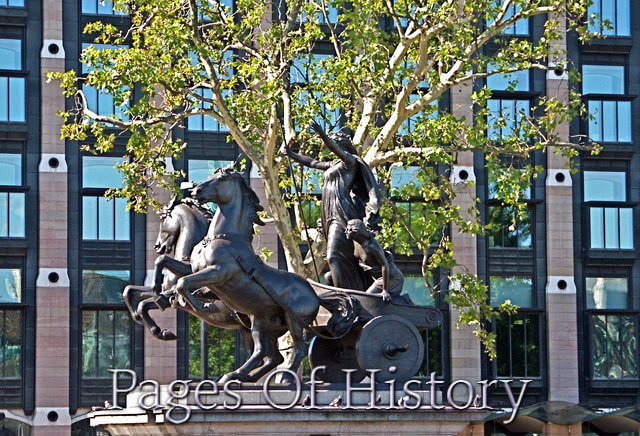
Boudica’s legacy is complex and has been reinterpreted by every generation. To the Romans, she was a barbarian queen and a monstrous figure, a symbol of the chaos that threatened civilization. Tacitus, writing with a critical eye on Roman imperialism, presents her as a tragic and compelling figure, giving her powerful speeches that condemn Roman tyranny. To the Victorians, she became a symbol of British patriotism and female virtue, a proto-imperial heroine. Her statue, sculpted by Thomas Thornycroft in 1905, stands near Westminster Bridge in London, depicting her and her daughters in a chariot, a triumphant figure.
Today, the Boudica warrior queen is celebrated as a symbol of resistance against oppression, a feminist icon, and a powerful figure in British national identity. The image of her chariot, with its scythes, is a common motif. Her story continues to resonate because it touches on universal themes: the abuse of power, the fight for freedom, and the terrible cost of rebellion. The archaeological evidence of the Boudican destruction layer in London, a thick band of red ash, serves as a stark physical reminder of the fiery wrath she unleashed. The story of Boudica is not just one of a warrior queen, but of a pivotal moment when the fate of Britain hung in the balance, and a woman’s fury nearly changed the course of history.