
📅 Last updated: 09.11.2026
The English longbow decline is one of military history’s most consequential technological shifts, a slow unraveling that saw a weapon of devastating medieval power yield, over roughly two centuries, to the noisy, smoky, and ultimately unstoppable rise of gunpowder firearms. For generations, the yew bow of the English archer had shattered cavalry charges and broken the finest armies of France; yet by the late sixteenth century, the weapon that won at Crécy and Agincourt had become a ceremonial relic, kept alive by statute and nostalgia rather than battlefield necessity. Understanding why the longbow failed to replace—or rather, failed to resist replacement by—guns reveals as much about economics, social structure, and logistics as it does about ballistics.
The English longbow declined because it was a weapon system dependent on a whole society, not just a piece of wood: it required years of archer training, a steady supply of imported yew, and massed formations that firearms could match with far less skill and cost. Firearms, though initially inferior in range and rate of fire, offered cheap training, armor-piercing power, and industrial scalability that the longbow could never match. By the late 1500s, the English crown itself was phasing out the bow in favor of the caliver and musket.
- What Made the English Longbow So Formidable in the First Place?
- How Did Firearms First Appear on European Battlefields?
- Why Did the English Longbow Decline Begin in the Sixteenth Century?
- Why Did Guns Ultimately Prove Superior to the Longbow?
- When Did England Officially Abandon the Longbow?
- What Role Did Economics and Society Play in the English Longbow Decline?
- Did the Longbow Have Any Lasting Advantages?
- What Is the Lasting Legacy of the English Longbow Decline?
What Made the English Longbow So Formidable in the First Place?
To understand the decline, one must first grasp the improbable peak. The English longbow—typically a yew stave some six feet in length, drawing perhaps 100 to 150 pounds—was not unique to England, but the English developed a system around it that no other kingdom matched. The key was not the bow itself but the archer: a man who had trained from boyhood, whose skeleton could be deformed by a lifetime of pulling heavy draw weights, and who could loose ten to twelve aimed arrows a minute at ranges exceeding 200 yards.
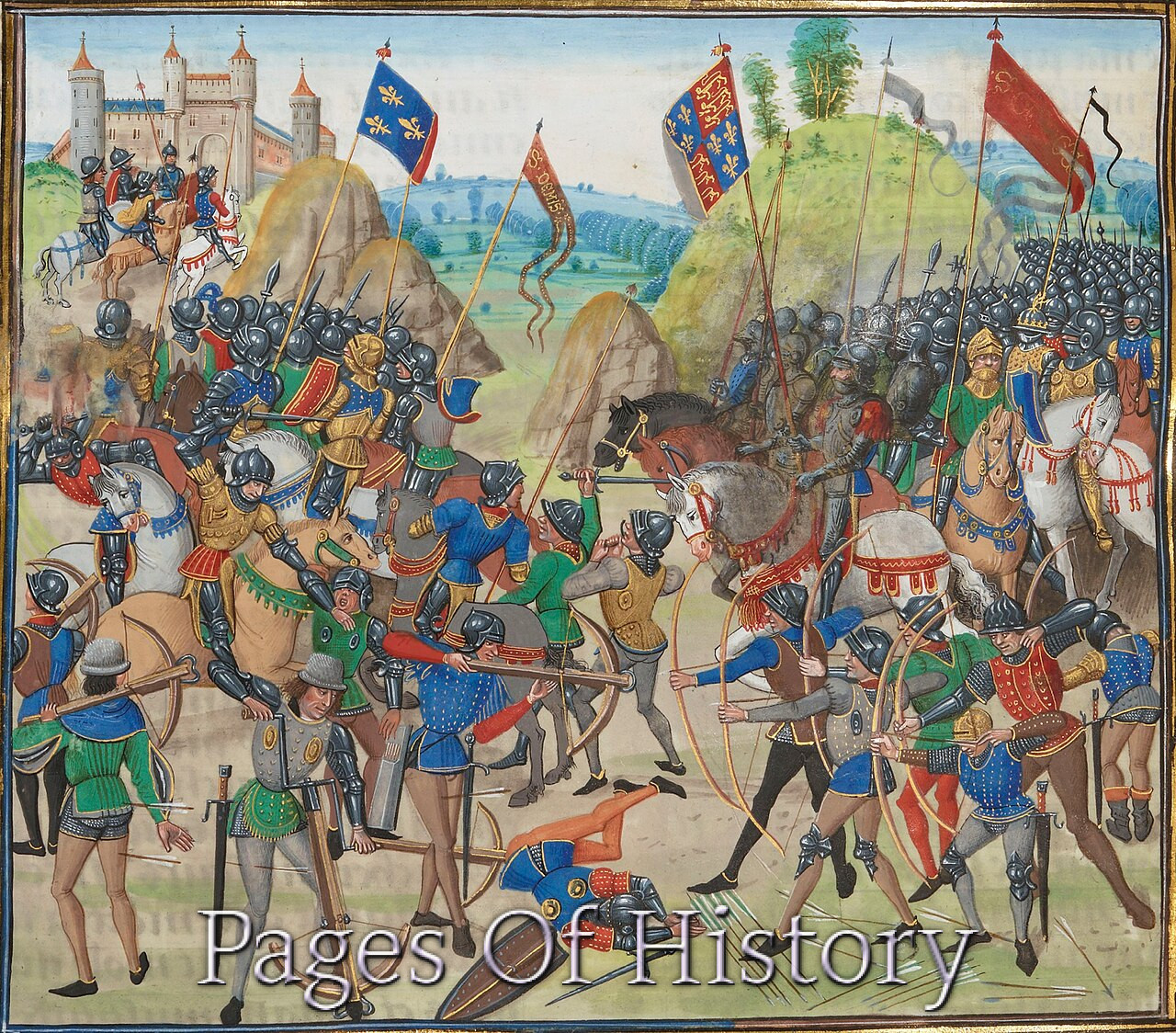
The system crystallized under Edward III during the Hundred Years’ War. At the Battle of Crécy on 26 August 1346, English and Welsh archers—perhaps 7,000 strong—broke repeated French cavalry charges, their arrows falling on horses and men alike. At Poitiers in 1356 and again at Agincourt on 25 October 1415, where Henry V’s exhausted, outnumbered army destroyed a vastly larger French force, the longbow became legendary. Contemporary chroniclers such as Jean Froissart marveled at the “shower of arrows” that darkened the sky, and the English archer entered national mythology.
Yet even at Agincourt, the seeds of vulnerability were visible. The victory depended on carefully chosen ground, prepared stakes, and a French command that attacked in piecemeal waves. The bow was a weapon of the defensive set-piece, not a universal solvent.
How Did Firearms First Appear on European Battlefields?
Gunpowder reached Europe in the fourteenth century, and by the 1320s and 1340s crude cannon were appearing in sieges from Italy to France. Hand-held firearms—the “hand gonne”—emerged by the late 1300s. Early guns were dreadful: inaccurate, slow to load, prone to bursting, and terrifying more to their users than their targets. At the Battle of Agincourt, French gunners were present but contributed little. For most of the fifteenth century, the longbow remained the superior battlefield missile weapon in English hands.
The critical shift came in the late fifteenth and early sixteenth centuries. The matchlock mechanism, developed around the 1470s, allowed a gunner to fire without holding a burning match to a touchhole by hand. The arquebus and, later, the heavier musket became reliable enough to field in formations. The Spanish tercio, perfected in the Italian Wars of the 1490s and early 1500s, demonstrated that disciplined pike-and-shot formations could dominate open battlefields.
Why Did the English Longbow Decline Begin in the Sixteenth Century?
The English longbow decline accelerated dramatically under the Tudors, and the reasons were structural rather than purely technological. Henry VIII was a keen archer and patron of the bow, but even his reign saw firearms proliferate. His break with Rome in the 1530s had an unintended consequence for archery: the best yew came from Spain and Italy, and diplomatic isolation threatened a supply chain that English bowyers could not replace domestically.
By the mid-sixteenth century, several pressures converged:
– Training collapse: The longbow demanded lifelong practice. Economic changes, enclosure of common land, and the decline of mandatory Sunday archery meant fewer skilled archers. Firearms could be taught to a recruit in weeks.
– Supply fragility: English yew was scarce and inferior; the best staves were imported. Gunpowder’s ingredients—saltpeter, sulfur, charcoal—could be manufactured and stockpiled domestically.
– Armor penetration: As plate armor improved, the bow’s effectiveness against fully armored men declined at range. A heavy musket ball could punch through plate at close quarters.
– Cost per soldier: Muskets and powder were cheaper to equip and sustain than the years of investment a competent archer represented.
The Tudor Debates and the Statute of 1541
Parliament and crown were not blind to the change. The Unlawful Games Act of 1541 (33 Henry VIII c. 9) banned many pastimes to force commoners back to archery practice, a telling sign that the bow’s social base was eroding. Writers like Roger Ascham, in his 1545 treatise *Toxophilus*, defended the bow passionately—yet Ascham himself acknowledged the growing fashion for “handguns.” The very need for such advocacy revealed the direction of travel.
Why Did Guns Ultimately Prove Superior to the Longbow?
The English longbow decline was not a sudden defeat but a gradual verdict delivered by logistics, economics, and the changing character of war. Firearms won on several decisive fronts.
The Training Problem
An English longbowman was a decade-long investment. Firearms compressed that to weeks. As armies grew larger in the sixteenth and seventeenth centuries—the “military revolution” identified by historians such as Geoffrey Parker—states could not afford to wait a generation for each cohort of archers. The musket offered a scalable soldier.
The Cost and Supply Problem
Yew was a bottleneck. A single longbow consumed a stave that might take decades to grow, and the best wood was foreign. Gunpowder, by contrast, was an industrial product. Saltpeter could be cultivated from dung heaps and imported in bulk; sulfur and charcoal were abundant. By the late 1500s, England was building powder mills and stockpiling munitions in a way it had never done for bowstaves.
The Battlefield Problem
Against unarmored or lightly armored troops, the longbow remained deadly. But warfare was shifting toward massed infantry with pikes and shot, siegecraft dominated by artillery, and naval gunnery. The bow had no answer to a cannon, and on the increasingly fortified battlefield of the sixteenth century, the archer’s high, arcing volleys mattered less than the flat, armor-piercing trajectory of a musket ball.
When Did England Officially Abandon the Longbow?
The transition was gradual and contested. Queen Elizabeth I’s government debated the matter repeatedly. In 1569, the crown ordered a mixed armament, and by the 1580s militia returns show firearms steadily replacing bows. The decisive practical test came in the 1590s, and the longbow’s last significant battlefield appearance in English hands was at the Battle of Pinkie Cleugh near Musselburgh, Scotland, on 10 September 1547—where English forces under the Duke of Somerset used both bows and arquebuses against the Scots. After that, the bow faded from the field.
By the early seventeenth century, the longbow was legally obsolete for militia service. The 1595 muster returns and later Jacobean statutes reflect a kingdom that had, in practice, gone over to the gun. The last formal English archery units were ceremonial. The weapon that had defined English arms for three centuries was, by the death of Elizabeth I in 1603, a memory.
| Date | Event | Significance for the Longbow |
|---|---|---|
| 1346 | Battle of Crécy | Longbow’s decisive battlefield triumph over French cavalry |
| 1415 | Battle of Agincourt | Apogee of English archery; Henry V’s famous victory |
| c. 1470s | Development of the matchlock | Makes handheld firearms practical and reliable |
| 1541 | Unlawful Games Act | Statute forcing archery practice signals erosion of the bow’s social base |
| 1547 | Battle of Pinkie Cleugh | Last major English battlefield use of the longbow alongside firearms |
| c. 1590s | Militia rearmament with calivers and muskets | Practical replacement of the bow in English service |
What Role Did Economics and Society Play in the English Longbow Decline?
The English longbow decline cannot be separated from the transformation of English society. The bow was a weapon of a particular social order: a rural population with access to common land, leisure for Sunday practice, and a culture that valorized archery. The enclosure movement, the growth of wage labor, and urbanization all eroded that base. A yeoman who worked long hours in a textile workshop had no time to loose a hundred arrows a day.
Firearms fit the new order. A musket could be issued from a state armory, its user drilled in a few weeks, and its ammunition manufactured in bulk. The state could standardize calibers and supply powder. The bow, by contrast, was a personal craft artifact, its quality dependent on the individual archer’s strength and the bowyer’s skill. The military revolution was, at bottom, an industrial revolution in miniature—and the longbow was a pre-industrial weapon.
The Strategic Dimension: Why Guns Won Abroad Too
England was not alone in this transition. The Japanese abandoned the yumi for the tanegashima matchlock after its introduction by Portuguese traders in 1543, and by the 1570s Oda Nobunaga was fielding massed arquebusiers at Nagashino in 1575. The Ottomans, Mughals, and Safavids all embraced firearms. The longbow’s decline was part of a global pattern: wherever gunpowder weapons became cheap and reliable, projectile weapons dependent on individual strength and lifelong training receded.
Did the Longbow Have Any Lasting Advantages?
It would be a mistake to treat the longbow as simply inferior. In skilled hands it outperformed early firearms in rate of fire, accuracy at range, and reliability in wet weather—matchlocks were notoriously useless in rain. The English military writer Sir John Smythe argued in the 1590s that the bow remained superior for skirmishing and could outshoot the musket. But such arguments lost because they focused on the weapon’s best-case performance rather than the system’s average performance. A nation could not field an army of Smythes.
The longbow’s decline was thus a triumph of the average over the exceptional. Guns made mediocre soldiers dangerous; the bow made only exceptional soldiers deadly.
What Is the Lasting Legacy of the English Longbow Decline?
The English longbow decline marks a hinge in military history—the moment when the individual warrior’s prowess gave way to the state’s industrial capacity. The longbow was the last great missile weapon of the pre-gunpowder world, and its passing signaled the arrival of the era in which firepower, logistics, and standardization would decide wars.
Yet the longbow never truly vanished from English culture. It survived in the pages of Shakespeare, in the mythology of Agincourt, and in the enduring image of the yeoman archer as a symbol of English liberty. The weapon lost the battlefield, but it won the imagination. And the lesson it teaches—that technological superiority is never purely a matter of the weapon’s peak performance, but of the society that must sustain it—remains as relevant to the drones and precision munitions of the twenty-first century as it was to the archers of Henry V.