
📅 Last updated: 30.10.2026
The Battle of Hattin, fought on 3–4 July 1187, was the catastrophic defeat that shattered the Crusader Kingdom of Jerusalem and set the stage for the Muslim reconquest of the holy city itself. In a single, brutal engagement in the parched hills of Galilee, the largest field army the Latin East had ever assembled was annihilated by the forces of Saladin. The consequences were immediate and irreversible: within months, Jerusalem fell, and the Crusader states were reduced to a coastal remnant clinging to survival.
The Battle of Hattin (3–4 July 1187) saw Saladin’s Ayyubid army destroy the main field force of the Kingdom of Jerusalem near the Horns of Hattin in Galilee. King Guy of Lusignan was captured, the True Cross was lost, and the kingdom’s defensive capacity collapsed. Within three months, Saladin had taken Jerusalem, reversing nearly nine decades of Crusader rule.
- What Was the Strategic Situation Before the Battle of Hattin?
- How Did the Armies Prepare for the Battle of Hattin?
- What Happened During the March to Hattin?
- Why Did the Crusaders Lose the Battle of Hattin?
- What Were the Immediate Consequences of the Battle of Hattin?
- How Did the Battle of Hattin Reshape the Crusader States?
- Why Does the Battle of Hattin Still Matter?
- The Lasting Legacy of the Battle of Hattin
What Was the Strategic Situation Before the Battle of Hattin?
By the mid-1180s, the Kingdom of Jerusalem was a state under siege by its own contradictions. Founded in 1099 after the First Crusade, the Latin Kingdom had always been a thin, vulnerable sliver of territory surrounded by hostile Muslim powers. Its survival had depended on two things: a steady flow of manpower and money from Western Europe, and the fragmentation of its Muslim neighbors. By the time Saladin (Salah al-Din Yusuf ibn Ayyub) consolidated power in Egypt and Syria, both pillars were crumbling.
Saladin’s rise was the decisive strategic development. Having seized Egypt in 1169 and gradually absorbed Damascus, Aleppo, and Mosul into a unified Ayyubid state, he encircled the Crusader kingdom from the south, east, and north. His stated goal was the recovery of Jerusalem and the reversal of the Crusader conquest. The Kingdom of Jerusalem, meanwhile, was torn by internal factionalism that would prove as fatal as any enemy army.
The Court Factions: A Kingdom Divided
Two rival parties dominated the kingdom’s politics. The “court party,” led by Guy of Lusignan (who became king in 1186 through his marriage to Queen Sibylla), drew support from newcomers from Western Europe and was closely allied with the aggressive military orders—the Knights Templar under Gerard de Ridefort and the Knights Hospitaller under Roger des Moulins. The “noble party” or “Ibelin faction,” led by Raymond III of Tripoli and the Ibelin family, represented the established baronage and favored a cautious policy of coexistence and containment with Saladin.
The personal and political hatred between Guy and Raymond was venomous. Raymond, who had been regent before Guy’s accession, resented the Lusignan takeover and had withdrawn to his own territories. This factional split meant that when crisis came, the kingdom’s leadership could not agree on a coherent strategy—a fatal handicap against a unified enemy.
Saladin’s Provocation and the Count of Tripoli’s Truce
In 1187, Saladin exploited the divisions. Raymond of Tripoli, in a separate truce with Saladin, allowed Muslim forces to pass through his lands. In late April or early May 1187, a Muslim force under Saladin’s son al-Afdal raided near Nazareth. Gerard de Ridefort, the Templar Grand Master, and Roger des Moulins, the Hospitaller Master, gathered a small force and marched to intercept them. The result was the disastrous Battle of Cresson (1 May 1187), where a few hundred Crusaders were ambushed and slaughtered; Gerard escaped, but Roger des Moulins was killed. The defeat inflamed tensions and pushed the kingdom toward open war.
Raymond, shamed by the raid through his territory, reconciled with Guy. The kingdom’s leaders gathered at Acre and resolved to confront Saladin in the field. It was a decision born of honor and desperation rather than sound strategy—and it would lead directly to the Battle of Hattin.
How Did the Armies Prepare for the Battle of Hattin?
Saladin assembled his forces at Tell Ashtara, near the Sea of Galilee, in late June 1187. His army was a coalition of Egyptian, Syrian, and Jaziran contingents, numbering perhaps 30,000–40,000 men, including a substantial cavalry arm. On 1 July, his forces crossed the Jordan and invested the Crusader fortress of Tiberias, held by Raymond of Tripoli’s wife, Eschiva. The town fell; the citadel held out.
The Crusader army mustered at the Springs of Sepphoris (Saffuriya), a well-watered position about 20 miles west of Tiberias. Contemporary sources suggest a force of around 20,000 men, including 1,200 knights, several thousand Turcopoles (light cavalry), and a large infantry contingent. The army carried the True Cross, a relic of immense spiritual significance, borne before the host as a talisman of divine favor.
The Council at Sepphoris: Strategy and Dissent
A council of war convened on 2 July. Raymond of Tripoli, who knew the terrain intimately, argued forcefully against marching to relieve Tiberias. His reasoning was sound: the route from Sepphoris to Tiberias crossed a waterless plateau in the heat of summer, and Saladin’s cavalry would harass the column. He proposed waiting at Sepphoris, forcing Saladin to come to them on ground of their choosing. He even offered to sacrifice the citadel and his own wife rather than risk the army.
Gerard de Ridefort and the more aggressive barons, including Reynald of Châtillon (lord of Kerak and Oultrejordain), accused Raymond of cowardice and treason. Guy of Lusignan, swayed by the Templar Master and stung by accusations of inaction, ordered the march. The decision to leave the water at Sepphoris on 3 July 1187 was the single most consequential tactical error of the campaign.
What Happened During the March to Hattin?
The Crusader army set out on the morning of 3 July, marching east toward Tiberias. The column was strung out over several miles, with the infantry in the van and rear and the cavalry in the center. Almost immediately, Saladin’s skirmishers began harassing the flanks. The heat was oppressive; the terrain was rocky and dry. By midday, the army had reached the plateau near the village of Hattin, beneath a volcanic outcrop known as the Horns of Hattin (Qurun Hattin).
Saladin’s forces had occupied the wells and springs ahead, denying water to the Crusaders. The Muslim cavalry set fire to the dry brush and grass, adding smoke and flame to the torment of thirst. The Crusader column began to disintegrate. Guy ordered a halt near the Horns, hoping to regroup and rest—but there was no water. That night, the army camped in a state of near-collapse, surrounded by the enemy and tormented by thirst.
The Night of 3–4 July: Desperation and Collapse
During the night, the situation deteriorated further. Saladin’s troops tightened the cordon and kept up psychological pressure, beating drums and chanting. Some Crusader infantry, unable to endure the thirst, broke ranks and tried to reach the lake, only to be cut down or captured. Morale shattered. Guy attempted to organize a breakout at dawn, but coordination had collapsed.
On the morning of 4 July 1187, the Crusader army attempted to fight its way toward the springs at Hattin. The infantry, many of whom had been ordered to march and fight in the heat without water, were on the verge of mutiny. Some sources report that infantrymen refused to advance or broke away to surrender. The cavalry charges, unsupported and enfeebled by thirst, failed to break the Ayyubid lines.
Why Did the Crusaders Lose the Battle of Hattin?
The Battle of Hattin was not lost in a single moment but through a cascade of failures. Saladin’s army, well-watered and well-positioned, methodically dismantled the exhausted Crusader force. The final phase saw the Crusader cavalry attempt a desperate charge toward the Horns of Hattin, where some units made a last stand. Guy of Lusignan, surrounded and unable to break out, was captured. Raymond of Tripoli, leading a charge of knights, managed to cut through the enemy lines and escape—a flight that some contemporaries viewed as desertion, though it may have been a genuine breakout attempt that failed to rally the rest.
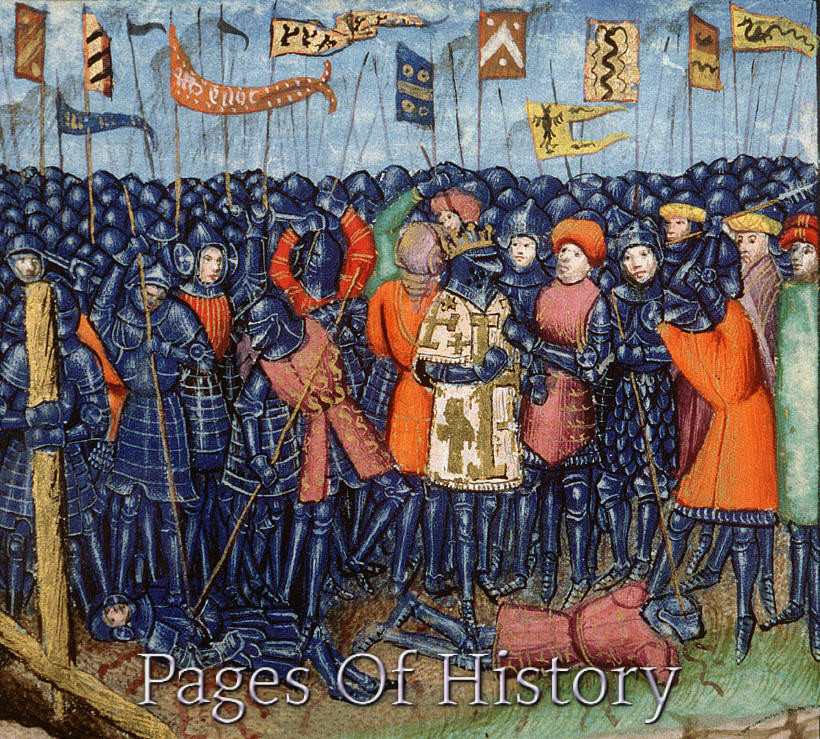
Reynald of Châtillon was captured and brought before Saladin. According to the account of Saladin’s secretary Imad al-Din and later chroniclers, Saladin offered Guy a cup of water—a gesture of hospitality that, under Arab custom, meant the captive’s life was spared. When Guy passed the cup to Reynald, Saladin reportedly declared that he had not offered it to Reynald, and then personally executed him with his sword, citing Reynald’s raids on Muslim caravans and his violation of truces. The True Cross was captured and carried away, a psychological blow of enormous magnitude.
The casualties were staggering. Most of the Crusader army was killed or captured. The military orders suffered catastrophic losses: the Templars and Hospitallers lost hundreds of knights, and Gerard de Ridefort was captured (he was later ransomed). The flower of the kingdom’s nobility was wiped out or taken prisoner.
Key Factors in the Defeat
- Strategic disunity: The factional hatred between Guy and Raymond paralyzed decision-making and led to a march that Raymond had warned against.
- Water and terrain: The Crusaders left a secure water source and marched into a waterless plateau under a punishing summer sun, while Saladin’s forces controlled the wells.
- Tactical mismanagement: The column was strung out and vulnerable to harassment; the infantry were pushed beyond endurance; and the army halted in the worst possible position.
- Saladin’s generalship: He chose the ground, controlled the water, and used his cavalry and skirmishers to wear down the enemy before delivering the decisive blow.
- Loss of the True Cross: The relic’s capture shattered morale and was interpreted by many as a sign of divine abandonment.
What Were the Immediate Consequences of the Battle of Hattin?
The defeat at Hattin destroyed the Kingdom of Jerusalem’s field army and its ability to resist. Saladin moved rapidly to exploit the victory. He captured Acre, Jaffa, Sidon, Beirut, and other coastal cities in quick succession. Many towns surrendered without a fight, their garrisons depleted and their morale broken. By September 1187, Saladin’s forces stood before Jerusalem.
The city, defended by a scratch garrison under Queen Sibylla and Balian of Ibelin (who had escaped Hattin), surrendered on 2 October 1187 after a brief siege. Saladin’s terms were relatively generous by the standards of the age: the inhabitants were allowed to ransom themselves, and those who could not pay were enslaved, though many were later freed. The loss of Jerusalem sent shockwaves through Western Europe and triggered the Third Crusade (1189–1192), led by Richard the Lionheart, Philip II of France, and Frederick Barbarossa.
Timeline of the Hattin Campaign and Its Aftermath
| Date | Event | Significance |
|---|---|---|
| 1 May 1187 | Battle of Cresson | Crusader force ambushed; Hospitaller Master killed; tensions escalate |
| 1 July 1187 | Saladin invests Tiberias | Town falls; citadel holds; Crusader army musters at Sepphoris |
| 2 July 1187 | Council at Sepphoris | Raymond advises caution; Guy orders march to relieve Tiberias |
| 3–4 July 1187 | Battle of Hattin | Crusader army annihilated; Guy captured; True Cross lost |
| 2 October 1187 | Fall of Jerusalem | Saladin recaptures the holy city; Crusader states reduced to coastal remnant |
How Did the Battle of Hattin Reshape the Crusader States?
The Battle of Hattin is often described as the death blow to the First Crusade’s achievements. In practical terms, it eliminated the Kingdom of Jerusalem’s capacity for independent offensive action. The surviving Crusader holdings—Tyre, Tripoli, Antioch, and a few fortresses—depended on Western reinforcements and the protection of the military orders. Tyre, under Conrad of Montferrat, famously resisted Saladin and became the beachhead for the Third Crusade.
The battle also exposed the structural weaknesses of the Crusader states: their reliance on a small, fractious nobility; their inability to maintain a standing army; and their dependence on a constant stream of pilgrims and crusaders from Europe. Saladin’s victory demonstrated that a unified Muslim state could, with patience and strategic vision, overcome the fragmented Latin East.
The Aftermath in the Latin East
Guy of Lusignan was eventually released and, after the Third Crusade, was granted Cyprus, where he founded a Lusignan dynasty that lasted for centuries. The Kingdom of Jerusalem survived in a reduced form, centered on Acre, until the fall of Acre in 1291. The True Cross was never recovered. The Templars and Hospitallers, though devastated at Hattin, rebuilt their forces and played major roles in the Third Crusade and beyond.
Saladin’s reputation as a chivalrous and merciful conqueror was cemented by his treatment of Jerusalem’s inhabitants, though the reality was more complex—ransoms, enslavement, and the destruction of Crusader fortifications were all part of the campaign. His victory at Hattin made him the most powerful Muslim ruler of his age and a legendary figure in both Islamic and Western historiography.
Why Does the Battle of Hattin Still Matter?
The Battle of Hattin is a case study in how strategic, political, and tactical failures compound. It shows that military strength alone cannot compensate for a divided command and a flawed plan. The Crusader army at Hattin was not vastly outnumbered in the way popular accounts sometimes suggest; it was, however, outmaneuvered, out-generaled, and destroyed by its own leadership’s refusal to heed sound advice.
The battle also illustrates the importance of logistics and terrain in pre-modern warfare. Water, heat, and distance were as decisive as swords and lances. Saladin’s control of the wells and his use of harassment tactics turned the Crusader march into a death march before a single major engagement was fought.
For historians, Hattin marks a turning point in the Crusades. It ended the first phase of Latin settlement in the Levant and inaugurated a century of increasingly desperate and fragmented Crusader efforts. The memory of Hattin shaped Muslim and Christian perceptions of the Crusades for generations.
The Lasting Legacy of the Battle of Hattin
The Battle of Hattin was a decisive defeat that destroyed the military power of the Kingdom of Jerusalem and opened the way for Saladin’s reconquest of the holy city. Its causes were a mixture of political factionalism, strategic miscalculation, and tactical failure, compounded by Saladin’s skillful use of terrain and water. The battle’s consequences were profound: the loss of Jerusalem, the launch of the Third Crusade, and the transformation of the Crusader states into a dependent, defensive remnant.
The Battle of Hattin remains a powerful reminder of how leadership, unity, and logistics determine the fate of armies and states. It is a battle that historians study not only for its drama but for its lessons about the fragility of power and the cost of division.