
📅 Last updated: 30.10.2026
The Battle of Agincourt, fought on 25 October 1415, stands as one of the most astonishing military upsets in European history, a muddy slaughter in northern France where a sick, exhausted, and heavily outnumbered English army destroyed the flower of French chivalry. Yet the familiar image of 6,000 Englishmen defeating 30,000 Frenchmen conceals as much as it reveals about how the battle was actually won and why it mattered for the next century of European politics.
The Battle of Agincourt was fought on 25 October 1415 near the village of Azincourt in northern France. An exhausted English army of roughly 6,000–9,000 men under King Henry V defeated a French royal army of perhaps 12,000–30,000, killing or capturing thousands of French nobles. The victory was decided by the English longbow, the cramped muddy battlefield, French tactical disorganization, and Henry’s ruthless leadership—not simply by numbers.
- What Caused the Battle of Agincourt?
- The Long March and the Road to Azincourt
- How Did the Battlefield Favor the English?
- The Battle of Agincourt: How the Longbow and the Mud Won the Day
- Why Did the French Lose So Catastrophically?
- What Happened After the Battle?
- The Table of Key Facts
- What Was the Lasting Legacy of Agincourt?
- Why Does the Battle of Agincourt Still Matter?
What Caused the Battle of Agincourt?
The road to Agincourt began with a claim to a throne. Henry V, crowned in 1413 after the death of his father Henry IV, revived the English monarchy’s long-standing claim to the French crown, inherited through his great-great-grandfather Edward III. France in 1415 was also unusually vulnerable: King Charles VI suffered from recurring bouts of insanity, and the realm was torn apart by a civil war between the Armagnac and Burgundian factions, each of which courted English support against the other.
Henry calculated that this division gave him an opening. In August 1415 he landed near Harfleur at the head of an army of perhaps 12,000 men and laid siege to the port. The siege succeeded, but at a terrible cost: dysentery swept through the camp, killing or incapacitating a large share of his troops, and the campaign consumed weeks that Henry could not afford. By the time Harfleur surrendered on 22 September, Henry’s army was a shadow of the force that had sailed from Southampton.
Rather than sail home—which would have looked like a confession of failure—Henry decided to march his diminished army across Normandy to the English-held port of Calais, roughly 200 miles away. It was a calculated gamble meant to demonstrate that an English king could walk through the heart of France with impunity. The French, humiliated by the loss of Harfleur, gathered a large army to intercept him.
The Long March and the Road to Azincourt
The march was a misery. Autumn rains turned roads into quagmires, food ran short, and dysentery continued to kill men. Henry’s army crossed the Somme near the ford at Béthencourt after being blocked farther upstream, buying precious days but losing more stragglers to hunger and sickness. By mid-October the English were being shadowed and harassed by French forces, and on 24 October, near the village of Azincourt (Agincourt in English), Henry’s scouts reported that a large French army had blocked the road to Calais.
Henry’s position was dire. His men were weakened, hungry, and outnumbered—contemporary English accounts put the French at six times their number, though modern historians regard such ratios as inflated. What is clear is that the English were substantially outnumbered, deep in hostile territory, with no realistic prospect of retreat or reinforcement. Henry could either fight or surrender his army and his claim to the French throne. He chose to fight.
That night, according to the chronicler Enguerrand de Monstrelet, the English soldiers knelt in the mud to pray and made their confessions, while the French nobles in their camp quarreled over precedence and who would have the honor of the first charge. The contrast between the two camps on the eve of battle—English discipline and French vanity—would prove prophetic.
How Did the Battlefield Favor the English?
The field of Agincourt was not a random patch of ground. Henry chose his position deliberately: a narrow strip of open farmland between two woods, the Tramecourt wood on his left and the Agincourt wood on his right. The gap between the woods was perhaps 1,000 yards wide, and it narrowed further toward the French lines. This funnel-shaped battlefield neutralized the French advantage in numbers, because the French could not deploy their full host across such a narrow front.
Henry deployed his men-at-arms—perhaps 1,000–1,500 of them—in the center, dismounted and standing shoulder to shoulder in a line four deep. The longbowmen, the heart of his army at perhaps 5,000–7,000 strong, were placed on the flanks, protected by sharpened stakes hammered into the ground at an angle to impale charging horses, a tactic borrowed from the Hussite wars and used to devastating effect. Behind the main line, Henry kept a small reserve.
The French, by contrast, deployed in three dense “battles” or divisions, one behind another, with mounted men-at-arms on the wings. Their front line was so crowded that men could barely raise their weapons. The French plan was a straightforward frontal assault by heavily armored knights on foot and horseback, relying on weight and numbers to crush the English line.
The Battle of Agincourt: How the Longbow and the Mud Won the Day
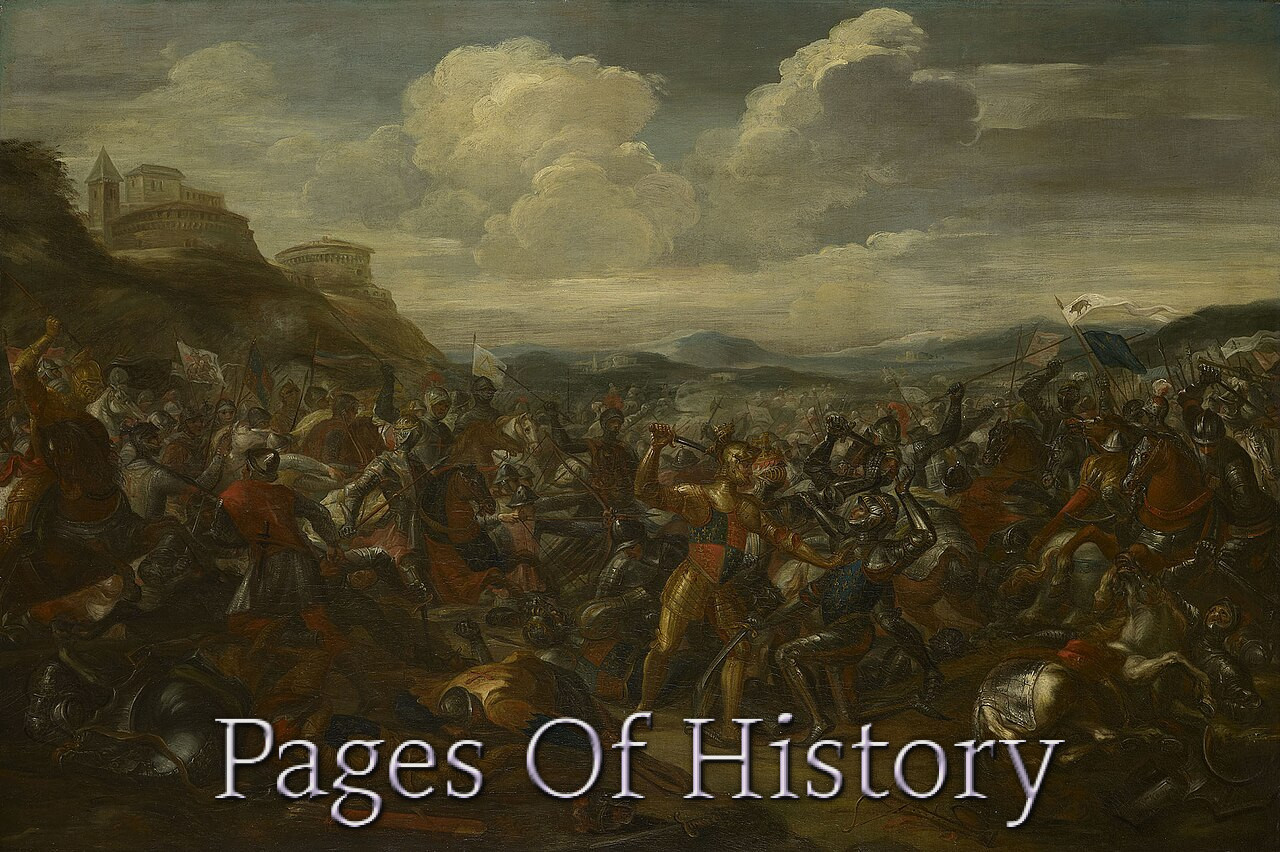
The battle opened in the late morning with a French cavalry charge on the English flanks, intended to ride down the archers. It failed catastrophically. The ground, churned by days of rain and the passage of thousands of men and horses, was a bog. The French cavalry struggled to gain speed, took heavy losses from arrow fire, and was driven back in confusion, some of the horsemen crashing into their own advancing infantry.
The French main body then advanced on foot, thousands of heavily armored men-at-arms crammed together in a narrowing field. They were exhausted before they reached the English line—the mud clinging to their armor, the arrows falling among them, the press of bodies behind preventing any retreat. When the French vanguard finally struck the English men-at-arms, the fighting became a brutal shoving match at close quarters. The English, lighter and fresher, and supported by archers who dropped their bows and attacked the flanks of the French formation with axes, hammers, and swords, began to overwhelm the French front line.
As the French vanguard collapsed, the second French division advanced and was drawn into the same slaughter, while the third division, seeing the disaster unfold, largely failed to engage. Thousands of Frenchmen were killed or captured. The English had won.
Why Did the French Lose So Catastrophically?
The scale of the French defeat demands explanation. Several factors combined:
– Terrain and weather: The narrow, muddy field negated French numerical superiority and slowed their heavy cavalry and infantry to a crawl.
– Tactical rigidity: The French committed to a frontal assault without coordination between the mounted wings and the infantry center, allowing the English to defeat them piecemeal.
– The longbow: English archers, firing at close range into dense packed formations, inflicted devastating casualties and disrupted the French advance.
– Leadership and discipline: Henry V led from the front and maintained control of his army; the French command was divided by factional rivalries and aristocratic competition.
– The stakes of capture: For the French nobility, capture meant ransom rather than death, encouraging surrender; for the English, surrounded and far from home, surrender meant annihilation, which stiffened their resolve.
What Happened After the Battle?
The immediate aftermath was grim. Henry ordered the killing of French prisoners when a French attack on the English baggage train suggested the battle might be renewed—an act that shocked even contemporary observers and remains one of the darkest episodes of the campaign. Estimates of French dead range from 3,000 to 10,000, including a large number of the highest nobility of France: the Duke of Alençon, the Duke of Brabant, the Constable of France Charles d’Albret, and the Duke of Bar were among the slain. The English losses were comparatively light, perhaps a few hundred men.
Henry returned to England in triumph in November 1415, and the victory at Agincourt transformed his political position. It gave him the prestige and bargaining power to press his claim to the French throne, and in 1420 the Treaty of Troyes recognized him as heir to Charles VI and regent of France, with his marriage to Catherine of Valois sealing the agreement. For a brief moment, it seemed that the crowns of England and France would be united under a single ruler.
The Table of Key Facts
| Fact | Detail |
|---|---|
| Date | 25 October 1415 (St Crispin’s Day) |
| Location | Near Azincourt, Pas-de-Calais, northern France |
| English commander | King Henry V |
| French commander | Charles d’Albret, Constable of France (killed) |
| English strength | Approximately 6,000–9,000 men, mostly longbowmen |
| French strength | Approximately 12,000–30,000 men (estimates vary widely) |
| Outcome | Decisive English victory; heavy French casualties |
What Was the Lasting Legacy of Agincourt?
The Battle of Agincourt’s immediate political consequences were enormous, but its long-term legacy is more complicated. The English conquest of France that followed Agincourt proved fragile. Henry V died of dysentery in 1422 at the age of 35, leaving an infant son, Henry VI, as king. The French, galvanized by Joan of Arc, began to reverse English gains from 1429 onward, and by 1453 the English had lost almost all their continental possessions except Calais. The Hundred Years’ War ended in French victory.
Militarily, Agincourt became a legend—a demonstration of what disciplined infantry and the longbow could achieve against aristocratic cavalry. It was celebrated in English chronicles and later in Shakespeare’s *Henry V*, which gave the world the St Crispin’s Day speech and cemented the battle’s place in the English national imagination. Yet historians have increasingly emphasized that Agincourt was not a victory of technology over chivalry in any simple sense: the longbow was effective, but so were the terrain, the weather, French disunity, and Henry’s leadership.
The battle also left a darker legacy. The killing of prisoners and the sheer scale of the French nobility’s destruction weakened the French aristocracy for a generation. And the English victory, however spectacular, ultimately proved a strategic dead end: it bought Henry a claim to a throne he would never fully hold and set the stage for decades of costly warfare that drained England’s treasury and ended in defeat.
Why Does the Battle of Agincourt Still Matter?
The Battle of Agincourt endures because it dramatizes a question that has fascinated military historians for centuries: how do smaller, disciplined forces defeat larger ones? The answer, as Agincourt shows, is rarely a single factor. It was the longbow, but also the mud; it was Henry’s leadership, but also French factionalism; it was English desperation, but also French overconfidence.
The battle also matters as a case study in the limits of military victory. Henry V won one of the most complete battlefield triumphs in medieval history, yet the political settlement it produced collapsed within a generation. Agincourt reminds us that battles are not wars, and that the strategic consequences of a victory depend on what happens afterward—on leadership, resources, alliances, and time. For students of history, the Battle of Agincourt remains a vivid, brutal, and endlessly instructive episode: a moment when the odds were defied, the impossible happened, and the consequences echoed across a century of European conflict.