
📅 Last updated: 31.10.2026
The Knights Templar fall was not the result of a single scandal or battlefield defeat but a calculated destruction engineered by King Philip IV of France and executed through a compliant papacy, driven by money, debt, and the political vulnerability of an order that had outlived its original purpose. Founded around 1119 to protect pilgrims in the Holy Land, the Templars grew into Christendom’s wealthiest military-religious institution before being dismantled between 1307 and 1312.
The Knights Templar were destroyed primarily because King Philip IV of France, deeply indebted to the order and desperate for cash, orchestrated their arrest on October 13, 1307, on fabricated charges of heresy. Pope Clement V, politically dependent on Philip and residing in Avignon, dissolved the order at the Council of Vienne in 1312. The last Grand Master, Jacques de Molay, was burned at the stake in Paris on March 18, 1314.
- What Was the Knights Templar, and Why Did It Become So Powerful?
- How Did the Loss of the Holy Land Undermine the Order?
- Why Did King Philip IV Target the Templars?
- The Arrests of October 13, 1307: A Coordinated Strike
- How Did Pope Clement V Respond to the Crisis?
- What Happened to Jacques de Molay and the Last Templars?
- Why Did the Knights Templar Fall? Weighing the Causes
- How Did the Knights Templar Fall Reshape Medieval Europe?
- What Does the Knights Templar Fall Teach Us About Power and Memory?
What Was the Knights Templar, and Why Did It Become So Powerful?
The Poor Fellow-Soldiers of Christ and of the Temple of Solomon began as a small band of knights, led by Hugues de Payens, sworn to protect pilgrims on the roads between the port of Jaffa and Jerusalem. In 1129, the Council of Troyes granted them a formal rule, largely shaped by Bernard of Clairvaux, whose treatise *De Laude Novae Militiae* (“In Praise of the New Knighthood”) gave the order intellectual and spiritual legitimacy. Papal bulls—most crucially *Omne Datum Optimum* (1139)—exempted the Templars from local ecclesiastical authority, allowed them to keep spoils, and placed them directly under the pope.
That autonomy proved a double-edged sword. The order built a Europe-wide network of commanderies and became medieval Europe’s closest thing to a banking system. Pilgrims deposited funds in Paris and withdrew them in Acre using letters of credit. Kings borrowed from the Templars: Philip IV himself sought refuge with them during the Paris riots of 1306, and the order held vast deposits and loans. By the early 1300s, the Templars owned thousands of estates, commanded fleets, and answered to no bishop. Their wealth was visible, their privileges resented, and their original mission—defending the crusader states—had collapsed with the fall of Acre in 1291.
How Did the Loss of the Holy Land Undermine the Order?
The Templars’ raison d’être evaporated with the final expulsion of the crusaders from the Levant. After the Siege of Acre in 1291, the order relocated its headquarters to Cyprus and then, effectively, to Paris, where it became a wealthy landowner and financier rather than a fighting force on the frontier. This created a legitimacy problem. Critics asked why an order founded to guard the Holy Sepulchre maintained such wealth and privilege when there was no Holy Land to defend.
The late 13th and early 14th centuries also saw a broader crisis of the crusading ideal. The fall of Tripoli (1289) and Acre (1291) shattered confidence. Calls for reform of the military orders—sometimes proposals to merge the Templars and Hospitallers—circulated at the highest levels. The Templars were not uniquely corrupt; the Hospitallers faced similar critiques. But the Templars were the richest and most visible target, and their lack of a clear territorial mission made them politically expendable.
Why Did King Philip IV Target the Templars?
Philip IV “the Fair” (r. 1285–1314) was a centralizing monarch locked in conflict with the papacy and perpetually short of money. His wars against England and Flanders, especially the costly Battle of the Golden Spurs at Courtrai (1302), drained the treasury. He had already attacked two vulnerable wealthy groups: he expelled the Jews from France in 1306 and seized their property, and he had clashed with Pope Boniface VIII, culminating in the outrageous Anagni incident of 1303, when Philip’s agents physically assaulted the pope.
The Templars were the next logical target. Philip owed them substantial sums, and their treasury in Paris was legendary. Arresting the order would simultaneously erase his debts and fill his coffers. The charges he manufactured—denial of Christ, spitting on the cross, obscene kisses during initiation, idol worship, and sodomy—were stock accusations of heresy that resonated with a medieval public primed to believe the worst of secretive elites.
The Role of Esquieu de Floyran
A key catalyst was Esquieu de Floyran, a former Templar from Béziers with a grudge, who brought accusations of heresy to Philip’s officials around 1305. Whether Esquieu fabricated the charges or repeated rumors, his testimony gave Philip the pretext he needed. Philip forwarded the allegations to Pope Clement V, pressuring him to act. Clement, a Frenchman elected in 1305 and effectively resident in France, hesitated—he had once been favorable to the order—but he was no match for Philip’s ruthlessness.
The Arrests of October 13, 1307: A Coordinated Strike
On Friday, October 13, 1307—a date sometimes romantically linked to the later superstition about Friday the 13th—Philip’s officers executed a synchronized raid across France. Jacques de Molay, the Grand Master, was seized in Paris along with dozens of senior brothers. The operation was swift and secret, catching the order entirely off guard. Philip’s propaganda machine followed immediately: royal agents spread the charges, and confessions were extracted under torture by the inquisitor Guillaume de Paris and the king’s ministers.
Under torture, many Templars confessed to the fabricated charges. Some recanted as soon as the torture stopped. The confessions, however extracted, were broadcast as proof of guilt. Philip wrote to other European rulers urging them to arrest Templars in their domains. Responses varied sharply: England’s Edward II initially disbelieved the charges, and in the Kingdom of Aragon, James II resisted. But papal pressure and the weight of French power eventually forced most rulers to comply, though outside France the evidence was generally found wanting.
How Did Pope Clement V Respond to the Crisis?
Clement V found himself trapped between a king who had already demonstrated he would assault a pope and an order that was technically answerable only to the papacy. Initially, Clement protested the arrests as a violation of ecclesiastical jurisdiction and suspended the French proceedings. But Philip escalated: in 1308, he convened the Estates-General at Tours to endorse the charges and threatened to try the Templars as heretics in a secular court—a move that would have destroyed papal authority over the case.
Clement capitulated. He agreed to a papal inquiry, and in 1308 he issued the bull *Faciens misericordiam*, opening proceedings against the order. In 1310, at the Cathedral of Paris, dozens of Templars who had recanted their confessions were declared relapsed heretics and burned at the stake—a brutal warning to those who resisted. The papal commission, however, struggled to find consistent evidence. Outside France, investigations in England, Aragon, and Cyprus largely failed to substantiate the charges.
The Council of Vienne and the Bull Vox in Excelso
The matter came to a head at the Council of Vienne (1311–1312). Clement had hoped to judge the order fairly, but Philip arrived with an army and demanded its suppression. On March 22, 1312, Clement issued the bull *Vox in Excelso*, dissolving the Templars not by a formal condemnation of heresy—which the evidence did not support—but “by way of provision or apostolic ordinance,” citing the order’s scandal, the danger to the faith, and the impossibility of restoring its reputation. The order’s property was transferred to the Hospitallers by the bull *Ad Providam* (May 1312), though Philip extracted a large share of the proceeds to cover his “expenses.”
What Happened to Jacques de Molay and the Last Templars?
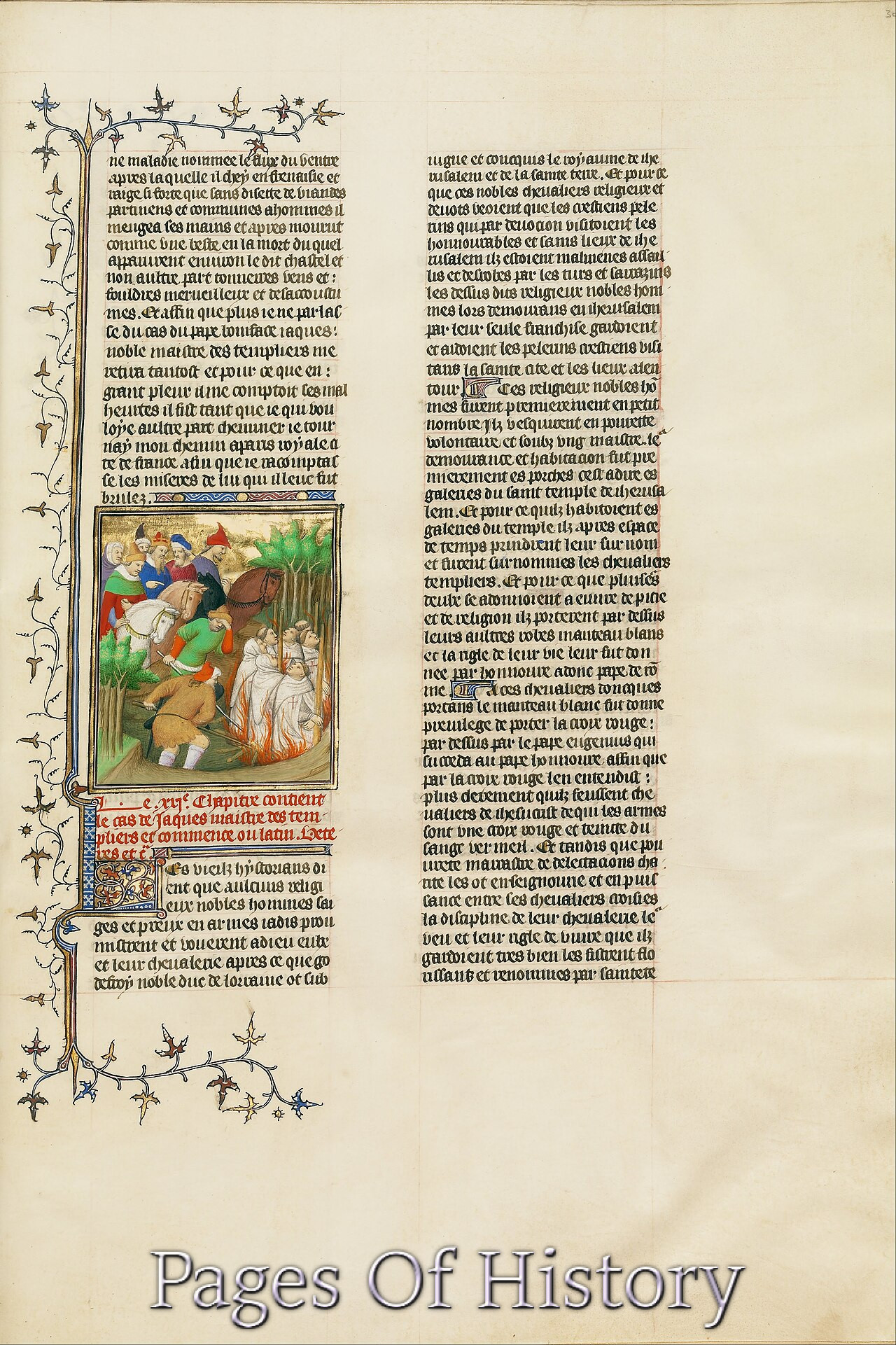
Jacques de Molay and the Preceptor of Normandy, Geoffroy de Charney, had confessed under torture in 1307 but later recanted. In March 1314, they were brought before a commission in Paris, set on a scaffold to hear their sentence—perpetual imprisonment. Instead, de Molay proclaimed the order’s innocence and his own, declaring the charges false and the confessions extracted by torture. Philip, furious at this public defiance, ordered them burned that same day. On March 18, 1314, de Molay and de Charney were burned on a small island in the Seine, the Île aux Juifs, near the royal palace.
Legend holds that de Molay cursed Philip and Clement from the flames, summoning them before God within a year. Both died in 1314—Clement on April 20, Philip on November 29. The coincidence fueled the myth of the Templar curse. The surviving Templars were pensioned off, absorbed into the Hospitallers, or faded into obscurity. The order was gone.
Why Did the Knights Templar Fall? Weighing the Causes
The destruction of the Templars was overdetermined—multiple forces converged. Historians continue to debate the balance among them, but several factors stand out.
- Financial predation: Philip IV’s debts and the lure of Templar wealth made the order a target. The seizure of assets and cancellation of debts were immediate material gains.
- Political weakness of the papacy: Clement V’s dependence on the French crown, following the humiliation of Boniface VIII at Anagni, meant the pope could not shield the order.
- Loss of mission: With the Holy Land lost after 1291, the Templars lacked a clear purpose, making them seem a privileged anachronism.
- Fabricated but credible charges: Heresy accusations, amplified by torture-confessions and royal propaganda, created a public spectacle that made acquittal politically impossible.
- Institutional secrecy: The order’s private initiation rites, unknown to outsiders, lent plausibility to lurid accusations.
The charges themselves were almost certainly false. Modern scholarship—notably the work of Malcolm Barber and the 2007 Vatican publication of the Chinon Parchment—has shown that Clement V had actually absolved de Molay and other leaders of heresy in 1308, a fact suppressed in the public narrative. The order was destroyed for reasons of state and money, not genuine heresy.
How Did the Knights Templar Fall Reshape Medieval Europe?
The suppression had consequences far beyond the order’s demise. It demonstrated the terrifying power of a determined monarch over the Church, foreshadowing the nationalization of ecclesiastical wealth during the Reformation two centuries later. It also weakened the papacy’s moral authority; a pope who dissolved a crusading order on a king’s orders could not easily claim spiritual supremacy. The transfer of Templar assets to the Hospitallers (later the Knights of Malta) enriched that rival order and shaped the later history of the military orders.
The Templars’ fall also fed a rich vein of myth. From the 18th century onward, Freemasons and later conspiracy theorists claimed descent from the order, and novels like Walter Scott’s *Ivanhoe* (1819) and, much later, Dan Brown’s *The Da Vinci Code* (2003) cemented the Templars as keepers of secret knowledge. These legends have no historical basis, but they testify to the enduring fascination with the order’s dramatic end.
| Date | Event | Significance |
|---|---|---|
| c. 1119 | Founding of the Templars by Hugues de Payens | Origins as pilgrim protectors in Jerusalem |
| 1139 | Papal bull Omne Datum Optimum | Exemption from local authority; direct papal protection |
| 1291 | Fall of Acre | Loss of the Holy Land; crisis of the crusading mission |
| Oct 13, 1307 | Mass arrests in France | Philip IV’s coordinated strike; torture confessions |
| 1312 | Council of Vienne; bull Vox in Excelso | Formal dissolution of the order |
| Mar 18, 1314 | Execution of Jacques de Molay | End of the order’s leadership; birth of the curse legend |
What Does the Knights Templar Fall Teach Us About Power and Memory?
The Templars’ destruction is a case study in how institutional vulnerability, when combined with a ruthless political actor and a compromised spiritual authority, can annihilate even the most privileged organization. The order was not destroyed by its enemies in battle but by a king who needed its money and a pope who could not refuse him. The charges were instruments, not causes.
For historians, the episode is a reminder to read confessions extracted under torture with extreme skepticism and to distinguish between legal verdicts and historical truth. The 2007 rediscovery of the Chinon Parchment, which recorded Clement’s absolution of the Templar leaders, vindicated what scholars had long suspected: the order was innocent of the heresy charges that justified its suppression.
The Knights Templar fall endures as a story about the fragility of privilege, the power of propaganda, and the way myths outlive facts. The order’s white mantles and red crosses vanished from Europe’s battlefields, but their legend—part cautionary tale, part romantic fantasy—has never faded. What remains is a sobering lesson: institutions that lose their purpose and their protectors can be erased by those who covet what they hold.