
📅 Last updated: 29.10.2026
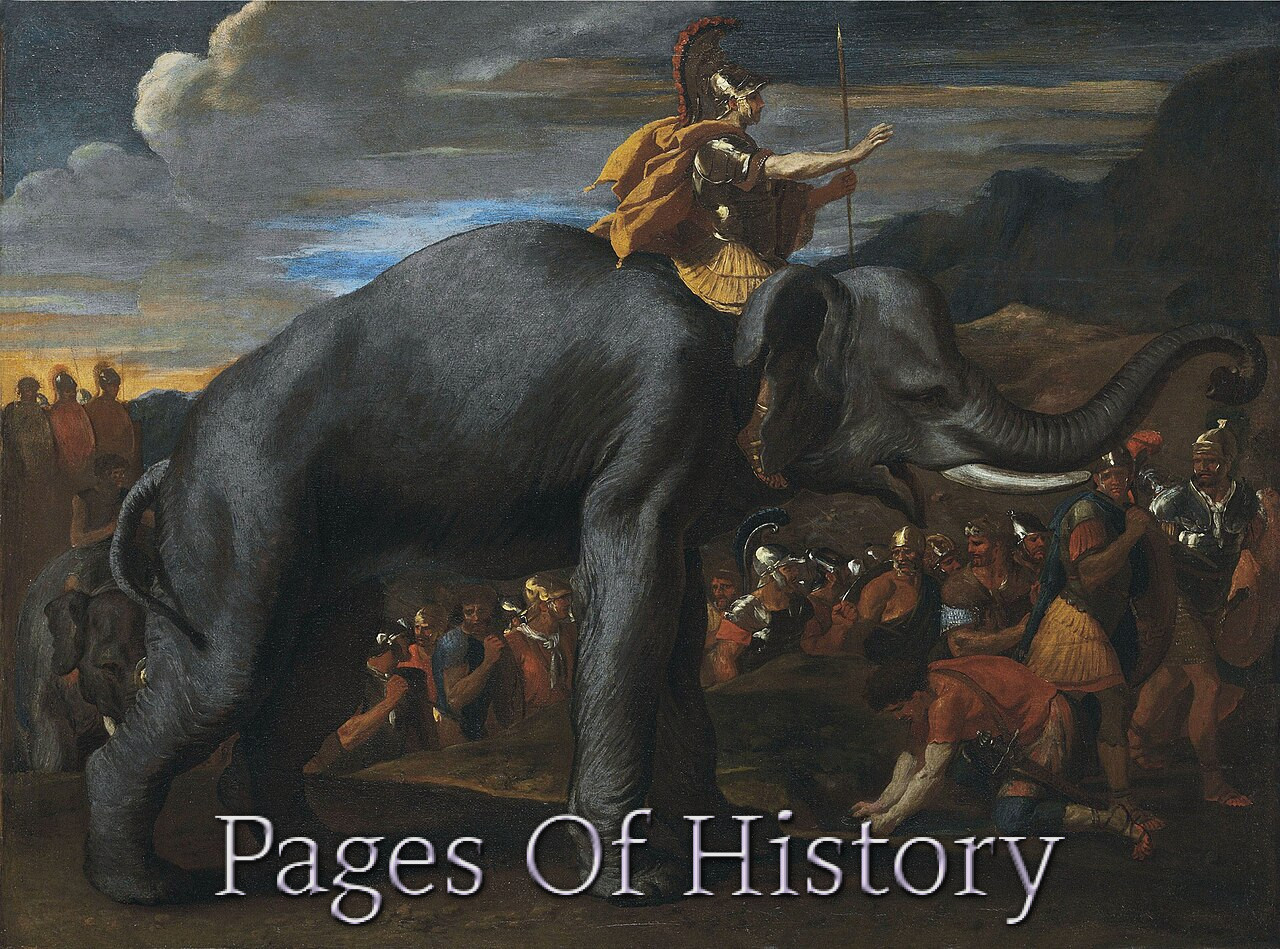
Hannibal crossing the Alps in 218 BCE remains one of the most audacious military maneuvers in recorded history—a Carthaginian army of roughly 50,000 men, 9,000 cavalry, and about 37 war elephants hauling itself over snowbound mountain passes to strike Rome from the north. The feat stunned the ancient world and still shapes how strategists think about surprise, logistics, and the limits of the possible.
In the spring of 218 BCE, Hannibal Barca marched from New Carthage in Spain with an army of roughly 50,000 infantry, 9,000 cavalry, and about 37 elephants. After crossing the Pyrenees and the Rhône, he took his force over the Alps in approximately 15 days in late autumn, losing nearly half his men and most of his elephants to cold, ambush, and mountain terrain. He then defeated Rome at the Trebia, Lake Trasimene, and Cannae—but without siege equipment or reinforcements, he could not take the city itself.
- Why Did Hannibal March on Italy at All?
- What Was the Route of Hannibal Crossing the Alps?
- How Did the Elephants Actually Get Over the Mountains?
- How Long Did Hannibal Crossing the Alps Take, and What Did It Cost?
- What Happened After Hannibal Crossing the Alps?
- Why Did the Elephants Matter—and Why Didn't They?
- What Did Ancient Writers Say About Hannibal Crossing the Alps?
- Why Does Hannibal Crossing the Alps Still Matter?
- The Lasting Perspective: Audacity, Logistics, and the Limits of Genius
Why Did Hannibal March on Italy at All?
The Second Punic War (218–201 BCE) grew out of the unfinished business of the First. After Carthage’s defeat in 241 BCE, Rome had stripped her of Sicily and later, under pressure, of Sardinia and Corsica. Carthage compensated by building a new empire in Iberia under the Barcid family—Hamilcar, then his son-in-law Hasdrubal, then Hannibal himself, who took command in 221 BCE at about 26 years old.
Rome watched the Barcid expansion with alarm and struck an alliance with Saguntum, a city south of the Ebro River that Carthage regarded as within its sphere. In 219 BCE Hannibal besieged and destroyed Saguntum. Rome demanded his surrender; Carthage refused, and war was declared.
Hannibal’s strategic logic was sound. Rome could draw on vast Italian manpower and command the sea. Carthage could not win a war of attrition in Italy or a naval contest in the western Mediterranean. The one path to victory was to fight Rome on Italian soil, break up its confederation of allies, and force the city to terms. That required moving the war from Spain to Italy—and the only viable route was overland, through southern Gaul and across the Alps. A sea crossing was impractical: Rome’s fleets controlled the routes, and Carthage had no secure Italian port to receive an army.
What Was the Route of Hannibal Crossing the Alps?
Hannibal left New Carthage in the spring of 218 BCE. His route ran north along the Iberian coast, through the Pyrenees, across southern Gaul to the Rhône near modern Avignon, and then northeast into the Alps. Polybius, who interviewed survivors and inspected the terrain himself, and Livy, writing later and more rhetorically, both describe the march in detail—though they disagree on specifics, and scholars still argue over which pass Hannibal used.
The Candidates: Little St Bernard, Mont Cenis, Montgenèvre, and Others
The debate has run for centuries. The strongest candidates are:
- Col de la Traversette (near Mont Viso): Favored by many modern scholars, including those who point to a 2016 sediment study that found unusual microbial evidence consistent with large numbers of animals and men passing through around the right period. It is high and difficult—arguably too difficult for elephants—which cuts both ways.
- Col du Mont Cenis: The traditional favorite because its descent leads toward the territory of the Taurini, whom Hannibal attacked shortly after arriving in Italy, and because Polybius describes a visible plain from the summit.
- Col de Montgenèvre: A lower, easier pass used by later armies; some historians favor it on logistical grounds.
- Little St Bernard: Popular with older scholarship, though it lies further north and fits the narrative of hostile tribes less neatly.
The honest answer is that the evidence is circumstantial. Polybius mentions a pass that is “very steep and precipitous” and near a white-rock summit—details that fit more than one candidate. What is not in dispute is the scale of the achievement: an army with pack animals and elephants climbing into the high Alps in autumn, with hostile Gauls controlling the heights.
How Did the Elephants Actually Get Over the Mountains?
The elephants were North African forest elephants—smaller than the Indian or savanna varieties, perhaps 2.5 meters at the shoulder. They were not the towering beasts of popular imagination, which is precisely why they could manage narrow mountain tracks. Hannibal deployed about 37 of them, according to Polybius; Livy gives a similar figure. They carried supplies, served as mobile platforms for archers and javelin throwers, and above all functioned as psychological weapons—horses unaccustomed to their scent panicked and bolted.
Logistics: Feeding an Army and Its Animals
The march was a logistical nightmare. An elephant consumes enormous quantities of fodder and water daily; so do thousands of horses and pack mules. Hannibal’s column moved through terrain where forage was scarce and where local tribes could deny him supplies. The army carried grain, drove cattle, and seized what it could. Polybius records that the men suffered from cold, hunger, and the hostility of the mountain peoples, and that the descent was more deadly than the climb.
Elephants were also vulnerable in ways the sources emphasize. They could not tolerate extreme cold well, and their feet were poorly suited to ice and loose rock. Some animals slipped from narrow paths; others died of exposure. By the time Hannibal reached the Po Valley, he had lost most of his elephants—Polybius implies only a handful survived, and Livy says one, the last, carried Hannibal himself across a swamp during the march to Etruria in 217 BCE.
How Long Did Hannibal Crossing the Alps Take, and What Did It Cost?
Polybius states that the crossing of the Alps took 15 days. The army that descended into Italy was a shadow of the one that had left Spain. According to Polybius, Hannibal arrived with about 20,000 infantry and 6,000 cavalry—roughly half his starting force. Livy’s figures differ, but the theme is consistent: the mountains exacted a brutal toll.
| Stage | Date (218 BCE) | Approximate Strength | Key Event |
|---|---|---|---|
| Departure from New Carthage | Spring | ~50,000 infantry, 9,000 cavalry, ~37 elephants | Army assembled and marched north |
| Crossing the Pyrenees | Summer | Reduced by garrisons left behind | Hannibal secures his rear in Spain |
| Crossing the Rhône | Late summer/early autumn | ~38,000 infantry, 8,000 cavalry | Defeats a Gallic force; elephants ferried across on rafts |
| Ascent of the Alps | Autumn | ~38,000 plus elephants | Fights hostile tribes; ambush in a narrow defile |
| Descent into Italy | Late autumn | ~20,000 infantry, 6,000 cavalry, few elephants | Reaches the Po Valley; defeats the Taurini |
The Ambush and the Rockfall
Polybius describes a critical moment on the ascent: local tribesmen, having offered hostages and guides, ambushed the column in a narrow gorge. Hannibal’s baggage train and cavalry were thrown into confusion. He responded by seizing the high ground above the ambush and driving the attackers off, but the delay cost him men and animals. A second crisis came on the descent, when a landslide blocked the path. Hannibal had the rock heated with fire and doused with vinegar—or so the tradition goes—to crack it, then hacked a passage through. The story may be embellished, but the engineering problem was real: the army had to widen a track for elephants and pack animals to pass.
What Happened After Hannibal Crossing the Alps?
Hannibal descended into the Po Valley and immediately attacked the Taurini, a tribe hostile to Carthage, capturing their chief town. He then defeated a Roman force under Publius Cornelius Scipio at the Ticinus River, and a larger army under Tiberius Sempronius Longus at the Trebia in December 218 BCE. The following spring, he ambushed and destroyed a Roman army at Lake Trasimene, killing or capturing perhaps 15,000 men. In 216 BCE came Cannae, where Hannibal’s double envelopment annihilated a Roman force of perhaps 50,000–70,000—one of the worst defeats in Roman history.
Yet Rome did not collapse. The confederation held. Hannibal lacked the siege equipment and reinforcements to take the city, and his brother Hasdrubal’s attempt to bring an army from Spain ended in defeat and death at the Metaurus in 207 BCE. Hannibal was finally recalled to Africa and defeated by Scipio Africanus at Zama in 202 BCE, ending the war.
Why Did the Elephants Matter—and Why Didn’t They?
The elephants were a tactical asset and a strategic failure. They terrified horses and infantry unfamiliar with them, and at the Trebia and elsewhere they contributed to Roman panic. But they were few in number, hard to replace, and vulnerable to cold and to the tactics Romans eventually developed—opening lanes to let the animals pass, then attacking them from the flanks and driving them back on their own lines, as at Zama.
- Psychological impact: Elephants were unfamiliar to most Romans and could break cavalry and light infantry formations.
- Logistical burden: Feeding and moving elephants consumed resources that a mountain campaign could not spare.
- Fragility: Cold, disease, and injury killed them faster than battle did.
- Diminishing returns: Once Romans learned countermeasures, elephants became a liability as often as an asset.
What Did Ancient Writers Say About Hannibal Crossing the Alps?
Polybius, writing in the second century BCE, is the more reliable source. He questioned survivors, walked part of the route, and criticized earlier writers for exaggerating. Livy, writing around the turn of the first century CE, dramatizes the crossing with speeches, omens, and vivid detail—useful for atmosphere, less so for precise fact. Both agree on the essentials: the scale of the army, the hostility of the mountain tribes, the losses, and the descent into Italy.
Polybius records Hannibal’s speech to his men before the ascent, in which he pointed to the Alps as the wall of Italy and promised that once crossed, the war would be fought on Roman soil. Whether or not the speech is authentic, it captures the strategic logic: the mountains were the obstacle between Carthage and its only realistic path to victory.
Why Does Hannibal Crossing the Alps Still Matter?
Hannibal’s march is studied today as a case study in strategic audacity and its limits. It demonstrated that a determined commander could move a large army through terrain considered impassable, achieving complete strategic surprise. It also demonstrated the cost: an army that arrived in Italy was too weak to finish the job, and without reinforcements or siege capability, tactical brilliance could not translate into strategic victory.
The crossing also left a cultural legacy. It became a byword for impossible ambition—”Hannibal ad portas” (“Hannibal at the gates”) was a Roman cry of alarm that echoed for centuries. Military academies still analyze the logistics of the march; historians still argue over the pass; and the image of elephants in the snow endures as one of antiquity’s most striking scenes.
The Lasting Perspective: Audacity, Logistics, and the Limits of Genius
Hannibal crossing the Alps was not a stunt but a calculated gamble by a commander who understood that Rome could only be beaten on Italian soil. He was right about the strategy and wrong about the resources. The crossing cost him half his army and most of his elephants, and the reinforcements he needed never arrived in sufficient strength. His victories at the Trebia, Trasimene, and Cannae were among the most devastating in military history, yet they did not break the Roman confederation—the political structure that was Rome’s real source of strength.
The lesson is not that the crossing was a mistake. It was the only move that offered a chance of victory, and it came closer to success than Rome ever liked to admit. The lesson is that audacity without logistics and without a plan to convert battlefield victory into political settlement has limits. Hannibal crossed the Alps, shattered Roman armies, and still lost the war—a reminder that in strategy, the boldest move is only as good as the resources and alliances that sustain it.