
📅 Last updated: 20.10.2026
The Knights Templar arrest of Friday, 13 October 1307, remains one of the most dramatic and consequential mass detentions in medieval European history — a single coordinated dawn raid that shattered the wealthiest military order in Christendom within a matter of hours. Ordered by King Philip IV of France and executed by his royal officials with the cooperation of the Inquisition, the operation netted thousands of knights, sergeants, and servants across the kingdom in one stroke. What followed — confessions extracted under torture, a papal dissolution, and the burning of the order’s last Grand Master — reshaped the relationship between crown and papacy and gave the world the enduring legend of the “cursed” Templars.
The Knights Templar were arrested on 13 October 1307 by order of King Philip IV of France, who accused them of heresy, blasphemy, and moral corruption to seize their wealth and eliminate a powerful debt-holder. The arrests were coordinated with Pope Clement V’s inquisitors, though the pope initially protested; under sustained royal pressure, he suppressed the order in 1312, and Grand Master Jacques de Molay was burned at the stake in 1314.
- What Was the Knights Templar Arrest, and Why Did It Happen So Suddenly?
- The Charges: Heresy, Blasphemy, and the Machinery of Confession
- How Did the Knights Templar Arrest Unfold Across Europe?
- Pope Clement V and the Struggle Over the Order's Fate
- The Final Act: Jacques de Molay and the Curse of 1314
- Why Did the Knights Templar Arrest Succeed Where the Order's Defenders Failed?
- Key Timeline of the Knights Templar Arrest and Aftermath
- What Really Motivated the Arrests? Evidence and Interpretation
- The Lasting Legacy of the Knights Templar Arrest
- Why the Knights Templar Arrest Still Matters
What Was the Knights Templar Arrest, and Why Did It Happen So Suddenly?
The speed of the operation was its defining feature. Philip IV’s orders, sealed on 14 September 1307 and distributed to his seneschals and baillis across France, instructed royal officers to seize every Templar in the kingdom at dawn on Friday, 13 October, and to hold them for interrogation by the Dominican inquisitors working alongside the crown. The secrecy was near-total: even Pope Clement V, then at Poitiers, appears to have been informed only days beforehand and did not grasp the scale of what was planned.
Why the Templars? The order had been founded around 1119 by Hugues de Payens and eight companions to protect pilgrims on the roads to Jerusalem, and it had grown into a transcontinental institution — banker to kings, landlord of thousands of estates, and a standing military force in the Levant. But by 1307 the Crusader states had collapsed: Acre fell in 1291, and the Templars had withdrawn to Cyprus and their European commanderies. Their original mission had evaporated, and their enormous wealth and privileges made them vulnerable to a king who was both deeply in debt to them and chronically short of cash.
Philip IV, known to history as Philip the Fair, had already clashed with Pope Boniface VIII at Anagni in 1303 and had destroyed the wealthy Order of the Temple’s rival, the Knights Hospitaller’s political independence, through pressure. His treasury was strained by war with England and Flanders. The Templars were, in effect, his bankers — and his creditors. The arrest was not a spontaneous act of piety but a calculated fiscal and political strike.
The Charges: Heresy, Blasphemy, and the Machinery of Confession
The indictment against the Templars was lurid and precise. Royal officials and inquisitors alleged that on admission to the order, new brothers denied Christ and spat upon the cross; that they worshipped a mysterious idol (often described as a head, sometimes called “Baphomet”); that they engaged in obscene kisses during reception ceremonies; that they practiced sodomy; and that priests of the order omitted the words of consecration during Mass. These charges were crafted to fit the legal category of heresy, which placed the accused under inquisitorial jurisdiction rather than ordinary royal courts.
Torture and the Production of Evidence
The royal letters of 1307 explicitly authorized the use of torture to obtain confessions, a practice that had only recently been reintroduced into French legal procedure. Under the supervision of inquisitors such as Guillaume de Paris and the king’s ministers — most notably Guillaume de Nogaret, the architect of the Anagni attack on Boniface VIII — Templars were subjected to the strappado, the rack, and starvation. Confessions came quickly and in formulaic language, often mirroring the charges word for word. Jacques de Molay himself confessed on 24 October 1307 to denying Christ and spitting on the cross, though he later retracted, claiming the confession was extracted by torture and fear of death.
Historians have debated the charges ever since. Most modern scholars, including Malcolm Barber and Helen Nicholson, regard the core accusations as fabricated or grotesquely distorted, though some elements — such as idiosyncratic reception rituals or crude horseplay — may have had a kernel of truth that inquisitors inflated into heresy. The uniformity of the confessions across hundreds of prisoners, and their exact correspondence to the royal indictment, strongly suggests coercion rather than genuine discovery.
How Did the Knights Templar Arrest Unfold Across Europe?
The French arrests were only the first wave. Philip IV immediately wrote to other European rulers urging them to follow suit, and the response varied sharply by kingdom. This patchwork of compliance and resistance is one of the most revealing aspects of the affair, because it shows how differently secular rulers weighed papal authority, royal pressure, and the Templars’ local standing.
- France: Mass arrests on 13 October 1307; thousands detained, with confessions obtained under torture. Philip IV seized the order’s treasury and estates.
- England: Edward II initially refused, writing to Philip and to the pope in defense of the Templars’ orthodoxy. Under papal pressure, arrests began in January 1308, but torture was largely avoided and most English Templars were eventually released or pensioned.
- Aragon and Castile: James II of Aragon resisted for months, then complied; local councils found the charges unproven, and many Templars were acquitted or absorbed into other orders.
- Portugal: King Denis refused to dissolve the order outright, instead reconstituting its members and property as the Order of Christ in 1319 — a body that later funded Portuguese exploration.
- Germany and Cyprus: Trials produced mostly acquittals; the German councils rejected the charges as unproven, and the Cypriot proceedings were inconclusive.
The contrast matters. Where royal power was weak or the Templars were well integrated into local society, the charges collapsed. Where a strong king had a fiscal motive, the order was destroyed. The Knights Templar arrest was thus less a unified papal crusade against heresy than a series of national political operations dressed in canonical language.
Pope Clement V and the Struggle Over the Order’s Fate
Clement V, a Frenchman elected in 1305 with Philip’s backing, found himself trapped between the king’s determination and the Church’s legal procedures. On 22 November 1307, he issued the bull Pastoralis praeeminentiae, ordering all Christian rulers to arrest the Templars and sequester their property — a concession that effectively endorsed the French action while asserting papal control. But Clement also suspended the French proceedings in early 1308 and demanded that the accused be handed over to the Church, provoking a dangerous standoff with Philip.
The compromise came at Poitiers in the summer of 1308, when the pope agreed to a papal commission that would investigate the order as a whole rather than individual brothers, and to allow royal custody to continue. The papal commission opened in Paris in August 1309, but its proceedings were repeatedly disrupted by royal interference and by the refusal of many Templars to testify. In 1310, fifty-four Templars who had retracted their confessions and defended the order were burned at the stake outside Paris — a brutal signal that recantation meant death.
The Council of Vienne and the Suppression
At the Council of Vienne in 1311–1312, Clement V formally dissolved the Order of the Temple. The bull Vox in excelso, issued on 22 March 1312, suppressed the order “not by definitive sentence, but by apostolic provision,” acknowledging that the charges had not been legally proven against the order as a corporate body. The follow-up bull Ad providam (May 1312) transferred most Templar property to the Knights Hospitaller — a decision that enraged Philip IV, who had expected to keep the assets.
The Final Act: Jacques de Molay and the Curse of 1314
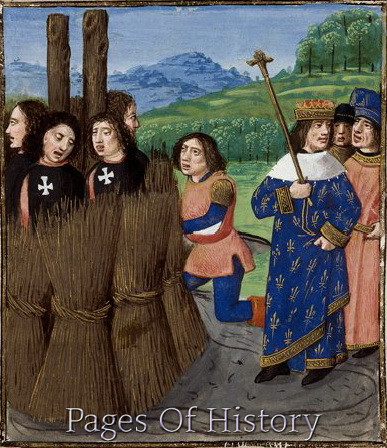
The order’s leaders — Grand Master Jacques de Molay, Geoffrey de Charney, and others — had been held in royal custody since 1307. In March 1314, a papal commission convened in Paris to pronounce final sentence. At the climax, de Molay and de Charney publicly retracted their confessions, declaring the order innocent and the charges false. Philip IV, furious at the defiance, ordered them burned that same day on the Île de la Cité in Paris.
According to the chronicler Geoffroi de Paris, de Molay’s last words summoned his accusers before the judgment of God: he declared that Philip and Clement would both die within a year. Both did — Clement V died on 20 April 1314, and Philip IV on 29 November 1314. The coincidence, whether or not the curse was actually spoken, became the seed of the “Curse of the Templars” legend that has fascinated writers from Dante to modern novelists.
Why Did the Knights Templar Arrest Succeed Where the Order’s Defenders Failed?
The Templars were not without defenders. They had powerful allies in England, Aragon, and Germany, and their legal position was strong: the charges rested on coerced testimony, and the papal commission’s own records show widespread retractions. Yet the order fell. Several factors explain the outcome.
- Fiscal desperation: Philip IV owed the Templars enormous sums and could erase the debt by destroying the creditor.
- Papal weakness: Clement V, based in Avignon and dependent on French protection, could not resist Philip directly.
- Loss of mission: With the Holy Land lost after 1291, the order’s raison d’être had become contested; reform proposals circulated for decades.
- Institutional isolation: The Templars answered only to the pope, which left them without local protectors when the papacy wavered.
- The machinery of inquisition: Confession-based procedure and recent legal acceptance of torture made mass condemnation administratively feasible.
The Knights Templar arrest also served a broader political purpose for Philip IV: by demonstrating that even the pope’s own order could be tried and destroyed, he asserted royal supremacy over the Church in France — a preview of the Gallican and later national-church conflicts.
Key Timeline of the Knights Templar Arrest and Aftermath
| Date | Event | Significance |
|---|---|---|
| 14 September 1307 | Philip IV’s secret arrest orders sealed | Coordinated royal operation prepared across France |
| 13 October 1307 | Mass arrest of Templars in France | Thousands detained; confessions begin under torture |
| 22 November 1307 | Papal bull Pastoralis praeeminentiae | Clement V orders arrests across Christendom |
| August 1309 | Papal commission opens in Paris | Investigation disrupted by royal interference |
| 22 March 1312 | Bull Vox in excelso | Order of the Temple formally dissolved at Vienne |
| 18–19 March 1314 | Jacques de Molay burned in Paris | Final retraction and death of the last Grand Master |
What Really Motivated the Arrests? Evidence and Interpretation
Modern scholarship has moved beyond the simple “innocent victims” narrative without fully endorsing the inquisitors either. The trial records — published in the 19th century by Jules Michelet and later edited by Heinrich Finke and others — reveal a complex picture. Some Templars described irregular reception rites involving denial of Christ or spitting near the cross, which may have been tests of obedience or crude initiation customs rather than genuine apostasy. Others denied everything even under torture. The papal commission’s records show that many brothers maintained the order’s orthodoxy to the end.
What is clear is that the Knights Templar arrest was driven primarily by Philip IV’s political and financial agenda, executed through a legal process that violated contemporary standards of proof. The order’s guilt was assumed rather than demonstrated, and the suppression at Vienne was explicitly framed as an administrative measure rather than a judicial verdict of heresy. The tragedy is that the order’s own secrecy and centralized structure made it easy to portray as a conspiratorial body — a perception that has never entirely faded.
The Lasting Legacy of the Knights Templar Arrest
The consequences extended far beyond the order’s destruction. The transfer of Templar property to the Hospitallers reshaped the military orders of Europe, and the creation of Portugal’s Order of Christ in 1319 ensured that Templar wealth and personnel would later support the Age of Discovery. The precedent of a king trying and destroying a papal order weakened the papacy’s independence and contributed to the tensions that culminated in the Avignon Papacy and, later, the Reformation.
Culturally, the arrest and the deaths of 1314 gave rise to centuries of legend — the supposed survival of the order, the “Baphomet” idol, the curse on Philip and Clement, and the modern fascination with Templar conspiracies that runs from Freemasonry to popular fiction. Historians continue to debate the degree of actual heterodoxy within the order, but the weight of evidence supports the view that the Knights Templar arrest was a politically motivated act of expropriation cloaked in religious accusation.
Why the Knights Templar Arrest Still Matters
The events of 13 October 1307 remain a case study in how legal machinery, when captured by political power, can destroy an institution regardless of its actual guilt. The Templars were not saints — they were a wealthy, privileged, and sometimes arrogant corporation — but the evidence against them was produced by torture and shaped by a king’s debts. The arrest demonstrated that no institution, however venerable or papal, was safe from a determined secular ruler, and it exposed the fragility of the medieval papacy when confronted with French royal power. For readers today, the Knights Templar arrest is less a story of hidden treasure or secret rites than a warning about the use of heresy accusations as instruments of state — a lesson whose resonance has never fully disappeared.