
📅 Last updated: 25.10.2026
The story of the Rome Scotland conquest is one of history’s great strategic puzzles: why did the most powerful empire of the ancient world, a military machine that subdued Gaul, Egypt, and most of Britain, fail to bring the Scottish Highlands to heel? The answer lies less in Roman weakness than in a cold calculation of cost, geography, and the limits of imperial ambition.
Rome never conquered Scotland because the projected cost—in legions, gold, and political risk—outweighed any conceivable return. After the severe losses of the Ninth Legion and the grinding attrition of guerrilla war, Roman commanders concluded that the far north of Britain was a poor, mountainous, and rebellious land not worth garrisoning. Rome settled for a fortified frontier policy—most famously the Antonine Wall and then Hadrian’s Wall—treating Scotland as a buffer zone rather than a province.
- What Did Rome Actually Conquer in Britain?
- Agricola's Campaign: The High-Water Mark of Rome Scotland Conquest
- What Happened to the Ninth Legion? The Myth and the Evidence
- Why Did Septimius Severus Fail to Conquer Scotland?
- Was It Really "Never Conquered"? The Nuance
- What Was the Real Reason Rome Never Conquered Scotland?
- What Was the Legacy of Rome's Failure in Scotland?
- The Lasting Perspective: Why Rome Stopped at the Wall
What Did Rome Actually Conquer in Britain?
To understand the failure in Scotland, we must first understand the success in England. The Claudian invasion of 43 AD established Roman Britain (Britannia) across the lowland south and east. Over the next four decades, governors such as Ostorius Scapula, Suetonius Paulinus, and Gnaeus Julius Agricola pushed the frontier steadily north and west. By the early 80s AD, Rome controlled territory as far north as the Scottish Lowlands, with forts and roads extending beyond the Forth–Clyde line.
But “control” in the Roman sense meant something specific: a network of garrisoned forts, paved roads, tax collection, and cooperative local elites. In the fertile, densely settled lowlands of southern Britain, that model worked. In the uplands of Wales and northern Britain, it required permanent military occupation. In the Highlands of Scotland, it broke down entirely.
The Geography That Defeated Legions
Scotland’s terrain is the first and most underrated factor. North of the Forth and Clyde valleys rise the Grampian Mountains, the Cairngorms, and a vast network of lochs, bogs, and glens. Roman legions were built for pitched battles on open ground and for siege warfare against fortified towns. They were not built for counterinsurgency across hundreds of miles of trackless mountain. Supply lines that worked beautifully along the straight roads of Gaul became nightmares in the Highlands, where a column could be ambushed from high ground at any river crossing.
Roman logistics depended on water transport and roads. The Scottish interior offered neither in usable form. A legion of roughly 5,000 men plus auxiliaries consumed enormous quantities of grain, and hauling that grain over Highland passes by mule was ruinously expensive. The geographer Strabo, writing earlier, had already dismissed Britain’s far north as marginal; the experience of the first century AD confirmed that judgment.
Agricola’s Campaign: The High-Water Mark of Rome Scotland Conquest
The most serious attempt at a Rome Scotland conquest came under Gnaeus Julius Agricola, governor of Britannia from 77 to 84 AD and father-in-law of the historian Tacitus. Tacitus’s Agricola is our principal—and highly partisan—source. According to it, Agricola campaigned north through the Lowlands, built a chain of forts across the Forth–Clyde isthmus, and in 83 or 84 AD met the massed forces of the Caledonian confederation at Mons Graupius.
The Battle of Mons Graupius
The location of Mons Graupius remains unidentified, though candidates range from the Bennachie massif in Aberdeenshire to sites further north. Tacitus puts the Caledonian army at over 30,000 under the chieftain Calgacus, and the Roman force at about 20,000, of whom only the auxiliaries—Batavians and Tungrians—did the fighting. The Romans won decisively, reportedly killing some 10,000 Caledonians for the loss of 360 men.
Tacitus places in Calgacus’s mouth the famous line, “They make a desert and call it peace” (ubi solitudinem faciunt, pacem appellant). Whether Calgacus said it or Tacitus wrote it, the speech captures the Caledonian view of Rome. More importantly, the aftermath reveals the truth: Agricola did not stay. He was recalled to Rome, and his conquests were progressively abandoned.
Why Did Rome Withdraw After Victory?
This is the pivotal question. Agricola won the battle but not the war, because the Caledonians simply dispersed into the mountains rather than submit. Rome had no way to occupy the north permanently without an enormous garrison. Around 87 AD, the fortress at Inchtuthil on the Tay—a legionary base built to anchor the northern conquest—was deliberately dismantled before completion, its iron nails buried in a pit to deny them to the enemy. That single archaeological fact is the clearest evidence that Rome made a conscious decision to pull back.
- Military cost: A permanent garrison of the north would have required multiple legions, stripping the Rhine and Danube frontiers.
- Economic return: The Highlands offered little arable land, few towns, and no mineral wealth comparable to the silver and gold of Spain.
- Political risk: Emperors feared successful generals; a costly, endless northern war offered no glory and much danger.
- Strategic logic: A fortified frontier was cheaper and more defensible than occupation.
What Happened to the Ninth Legion? The Myth and the Evidence
Few episodes in Roman history are as romanticized as the supposed annihilation of Legio IX Hispana in Scotland. The story—that the Ninth marched north and vanished—inspired novels and films. The evidence is more prosaic and more interesting.
The Ninth Legion was indeed stationed in Britain in the first century and suffered a serious defeat somewhere in the north around 117–118 AD, during unrest early in Hadrian’s reign. But it was not “lost” in a single catastrophic battle in Scotland. Inscriptions and diplomas show it was still in existence in the early second century, and it was likely transferred or disbanded later. The myth endures because it dramatizes a real truth: northern Britain was dangerous, and Roman units there did suffer sharp reverses.
The Frontier Moves South
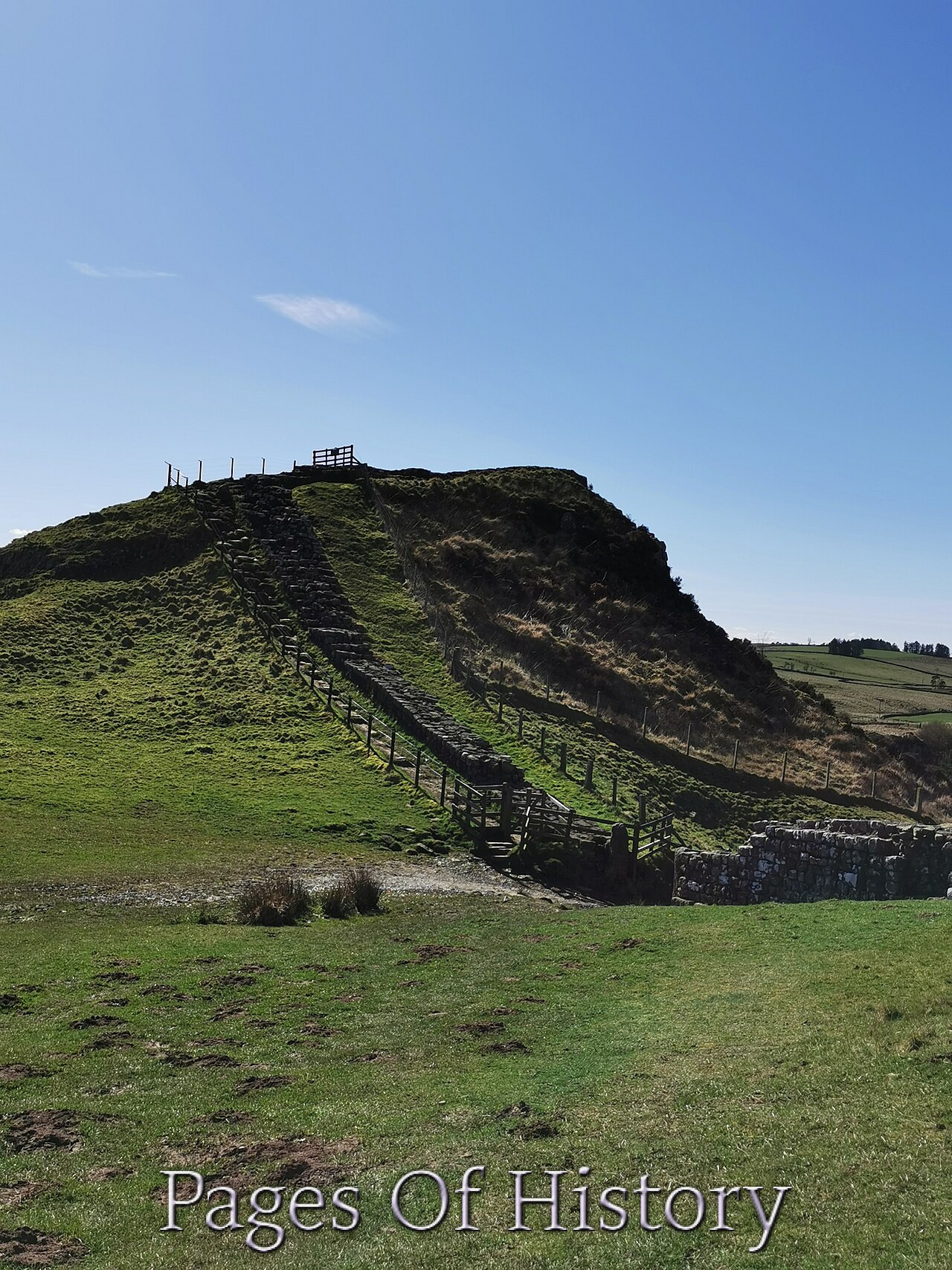
Under Hadrian (emperor 117–138 AD), Rome abandoned the attempt to hold the north and built the wall that bears his name, begun around 122 AD and running 73 miles from the Solway to the Tyne. Hadrian’s Wall was not a border in the modern sense but a controlled frontier: gates, milecastles, and forts managing movement, trade, and taxation. It marked the line beyond which Rome chose not to govern.
Hadrian’s successor Antoninus Pius pushed north again around 142 AD and built the Antonine Wall across the Forth–Clyde isthmus, roughly 39 miles of turf rampart. For about twenty years Rome held the Lowlands. Then, around 162 AD, the Antonine Wall was abandoned and the frontier pulled back to Hadrian’s Wall. The pattern was set: advance, overextend, withdraw.
| Date (AD) | Event | Significance |
|---|---|---|
| 77–84 | Governorship of Agricola; Battle of Mons Graupius (83/84) | Peak of Roman penetration into Scotland; victory without lasting occupation |
| c. 87 | Inchtuthil fortress dismantled | Deliberate withdrawal from the north |
| c. 122 | Construction of Hadrian’s Wall begins | Frontier fixed at the Tyne–Solway line |
| c. 142 | Antonine Wall built across Forth–Clyde | Brief re-advance into the Lowlands |
| c. 162 | Antonine Wall abandoned | Return to Hadrian’s Wall; Scotland left as buffer zone |
| 208–211 | Campaigns of Septimius Severus | Last major Roman offensive; inconclusive, abandoned on emperor’s death |
Why Did Septimius Severus Fail to Conquer Scotland?
The last serious Roman offensive into Scotland came under Emperor Septimius Severus between 208 and 211 AD. Severus, aging and ill, personally led a massive expedition north, rebuilding roads and forts and pushing deep into Caledonia. The Caledonians avoided pitched battle and waged guerrilla war, harassing Roman columns and disappearing into the hills.
Severus reportedly said of the enemy that they were impossible to subdue—not because they could not be beaten in battle, but because they could not be brought to battle at all. He died at York in 211 AD, and his sons Caracalla and Geta immediately abandoned the campaign, withdrawing to Hadrian’s Wall and making peace with the northern tribes. Rome never again attempted a full conquest.
The Guerrilla Problem
The Caledonian way of war was the decisive military factor. These were not a centralized kingdom with a capital to seize. They were a patchwork of tribes—the Caledonii, Maeatae, and others—who fought in small bands, used terrain brilliantly, and refused to mass for a decisive engagement unless it suited them. Rome could win every battle and still lose the war, because there was no political center whose capture would end resistance.
“The enemy… never dared to come to close quarters… they were defeated in every engagement, but they could not be conquered.” — paraphrase of Cassius Dio’s account of Severus’s campaigns (Roman History, Book 76)
This asymmetry is the core of the answer. Rome’s military system was designed for states, not for stateless societies. Against the Caledonians, the legions were a sledgehammer facing a swarm of wasps.
Was It Really “Never Conquered”? The Nuance
The popular claim that “Rome never conquered Scotland” needs qualification. Rome did occupy and govern parts of southern Scotland for extended periods—most notably during the Antonine period, when the Lowlands were administered as part of Britannia. Roman forts, roads, and temporary camps reached far north, and Roman coins, pottery, and diplomatic gifts circulated deep into Caledonia through trade and bribery.
What Rome never achieved was the permanent subjugation of the Highlands and the incorporation of the whole of Scotland into the provincial system. The distinction matters: Rome’s frontier was not a hard wall of ignorance but a zone of influence, diplomacy, and intermittent war. The tribes north of the wall were clients, enemies, and trading partners by turns.
What Was the Real Reason Rome Never Conquered Scotland?
Weighing the evidence, the failure of the Rome Scotland conquest was not a single defeat but a convergence of factors that made conquest irrational by Roman standards of value.
- Cost-benefit calculus: The north was poor in taxable wealth and expensive to garrison. Rome’s empire was a profit-seeking enterprise as much as a power projection.
- Terrain and logistics: Mountains, bogs, and distance made supply and control prohibitively difficult.
- Asymmetric warfare: A decentralized, mobile enemy could not be defeated by conventional means.
- Frontier strategy: Fortified lines and buffer states were a cheaper, more flexible solution than annexation.
- Imperial politics: Emperors needed victories, not quagmires; endless northern wars offered neither.
What Was the Legacy of Rome’s Failure in Scotland?
The consequences were profound and long-lasting. Hadrian’s Wall became the symbolic and physical boundary between Roman Britain and the peoples to the north. The tribes beyond it—later coalescing into the Picts and, in due course, the Scots of Dál Riata—developed outside direct Roman rule, preserving a distinct cultural and political trajectory.
The withdrawal also shaped the later history of Britain. When Roman authority collapsed in the early fifth century, the frontier zones were left to fend for themselves, contributing to the migrations and conflicts that produced early medieval Scotland, England, and Wales. The Antonine and Hadrianic frontiers left a landscape of forts and roads that still marks the country today.
A Frontier, Not a Failure
Modern historians increasingly reject the idea that Rome “failed” in Scotland. From the Roman perspective, the frontier system worked: it managed the northern threat at acceptable cost for centuries. The real lesson is about the limits of empire—that even the greatest powers must reckon with geography, culture, and arithmetic.
The Lasting Perspective: Why Rome Stopped at the Wall
The Rome Scotland conquest remains one of antiquity’s clearest case studies in strategic restraint. Rome could march to the Moray Firth and win battles in the shadow of the Grampians, but it could not make the Highlands profitable or peaceful. The legions withdrew not from weakness but from a rational assessment that the game was not worth the candle.
That decision left a permanent mark on the map of Britain. The wall that Hadrian built still stands as a monument to a simple truth: the most sophisticated military machine of the ancient world looked north, weighed the cost, and chose a frontier over a conquest. Scotland’s survival outside the empire was not an accident of battle but the product of mountains, distance, and a cold-eyed imperial calculus that decided the north was a land Rome could visit but never truly own.