
📅 Last updated: 25.10.2026
Johannes Gutenberg did not invent the printing press out of nothing. When people ask who invented the printing press, the honest answer is that the machine we recognize as the printing press emerged in Mainz, Germany, around 1440–1450 from the work of Johannes Gutenberg, who fused existing technologies—the wine screw press, oil-based ink, and movable metal type—into a single, repeatable system. Yet Gutenberg’s breakthrough rested on centuries of earlier innovation in China and Korea, where movable type and even metal type appeared long before any European workshop cast its first letter.
The printing press is conventionally credited to Johannes Gutenberg, a goldsmith from Mainz, Germany, who developed his movable-metal-type system around 1440–1450 and printed the 42-line Bible by 1455. However, movable type was invented in China by Bi Sheng around 1040 using fired clay, and Korean artisans cast metal movable type by the early 13th century. Gutenberg’s decisive contribution was not movable type itself but the integrated system—adjustable molds for casting type, oil-based ink, and a modified screw press—that made mass printing practical in Europe.
- What Did Johannes Gutenberg Actually Invent?
- Who Invented Movable Type Before Gutenberg?
- Why Did the Printing Press Emerge in Europe in the 1450s?
- Comparative Timeline: From Bi Sheng to Gutenberg
- How Did Gutenberg's Press Spread Across Europe?
- What Was the Printing Press's Lasting Impact?
- Who Really Invented the Printing Press? A Balanced Verdict
- The Printing Press as a Continuing Inheritance
What Did Johannes Gutenberg Actually Invent?
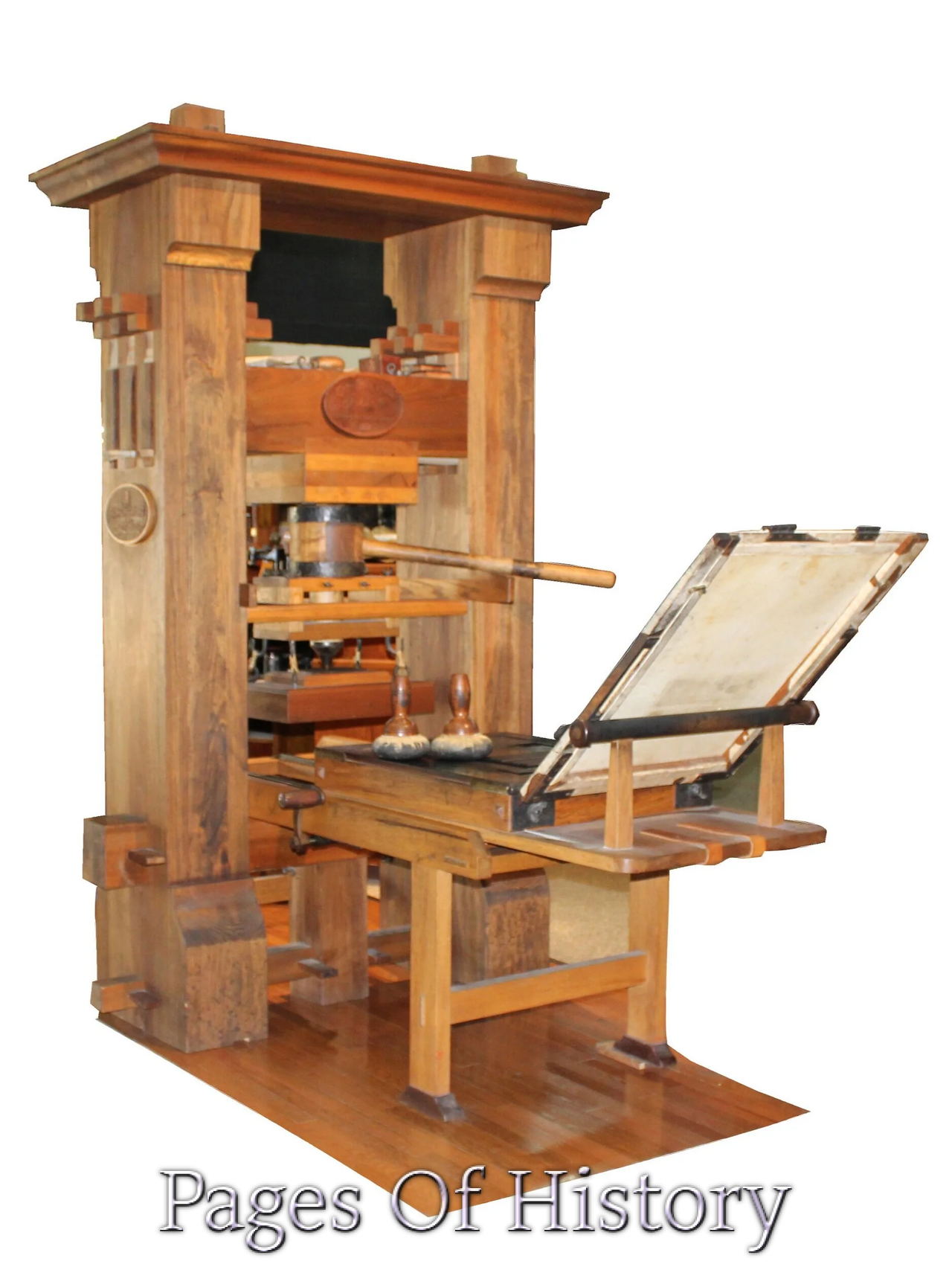
Gutenberg’s genius lay in systems integration rather than a single eureka moment. Between roughly 1440 and 1450, working in Mainz, he assembled a production chain that no predecessor had combined: a hand mold that let a caster produce identical metal letters quickly and precisely; an alloy of lead, tin, and antimony that melted at low temperature but resisted press pressure; an oil-based ink that adhered to metal type (unlike the water-based inks used in East Asia); and a modified screw press borrowed from winemaking and papermaking. Each element existed somewhere before. The synthesis did not.
The hand mold deserves particular attention. Earlier movable type systems, including Chinese and Korean ones, cast or carved characters individually, which was workable for the thousands of distinct characters in Chinese script but slow. Gutenberg’s adjustable matrix mold allowed a single caster to produce hundreds of identical sorts per day, standardizing letter heights so they locked together in a forme. The famous 42-line Bible, printed in Mainz and completed around 1455, demonstrated the system’s commercial potential: roughly 180 copies, on paper and vellum, with type so uniform that modern scholars still debate how many presses and compositors were involved.
Gutenberg himself profited little. In 1455 he lost a lawsuit to his financier Johann Fust, who seized the printing materials, and Fust’s associate Peter Schöffer—Gutenberg’s former apprentice—went on to run one of Europe’s most successful early presses. The invention outlived the inventor’s fortunes.
Who Invented Movable Type Before Gutenberg?
The question of who invented the printing press in its broader sense runs through East Asia. Around 1040, during the Northern Song dynasty, the artisan Bi Sheng (畢昇) devised movable type from fired clay, as recorded by the scholar Shen Kuo (沈括) in his Dream Pool Essays (夢溪筆談). Shen Kuo described characters baked hard, arranged in trays by rhyme, and reused—a genuine movable type system, though surviving physical examples are scarce.
China: Clay, Wood, and the Limits of Scale
Woodblock printing had already flourished in China by the Tang dynasty; the Diamond Sutra scroll dated 868, found at Dunhuang, is the world’s earliest securely dated printed book. Movable type never displaced woodblock printing in China for a simple reason: Chinese script requires thousands of characters, so a printer needed enormous type inventories, while woodblocks could be carved, stored, and reused for a specific text. Wang Zhen (王禎) described wooden movable type in his Book of Agriculture (農書) around 1313, and metal type—bronze and later copper—appeared in Ming-era workshops. The technology worked; the economics favored blocks.
Korea: The First Metal Movable Type
Korea’s contribution is often understated. The Sangjeong Gogeum Yemun (詳定古今禮文), a ritual text commissioned by King Taejong of Goryeo, is traditionally dated to 1234–1241 and is described in later sources as printed with cast metal type—making it the earliest known use of metal movable type anywhere. The Jikji (直指), a Buddhist Zen text printed at Heungdeok Temple in 1377, survives and is recognized as the oldest extant book printed with metal movable type. Korean artisans cast type in bronze using sand molds and wax casting techniques. Yet the Goryeo and Joseon courts kept printing largely a state enterprise, and the technology did not spread westward.
Why Did the Printing Press Emerge in Europe in the 1450s?
Europe in Gutenberg’s lifetime offered conditions East Asia did not: an alphabetic script with roughly two dozen letters, meaning a compact type inventory could set any text; a commercial paper industry established in Italy by the 13th century; a rising literate urban class and universities hungry for texts; and a money economy that made printed goods saleable. The screw press itself was familiar—wine presses and linen presses were common in the Rhineland.
Gutenberg’s innovation mattered because it arrived at a moment of demand. The fall of Constantinople in 1453 sent Greek manuscripts and scholars westward. The Church and universities needed standardized texts. By 1500, presses operated in more than 250 European towns and had produced an estimated 20 million volumes—a scale no manuscript scriptorium could approach.
- Alphabetic efficiency: A Latin or vernacular printer needed dozens of sorts, not thousands, making type casting and composition economically viable.
- Paper supply: European paper mills, established from the 13th century, provided a cheap substrate that parchment could not match in volume.
- Commercial demand: Universities, courts, and a growing merchant class created a market for standardized, affordable texts.
Comparative Timeline: From Bi Sheng to Gutenberg
| Date | Place | Innovation | Significance |
|---|---|---|---|
| c. 1040 | Northern Song China | Bi Sheng’s movable clay type | First documented movable type system, described by Shen Kuo |
| c. 1234–1241 | Goryeo Korea | Cast metal movable type (Sangjeong Gogeum Yemun) | Earliest known use of metal movable type |
| 1377 | Heungdeok Temple, Korea | Jikji printed with metal type | Oldest extant book printed with metal movable type |
| c. 1440–1450 | Mainz, Germany | Gutenberg’s integrated system: hand mold, alloy, oil ink, press | First practical, commercial mass-printing system in Europe |
| c. 1455 | Mainz, Germany | 42-line Gutenberg Bible | Demonstrated the system’s quality and commercial scale |
How Did Gutenberg’s Press Spread Across Europe?
The technology traveled fast because it was carried by people, not patents. When Mainz was sacked in 1462 during the archbishopric dispute between Diether von Isenburg and Adolf von Nassau, printers fled the city and established workshops elsewhere. By 1470, presses operated in Paris, Rome, Venice, and Cologne. Venice became Europe’s printing capital: Aldus Manutius, active from 1494, popularized the portable octavo format and italic type, and his editions of Greek and Latin classics reshaped scholarship.
William Caxton set up England’s first press at Westminster in 1476 and printed Chaucer’s Canterbury Tales and Malory’s Le Morte d’Arthur, helping standardize English prose. In France, the Sorbonne’s theologians fought over printed Bibles; in Spain, presses accompanied the Reconquista’s administrative machinery. The press became infrastructure—for law, liturgy, science, and propaganda alike.
What Was the Printing Press’s Lasting Impact?
The consequences of the press were structural, not merely cultural. Martin Luther’s 95 Theses of 1517 spread across Germany in weeks largely through printed broadsides and pamphlets; Luther himself recognized the press as “God’s highest and extremest act of grace.” The Reformation’s speed and reach depended on print, even as Catholic and Protestant authorities both used licensing and index laws to control it. The Scientific Revolution’s reproducibility—identical diagrams, shared tables, standardized notation—rested on print. The Enlightenment’s public sphere of journals, pamphlets, and novels was a print creation.
The press also transformed language and knowledge itself. Standardized spelling, punctuation, and page layout emerged from print shops. Reference works—dictionaries, encyclopedias, atlases—became possible at scale. The cost of copying collapsed, and with it the monopoly of scribal elites over textual authority.
- Reformation speed: Printed pamphlets allowed Luther’s ideas to circulate faster than authorities could suppress them.
- Scientific standardization: Identical printed diagrams and tables made replication and critique feasible across Europe.
- Vernacular literacy: Cheap printed texts—primers, almanacs, chapbooks—expanded reading beyond Latin-literate elites.
Who Really Invented the Printing Press? A Balanced Verdict
If the question means the specific machine that industrialized text in Europe, the answer is Johannes Gutenberg, whose Mainz workshop around 1440–1450 produced the first practical movable-metal-type printing system in the West. If the question means movable type itself, the answer is Bi Sheng in China around 1040, with Korean artisans casting metal type by the 1230s. The history of who invented the printing press is therefore a history of convergent invention: multiple societies solved parts of the problem, and one workshop—Gutenberg’s—assembled the parts into a commercially explosive whole.
This distinction matters because it corrects a Eurocentric myth without diminishing Gutenberg’s achievement. He did not invent printing, paper, ink, presses, or movable type. He invented the system that made them work together at industrial scale, and that system, once loosed on Europe, reshaped religion, science, politics, and language within a single generation.
The Printing Press as a Continuing Inheritance
Gutenberg’s press was obsolete within four centuries—iron presses, rotary presses, and eventually digital reproduction replaced it—but the logic it established persists: standardized, replicable, distributable text as the substrate of modern public life. When a modern reader asks who invented the printing press, the most useful answer is layered. Bi Sheng proved movable type could work. Korean casters proved metal type could work. Gutenberg proved that a complete system could work profitably, and that proof changed the world. The invention was not a single flash of genius but a chain of adaptations, each built on the last, and the chain has never really ended.