
📅 Last updated: 21.10.2026
The Antikythera mechanism is the world’s oldest known analog computer, a bronze gearwork device built by Greek craftsmen around the 2nd century BCE to model the movements of the Sun, Moon, and planets. Recovered in 1901 from a Roman-era shipwreck off the island of Antikythera, the corroded fragments have been decoded over more than a century of scholarship, revealing a machine of staggering mechanical sophistication that would not be matched in the West for over a thousand years. It was not a toy or a royal curiosity alone: it was a working astronomical calculator, a calendar engine, and possibly a teaching instrument for predicting eclipses and tracking the heavens.
The Antikythera mechanism is an ancient Greek bronze-geared analog computer, dated to roughly 150–100 BCE, that calculated the positions of the Sun, Moon, and planets, tracked the lunisolar calendar, and predicted eclipses. Discovered in 1901 in a shipwreck near the Greek island of Antikythera, its surviving fragments contain at least 30 interlocking gears, and its sophistication was unmatched in Europe until the 14th century.
- What Is the Antikythera Mechanism and Why Does It Matter?
- The Shipwreck Discovery: How the Antikythera Mechanism Was Found
- How Did the Antikythera Mechanism Work? Gears, Dials, and Celestial Cycles
- Key Facts and Timeline of the Antikythera Mechanism
- Who Built the Antikythera Mechanism, and Why?
- Why Did This Technology Disappear?
- What Did the Antikythera Mechanism Predict—and How Accurately?
- The Antikythera Mechanism's Legacy in Science and History
- Conclusion: A Machine Ahead of Its Time
What Is the Antikythera Mechanism and Why Does It Matter?
The Antikythera mechanism is not a myth or a Victorian hoax. It is a physical object, now housed in the National Archaeological Museum in Athens, consisting of dozens of corroded bronze fragments recovered from a first-century-BCE shipwreck. The device originally sat inside a wooden case roughly the size of a shoebox, with a front face displaying a circular zodiac dial and a solar/lunar pointer, and a rear face carrying at least two spiral dials—one for a 19-year lunar calendar and one for eclipse prediction.
Its significance lies in what it proves about ancient technology. Before its discovery, historians generally assumed that precision gearwork was a medieval European or Islamic invention. The Antikythera mechanism overturned that assumption overnight. Here was a Hellenistic-era machine, built before the birth of Christ, using cut bronze gears with triangular teeth to multiply and divide motion—mechanical computation in the truest sense. The device encoded astronomical cycles as gear ratios, turning the crank of human knowledge into a physical model of the cosmos.
The machine also matters because it is a survivor of a lost tradition. Ancient writers such as Cicero and Pappus of Alexandria mention geared astronomical devices, but no comparable object survives. The Antikythera mechanism is the sole physical witness to a Hellenistic mechanical culture that may have produced many such instruments—most of which have vanished, melted down, or rotted away.
The Shipwreck Discovery: How the Antikythera Mechanism Was Found
In the spring of 1900, Greek sponge divers sheltering from a storm off the barren islet of Antikythera, between Crete and the Peloponnese, stumbled on a Roman-era cargo ship wrecked in roughly 50 meters of water. The following year, in 1901, systematic salvage began under the direction of the Greek government, with divers working in dangerous conditions. Alongside marble and bronze statues, coins, glassware, and jewelry, they brought up a lump of corroded bronze and wood that nobody initially recognized.
That lump was the Antikythera mechanism. On 17 May 1902, the archaeologist Valerios Stais, examining the material at the National Archaeological Museum, noticed a gear wheel embedded in the rock-like corrosion. His observation sparked debate: some scholars dismissed the gears as later intrusions or as part of an astrolabe. It took decades—and new technologies—to confirm that the object was a coherent, ancient, geared astronomical device.
From Curiosity to Cipher
The first serious breakthrough came in 1974, when the physicist and historian Derek de Solla Price published Gears from the Greeks, arguing that the device was a calendrical and astronomical computer. Price’s work was pioneering but incomplete; the fragments were too corroded for the naked eye to resolve the tooth counts of every gear. The decisive advances came from Derek’s successors using X-ray computed tomography.
The Antikythera Mechanism Research Project
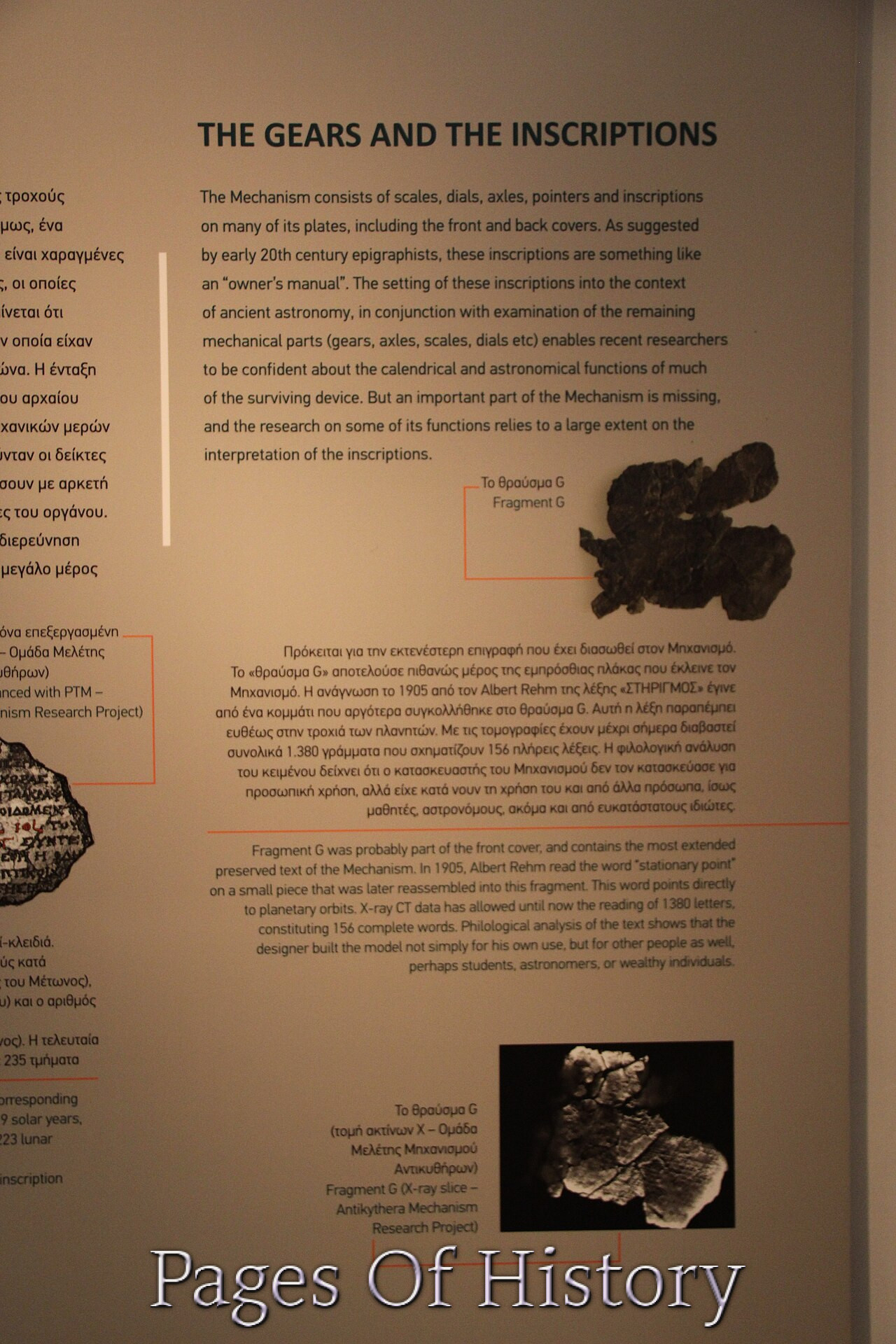
Beginning in 2005, an international team—the Antikythera Mechanism Research Project—used high-resolution X-ray CT and reflectance imaging to read inscriptions and count gear teeth hidden inside the fragments. Their 2006 findings, published in Nature, revealed previously unknown gears and a sophisticated epicyclic pin-and-slot system that modeled the Moon’s variable speed across the sky. In 2021, University College London researchers led by Tony Freeth published a reconstruction in Scientific Reports proposing a complete model of the front face, including the positions of the planets and a “Cosmos” display of the Greek cosmos. The investigation continues today, with new imaging and 3D modeling techniques still extracting details.
How Did the Antikythera Mechanism Work? Gears, Dials, and Celestial Cycles
The core principle of the Antikythera mechanism is mechanical analogy: each astronomical cycle is represented by a gear ratio. Turn a handle (likely on the side of the case), and a train of bronze gears drives pointers across dials, showing where the Sun, Moon, and planets would appear on a given date. The surviving fragments preserve at least 30 gears, and reconstructions suggest the original may have had 37 or more.
The Front Dial: Sun, Moon, and Zodiac
The front face carried a large circular dial marked with the 12 signs of the zodiac and the 365-day Egyptian calendar. A pointer showed the Sun’s position through the year, while a second pointer—driven through a complex gear train—showed the Moon’s position and phase. A small rotating sphere, painted half black and half white, displayed the Moon’s phase directly. The front also included a parapegma, an inscription listing the rising and setting of bright stars and associated weather omens, effectively a farmer’s almanac keyed to the calendar.
The Back Dials: Calendar and Eclipses
The rear face held two large spiral dials. The upper one displayed the 19-year Metonic cycle—the period after which lunar phases recur on the same calendar dates—with month names from the Corinthian calendar, suggesting a connection to northwestern Greece or Syracuse. The lower dial displayed the 223-month Saros cycle, the eclipse-prediction period, with glyphs indicating whether an eclipse would be solar or lunar and at what time of day it was expected. A smaller subsidiary dial tracked the 54-year Callippic cycle, a refinement of the Metonic cycle.
The Pin-and-Slot Moon Mechanism
One of the most remarkable features is the pin-and-slot device that modeled the Moon’s variable angular speed. Because the Moon’s orbit is elliptical, its apparent motion across the sky speeds up and slows down. The Greeks did not know about elliptical orbits, but they knew the effect—the “first anomaly”—and the Antikythera mechanism reproduced it mechanically with a gear carrying a pin that slid in a slot on another gear, producing a periodic variation in output speed. This is an epicyclic mechanism, centuries before its supposed invention in medieval Islam or Renaissance Europe.
Key Facts and Timeline of the Antikythera Mechanism
| Date | Event or Development | Significance |
|---|---|---|
| c. 150–100 BCE | Probable construction of the Antikythera mechanism | Dating based on inscriptions, calendar, and astronomical alignments; likely Hellenistic Greek craftsmanship |
| c. 70–60 BCE | Shipwreck off Antikythera | Roman cargo ship carrying Greek art and technology sinks; mechanism preserved in sediment |
| 1900–1901 | Sponge divers discover and salvage the wreck | Mechanism recovered among statues and coins; initially unrecognized |
| 17 May 1902 | Valerios Stais identifies a gear wheel | First recognition that the object contained precision gearing |
| 1974 | Derek de Solla Price publishes Gears from the Greeks | Establishes the device as an astronomical computer |
| 2006 | Antikythera Mechanism Research Project publishes CT findings in Nature | Reveals hidden gears, inscriptions, and the pin-and-slot lunar mechanism |
| 2021 | UCL team publishes a complete front-face reconstruction | Proposes a full model of planetary displays and the “Cosmos” arrangement |
Who Built the Antikythera Mechanism, and Why?
The maker is unknown, but the cultural fingerprints point to the Hellenistic Greek world. The month names on the calendar dial are Corinthian, and the device’s astronomical parameters align with the work of Greek astronomers, especially Hipparchus of Rhodes (c. 190–120 BCE), whose lunar theory and eclipse cycles appear embedded in the gear ratios. Syracuse, the home of Archimedes, was a major center of mechanical innovation, and Cicero records that Archimedes built a bronze sphere that reproduced the motions of the heavens—a tantalizing, though unproven, ancestor of the Antikythera device.
The mechanism was likely a prestige object: an instrument for a wealthy patron, a scholar, or a ruler’s court, demonstrating mastery of the cosmos. It may also have served a practical purpose—astronomical prediction, calendar regulation, and the timing of religious festivals and agricultural activities. Its inscriptions, which include a user’s guide to the dials, suggest it was meant to be operated and understood, not merely admired.
Why Did This Technology Disappear?
The Antikythera mechanism’s existence raises an uncomfortable question: if the Greeks could build geared astronomical computers in the 2nd century BCE, why did such technology vanish for more than a millennium? Several factors explain the gap.
- Elite, small-scale production: The device required highly skilled craftsmen, precision bronze-working, and expensive materials. It was not a mass-produced technology and depended on a narrow class of patrons.
- Fragility and recycling: Bronze was valuable and routinely melted down. A broken geared device was more likely to be scrapped than repaired, especially outside a few scholarly centers.
- Political and economic disruption: The Roman conquest of the Greek world, followed by the collapse of Roman imperial infrastructure, disrupted the networks of patronage and learning that sustained such crafts.
- Loss of written transmission: The technical manuals describing how to build such devices did not survive antiquity. Without the texts, the craft knowledge died with its practitioners.
The result was a technological regression in the West. Comparable geared astronomical devices reappear in the Islamic world and medieval Europe—the astrolabe and the geared astronomical clock—but the specific tradition of the Antikythera mechanism was broken. Its rediscovery in 1901 was, in effect, the recovery of a lost branch of the technological family tree.
What Did the Antikythera Mechanism Predict—and How Accurately?
The device’s accuracy was remarkable for its era, though not perfect. Its solar and lunar positions were accurate to within a few degrees over short periods, and its eclipse predictions were based on the Saros cycle, which reliably forecasts the possibility of eclipses but not their exact visibility or magnitude. The mechanism did not model planetary motion with the same precision as the Sun and Moon; the 2021 reconstruction suggests the planets were displayed in a simplified, schematic way, possibly using the epicyclic models of Greek astronomy.
The machine’s real achievement was conceptual: it translated astronomical theory into a physical, predictive model. It encoded the Metonic cycle, the Saros cycle, the Callippic cycle, and the lunar anomaly into gear ratios—an act of mathematical engineering that would not be equaled in complexity until the astronomical clocks of the 14th century, such as the astrarium of Giovanni de’ Dondi in Padua (completed around 1364).
The Antikythera Mechanism’s Legacy in Science and History
The Antikythera mechanism has become a touchstone in the history of science and technology. It challenges the narrative of linear technological progress and forces historians to reckon with lost knowledge. It also demonstrates that the ancient Greeks were not merely theorists—they were practical engineers capable of precision manufacturing at a scale that rivals much later workshops.
Its influence extends beyond academia. The device has inspired modern reconstructions, including working models built by Michael Wright and others, and it has entered popular culture as a symbol of ancient ingenuity. For historians of technology, it is a case study in how knowledge can be lost, rediscovered, and reinterpreted—each generation of scholars extracting new details from the same corroded fragments.
Conclusion: A Machine Ahead of Its Time
The Antikythera mechanism is a reminder that the ancient world was not a prelude to modernity but a civilization with its own sophisticated science and engineering. Built by Greek craftsmen around 150–100 BCE, lost in a shipwreck, and recovered by sponge divers in 1901, it represents a peak of Hellenistic mechanical achievement that would not be matched for over a thousand years. Its gears, dials, and inscriptions encode a worldview—a cosmos of cycles and predictions—rendered in bronze. The Antikythera mechanism survives as both a technical marvel and a historical lesson: that human knowledge is fragile, that progress is not guaranteed, and that the past can still surprise us with machines we thought were impossible.