
📅 Last updated: 10.11.2026
The Winter War began on 30 November 1939, when Soviet forces crossed the Finnish frontier at multiple points along an 800-mile border, opening one of the most lopsided military contests of the twentieth century. Joseph Stalin expected a swift, bloodless annexation of a small neighbor; instead, Finland’s outnumbered defenders inflicted catastrophic losses on the Red Army and held out for 105 days. The conflict became a case study in how terrain, climate, morale, and doctrine can outweigh raw numerical strength.
The Winter War (30 November 1939 – 13 March 1940) was a Soviet invasion of Finland following the collapse of territorial negotiations. Though the Red Army eventually forced Finland to cede territory under the Treaty of Moscow, its initial failures against a far smaller Finnish force—including the destruction of entire divisions in the forests north of Lake Ladoga—exposed severe weaknesses in Soviet command and training. The war cost the USSR an estimated 126,000–168,000 dead, damaged its military reputation, and helped convince Adolf Hitler that the Soviet Union could be defeated quickly.
- Why Did the Soviet Union Invade Finland in 1939?
- What Were the Forces on Each Side?
- How Did the Winter War Unfold on the Battlefield?
- Key Battles and Turning Points of the Winter War
- What Were the Human and Material Costs?
- How Did the Winter War End?
- Why Did the Winter War Matter?
- What Does the Winter War Teach Us?
- The Winter War's Lasting Perspective
Why Did the Soviet Union Invade Finland in 1939?
The roots of the conflict lie in Soviet geography and fear. Leningrad (modern St. Petersburg), then the USSR’s second city and a major industrial center, sat roughly 20 miles from the Finnish border and within artillery range of Finnish territory. Soviet planners, haunted by the 1918–1920 Allied interventions and the prospect of a future war with Germany, wanted a buffer. In October 1939, after the Molotov–Ribbentrop Pact had effectively placed Finland in the Soviet sphere, Moscow invited a Finnish delegation to negotiate.
The Soviet demands were substantial: Finland was to cede the Karelian Isthmus frontier, lease the Hanko Peninsula as a naval base, and hand over several islands in the Gulf of Finland—in exchange for roughly twice as much land farther north, near Lake Onega. On paper the trade looked generous, but the Finnish government, led by Prime Minister Aimo Cajander and later Risto Ryti, saw the proposals as a fatal breach of neutrality and territorial integrity. Negotiations collapsed in mid-November 1939.
On 30 November, Soviet aircraft bombed Helsinki and Red Army units advanced across the border. Moscow claimed Finnish artillery had fired on Soviet troops near the village of Mainila on 26 November—a claim historians overwhelmingly regard as a manufactured pretext. The Soviet Union was expelled from the League of Nations on 14 December 1939 for the aggression.
What Were the Forces on Each Side?
The imbalance was staggering. The Soviet Union committed roughly 750,000 troops at the outset, backed by thousands of tanks, artillery pieces, and aircraft. Finland, a nation of about 3.7 million people, mobilized around 300,000 soldiers—but with almost no tanks, minimal anti-tank weaponry, and a tiny air force of fewer than 150 aircraft.
Finland’s Advantages: Terrain, Climate, and Morale
What Finland lacked in numbers it compensated for in conditions. The Karelian Isthmus, the main invasion corridor, was fortified by the Mannerheim Line—a belt of concrete bunkers, trenches, and obstacles named for Field Marshal Carl Gustaf Emil Mannerheim, commander-in-chief of the Finnish armed forces. North of Lake Ladoga, the border region was dense forest and frozen swamp, terrain that channeled Soviet armor onto narrow roads and into ambushes.
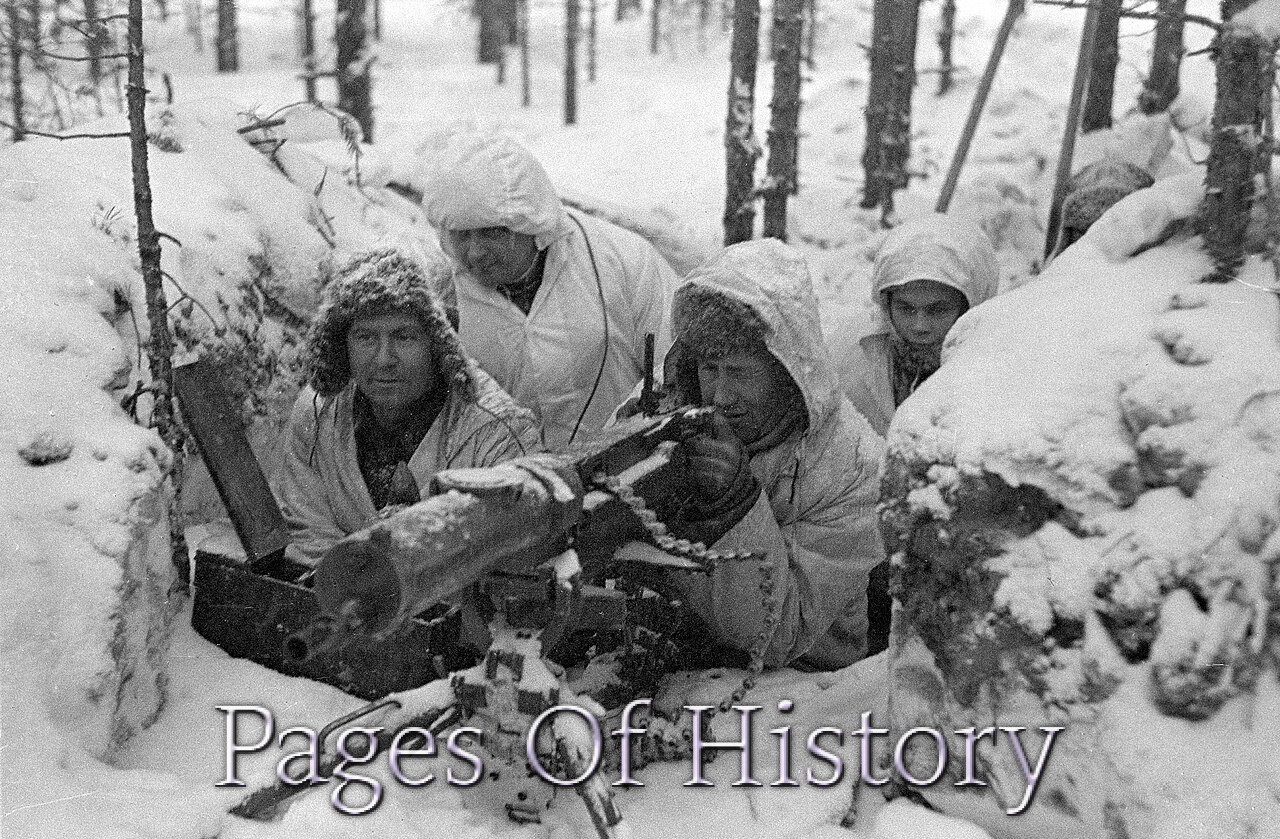
Finnish troops, many raised in these forests, moved on skis and fought in small, flexible units. Their white snow camouflage earned Soviet soldiers the nickname “Belaya Smert”—the White Death—though the phrase is most associated with sniper Simo Häyhä, credited with over 500 kills. Finnish morale was anchored in defense of national independence, won only two decades earlier during the 1918 Finnish Civil War and the subsequent conflicts with Soviet Russia.
Soviet Assumptions and Weaknesses
Stalin and his commanders expected a quick capitulation. Soviet doctrine, still shaped by the purges of 1937–1938 that had removed or killed a large share of senior officers, was rigid and centralized. Troops were poorly prepared for winter warfare, lacked adequate winter clothing and camouflage, and operated with clumsy combined-arms coordination. The Red Army’s performance in the Winter War stunned foreign observers—and encouraged Germany’s later assessment of Soviet weakness.
How Did the Winter War Unfold on the Battlefield?
The war unfolded along several fronts, each with a distinct character.
The Karelian Isthmus: Attrition on the Mannerheim Line
The main Soviet thrust aimed at the Mannerheim Line. Initial frontal assaults in December 1939 failed bloodily. Soviet infantry and armor attacked across open, snow-covered ground against prepared defenses, taking heavy casualties. By late December, the offensive had stalled. In February 1940, after massive reinforcement and a brutal artillery and air bombardment, Soviet forces under Marshal Semyon Timoshenko broke through near Summa. The line was breached, and Finnish forces withdrew to a secondary position. The fighting here was grinding and costly for both sides.
Suomussalmi and the Destruction of Soviet Divisions
North of Lake Ladoga, the story was different. Soviet columns advancing on narrow forest roads became strangled bottlenecks. At Suomussalmi in December 1939 and January 1940, Finnish forces under Colonel Hjalmar Siilasvuo surrounded and destroyed the Soviet 163rd and 44th Rifle Divisions—the latter largely annihilated on the Raate Road. Finnish troops, using ski mobility and “motti” tactics (encircling and fragmenting enemy units), cut Soviet columns into isolated pockets and destroyed them piecemeal. These victories became the war’s most famous examples of asymmetric warfare.
The Air War and the Baltic
Soviet aircraft bombed Finnish cities, including Helsinki, in raids that caused civilian casualties but stiffened Finnish resolve. Finnish pilots, flying mostly obsolete aircraft, scored a surprising number of kills against Soviet formations. At sea, Soviet naval forces and the Baltic Fleet operated against Finnish coastal defenses and shipping, though winter ice limited large-scale naval action.
Key Battles and Turning Points of the Winter War
Several engagements defined the conflict’s trajectory and its memory.
- Battle of Suomussalmi (December 1939–January 1940): Finnish ski troops encircled and destroyed two Soviet divisions, demonstrating the vulnerability of road-bound columns in forest terrain.
- The Mannerheim Line battles (December 1939–February 1940): Repeated Soviet assaults failed until overwhelming artillery and fresh forces broke through in February.
- Battle of Tolvajärvi (December 1939): Finnish forces under Colonel Paavo Talvela stopped a Soviet advance in Ladoga Karelia, one of the first clear Finnish victories.
- The February 1940 breakthrough: Soviet forces massed on the Karelian Isthmus and, after intense bombardment, forced the Finns to retreat.
By late February, Finnish reserves were exhausted. The army had suffered roughly 25,000 dead and tens of thousands wounded, and its ammunition and manpower were running low. Finland’s government, facing the prospect of total defeat, sought peace terms.
What Were the Human and Material Costs?
The Winter War was short but exceptionally lethal. Estimates vary, but the most widely cited figures place Soviet dead and missing at roughly 126,000–168,000, with total casualties (including wounded and sick) far higher—some estimates exceeding 300,000. Finnish dead numbered about 25,000, with roughly 43,000 wounded. Soviet tank losses were in the thousands; Finnish losses were small by comparison.
| Category | Finland | Soviet Union |
|---|---|---|
| Troops committed (peak) | ~300,000 | ~750,000+ |
| Dead / missing | ~25,000 | ~126,000–168,000 |
| Wounded | ~43,000 | ~200,000+ (estimated) |
| Tanks | Negligible | Thousands committed |
| Duration | 30 November 1939 – 13 March 1940 (105 days) | |
Beyond casualties, the war displaced roughly 400,000 Karelian civilians who chose to evacuate rather than live under Soviet rule. Their resettlement across Finland became a lasting social and political challenge.
How Did the Winter War End?
On 13 March 1940, the Treaty of Moscow ended hostilities. Finland ceded the Karelian Isthmus, including the city of Viipuri (Vyborg), a large slice of Ladoga Karelia, and the Hanko Peninsula, leased to the USSR for 30 years. In total, Finland lost about 11 percent of its territory and roughly 30 percent of its industrial capacity. The terms were harsh—harsher than the original October 1939 demands—but Finland retained its independence.
The Soviet Union achieved its territorial objectives, yet the war’s strategic ledger was mixed. Stalin gained a buffer for Leningrad, but the campaign revealed the Red Army’s institutional weaknesses and cost the USSR enormous casualties and international prestige. The League of Nations expulsion isolated Moscow diplomatically.
Why Did the Winter War Matter?
The Winter War’s consequences rippled far beyond the Baltic.
Military Lessons and the Road to Barbarossa
Hitler and the German high command watched the Red Army’s struggles closely. The poor performance against Finland reinforced the Nazi belief that the Soviet Union was a “rotten structure” that could be defeated in a short campaign. That assessment contributed to the decision to invade the USSR in June 1941—Operation Barbarossa—and to German overconfidence in the opening months of that war. Soviet planners, for their part, drew lessons about winter warfare, combined arms, and command flexibility that influenced later reforms.
Finland’s Wartime Alignment
Humiliated and territorially diminished, Finland sought security. When Germany invaded the Soviet Union in 1941, Finland joined the war against the USSR in what Finns call the Continuation War, seeking to recover lost territory. Finland’s wartime alliance with Nazi Germany remains a complex and debated chapter of its history, shaped directly by the Winter War’s outcome.
International Reputation and the “Spirit of the Winter War”
The conflict became a symbol of national resistance. The phrase “the spirit of the Winter War” entered Finnish political language, invoked during later crises as a model of unity and sacrifice. Foreign volunteers from Sweden, Denmark, Norway, and elsewhere joined the Finnish cause, and international sympathy for Finland was widespread, though material aid arrived slowly.
What Does the Winter War Teach Us?
The Winter War remains a powerful case study in military analysis. Several factors explain Finland’s ability to resist far longer than anyone expected:
- Terrain and climate as force multipliers: Forests, frozen lakes, and deep snow negated Soviet numerical and armored advantages and favored small-unit, mobile tactics.
- Doctrinal flexibility: Finnish forces adapted quickly, using ski mobility and encirclement tactics against road-bound Soviet columns.
- Morale and legitimacy: Finnish soldiers fought for national survival, while Soviet conscripts often lacked clear motivation and adequate preparation.
- Soviet institutional weaknesses: Purges, rigid command, and poor logistics undermined the Red Army’s quantitative superiority.
The war also illustrates the limits of raw power. Stalin’s forces eventually won the territorial objective, but at a cost that exposed systemic problems and shaped the strategic calculations of friend and foe alike. The Winter War was not a Finnish victory in the conventional sense—Finland lost territory and sued for peace—but it was a strategic embarrassment for the Soviet Union and a defining moment in Finnish national identity.
The Winter War’s Lasting Perspective
Eighty-five years later, the Winter War still resonates. It demonstrates how a small state, prepared to pay a terrible price, can impose disproportionate costs on a vastly larger adversary. It shows how underestimating an opponent’s morale and terrain can turn a predicted quick victory into a prolonged, bloody campaign. And it reminds us that military strength is not merely a matter of numbers—it is a function of training, doctrine, logistics, leadership, and the willingness of soldiers to fight for a cause they believe in.
For Finland, the war’s memory is both painful and formative: a nation that lost its eastern provinces but kept its independence, and whose soldiers’ resistance became a permanent part of its self-understanding. For historians, the Winter War remains a rich, sobering study in the gap between strategic expectation and battlefield reality—a gap that has decided the fate of nations before and since.