
📅 Last updated: 11.11.2026
The Sea Peoples are among history’s most consequential yet least understood actors: a loose coalition of seaborne raiders, migrants, and displaced communities whose attacks around 1200 BCE helped topple the Hittite Empire, devastate the Levantine coast, and push New Kingdom Egypt to the brink. For over a century, scholars have cast them as either the prime movers of the Late Bronze Age collapse or as opportunistic scavengers picking at a system already rotten from drought, famine, and rebellion. The truth, as this article will show, lies in a more complex and far more interesting middle ground.
The Sea Peoples were a coalition of maritime raiders and migrants—including groups the Egyptians called the Peleset, Tjeker, Shekelesh, Denyen, and Weshesh—who attacked Egypt and the eastern Mediterranean around 1208–1177 BCE. They did not single-handedly destroy the Bronze Age; instead, they accelerated a collapse already underway, driven by drought, famine, internal revolt, and the breakdown of trade networks. Their most lasting legacy was the settlement of the Philistines on the Levantine coast.
- Who Were the Sea Peoples, and Where Did They Come From?
- What Caused the Late Bronze Age Collapse?
- The Sea Peoples in Egyptian Records: Merneptah and Ramesses III
- How Did the Sea Peoples Destroy the Hittite Empire and Ugarit?
- Key Timeline and Comparative Breakdown
- Were the Sea Peoples a Cause or a Symptom of Collapse?
- Who Were the Philistines, and Why Do They Matter?
- What Did the Sea Peoples Leave Behind?
- Why the Sea Peoples Still Matter
Who Were the Sea Peoples, and Where Did They Come From?
The name itself is a modern convenience. Ancient Egyptians called them nꜣ ḫꜣswt n pꜣ ym—”the foreign peoples of the sea”—a label that appears in inscriptions from the reigns of Merneptah (c. 1213–1203 BCE) and Ramesses III (c. 1184–1153 BCE). The Egyptians never claimed to know exactly where these people originated, and neither, despite enormous effort, do modern historians.
What we do have are names. Egyptian records list specific groups: the Peleset (almost certainly the Philistines), the Tjeker, the Shekelesh, the Denyen, the Weshesh, the Ekwesh (often linked to “Achaeans”), the Lukka, the Sherden, and the Teresh. These names offer tantalizing linguistic hints—Shekelesh may connect to Sicily, Sherden to Sardinia, Teresh to the Tyrsenoi/Etruscans, Ekwesh to the Homeric Achaeans—but the connections remain debated and, in several cases, probably misleading. The Sea Peoples were likely not a single ethnic group migrating from one homeland but a coalition of diverse, mobile populations drawn from the Aegean, Anatolia, and the central Mediterranean, bound together by circumstance, opportunity, and shared maritime tactics.
The Earliest Mentions: Lukka and Sherden Before the Collapse
The Sea Peoples did not appear from nowhere in 1200 BCE. Egyptian and Hittite records from the 14th and 13th centuries already mention the Lukka and Sherden as raiders and mercenaries. The Sherden famously fought both against and for Ramesses II at the Battle of Kadesh in 1274 BCE, where Egyptian reliefs show them wearing distinctive horned helmets. This long prehistory matters: it suggests the Sea Peoples were not a sudden eruption but an intensification of maritime raiding that grew as the eastern Mediterranean’s political order weakened.
What Caused the Late Bronze Age Collapse?
To understand the Sea Peoples, you must understand the world they attacked. By the late 13th century BCE, the eastern Mediterranean was an interconnected system of palace economies: the Hittite Empire in Anatolia, the Mycenaean kingdoms of Greece, the New Kingdom of Egypt, the city-states of Cyprus and the Levant, and the trading hubs of Ugarit and Alashiya. These powers exchanged goods, letters, and royal marriages through a dense diplomatic network—the Amarna letters preserve this correspondence in vivid detail.
That network was fragile. It depended on long-distance trade, bronze (itself dependent on tin imported from distant sources), and centralized palace control. Beginning around 1220 BCE, a cascade of stressors struck simultaneously:
- Climate change and drought: Pollen cores, isotope analysis, and tree-ring data point to a severe multi-decade drought across the eastern Mediterranean around 1200 BCE, devastating harvests and triggering famine.
- Earthquakes: A cluster of seismic events destroyed cities across the Aegean and Anatolia, including the Hittite capital region.
- Systems collapse: As trade routes failed, palace economies lost the surplus that sustained their armies, bureaucracies, and monumental building programs.
- Internal rebellion and migration: Hittite records describe famine, grain shipments from Egypt, and rebellious subjects; Mycenaean Greece shows signs of widespread destruction and depopulation.
The Sea Peoples were both a symptom and an accelerant of this breakdown. As drought and famine displaced populations, maritime raiding became survival strategy as much as conquest.
The Sea Peoples in Egyptian Records: Merneptah and Ramesses III
Our richest textual evidence for the Sea Peoples comes from Egypt, whose monumental inscriptions preserve the only contemporary accounts written from the perspective of a major power that survived the crisis.
Merneptah’s Victory (c. 1208 BCE)
The first major confrontation appears on the Great Karnak Inscription of Pharaoh Merneptah. In his fifth year (c. 1208 BCE), Merneptah faced a coalition of Sea Peoples—the Ekwesh, Teresh, Lukka, Sherden, and Shekelesh—who were reportedly allied with the Libyans under their king Meryey and threatening Egypt’s western frontier. Merneptah’s forces crushed the coalition, and the pharaoh boasted of killing over 6,000 enemies and capturing thousands more. The inscription is our earliest detailed account of a Sea Peoples coalition in action, and it shows they were already operating in force as far as the Nile Delta.
Ramesses III and the Great Invasion (c. 1177 BCE)
Two decades later, the threat returned on a far larger scale. Ramesses III’s mortuary temple at Medinet Habu preserves the most famous—and most dramatic—account. The inscription describes a vast movement of peoples:
“The foreign countries made a conspiracy in their islands. All at once the lands were removed and scattered in the fray. No land could stand before their arms, from Hatti, Kode, Carchemish, Arzawa, and Alashiya on, being cut off at one time. A camp was set up in one place in Amor. They desolated its people, and its land was like that which has never come into being. They were coming forward toward Egypt, while the flame was prepared before them.”
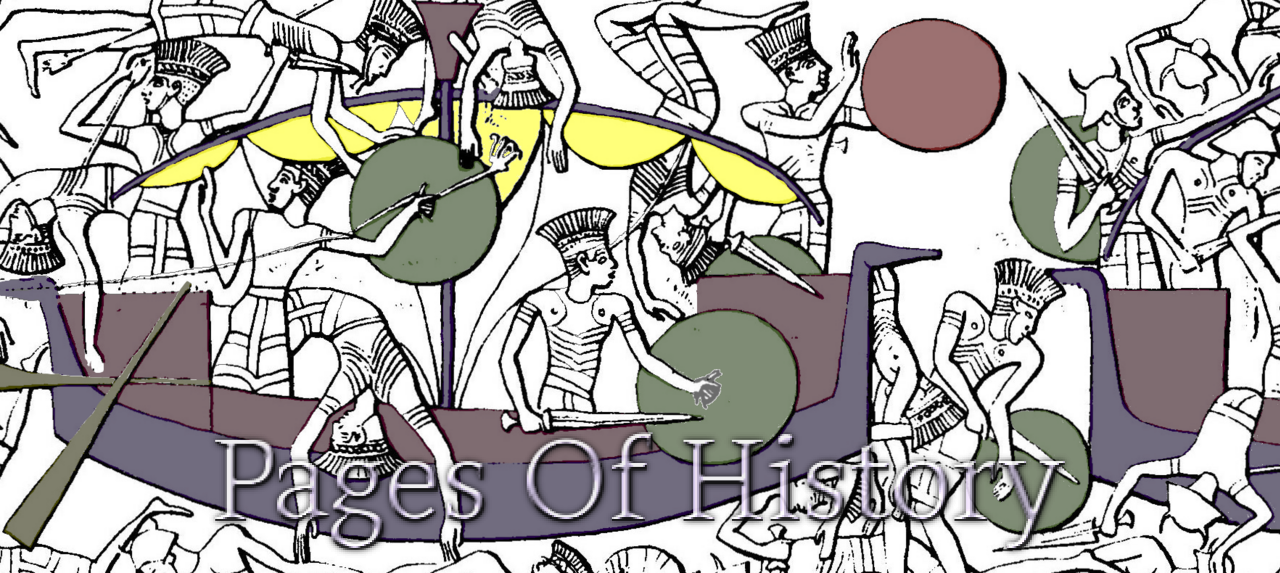
This passage is crucial: it explicitly names the Hittite lands (Hatti), Cilicia (Kode), Carchemish, western Anatolia (Arzawa), and Cyprus (Alashiya) as already destroyed. The Sea Peoples, according to Ramesses, were moving by land and sea with their families and possessions—a migration, not merely a raid. The accompanying reliefs at Medinet Habu depict a chaotic naval battle, ox-carts loaded with women and children, and the pharaoh personally leading the counterattack.
Ramesses III defeated the invasion in a land and sea battle in the Nile Delta around 1177 BCE, capturing and settling some of the defeated Peleset in fortified garrisons in Canaan. That decision would reshape the Levant for centuries.
How Did the Sea Peoples Destroy the Hittite Empire and Ugarit?
The Hittite Empire, based at Hattusa in central Anatolia, was one of the great powers of the Bronze Age. Its collapse around 1180 BCE is one of the most dramatic events of the period, and the Sea Peoples played a central role—though not an exclusive one.
The Hittite capital was abandoned, and the empire fragmented into smaller Neo-Hittite states. Hittite records describe desperate grain shortages and appeals to Egypt for food. The coastal city of Ugarit, a wealthy trading port on the Syrian coast, provides a haunting archaeological snapshot. In its final destruction layer, archaeologists found a tablet containing a letter from the Hittite king requesting grain shipments—and another with a desperate plea from a local official: enemy ships had been sighted, the city’s troops were in Anatolia, and the situation was dire. Ugarit was destroyed shortly afterward, around 1185 BCE.
Yet the Hittite collapse also involved internal rebellion, dynastic conflict, and the loss of the grain supply from the Levant. The Sea Peoples were the final blow, not the sole cause.
Key Timeline and Comparative Breakdown
| Date (c.) | Event | Significance |
|---|---|---|
| 1274 BCE | Battle of Kadesh | Sherden mercenaries fight on both sides; earliest visual evidence of Sea Peoples in Egypt |
| 1220–1200 BCE | Drought, earthquakes, famine | Climate and seismic stressors destabilize the eastern Mediterranean |
| 1208 BCE | Merneptah defeats Sea Peoples–Libyan coalition | First major Egyptian victory over a Sea Peoples alliance |
| 1185 BCE | Destruction of Ugarit | Levantine trade hub burned; Hittite supply line severed |
| 1180 BCE | Fall of Hattusa | Hittite Empire collapses; Neo-Hittite states emerge |
| 1177 BCE | Ramesses III’s victory at Medinet Habu | Sea Peoples invasion of Egypt repelled; Peleset settled in Canaan |
Were the Sea Peoples a Cause or a Symptom of Collapse?
The scholarly debate has shifted dramatically over the past half-century. Early 20th-century historians, following the Medinet Habu inscriptions, treated the Sea Peoples as the primary agents of destruction—a kind of prehistoric blitzkrieg. More recent scholarship has emphasized multicausal explanations: climate change, drought, earthquake, and systems collapse.
The most defensible position is that the Sea Peoples were both. They were a symptom of a collapsing system—populations displaced by drought, famine, and war—and simultaneously an accelerant, because their maritime mobility allowed them to strike weakened cities and disrupt the remaining trade networks. A drought-stricken Hittite Empire could not survive a coordinated naval assault on its coast; a Mycenaean Greece already weakened by internal conflict could not repel raiders. The Sea Peoples exploited fragility, and in doing so, they deepened it.
Who Were the Philistines, and Why Do They Matter?
The most enduring legacy of the Sea Peoples is the settlement of the Peleset—the Philistines—on the southern coast of Canaan. Ramesses III, after defeating the invasion, settled some of the captured Peleset in fortified towns, possibly as garrison troops. Over the following decades, the Philistines established a powerful confederation of five city-states: Gaza, Ashkelon, Ashdod, Ekron, and Gath.
Archaeology has confirmed a distinctive Philistine material culture that appears suddenly in the early 12th century BCE: Aegean-style pottery (Mycenaean IIIC), distinctive loom weights, and dietary habits that include pork—unusual in the region. These findings support the Egyptian and biblical traditions that the Philistines came from across the sea. Their origins remain debated—Crete, Cyprus, and the Aegean are all candidates—but the cultural rupture is unmistakable.
The Philistines became one of the most consequential peoples of the Iron Age. They fought the Israelites for centuries, and their conflicts are preserved in the Hebrew Bible—most famously in the story of David and Goliath, set in the Philistine-Israelite wars of the 11th century BCE. The name “Palestine” itself derives from the Philistines, via the Greek Palaistine and the Roman province of Palaestina.
What Did the Sea Peoples Leave Behind?
The Bronze Age collapse did not end civilization—it transformed it. The centralized palace economies gave way to smaller, more decentralized Iron Age states. Ironworking spread as bronze supply chains failed. Alphabetic scripts, already developing in the Levant, flourished as bureaucratic literacy declined. New peoples—Philistines, Israelites, Phoenicians, Aramaeans—rose to prominence.
The Sea Peoples themselves largely disappeared as a distinct identity, absorbed into the populations they settled among. Their memory persisted in Egyptian inscriptions, in the Hebrew Bible’s accounts of the Philistines, and in later Greek legends of sea-raiders. But their greatest legacy was indirect: by helping to dismantle the old order, they helped to create the world of the Iron Age.
Why the Sea Peoples Still Matter
The Sea Peoples are more than an archaeological curiosity. They raise questions that remain urgent: How do complex, interconnected societies respond to climate stress and systemic risk? What happens when trade networks fail and displaced populations become mobile and militarized? The Late Bronze Age collapse was not a single event but a cascade—and the Sea Peoples were one of its most visible and dramatic expressions.
They were not the sole destroyers of the Bronze Age, and the evidence does not support the old image of a unified invading horde. They were, instead, a coalition of the displaced and the desperate, exploiting a world already unraveling. Their story is a reminder that collapse is rarely monocausal, and that the peoples history remembers as destroyers are often themselves products of destruction.