
📅 Last updated: 03.11.2026
Mansa Musa was the tenth mansa (king) of the Mali Empire, a West African state that dominated the trans-Saharan trade in gold and salt during the fourteenth century. Crowned around 1312 and ruling until roughly 1337, he turned a regional power into an internationally recognized empire and, through his 1324 pilgrimage to Mecca, became the first sub-Saharan African ruler to appear on European maps. His wealth derived from Mali’s control of the Bambuk and Bure goldfields, which supplied a substantial share of the Old World’s gold during his reign.
Mansa Musa (r. c. 1312–1337) was the emperor of Mali and is widely regarded as the wealthiest individual in recorded history. His fortune came from Mali’s vast gold and salt trade, and his lavish 1324 pilgrimage to Mecca—during which he distributed so much gold in Cairo that it depressed prices for years—made him famous across the Islamic world and Europe. He also transformed Timbuktu into a renowned center of Islamic scholarship.
- Who Was Mansa Musa? The Man Behind the Legend
- How Did Mali Become So Rich? Gold, Salt, and the Trans-Saharan Trade
- Mansa Musa's Pilgrimage: The 1324 Hajj That Shook Cairo
- How Did Mansa Musa Change Timbuktu and Mali's Legacy?
- What Did Mansa Musa's Empire Look Like? A Timeline of Key Facts
- Was Mansa Musa Really the Richest Man in History?
- What Was Mansa Musa's Legacy—and Why Does It Matter?
- The Lasting Perspective: Wealth, Power, and Memory
Who Was Mansa Musa? The Man Behind the Legend
The name “Mansa Musa” combines a royal title and a personal name: mansa means “king of kings” or emperor in the Mande languages of West Africa, and Musa refers to Musa I. He belonged to the Keita dynasty, the ruling lineage of the Mali Empire, and came to power around 1312, though the exact date is uncertain. Arab chroniclers later gave him the honorific al-Mulaththam, “the veiled one,” a reference to the face veil worn by Mande royalty in certain ceremonial settings.
What we know of him comes largely from Arabic sources written outside Mali—most importantly the Moroccan traveler Ibn Battuta, who visited Mali in 1352–1353 (after Musa’s death), and the Egyptian historian al-Umari, who interviewed people in Cairo who had witnessed Musa’s passage in 1324. Al-Umari’s account, preserved in his encyclopedic work Masalik al-Absar fi Mamalik al-Amsar, is one of the richest contemporary descriptions of the pilgrimage and its economic shockwaves. These external sources, combined with oral traditions preserved by Mande griots (the jeliw) and the travelogue of the Andalusian writer Leo Africanus (writing in the early sixteenth century), form the evidentiary basis for reconstructing his reign.
Musa inherited an empire already wealthy and expanding. His predecessor, often identified as Abu Bakr II, is said to have abdicated to pursue a voyage across the Atlantic—a story recorded by al-Umari and later repeated by European writers, though its historicity is debated. Whatever the truth of that tale, Musa came to the throne of a state that stretched from the Atlantic coast of modern Senegal and Gambia eastward to the bend of the Niger River, encompassing the gold-producing regions of Bambuk and Bure.
How Did Mali Become So Rich? Gold, Salt, and the Trans-Saharan Trade
Mali’s wealth rested on geography and control of trade routes. The empire sat astride the western trans-Saharan caravan corridors that connected the Niger River basin to the Mediterranean world via the Sahara. Two commodities dominated: gold and salt.
The Goldfields of Bambuk and Bure
South of the Niger, the Bambuk region (between the upper Senegal and Falémé rivers) and the Bure goldfields (further south, near the headwaters of the Niger) produced alluvial gold that was panned and traded in dust form. Medieval Arab geographers and European chroniclers alike marveled at the abundance. The fourteenth-century Moroccan writer Ibn Khaldun noted that Mali’s kings controlled the export of gold, and al-Umari reported that Mali possessed “the greatest quantity of gold” of any land. Much of this gold reached North Africa and then Europe, where it was minted into coins—Venetian ducats and Florentine florins of the fourteenth century depended in part on West African bullion.
Salt: The Other Currency
Salt from the Saharan mines of Taghaza, in modern northern Mali, was equally vital. In the arid Sahel, salt was a dietary necessity and a preservative, and it moved south in slabs that were sometimes literally used as currency. The trade was reciprocal: gold and enslaved people moved north, salt and manufactured goods moved south. Mali taxed both directions, and the crown claimed nuggets of native gold while leaving gold dust to private traders.
- Gold: Mined in Bambuk and Bure, exported north and east; a principal source of Mediterranean coinage metal.
- Salt: Mined at Taghaza and traded south; slabs functioned as money in some markets.
- Copper and kola nuts: Regional trade goods that supplemented the imperial treasury.
- Taxation: The mansa levied duties on caravans and controlled the minting and export of gold.
Mansa Musa’s Pilgrimage: The 1324 Hajj That Shook Cairo
In 1324, Mansa Musa undertook the hajj, the pilgrimage to Mecca that is one of the Five Pillars of Islam. The journey was both an act of devotion and a display of imperial power. According to al-Umari, the caravan included thousands of followers—some accounts say 60,000, though such figures are likely exaggerated—along with camels laden with gold, enslaved attendants, and heralds dressed in silk and carrying staffs of gold. Musa reportedly traveled with a baggage train of 100 camel-loads of gold dust, and he gave generously to the poor, to scholars, and to the holy cities along the way.
The Economic Shock in Cairo
The most consequential stop was Cairo, then the capital of the Mamluk Sultanate and the largest city in the Islamic world outside China. Al-Umari, who visited Cairo some twelve years after the pilgrimage, recorded that Musa’s gifts and purchases flooded the market with gold. The value of gold in Cairo reportedly fell by as much as a fifth and took years to recover—an early documented case of inflation caused by a single traveler’s spending. Musa also borrowed money at high interest in Cairo when his funds ran short, an irony that impressed itself on the chroniclers: the richest man in the world, temporarily cash-poor on the road.
Musa’s piety and generosity made him famous, but the visit also had diplomatic consequences. The Mamluk sultan al-Nasir Muhammad received him with honor, and Musa’s reputation as a devout and immensely wealthy ruler spread through the Islamic world. On his return journey, he is said to have brought back architects, scholars, and books, laying the foundation for Mali’s cultural flourishing.
How Did Mansa Musa Change Timbuktu and Mali’s Legacy?
Mansa Musa’s most enduring contribution was the transformation of Timbuktu. The city, at the southern edge of the Sahara near the Niger River, had been a trading post; under Musa it became a center of learning. He commissioned the Djinguereber Mosque in 1327, a monumental mud-brick structure designed with the help of the Andalusian poet and architect Abu Ishaq al-Sahili, whom Musa reportedly brought back from Mecca. The Sankore Mosque and the wider scholarly quarter grew in the same period, and by the fifteenth century Timbuktu’s libraries and madrasas held thousands of manuscripts on astronomy, law, medicine, and theology.
Musa also strengthened the empire’s administration, standardized weights and measures, and expanded diplomatic contacts. The historian Ibn Khaldun, writing in the late fourteenth century, described Mali as a powerful state whose kings commanded respect across the region. The empire’s reach was such that when Ibn Battuta visited in 1352, he found a well-ordered realm with effective justice, abundant food, and a strong Islamic culture—though he also noted the persistence of local customs that troubled his orthodox sensibilities.
What Did Mansa Musa’s Empire Look Like? A Timeline of Key Facts
| Date | Event | Significance |
|---|---|---|
| c. 1235 | Sundiata Keita founds the Mali Empire | Establishes the Keita dynasty that Mansa Musa later inherits |
| c. 1312 | Mansa Musa ascends the throne | Begins a reign of roughly 25 years marked by territorial and cultural expansion |
| 1324 | Pilgrimage to Mecca | Gold distribution in Cairo depresses prices; Musa’s fame spreads to Europe and the Islamic world |
| 1327 | Djinguereber Mosque commissioned in Timbuktu | Marks Timbuktu’s rise as a center of Islamic scholarship and architecture |
| c. 1337 | Death of Mansa Musa | Empire continues under successors but faces internal and external pressures |
| 1352–1353 | Ibn Battuta visits Mali | Provides one of the most detailed eyewitness accounts of the empire |
Was Mansa Musa Really the Richest Man in History?
The claim that Mansa Musa was the richest person in history is a modern assessment, not a medieval one. It rests on estimates of Mali’s gold production and the scale of his personal treasury. Some popular calculations—such as those cited by outlets like Time and Celebrity Net Worth—put his inflation-adjusted wealth in the hundreds of billions of dollars, but these figures are speculative and methodologically shaky. Medieval economies were not measured in modern currency, and the concept of a personal “net worth” did not exist in the same way.
What can be said with confidence is that Musa controlled a state that was among the largest producers of gold in the medieval world, and that his personal wealth was extraordinary by any contemporary standard. The Cairo episode is the best evidence: a single ruler’s spending was large enough to distort the gold market of one of the era’s greatest cities. Comparisons with other historical figures—Augustus Caesar, Genghis Khan, the Rothschilds—are inherently imprecise, but the consensus among historians who study West Africa is that Musa’s resources were exceptional.
- Control of production: Mali’s goldfields were the largest single source of gold in the medieval Mediterranean economy.
- Monopoly power: The mansa claimed native gold nuggets and taxed exports, concentrating wealth at the top.
- Documented impact: The Cairo inflation episode is a rare, contemporaneously recorded example of a ruler’s wealth affecting a foreign economy.
What Was Mansa Musa’s Legacy—and Why Does It Matter?
Mansa Musa’s reign marked the high point of Mali’s power and prestige. After his death around 1337, the empire endured for another century but faced succession disputes, the rise of the Songhai state to the east, and the gradual shift of trade routes. By the late fifteenth century, Songhai had eclipsed Mali, and the Moroccan invasion of 1591 destroyed the Songhai Empire, ending the era of West African imperial dominance.
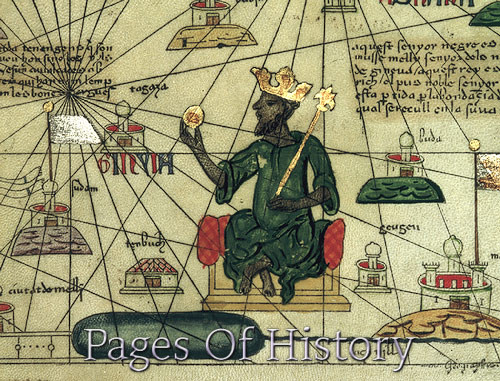
Yet Musa’s legacy persisted. Timbuktu remained a center of learning into the sixteenth century, and its manuscript collections—tens of thousands of texts preserved by families and libraries—survive today as a testament to the intellectual culture he helped foster. His image appeared on the Catalan Atlas of 1375, where he is depicted holding a gold nugget, a visual acknowledgment by European cartographers of the wealth and reach of Mali. The pilgrimage also cemented Mali’s place in the wider Islamic world, linking West Africa to the intellectual and commercial networks of the Mediterranean and the Middle East.
For historians, Mansa Musa is a corrective to narratives that treat medieval Africa as isolated or impoverished. His empire was a sophisticated state with a complex bureaucracy, a legal system, and a thriving culture. The accounts of al-Umari and Ibn Battuta, though filtered through foreign eyes, describe a society that was wealthy, orderly, and connected to global trade networks. Musa’s story also illustrates the limits of wealth: his spending in Cairo caused inflation, and the empire he ruled eventually declined, reminding us that economic power is contingent on institutions, geography, and time.
The Lasting Perspective: Wealth, Power, and Memory
Mansa Musa’s place in history rests on a paradox. He is remembered today primarily for his wealth—a modern obsession—yet the medieval sources emphasize his piety, his generosity, and his role as a patron of learning. The gold he distributed in Cairo is a vivid anecdote, but the mosques and manuscripts he commissioned outlasted the gold by centuries. His reign demonstrates how a state could leverage natural resources and trade routes into political and cultural capital, and how a single ruler’s actions could ripple across continents.
For readers encountering Mansa Musa for the first time, the takeaway is not simply that he was rich. It is that fourteenth-century West Africa was home to one of the world’s great powers, a state whose influence reached from the Atlantic to the Nile and whose legacy survives in the libraries of Timbuktu and the maps of medieval Europe. The question “Who was Mansa Musa?” is answered not only by his gold but by the institutions and ideas he helped build—and by the enduring fascination with a ruler whose wealth, even by modern standards, remains difficult to comprehend.