
📅 Last updated: 03.11.2026
The Fall of Constantinople on 29 May 1453 ended a Roman state that had endured for eleven centuries in the East and a city that had stood as a fortified capital for over a thousand years. For generations, popular memory has framed the Fall of Constantinople as a simple morality tale: a decaying empire, a brilliant young sultan, and walls that finally gave way before gunpowder. The reality is more specific and more interesting. Constantinople fell because of a convergence of logistical exhaustion, diplomatic isolation, technological adaptation, and one of the most disciplined siege operations in premodern history—conducted by an Ottoman state that was itself the heir to Byzantine administrative and military traditions.
The Fall of Constantinople on 29 May 1453 resulted from Ottoman Sultan Mehmed II’s methodical 53-day siege, backed by massive bronze bombards, a fleet that partially blockaded the Golden Horn, and the systematic reduction of Byzantine outer defenses. Constantinople’s fall was made inevitable less by the walls themselves than by the defenders’ numerical weakness—perhaps 7,000–8,000 men against 50,000–80,000 attackers—and by the absence of meaningful Western relief. The city fell on the morning of 29 May 1453 after the Janissaries breached the area near the Gate of St. Romanus.
- What Was the Strategic Context Before the Fall of Constantinople?
- Why Did the Theodosian Walls Fail?
- How Did Diplomacy and Religion Weaken the Defense?
- What Happened During the Final Assault on 29 May 1453?
- Was Gunpowder Really the Decisive Factor?
- What Were the Consequences of the Fall of Constantinople?
- Why Does the Fall of Constantinople Still Matter?
What Was the Strategic Context Before the Fall of Constantinople?
By the mid-fifteenth century, the Byzantine Empire had been reduced to a fragment: Constantinople itself, a strip of Thrace, a few Aegean islands, and the Morea (the Peloponnese). The empire’s tax base had collapsed, its coinage had been debased to near-worthlessness, and its population had shrunk catastrophically. When the Ottoman Sultan Murad II besieged Constantinople in 1422, the city survived largely because internal Ottoman politics forced a withdrawal. That reprieve did not reverse the structural decline.
The decisive strategic shift came with the Ottoman conquest of Thessalonica in 1430 and, more importantly, the consolidation of Ottoman power in the Balkans after the defeat at Varna in 1444 and the Second Battle of Kosovo in 1448. By the time Mehmed II ascended the throne a second time in 1451—having first ruled briefly in 1444–46 before being forced back by a Janissary revolt—the Ottomans controlled both shores of the Bosphorus and the Dardanelles. Constantinople was a walled enclave inside Ottoman territory, dependent on Ottoman goodwill for the grain shipments that fed it.
Mehmed understood the geography precisely. In 1452 he built the fortress of Rumeli Hisarı on the European shore of the Bosphorus, opposite the older Anadolu Hisarı, creating a choke point that could close the strait to Genoese and Venetian shipping. This was not a symbolic gesture. It was the logistical groundwork for a siege, and it worked: in November 1452, the Ottoman fortress bombarded and sank a Venetian vessel attempting to run the strait, an early demonstration that the sultan intended to control the approaches to the city.
Why Did the Theodosian Walls Fail?
The Theodosian Walls, completed in the fifth century under Emperor Theodosius II, were a layered system: a moat, an outer wall, and an inner wall of roughly 12 meters in height with 96 towers. For a millennium they had repelled every attacker, including the Avars, the Arabs in the sieges of 674–678 and 717–718, and the Bulgars. The walls were not obsolete in 1453—they were still formidable—but they were designed for a different threat profile.
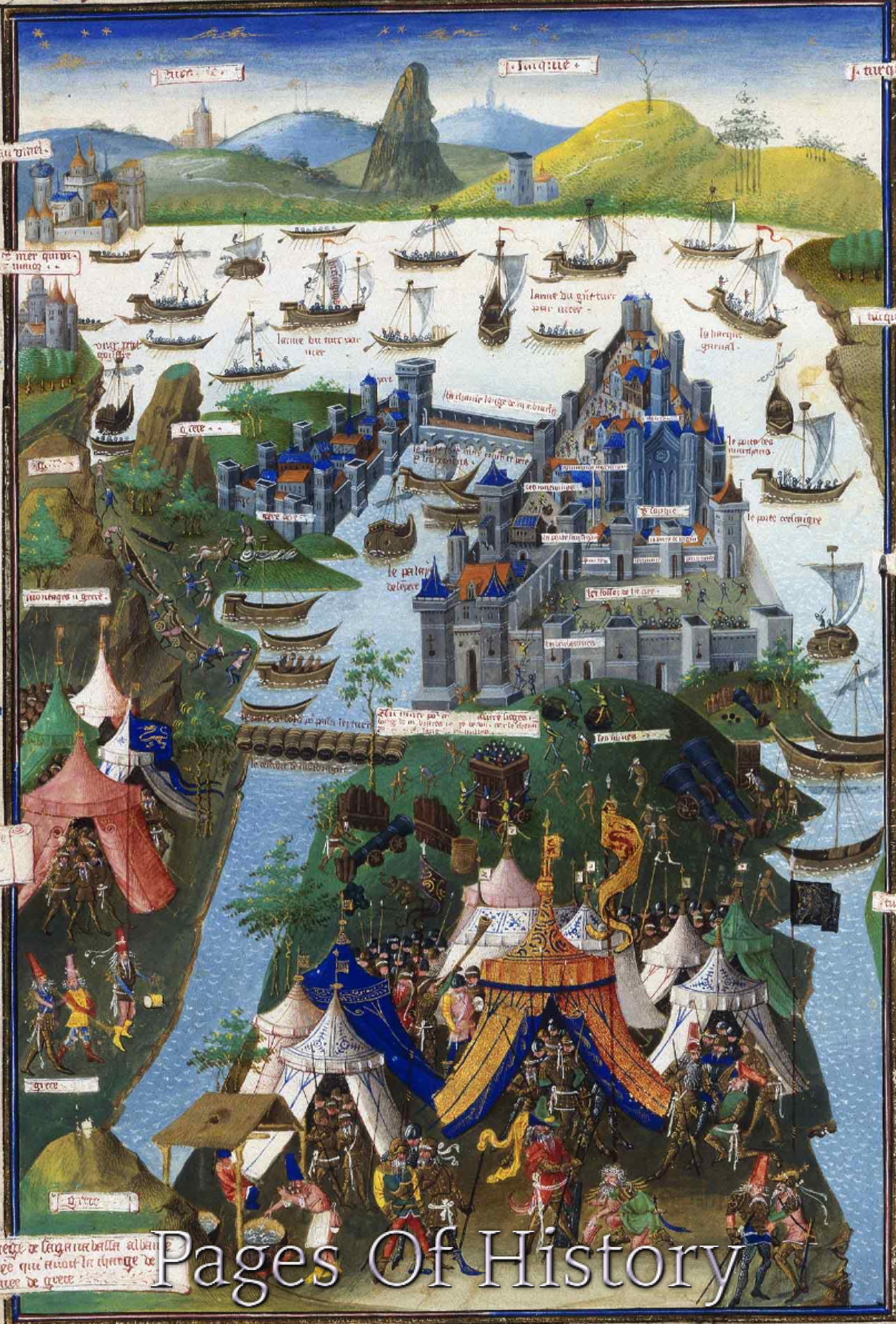
Mehmed’s answer was artillery. Working with the Hungarian founder Orban (variously spelled Urban), the Ottomans cast a series of enormous bronze bombards, including one often described as firing stone balls weighing roughly 600 kilograms (some sources give higher figures). The great bombard could be fired only a handful of times per day because of the heat generated and the risk of cracking, and it was notoriously inaccurate. But accuracy was not the point. The Ottomans used a battery of smaller and medium guns to batter the outer wall continuously while the great bombard targeted specific sections, particularly near the Gate of St. Romanus (modern Topkapı) in the Mesoteichion, the valley where the walls were lowest relative to the surrounding terrain.
The defenders, under Emperor Constantine XI Palaiologos, had some artillery of their own, but far less and of inferior quality; their gunpowder supply was limited and their foundry capacity negligible. The critical asymmetry was not simply that the Ottomans had cannon—the Byzantines had used cannon in the 1422 siege—but that the Ottomans could sustain a bombardment for weeks, repair and replace damaged guns, and coordinate artillery with infantry assaults.
- Continuous bombardment: Ottoman guns fired day and night at selected wall sections, preventing repairs and exhausting defenders.
- Filling the moat: Ottoman troops and laborers filled sections of the moat with rubble, earth, and fascines to allow infantry to approach the outer wall.
- Coordinated assault waves: Irregulars (azaps) and Anatolian troops attacked first to wear down defenders, followed by better-equipped provincial forces, and finally the Janissaries in a concentrated push.
- Naval pressure: The Ottoman fleet attempted to force the boom across the Golden Horn, and when that failed, Mehmed ordered ships hauled overland on greased wooden tracks to bypass the chain—a move that demoralized the defenders.
How Did Diplomacy and Religion Weaken the Defense?
The Fall of Constantinople was accelerated by the failure of Latin Christendom to mount a serious relief effort. The Union of Florence (1439) had nominally reunited the Eastern and Western churches under papal primacy, but it was deeply unpopular in Constantinople. Many Orthodox clergy and citizens regarded it as betrayal, and the slogan attributed to the anti-unionist faction—better the Turkish turban than the Latin mitre—captured a real sentiment. When Constantine XI sought Western aid, Pope Nicholas V and several Italian states responded with limited support: Genoese volunteers under Giovanni Giustiniani Longo, a few Venetian ships, and some papal galleys. But no major Western army marched to relieve the city.
Venice and Genoa were commercial rivals more interested in protecting their own trading privileges than in saving Byzantium. The Venetian Senate debated intervention and sent a small fleet, but it arrived too late to affect the outcome. The Genoese colony of Pera (Galata) across the Golden Horn remained officially neutral, though individual Genoese fought in the defense. The lack of a unified command among the defenders—Byzantines, Genoese, Venetians, and Catalans each with their own leaders—complicated the defense and contributed to the collapse of coordination at critical moments.
What Happened During the Final Assault on 29 May 1453?
The final Ottoman assault began in the early hours of 29 May 1453, after weeks of bombardment and several failed attempts. Mehmed ordered a general attack. The first waves, composed of irregulars and provincial troops, were repulsed with heavy losses. The second wave, better disciplined, also failed to break through. The third wave consisted of the Janissaries, the sultan’s elite infantry, who attacked in a concentrated column near the Gate of St. Romanus.
The critical break came when Giovanni Giustiniani Longo, the Genoese commander of the land defenses, was wounded—accounts differ on whether by an arrow, a bullet, or a stone fragment—and withdrew from the walls. His departure caused confusion among the defenders on that sector. Around the same time, a small group of Ottomans discovered that the Kerkoporta, a small postern gate near the Blachernae palace, had been left unlocked or was forced open. They entered the city and raised the Ottoman flag on the walls, causing panic. The defense collapsed.
Constantine XI died in the fighting; his body was never definitively identified. By midday, the city was in Ottoman hands. Mehmed entered Constantinople in the afternoon and rode to Hagia Sophia, where he ordered that the building be converted into a mosque. The city was subjected to the customary three days of plunder, though Mehmed limited the destruction and took steps to repopulate the city afterward.
| Date | Event | Significance |
|---|---|---|
| March 1452 | Construction of Rumeli Hisarı begins | Ottoman control of the Bosphorus choke point |
| November 1452 | Ottoman guns sink a Venetian ship at the Bosphorus | Demonstration of naval-artillery control |
| 2 April 1453 | Ottoman army encamps before Constantinople | Siege formally begins |
| 20 April 1453 | Naval battle in the Golden Horn; Christian ships reach the city | Moral boost for defenders, but no strategic relief |
| 22 April 1453 | Ottoman ships hauled overland into the Golden Horn | Bypasses the boom; demoralizes defenders |
| 29 May 1453 | Final assault; city falls | End of the Byzantine Empire |
Was Gunpowder Really the Decisive Factor?
Gunpowder artillery was necessary but not sufficient. The Ottoman bombards were slow, inaccurate, and prone to failure; several cracked during the siege. The walls were breached not by a single decisive shot but by weeks of cumulative damage, followed by infantry assault through the breaches. The defenders, moreover, repaired the walls repeatedly at night, using barrels, stones, and timber to fill gaps. The Ottomans countered by concentrating fire on the same sections and by filling the moat to allow closer approach.
The decisive factor was the Ottoman ability to sustain a large, well-supplied army in the field for nearly two months while maintaining naval pressure and rotating troops. Mehmed’s logistical organization—supply lines from Anatolia and the Balkans, the construction of siege works, the coordination of artillery, infantry, and naval forces—was the real innovation. The Byzantines, by contrast, could not replace losses, could not repair their walls indefinitely, and could not expect relief. The Fall of Constantinople was, in this sense, a triumph of sustained logistics and command organization as much as of technology.
What Were the Consequences of the Fall of Constantinople?
The immediate consequence was the end of the Byzantine Empire, the eastern half of the Roman Empire that had survived the fall of the West in 476. Mehmed II took the title Kayser-i Rûm (Caesar of Rome) and presented himself as the heir to Byzantine imperial authority, incorporating Byzantine administrative practices and employing Greek scribes and officials in the Ottoman state. Constantinople became the Ottoman capital (later Istanbul), and Mehmed launched a program of repopulation, resettling Greeks, Armenians, Jews, and Muslims in the city.
The longer-term consequences were profound. The fall removed a buffer between the Ottoman state and Christian Europe, and Ottoman expansion into the Balkans and toward Hungary accelerated. The flight of Greek scholars to Italy—though often exaggerated in its scale—contributed to the circulation of Greek manuscripts in the West and to the intellectual ferment of the Renaissance. The event also shaped European perceptions of the Ottoman Empire for centuries, feeding both fear and fascination.
For the Orthodox world, the fall of Constantinople had ecclesiastical consequences. The Patriarchate of Constantinople continued under Ottoman authority, with the sultan appointing the patriarch, but the city’s loss of political power shifted the center of Orthodox Christianity northward, particularly toward Moscow, which increasingly claimed the role of protector of Orthodoxy—a claim that would later be expressed in the idea of Moscow as the “Third Rome.”
Why Does the Fall of Constantinople Still Matter?
The Fall of Constantinople is often described as a turning point between the medieval and early modern worlds, and there is truth to that framing, but the transition was gradual. The Ottoman state that captured the city in 1453 was already a sophisticated early modern power with a standing army, a bureaucratic apparatus, and a legal system. The Byzantine Empire that fell was already a diminished fragment. What changed in 1453 was the symbolic and strategic landscape: the last direct heir of Roman imperial authority in the East was gone, and the Ottoman Empire became the dominant power in the eastern Mediterranean.
The siege also offers a case study in how military technology and logistics interact with political will. The Ottomans won because they could concentrate resources, adapt tactics, and sustain a campaign; the Byzantines lost because they could not. The walls of Constantinople were not obsolete—they were overwhelmed by a state that had learned to combine artillery, infantry, and naval power in a coordinated siege. That lesson would shape fortification design in Europe for the next two centuries, as engineers developed the low, angled bastion systems known as the trace italienne to resist cannon fire.
The Fall of Constantinople remains a subject of intense historical interest because it sits at the intersection of multiple histories: Roman, Byzantine, Ottoman, Mediterranean, and European. It is a story of a city that had survived for a thousand years and of the state that finally took it—not by a single stroke of genius, but by the patient accumulation of advantages that the defenders could not match. The real reason Constantinople fell is that the Ottoman Empire was stronger, better organized, and more willing to commit resources to the siege than the Byzantine state and its Western sympathizers were to save it.