
📅 Last updated: 14.11.2026
The Roman testudo formation was one of the most distinctive tactical innovations of the ancient world—a bristling shield “tortoise” that turned a century of legionaries into a moving fortress. Roman soldiers locked their curved scuta edge-to-edge on the front and flanks, then raised a second layer of shields overhead, creating a nearly seamless shell against arrows, slingstones, and thrown javelins. What made this formation so difficult to break was not any single feature but a combination of engineering, discipline, and battlefield psychology that few enemies could match.
The Roman testudo formation was hard to break because it layered interlocking curved shields into a continuous protective shell, relied on highly trained legionaries who could hold that shell under missile fire and on uneven ground, and advanced slowly enough to maintain cohesion while closing on a fortified position. Its main weaknesses—flank exposure, vulnerability to flanking or siege engines, and reduced mobility—were rarely exploitable by the missile-heavy armies Rome typically faced.
- What Exactly Was the Roman Testudo Formation?
- Why Was the Roman Testudo Formation So Hard to Break?
- How Did the Roman Testudo Formation Perform in Real Battles and Sieges?
- What Were the Weaknesses of the Roman Testudo Formation?
- Why Did Enemies Rarely Break the Roman Testudo Formation?
- What Does the Roman Testudo Formation Teach Us About Military Innovation?
- Why the Roman Testudo Formation Endures as a Symbol of Legionary Discipline
What Exactly Was the Roman Testudo Formation?
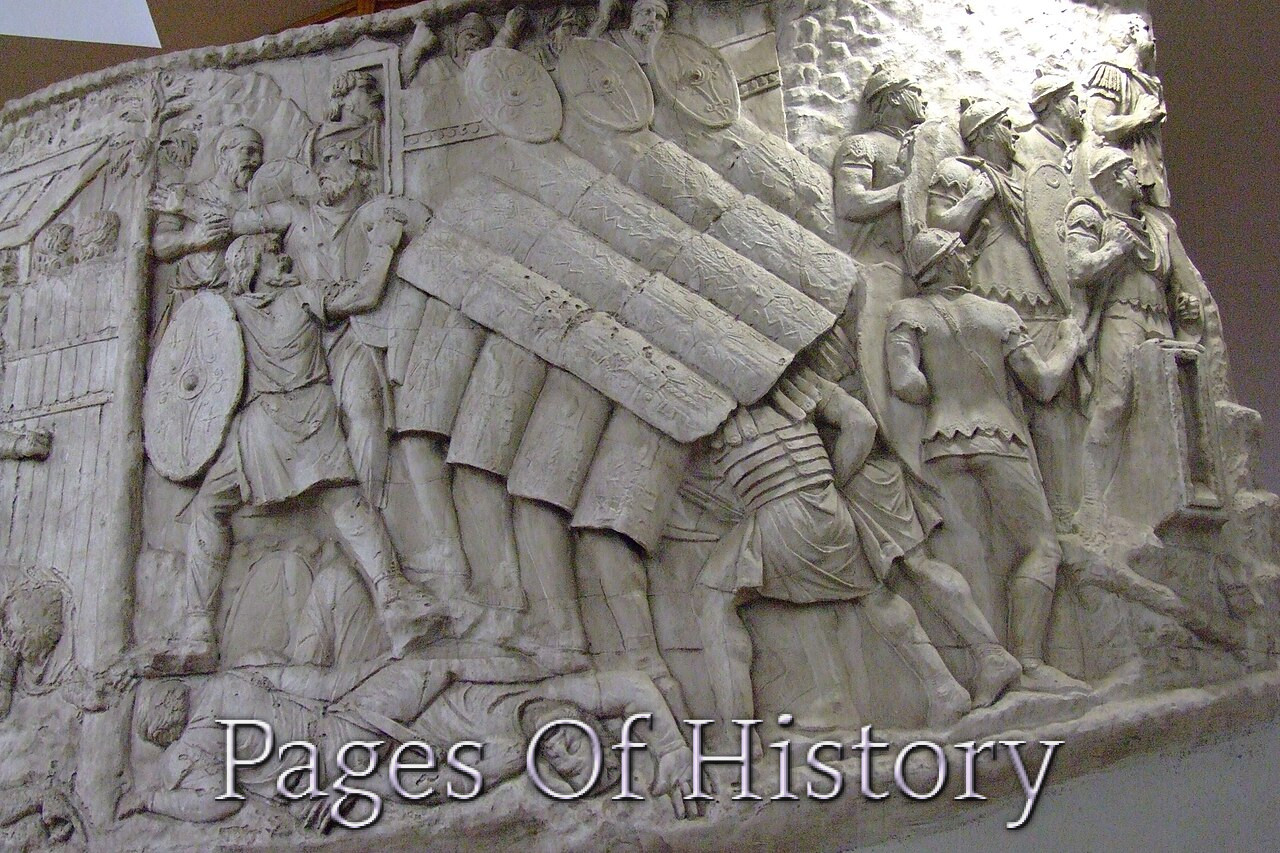
The word testudo is Latin for “tortoise,” and the name describes the shape rather than any single drill. The Roman historian Cassius Dio, writing about Mark Antony’s operations in 36 BC, gives one of the clearest ancient descriptions: the soldiers “closed up together and formed a testudo, joining their shields in front of them and over their heads.” Front-rank men held their shields vertically to form a wall; men behind raised theirs overhead, overlapping like roof tiles, so that missiles would glance off the curved surfaces rather than punch through.
The shields themselves mattered enormously. The imperial legionary scutum was a large, gently curved rectangle, roughly 1 meter tall, made of glued plywood strips covered in leather and edged with metal. The curve was not decorative—it created a convex surface that deflected arrows and gave overlapping shields a natural interlock. Polybius, describing Roman equipment in the 2nd century BC, notes the shield’s unusual size and the iron boss that reinforced its center, useful for punching in close combat but equally handy for bracing the shield line.
The testudo came in variants. A full “roofed” testudo protected against missiles from above and the front; a “siege” testudo might cover only the front and sides while soldiers worked a battering ram or undermined a wall. Vegetius, writing in the late 4th century AD, describes the drill in his Epitoma Rei Militaris as a standard exercise: recruits were trained to form the shell so that “arrows falling from above slide off like rain from a roof.”
Why Was the Roman Testudo Formation So Hard to Break?
The answer lies in overlapping layers of protection—physical, tactical, and psychological. No single element made the testudo invulnerable; together they made it disproportionately costly to attack.
1. Redundant, Deflecting Shield Geometry
A single shield can be split by an axe or pierced by a heavy arrow. A double layer of curved, overlapping shields is another matter. Missiles that strike the outer layer rarely carry enough energy to penetrate the inner one, and the curvature channels force sideways rather than through. Arrows shot at a steep angle—the standard trajectory against a besieged wall—glance off the roof of shields almost harmlessly. This is why testudo assaults on fortress gates and walls were so effective: defenders on ramparts could not generate the flat, perpendicular impact needed to defeat the shell.
2. Training and Unit Cohesion
The testudo demanded that every man in a century hold his position at the same pace. A gap of a few centimeters between shields was a death sentence for the man behind it. Roman legionaries trained constantly; Josephus, describing the Roman army in the 1st century AD, marvels that their drills were “bloodless battles” and their battles “bloody drills.” That discipline is what allowed a formation of hundreds of men to move as a single organism under a hail of projectiles—something militia or tribal warriors could rarely replicate.
3. Slow, Deliberate Advance
The testudo advanced at a walk, not a charge. This seems like a weakness, but it was the point: speed would break the shell. By moving slowly and steadily, the formation maintained its integrity all the way to the enemy wall or battle line. Against defenders who expected a rapid rush they could break up with missiles, the implacable crawl of a testudo was deeply demoralizing.
4. Psychological Deterrence
Ancient sources repeatedly note the intimidating effect of the shell. When a testudo advanced, defenders often wasted ammunition on it—arrows, stones, and javelins that bounced off the roof—while the Romans closed the distance unharmed. That expenditure of effort with no visible result sapped morale. The testudo was as much a psychological weapon as a physical one.
- Geometry: Curved, overlapping shields deflect rather than absorb missile energy.
- Discipline: Constant drill kept the shell sealed under fire and on rough ground.
- Tempo: A slow, steady advance preserved cohesion that a charge would destroy.
- Morale: The visible futility of missile attacks eroded defender confidence.
How Did the Roman Testudo Formation Perform in Real Battles and Sieges?
The testudo was primarily a siege and assault formation, and the historical record shows it at its best against fortified positions. At the siege of Jerusalem in AD 70, Josephus describes Roman soldiers forming testudines to approach the walls while under constant fire from Jewish defenders, then using the protected space to undermine foundations and bring up rams. The shell allowed engineering work to proceed within meters of hostile ramparts—work that would otherwise have been suicidal.
Earlier, during the Roman siege of Carthage in 149–146 BC, and in countless smaller operations across Gaul, Spain, and the Greek East, testudo tactics protected soldiers approaching gates and walls. Julius Caesar’s accounts of siege warfare in Gaul (58–50 BC) show Roman troops routinely using shield-roof formations to approach Gallic fortifications, and the technique appears in the archaeological record of siege works at sites such as Alesia.
The formation also had a battlefield role. At the Battle of Carrhae in 53 BC, Marcus Licinius Crassus’s legions faced Parthian horse archers on open desert. Roman sources describe the legions attempting to form testudines to shelter from the arrow storm—but the Parthians, mounted and mobile, simply circled and shot into the gaps and flanks, and the Romans could not close with them. Carrhae is the classic demonstration that the testudo was a siege tool, not a cure-all for open-field missile warfare.
| Event | Date | Context | Testudo Outcome |
|---|---|---|---|
| Siege of Carthage | 149–146 BC | Roman assault on Punic fortifications | Effective; protected approach and siege work |
| Caesar’s Gallic sieges (e.g., Alesia) | 52 BC | Approach to Gallic walls and gates | Effective in siege context |
| Battle of Carrhae | 53 BC | Open desert vs. Parthian horse archers | Failed; flanks and gaps exploited |
| Siege of Jerusalem | AD 70 | Assault on city walls under missile fire | Effective; enabled ram and mining work |
| Late imperial drill (Vegetius) | c. AD 390 | Standard training exercise | Codified as routine legionary skill |
What Were the Weaknesses of the Roman Testudo Formation?
No formation is invincible, and the testudo had clear limits that skilled enemies learned to exploit.
Flank and Rear Exposure
A testudo is a shell with a soft underside. The front and top are protected, but the sides and rear are far more vulnerable, and once the formation is engaged at a wall it cannot easily turn. An enemy who could maneuver—cavalry, skirmishers, or a sally from a second gate—could attack the unprotected flanks. This is precisely what made the Parthian tactics at Carrhae so devastating: mobility against a formation that had sacrificed mobility for protection.
Reduced Mobility and Vision
Soldiers under a shield roof cannot see much beyond the man in front. Command and control degrade, and the formation moves slowly. On broken ground, in mud, or on a slope, gaps open between shields, and a gap is a target. The testudo worked best on flat, predictable approaches to a fixed objective.
Vulnerability to Heavy Missiles and Siege Engines
Light arrows glanced off, but heavy bolts from ballistae, stones from onagers, and especially fire pots could break the shell. A large stone or a flaming projectile striking the roof could shatter shields and the men beneath them. Defenders who had artillery—or who could drop heavy weights from walls—could make the approach costly. The testudo was designed against massed light missiles, not against siege artillery.
Fatigue
Holding a heavy shield overhead for minutes at a time, while walking in step and maintaining contact with neighbors, is exhausting. A long approach under fire drained soldiers before they reached the wall, and a tired man lowers his shield. Roman training mitigated this, but it could not eliminate it.
Why Did Enemies Rarely Break the Roman Testudo Formation?
The deeper reason the testudo was so hard to break is that most of Rome’s enemies lacked the specific combination of tools needed to beat it: mobility to hit the flanks, heavy artillery to smash the roof, and the discipline to coordinate attacks against a moving formation. Tribal warriors in Gaul or Germany fought with ferocity but rarely had the unit cohesion to maneuver around a sealed shell. Missile-heavy armies like the Parthians could punish it in the open, but they could not storm a besieged city, and the testudo was above all a siege tool.
Rome’s own tactical culture reinforced this. The legion was a combined-arms system: testudo assault troops, artillery (ballistae and scorpiones), and supporting infantry worked together. The testudo was never meant to fight alone; it was a component of a siege machine, and attacking it meant attacking the whole Roman siege apparatus. That systemic integration—shield drill, engineering, artillery, and logistics—is what made the formation so durable in practice.
What Does the Roman Testudo Formation Teach Us About Military Innovation?
The testudo is a case study in how technology and discipline interact. The curved scutum was a piece of engineering, but without the drill to interlock hundreds of them, it was just a big shield. The Romans did not invent the shield wall—Greek hoplites and others used overlapping shields—but they systematized the idea into a repeatable, trainable drill that any legion could execute. Vegetius’s late-imperial training manual shows the technique was still standard centuries after Carrhae, a remarkable continuity.
The formation’s limits are equally instructive. It excelled in the specific environment it was designed for—approaching fortifications under light missile fire—and failed when that environment changed, as at Carrhae. Military innovation is always contextual: a tool that dominates one battlefield can be a liability on another. The testudo’s longevity came from Romans understanding exactly when to use it and when not to.
- Design for the threat: The testudo targeted massed light missiles, the dominant threat in siege warfare.
- Train the drill, not just the gear: The shield was common; the discipline to interlock it was Roman.
- Integrate with the system: The testudo worked as part of a combined-arms siege apparatus, not alone.
Why the Roman Testudo Formation Endures as a Symbol of Legionary Discipline
The testudo outlasted the legions that perfected it. Medieval armies used shield-roof formations, and the image of the tortoise of shields remains one of the most recognizable icons of Roman military power. Its endurance is not because it was unbeatable—Carrhae proved otherwise—but because it captured something essential about Roman warfare: the conversion of individual soldiers into a single, disciplined organism. The Roman testudo formation was hard to break because it was hard to build, and building it required exactly the qualities Rome prized most in its soldiers: patience, cohesion, and the willingness to trust the man beside you with your life. That is the lasting lesson of the tortoise—protection is not a matter of one shield, but of many shields held as one.