
📅 Last updated: 10.07.2026
- The Great Library of Alexandria: A City Built on Knowledge
- The First Blow: The Siege of Alexandria (48 BCE)
- The Slow Decline Under Roman Rule
- The Final Catastrophes: Aurelian and Theophilus
- Why the Arab Conquest Myth Persists
- Key Events in the Library's Decline: A Timeline
- The Real Legacy: What We Lost and What We Gained
- Conclusion: A Lesson in Historical Complexity
The popular image of the Library of Alexandria—a single, grand building consumed by fire in a single, dramatic event—is one of history’s most enduring and misleading myths. In reality, the Library of Alexandria was not one library but a complex of institutions, its decline was a protracted process spanning centuries, and its destruction was not a single act but a series of political, military, and economic catastrophes. The real reason the Library of Alexandria was destroyed is not a simple answer involving a mad Roman emperor or a zealous caliph, but a tragic story of systemic neglect, civil war, and the slow, grinding erosion of an entire civilization’s intellectual infrastructure.
The Great Library of Alexandria: A City Built on Knowledge
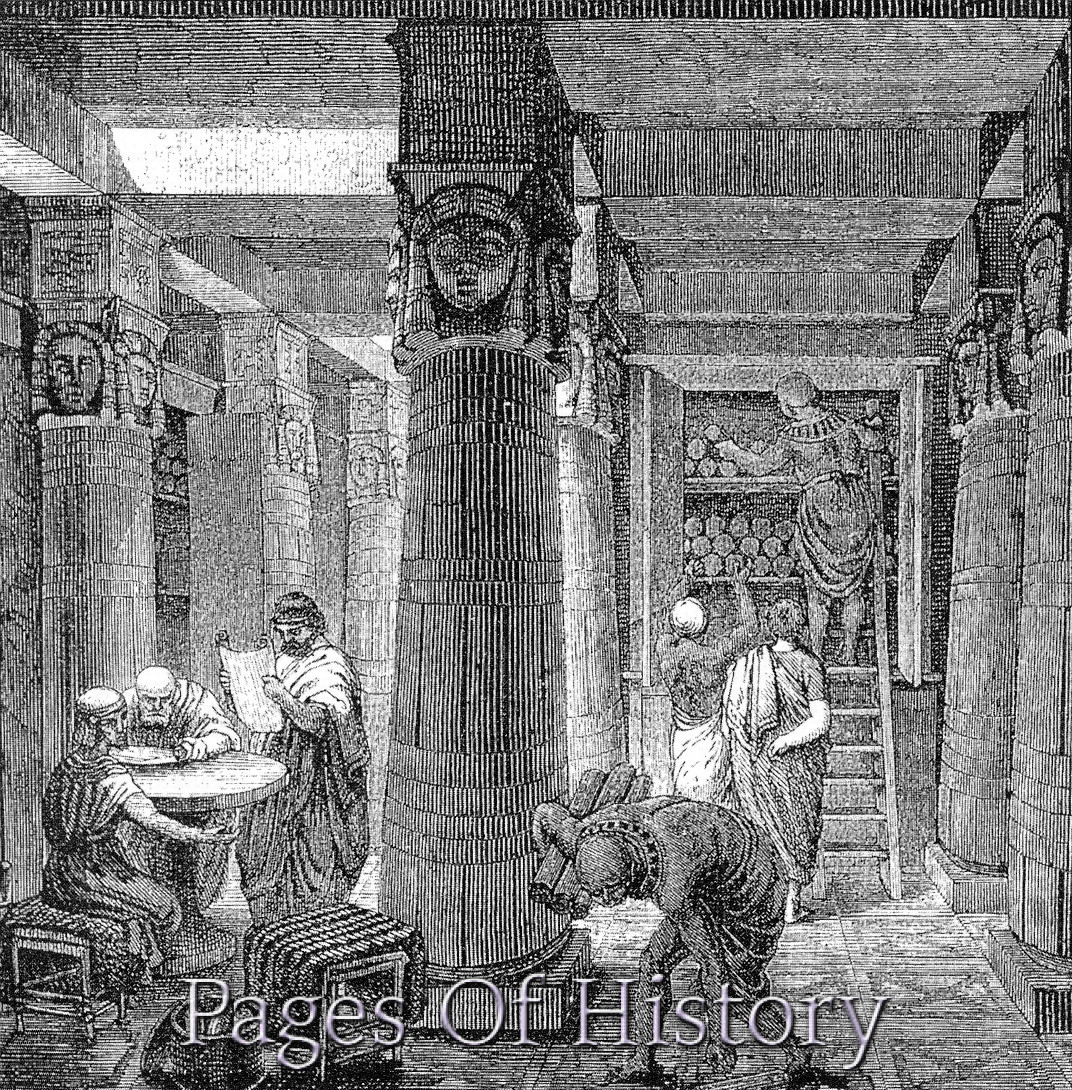
To understand its destruction, one must first understand its creation. The Library was the brainchild of Ptolemy I Soter, a successor of Alexander the Great who took control of Egypt after Alexander’s death in 323 BCE. The Ptolemies established Alexandria as the Mediterranean’s premier center of commerce and culture. The Library, part of the larger Mouseion (a temple to the Muses, essentially a research institute), was designed to attract the greatest scholars of the Greek world. Its mission was audacious: to collect a copy of every book in existence.
The Acquisition Machine
The Ptolemies used aggressive, sometimes ruthless, methods to amass their collection. Ships docking in Alexandria’s harbor were searched for scrolls. Any found were confiscated, copied by state scribes, and the copies returned to the owners. The originals were kept for the Library. This policy, while ethically dubious, was spectacularly effective. By the reign of Ptolemy III Euergetes (246–222 BCE), the Library housed perhaps 400,000 to 700,000 scrolls. This was not a mere collection; it was a comprehensive archive of human knowledge, containing works of mathematics, astronomy, medicine, literature, philosophy, and history from across the known world. Scholars like Euclid, Archimedes, Eratosthenes (who calculated the Earth’s circumference), and the astronomer Hipparchus all worked within its halls.
The First Blow: The Siege of Alexandria (48 BCE)
The first major documented destruction of the Library of Alexandria occurred not at the hands of a barbarian, but during a Roman civil war. In 48 BCE, the Roman general Julius Caesar arrived in Alexandria in pursuit of his rival, Gnaeus Pompeius Magnus. Pompey was already dead, assassinated by the Egyptians, but Caesar found himself entangled in the dynastic struggle between Cleopatra VII and her brother, Ptolemy XIII.
Caesar’s Alexandrian War
Caesar, attempting to mediate, was besieged in the royal palace complex, which housed the Library. To break the siege and destroy the Egyptian fleet anchored in the harbor, Caesar ordered his men to set the ships on fire. The flames, fanned by a strong wind, spread from the docks to the city itself. The Roman historian Cassius Dio, writing centuries later, states that the fire consumed the grain warehouses and “a great number of books.” The exact extent of the damage is debated. It is likely that the fire destroyed a large warehouse near the harbor containing scrolls awaiting sorting and cataloging—perhaps tens of thousands of volumes—but the main library building and the Mouseion survived.
What Was Lost?
While the loss was devastating, it was not the end. The Library continued to function after Caesar’s departure. Cleopatra, who became Caesar’s lover and later Mark Antony’s, is said to have attempted to replenish the collection. The ancient writer Plutarch claims that Mark Antony gifted Cleopatra over 200,000 scrolls from the rival library at Pergamum. This act, even if embellished, suggests that the institution was still considered valuable and worth rebuilding. The real damage of the Caesarian fire was symbolic and practical: it demonstrated that the city’s intellectual heart was vulnerable to the violence of Roman power politics.
The Slow Decline Under Roman Rule
The true death of the Library of Alexandria was not a fire, but a process of bureaucratic and intellectual strangulation. After Egypt became a Roman province in 30 BCE (following Cleopatra’s defeat by Octavian, later Augustus), the city of Alexandria remained a major center, but its relationship to power changed dramatically.
The Shift in Patronage
The Ptolemies had been active, dedicated patrons. The Roman emperors, however, were often indifferent or actively hostile. They viewed the Library as a potentially subversive institution—a place where Greek intellectuals could gather and criticize Roman rule. The Mouseion and its scholars were increasingly cut off from state funding. The great age of Alexandrian science—the era of Eratosthenes and Archimedes—ended. The focus shifted from original research to commentary, editing, and preservation. This was still valuable work, but it lacked the dynamism of the past.
A Key Date: The Antonine Plague (165-180 CE)
A more devastating blow came not from armies, but from disease. The Antonine Plague, likely smallpox brought back by Roman soldiers from the East, ravaged the Roman Empire. Alexandria, a densely packed port city, was hit especially hard. The population plummeted, and the city’s economy collapsed. The Library and the Mouseion, already struggling for patronage, lost their remaining support. This is likely the period when the institution ceased to function as a living research center. The building may have stood, but the life had gone out of it.
The Final Catastrophes: Aurelian and Theophilus
By the 3rd century CE, the Roman Empire was in crisis. In 270 CE, the Queen of the Palmyrene Empire, Zenobia, invaded Egypt. The Roman Emperor Aurelian recaptured Alexandria in 272 CE after a brutal siege. The historian Ammianus Marcellinus records that during the fighting, the “Brucheion,” the royal quarter of the city that housed the Mouseion and its library, was completely destroyed. This was not a targeted attack on knowledge; it was the indiscriminate destruction of a rebellious city’s most prestigious district. After this, the original Library of Alexandria was physically gone.
The Serapeum: The Last Refuge of the Scrolls
However, a daughter library existed. For decades, perhaps centuries, a secondary collection of scrolls had been housed in the Serapeum, the magnificent temple of the god Serapis. This was a public library, more accessible than the main research library. When the Brucheion was razed, the Serapeum became the final repository of Alexandria’s surviving intellectual heritage.
The Christian Mobs (391 CE)
The final, and most symbolic, act of destruction occurred in 391 CE. By this time, Christianity was the official religion of the Roman Empire. The Emperor Theodosius I issued a series of edicts banning pagan worship and ordering the closure of all pagan temples. In Alexandria, the powerful Patriarch Theophilus saw an opportunity. He led a mob of Christian zealots to attack the Serapeum, the city’s most prominent symbol of the old religion.
The temple was stormed, sacked, and burned. The statue of Serapis was smashed. The scrolls within—the last remnants of the Great Library’s collection—were either destroyed in the fire or looted. The historian Socrates Scholasticus, writing a few decades later, describes the event with chilling brevity: “The temple of Serapis at Alexandria was destroyed, and with it the library that had been housed there.”
The Final Loss: What Was In Those Scrolls?
This was the true end. The loss at the Serapeum was not of one building, but of the last surviving copies of countless works. We can only imagine what was lost: the complete plays of Sophocles and Euripides (we have only 7 of each out of over 100), the lost histories of Livy, the philosophical treatises of the Pre-Socratics, the mathematical works of Apollonius of Perga, and the detailed geographical surveys of the ancient world. The destruction was a self-inflicted wound, an act of cultural vandalism by one ideology against all others.
Why the Arab Conquest Myth Persists
No discussion of the Library of Alexandria is complete without addressing the most famous, and most false, story: that it was destroyed by the Arab general Amr ibn al-As in 642 CE. The story claims that Caliph Umar ordered the library burned, saying, “If these books agree with the Quran, they are useless; if they disagree, they are harmful. Therefore, burn them.”
This tale, which appears in the writings of the 13th-century Christian historian Bar Hebraeus, is almost certainly a fabrication.
Evidence Against the Myth
- Silence of Contemporary Sources: No 7th-century Arab, Greek, or Coptic historian mentions the destruction. John of Nikiû, a Coptic bishop who wrote a detailed chronicle of the Arab conquest, does not mention a library burning.
- No Library to Burn: By 642 CE, the Library of Alexandria had ceased to exist for over 250 years. The Serapeum was gone since 391. The Brucheion was gone since 272. There was no substantial collection of books to destroy.
- Motivation: The story was invented centuries later by Christian polemicists to paint Islam as an inherently anti-intellectual religion. In reality, the early Islamic caliphates were great patrons of learning, translating and preserving vast amounts of Greek philosophy and science.
- Contradictory Evidence: Amr ibn al-As was a cultured man who, according to other sources, allowed the Christian population of Alexandria to keep their churches. The idea that he would systematically burn books is inconsistent with his character and the policies of the early Caliphate.
The myth endures because it provides a simple, satisfying villain. The truth—a slow, complex death by neglect, civil war, and religious zealotry—is far more uncomfortable, because it implicates not a single enemy, but the entire arc of late antique history.
Key Events in the Library’s Decline: A Timeline
The following table summarizes the major events that contributed to the Library’s destruction. Note that there is no single date of “destruction.”
| Date | Event | Impact on the Library |
|---|---|---|
| ~280 BCE | Founding of the Library under Ptolemy I/II | Creation of the Mouseion and Library; peak of collection and scholarship. |
| 48 BCE | Caesar’s fire during the Alexandrian War | Destruction of a dock-side warehouse of scrolls; partial damage, but institution survives. |
| 165-180 CE | Antonine Plague | Severe depopulation and economic collapse; loss of patronage and scholars. |
| 272 CE | Siege of Alexandria by Emperor Aurelian | Physical destruction of the Brucheion district; the main library building is destroyed. |
| 391 CE | Destruction of the Serapeum by Christian mobs | Final destruction of the daughter library; last major collection of scrolls is lost. |
| 642 CE | Arab conquest of Alexandria | No evidence of library destruction; the institution had already been gone for centuries. |
The Real Legacy: What We Lost and What We Gained
The destruction of the Library of Alexandria was not a single, apocalyptic event. It was a slow hemorrhage of knowledge across four centuries. The real tragedy is not that one building burned, but that an entire culture of inquiry, a network of institutions and patronage, was allowed to wither and die. The loss was not just of scrolls, but of the process of knowledge creation—the ability to compare texts, to debate ideas, to perform experiments, and to train the next generation of scholars.
What Survived?
- Transmission through other centers: Many works survived because they were copied in Constantinople, Rome, and later in the Islamic world. The works of Euclid, Ptolemy, and Galen were preserved in Arabic translations, which later sparked the European Renaissance.
- The idea of the Library: The concept of a universal library, a comprehensive archive of all knowledge, survived the Library itself. It inspired later institutions, from the Library of Congress to the British Library.
- A cautionary tale: The story of the Library of Alexandria, even in its mythologized form, serves as a powerful warning about the fragility of knowledge and the importance of protecting cultural heritage from political violence and ideological intolerance.
Conclusion: A Lesson in Historical Complexity
The real reason the Library of Alexandria was destroyed was not one fire, one army, or one religion. It was a combination of systemic factors: the collapse of state patronage under Roman rule, the demographic catastrophe of plague, the violence of civil war, and finally, the militant intolerance of a rising religious orthodoxy. The story is a masterclass in historical complexity. It reminds us that the great turning points of history are rarely simple. They are the result of many forces acting over time, each one chipping away at something that once seemed permanent.
The Library of Alexandria was not murdered in a single, dramatic act. It was slowly starved, wounded repeatedly, and finally, when it was already a shadow of its former self, it was finished off by those who saw its contents as a threat. The lesson for our own digital age is clear: knowledge is not safe just because it is collected. It must be actively preserved, funded, protected, and valued by the society that holds it. The Library of Alexandria died because the world that built it no longer cared enough to keep it alive. That is the real, and deeply human, reason for its destruction.