
📅 Last updated: 07.07.2026
- The Waning Empire: A State Hollowed from Within
- The Gunpowder Revolution: The Engine of the Fall of Constantinople
- The Human Factor: Leadership, Desperation, and a Fatal Mistake
- The Aftermath: Plunder, Transformation, and the End of an Era
- Why the West Failed to Act: A Legacy of Distrust
- The Long-Term Consequences of the Fall of Constantinople
- Conclusion: The Real Reason Revisited
The Fall of Constantinople on May 29, 1453, was not a single event but the culmination of centuries of systemic decay, strategic blunders, and a dramatic shift in the balance of military technology. While popular history often paints it as a sudden, tragic end, the city’s conquest by the 21-year-old Ottoman Sultan Mehmed II was the inevitable result of a relentless siege that exploited deep structural weaknesses within the Byzantine Empire. The real reason for the city’s fall lies not in one heroic last stand, but in a perfect storm of financial collapse, demographic depletion, and the brutal effectiveness of gunpowder artillery.
The Waning Empire: A State Hollowed from Within
By the dawn of the 15th century, the Byzantine Empire was a ghost of its former Roman self. Once a vast Mediterranean superpower, it had been reduced to a small, tribune-paying city-state clinging to the tip of the Balkan peninsula. The Fourth Crusade in 1204 delivered a near-fatal blow, sacking the city and establishing a Latin Empire for 57 years. Though the Palaiologos dynasty recaptured Constantinople in 1261, they inherited a ruined shell.
Economic Strangulation and Demographic Collapse
The empire’s economy had collapsed. The loss of Anatolia, the empire’s richest agricultural and recruiting ground, to the Seljuk and later Ottoman Turks, starved Constantinople of both food and men. By 1453, the city’s population had plummeted from a high of perhaps 500,000 in the 10th century to a mere 40,000 to 50,000 souls. The once-great imperial city was a patchwork of abandoned mansions, overgrown fields, and small, fortified villages within the walls.
– Trade Dominance Lost: The Italian maritime republics of Venice and Genoa had taken over the lucrative Black Sea and spice trades. The Byzantines were reduced to taxing what little traffic passed through the Bosporus, often at rates dictated by their Italian “allies.”
– Currency Debasement: The once-revered gold hyperpyron had been debased to near-worthlessness. The empire could no longer mint reliable coinage to pay soldiers or buy supplies.
– Desperate Diplomacy: Emperor Constantine XI Palaiologos, the last Roman emperor, spent his reign begging for aid from Western Europe. In 1439, at the Council of Florence, the Byzantine church agreed to a humiliating union with the Roman Catholic Church in exchange for a promised crusade. This union was deeply unpopular in Constantinople, where the populace famously declared they would rather see the Sultan’s turban than the Pope’s mitre. The promised crusade was crushed at the Battle of Varna in 1444.
The emperor could only muster a defending force of roughly 7,000 men, including a contingent of perhaps 700 elite Genoese soldiers under the brilliant commander Giovanni Giustiniani Longo. Against them, Mehmed II assembled an army estimated at 80,000 to 100,000 regular troops, plus thousands of auxiliaries, engineers, and laborers.
The Gunpowder Revolution: The Engine of the Fall of Constantinople
The single most decisive factor in the siege was the Ottoman deployment of massive bombards, or siege cannons. While the city’s famous Theodosian Walls had repelled countless enemies for over a thousand years, they had never faced gunpowder artillery of this scale.
Urban the Hungarian and the “Great Bombard”
Mehmed II was a student of military technology. He personally recruited a Hungarian engineer named Urban, who had previously offered his services to Constantine XI. The emperor, unable to afford Urban’s salary or the raw materials for his cannons, turned him away. Mehmed, by contrast, paid Urban four times his asking price and gave him unlimited resources.
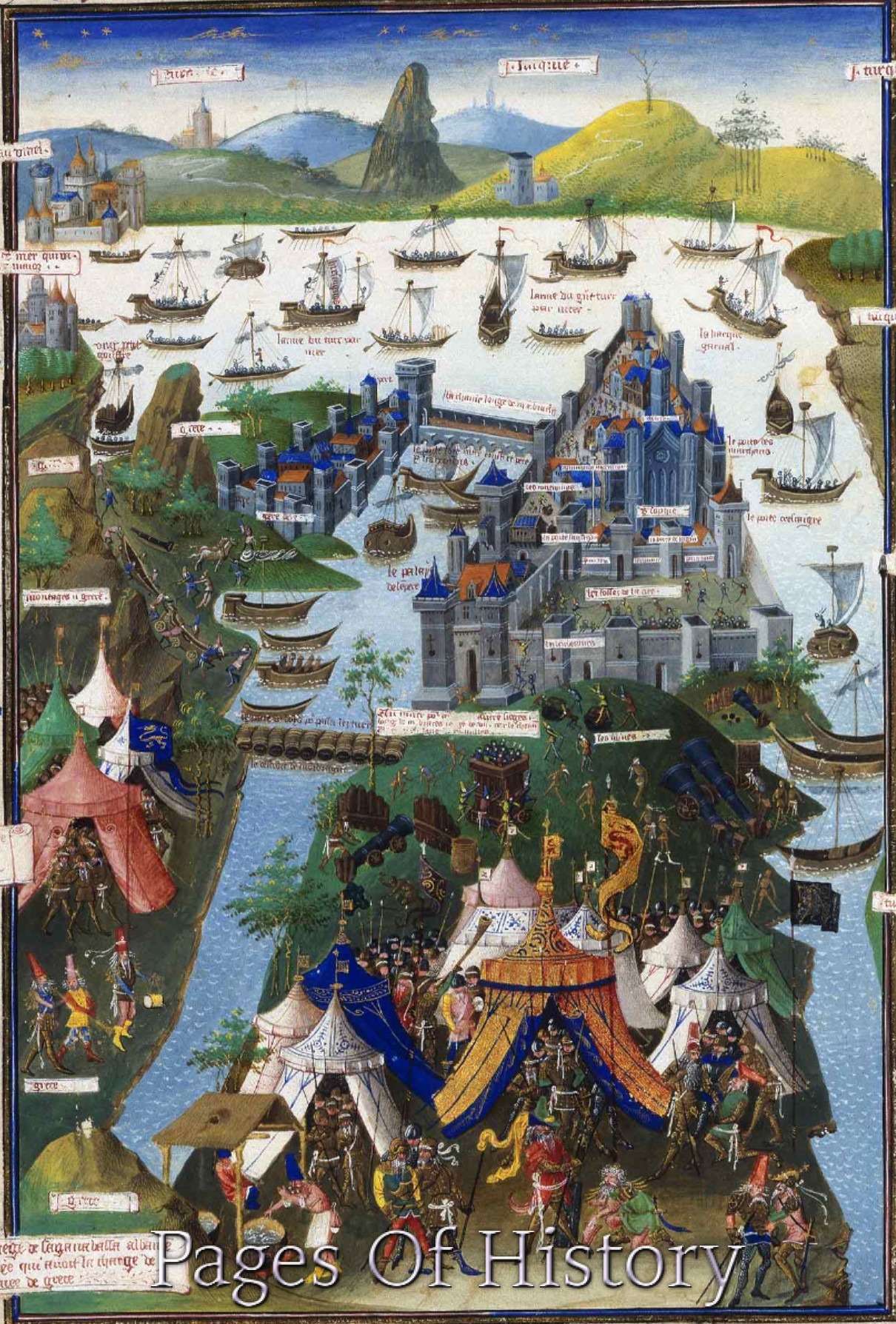
Urban cast a colossal bombard at Adrianople (Edirne) that was 27 feet long, weighed 19 tons, and fired stone balls weighing over 1,200 pounds. It took 60 oxen and 400 men to drag it to Constantinople, a journey of several weeks. This was not a precision weapon; it took hours to cool and reload after each shot, and its thunderous blast could be heard for miles. Yet its psychological impact was devastating.
“With the first shot, the wall shook violently. The second shot brought down a section of the parapet. The walls of Theodosius, which had stood for a millennium, were being reduced to rubble.” – Paraphrased from contemporary chronicler Doukas.
The Ottomans did not rely on one gun. They deployed a battery of perhaps 60-70 cannons of varying sizes, creating a continuous barrage that systematically hammered the land walls. The defenders, led by Giustiniani, worked frantically each night to repair the breaches with wooden palisades, rubble, and earth-filled barrels. But the tempo of destruction was relentless.
| Siege Element | Byzantine Defenders | Ottoman Attackers |
|---|---|---|
| Total Forces | ~7,000 (including 2,000 foreigners) | 80,000 – 100,000 + auxiliaries |
| Naval Power | 26 ships (mostly Genoese) | ~125 ships (including galleys) |
| Artillery | Small cannons, limited powder | ~70 cannons, including the Great Bombard |
| Leadership | Constantine XI & Giustiniani Longo | Sultan Mehmed II & Zagan Pasha |
| Key Weakness | Demographic & economic collapse | Logistical strain, naval vulnerability |
The Golden Horn Barrier Breached
The sea walls along the Golden Horn, protected by a massive iron chain, were the city’s other great defense. The Byzantine fleet, though small, was able to prevent the Ottoman navy from landing troops inside the harbor. Mehmed devised a legendary solution. In a feat of military engineering, he ordered his ships to be dragged overland on greased logs, across the hills of Galata (Pera), a distance of roughly three miles. On the night of April 22, 1453, the Ottoman fleet was launched into the Golden Horn behind the chain.
This maneuver split the defenders’ attention. They now had to man both the land walls and the harbor walls, stretching their already thin lines to the breaking point. The Genoese merchants of Galata, who had been officially neutral, were now intimidated into not helping the Byzantines.
The Human Factor: Leadership, Desperation, and a Fatal Mistake
While technology was the hammer, human decisions shaped the final blow. The siege lasted 54 days, from April 6 to May 29. The defenders fought with extraordinary courage, repelling multiple assaults. Constantine XI, a man of genuine integrity and bravery, led from the front, personally fighting on the walls alongside his men.
Giustiniani’s Wound and the Collapse of the Defense
The final Ottoman assault began in the early hours of May 29. It came in three waves: first, the azabs (irregulars) were sent to tire the defenders, then the Anatolian troops of Ishak Pasha, and finally, the elite Janissaries of the Sultan’s own guard. The Janissaries, the world’s first modern standing army, were slave-soldiers trained from childhood, fanatically loyal, and armed with composite bows, scimitars, and early firearms.
The decisive moment came at the Kerkoporta, a small postern gate in the Blachernae section of the walls. A group of Ottoman soldiers discovered it had been left unlocked. They poured in, but were quickly contained by the defenders. However, the greater disaster struck at the main breach. Giovanni Giustiniani was struck by a crossbow bolt or a bullet—sources differ—and was grievously wounded. He begged to be taken to the rear for treatment.
Constantine XI pleaded with him to stay, but Giustiniani was carried away by his men. The sight of their beloved commander leaving the walls caused a sudden, catastrophic panic. The Latin soldiers, believing the battle lost, began to fall back. The Janissaries seized the moment. A giant named Ulubatlı Hasan was the first Ottoman soldier to mount the wall, followed by dozens more. The line was broken.
Constantine XI’s Last Stand: The emperor, seeing the city was lost, is said to have thrown off his imperial regalia and charged into the mass of Ottoman soldiers, fighting with his sword until he was overwhelmed and killed. His body was never positively identified. Giustiniani himself died of his wounds a few days later on the island of Chios.
The Aftermath: Plunder, Transformation, and the End of an Era
Mehmed II granted his army the traditional three days of plunder, as was the custom of Islamic conquest. The city was systematically looted. Churches were stripped of their treasures, icons were smashed, and thousands of inhabitants were enslaved or killed. The great Hagia Sophia, the architectural marvel of the Christian world, was stripped of its Christian relics and converted into a mosque. The first Friday prayers were held there on June 1, 1453.
From Byzantium to Istanbul
Mehmed II, now styled Fatih (the Conqueror), acted with astonishing speed and pragmatism. He immediately began repopulating the city, offering incentives for Muslims, Christians, and Jews from across his empire to move there. He guaranteed the safety of the surviving Greek Orthodox population, even appointing a new Patriarch, Gennadius Scholarius, to lead them. The city was renamed Konstantiniyye in official Ottoman parlance, but it increasingly became known as Istanbul (from the Greek eis tin polin, “to the city”).
– Strategic Repopulation: Mehmed forced deportations of skilled artisans, merchants, and peasants from conquered territories like Trebizond and the Morea to fill the empty city.
– Architectural Transformation: The city was rebuilt with mosques, madrasas (schools), hammams (bathhouses), and a covered bazaar (the Grand Bazaar) that became the commercial heart of the Ottoman Empire.
– Legal Continuity: The Millet system was established, allowing religious communities (Orthodox, Armenian, Jewish) to govern their own civil affairs under their own religious laws, a system that would last for 400 years.
Why the West Failed to Act: A Legacy of Distrust
The Fall of Constantinople sent shockwaves through Christendom. Yet, no major relief force had arrived. The reasons for this failure are as important as the siege itself.
The Broken Promise of the Crusade
The papacy under Pope Nicholas V called for a crusade, but it was too little, too late. The Western powers were paralyzed by their own conflicts.
– Hundred Years’ War: England and France had just ended their century-long war in 1453. Both nations were exhausted and had no appetite for a new, expensive campaign in the East.
– Italian City-State Rivalry: Venice and Genoa were bitter rivals. While Venice had a fleet in the Aegean, it was slow to mobilize. Many Venetian merchants actually preferred trading with the Ottomans over fighting them, seeing the empire as a stable commercial partner.
– Hungarian Threat: The Kingdom of Hungary was the primary land barrier to Ottoman expansion into Europe. While they had fought Mehmed’s father, Murad II, they were wary of a direct confrontation with the new Sultan’s massive army and artillery.
– The Great Schism: The religious union of Florence (1439) had been rejected by most Byzantines. Many Western rulers felt no obligation to defend a people they considered schismatics or heretics who had refused to accept Papal authority in good faith.
The message was clear: the Byzantine Empire was alone. The West had either abandoned it or was too divided to act.
The Long-Term Consequences of the Fall of Constantinople
The fall of the city was a hinge point in world history, with consequences that rippled for centuries.
The Ottoman Empire Ascendant
Constantinople became the new capital of a world empire. From this strategic location, the Ottomans controlled the land and sea routes between Europe and Asia. Mehmed II and his successors used the city as a base to conquer the Balkans, the Black Sea coast, and eventually the Middle East and North Africa. The empire would dominate the Eastern Mediterranean for the next 400 years.
The Trigger for the Age of Exploration
The most profound indirect consequence was the acceleration of European maritime exploration. The Ottoman conquest of Constantinople and the subsequent control of the eastern trade routes made overland travel to Asia more expensive and dangerous for European merchants. This monopoly on the Silk Road and spice routes forced Western Europeans, particularly the Portuguese and Spanish, to seek alternative sea routes.
– Prince Henry the Navigator: Portuguese exploration down the coast of Africa was directly motivated by the desire to bypass Ottoman-controlled trade.
– Christopher Columbus: When Columbus sailed west in 1492, he was explicitly seeking a new route to the Indies, a journey made necessary by the Ottoman grip on the East.
– Vasco da Gama: His voyage around the Cape of Good Hope to India in 1498 was the culmination of this search, breaking the Venetian-Ottoman monopoly on the spice trade.
The Renaissance and the Flight of Greek Scholars
While the fall did not “cause” the Renaissance, it accelerated its spread. Greek scholars and intellectuals, fleeing the Ottoman conquest, carried priceless manuscripts of ancient Greek philosophy, science, and literature to Italy. They found refuge in cities like Florence, Venice, and Rome, where their knowledge of classical texts helped fuel the humanist movement and the High Renaissance.
– Manuel Chrysoloras: A Byzantine scholar who had taught Greek in Florence decades before the fall.
– Cardinal Bessarion: A Greek convert to Catholicism who donated his vast library of Greek manuscripts to Venice, forming the core of the Marciana Library.
These scholars brought not just texts but also a living tradition of classical learning that had been preserved in Byzantium while it had largely been lost in the West.
Conclusion: The Real Reason Revisited
The Fall of Constantinople was not a tragedy of fate, but a logical conclusion of historical processes. The real reason for its fall was a fatal combination of Byzantine weakness and Ottoman strength, where the old world of fortified walls and mercenary armies met the new world of gunpowder empires.
The empire had been dying for centuries. Its economy was a shadow, its army a mercenary force, and its population a fraction of what was needed to defend its ancient walls. The Ottomans, by contrast, were a dynamic, expanding state with a centralized treasury, a modern army, and a leader who understood the potential of gunpowder artillery. The cannon of Urban did not just break the walls of Constantinople; it broke the myth of Roman invincibility.
The city’s fall was a trauma for Christendom, but it was also a catalyst. It forced Europe to look outward, to the Atlantic and the Indian Ocean, and inward, to its own classical heritage. It transformed a dying medieval city into the vibrant, multi-ethnic capital of an Islamic empire. The Fall of Constantinople was not an end, but a beginning—the birth of a new world order where the center of gravity shifted from the Mediterranean to the open ocean, and from a crumbling empire to a rising one. The memory of that fateful Tuesday in May 1453 still lingers, a testament to the brutal, transformative power of history.