
📅 Last updated: 21.08.2026
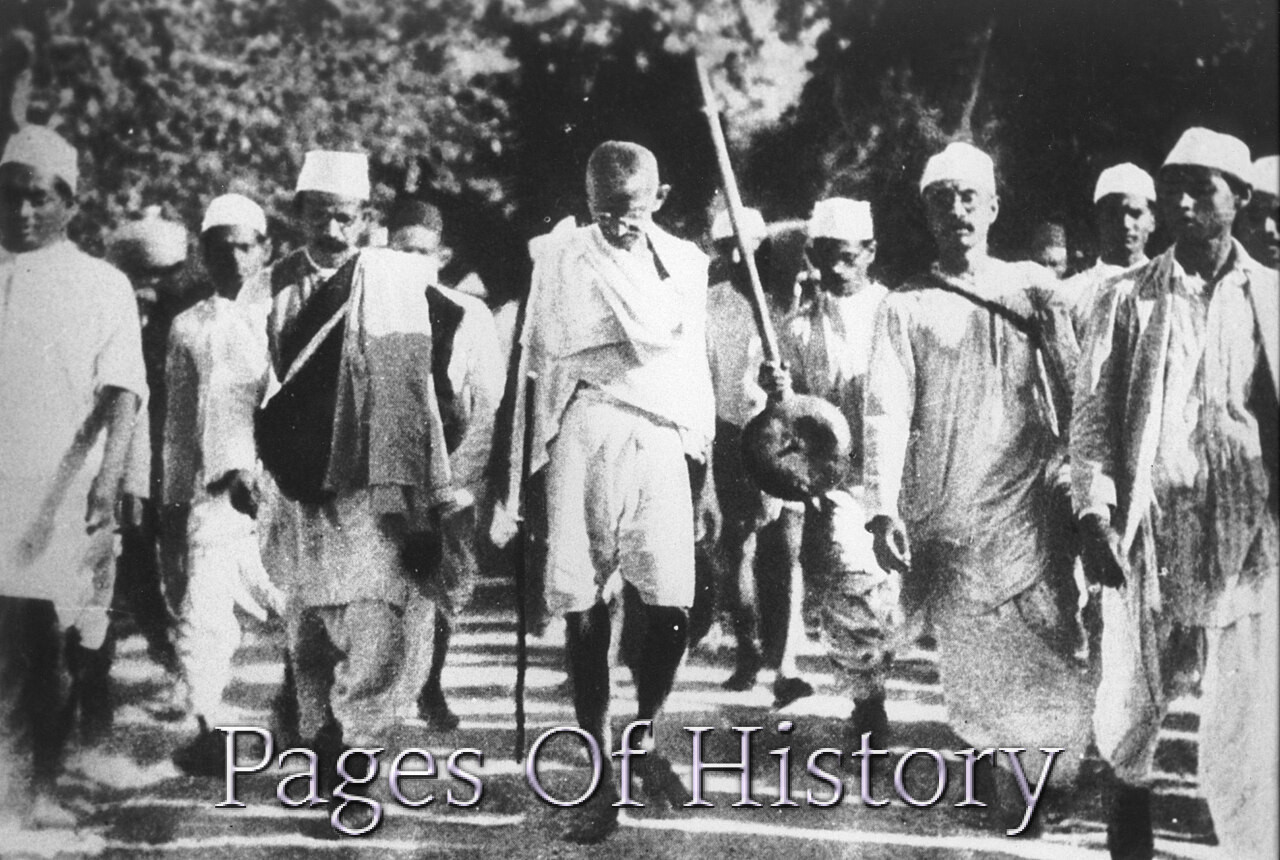
The Salt March 1930, also known as the Dandi March, was not merely a protest against a tax on a kitchen staple; it was a masterfully orchestrated political drama that fundamentally altered the course of the Indian independence movement. For 24 days, Mohandas Karamchand Gandhi and 78 hand-picked followers marched 240 miles from his Sabarmati Ashram in Ahmedabad to the coastal village of Dandi, where they defiantly boiled seawater to make salt. This single act of civil disobedience, rooted in the mundane reality of daily cooking, transformed the Indian National Congress’s struggle from a constitutional debate among elites into a mass movement that shook the foundations of the British Raj, proving that the empire’s power could be challenged not with guns, but with the simple, unbreakable resolve of its subjects.
- The Immediate Catalyst: The Failure of Dominion Status and the Nehru Report
- The Symbolic Power of Salt: More Than Just a Condiment
- The Anatomy of the March: From Sabarmati to Dandi
- Dandi and the Breaking of the Law
- The Ripple Effect: From Local Protest to Global Crisis
- The Gandhi-Irwin Pact and the Round Table Conference
- Key Facts and Timeline of the Movement
- The Legacy of the Salt March 1930
- Conclusion: The Taste of Freedom
To understand why this protest was so brilliantly conceived, one must look beyond the salt itself and into the profound political and economic crisis facing India in the late 1920s. The march was the culmination of a decade of frustration, a direct response to a specific colonial injustice, and the strategic brainchild of a leader who understood that the path to freedom lay not in petitioning the powerful, but in empowering the powerless.
The Immediate Catalyst: The Failure of Dominion Status and the Nehru Report
The political landscape of India in the late 1920s was one of simmering resentment and broken promises. The Montagu-Chelmsford Reforms of 1919 had introduced a limited form of self-governance, but they fell far short of Indian aspirations. The Government of India Act placed crucial subjects like finance and law and order firmly in the hands of British officials, a system derisively called dyarchy. This half-hearted measure, coupled with the horrific Jallianwala Bagh massacre in Amritsar in April 1919, had already poisoned the well of trust between the Indian populace and the British government.
The specific trigger for the Salt March 1930, however, was the rejection of Indian demands for full self-rule, or Purna Swaraj. In 1928, the British government sent the Simon Commission to India to review the constitutional situation. The commission was notable for two reasons: it contained not a single Indian member, and its arrival was met with mass protests and the infamous “Lathi Charge” (police baton charge) against demonstrators in Lahore, where the young revolutionary Lala Lajpat Rai was fatally injured.
In response, the Indian National Congress, under the leadership of Motilal Nehru (Jawaharlal Nehru’s father), drafted a constitution for an Indian dominion, known as the Nehru Report. This was Gandhi’s final attempt at constitutional negotiation. The report demanded that India be granted the same status as other British dominions like Canada and Australia. However, in December 1929, the Viceroy, Lord Irwin (later Lord Halifax), met with Indian leaders and offered only a vague “Round Table Conference” to discuss the future, explicitly refusing to commit to the principle of Dominion Status. This was the final straw.
On the last day of December 1929, on the banks of the Ravi River in Lahore, the Congress passed the historic Purna Swaraj resolution, declaring 26 January 1930 as the first Independence Day. The declaration was a direct challenge to British authority, but it was a paper promise. Gandhi knew he needed a concrete, symbolic action to translate this declaration into a living, breathing movement. He needed a “suitable issue” that could galvanize the masses, and he found it in the most unlikely of places: the British monopoly on salt.
As Gandhi himself wrote in his newspaper, Young India, in early 1930: “There is no article like salt outside water by which every person, rich or poor, can defy the Government. Salt is one of the most universal needs of the human family.”
The Symbolic Power of Salt: More Than Just a Condiment
The British salt tax was not a new imposition. It had been in place since 1882, but its impact was uniquely pernicious. Salt was—and remains—a fundamental necessity of life in India’s hot and humid climate. It was essential for preserving food, for maintaining bodily health, and for flavoring a predominantly vegetarian diet. The tax, which amounted to roughly 4% of the total government revenue, was a regressive levy that hit the poorest Indian the hardest. A laborer earning a few annas a day had to pay the equivalent of several days’ wages per year just to buy this essential mineral.
What made salt such a brilliant political weapon was its universality. Unlike other taxes (on income, land, or goods), the salt tax affected everyone: Hindu, Muslim, Sikh, Christian, high-caste, low-caste, rich, and poor. It was a daily, tangible reminder of colonial subjugation. The British had enacted laws—the Salt Acts—prohibiting Indians from manufacturing or selling salt, forcing them to buy the heavily taxed, government-produced product from the Salt Department. This was a monopoly enforced by over 7,000 British and Indian officials.
By targeting this specific law, Gandhi was doing something revolutionary. He was moving the focus of the struggle from abstract constitutional demands to a concrete, relatable grievance. It was a masterclass in political communication. He was saying, in effect: “The British don’t just tax your income; they tax the very air you breathe and the salt you eat. If we can defy this law, we can defy any law.”
This strategy was a departure from the methods of the more radical factions within the Congress, who favored violent revolution, and from the moderate constitutionalists who favored negotiation. Gandhi’s approach was rooted in his philosophy of Satyagraha—the force of truth and non-violent resistance. He believed that by willingly suffering the consequences of breaking an unjust law, he could awaken the conscience of the oppressor and win them over through moral force. The Salt March 1930 was the ultimate test of this theory on a mass scale.
The Anatomy of the March: From Sabarmati to Dandi
Gandhi’s plan was meticulously crafted as a spectacle designed to capture the world’s attention. He deliberately chose a route that would take him through villages and towns, allowing him to spread his message of non-violent resistance directly to the peasantry. He intentionally selected 78 followers, a number that was both manageable and symbolic (the number 78 was chosen for its association with the Ashram’s daily needs, but it also kept the group small enough to be seen as a disciplined, spiritual pilgrimage rather than a mob).
Before leaving, Gandhi issued an ultimatum to Viceroy Irwin on 2 March 1930. He listed his grievances—from the salt tax and the land revenue system to the high cost of administration and the import of foreign cloth—and warned that if they were not addressed, he would break the salt laws. When Irwin ignored the letter, dismissing it as a “storm in a teacup,” Gandhi began his march.
The Daily Ritual of Resistance
On 12 March 1930, at 6:30 in the morning, Gandhi and his followers departed from the Sabarmati Ashram. He was 61 years old. The group walked approximately 12 miles a day, a punishing pace in the March heat. They traveled through villages like Nadiad, Anand, and Borsad, following the banks of the Mahi River. Each evening, Gandhi would hold prayer meetings and give speeches, often drawing crowds of tens of thousands. The march was not just a trek; it was a traveling university of civil disobedience.
Gandhi’s daily routine was a lesson in discipline and symbolism. He would rise early, spin cotton on his charkha (spinning wheel) to promote self-sufficiency, and then walk. He spoke about the importance of swadeshi (self-reliance), the need for Hindu-Muslim unity, and the necessity of eradicating untouchability. He transformed a political protest into a moral crusade.
As the march progressed, the British administration became increasingly nervous. The local police were ordered to monitor the marchers but were forbidden from arresting them, for fear of creating martyrs. The world’s press, initially skeptical, began to follow the procession with intense interest. American journalist Webb Miller of the United Press, who would later describe the violence at the Dharasana Salt Works, was among the journalists who recognized the historic significance of the event. The march was a slow-burning fuse that was igniting the entire nation.
Dandi and the Breaking of the Law
After 24 days of walking, on the morning of 6 April 1930, Gandhi and his followers reached the shore at Dandi. The sea was calm, and the sun was rising. Gandhi walked into the water, performed his morning ablutions, and then bent down to pick up a lump of natural salt that had crystallized on the beach. He held it aloft for all to see. This single, silent act was the signal that the law had been broken.
He declared: “I want the world to know that the British Government has been defeated. It has been defeated by the simple act of picking up salt from the sea.” While the act itself was anti-climactic—a few handfuls of muddy salt—its symbolism was explosive. Gandhi had broken the law, and he urged all Indians to do the same. He instructed that, wherever possible, Indians should manufacture salt, sell it, and use it, thereby denying the state its revenue and its authority.
This call to action spread like wildfire. Within weeks, salt was being illegally manufactured across the length and breadth of India. In coastal regions, people flocked to the beaches. Inland, they boiled seawater or mined salt from the earth. The British response was swift and brutal. They arrested over 60,000 Indians in the spring and summer of 1930, including almost the entire leadership of the Congress. Jawaharlal Nehru was arrested in April; Gandhi himself was arrested on 5 May 1930, just days after the Dandi action.
The Dharasana Salt Works: The Bloody Climax
Perhaps the most iconic moment of the entire campaign came not at Dandi, but at the Dharasana Salt Works, a government facility near Dandi. After Gandhi’s arrest, the poet Sarojini Naidu and the Congress leader Manilal Gandhi (Gandhi’s son) led a group of 2,500 volunteers to march on the salt depot. They were met by a contingent of police led by a British officer, who ordered them to disperse. They did not.
Webb Miller’s dispatch to the United Press described the scene in harrowing detail: “The police rushed upon the advancing marchers and rained blows on their heads with their steel-shod lathis (batons). Not one of the marchers even raised an arm to fend off the blows. They went down like ten-pins… The waiting crowd of marchers groaned and sucked in their breath in sympathetic pain at every blow. Those struck down fell sprawling, unconscious or writhing with fractured skulls or broken shoulders.”
The sight of unarmed men and women, falling without a single cry of retaliation, was a public relations disaster for the British Empire. The images and reports from Dharasana were published in newspapers worldwide, from London to New York. They exposed the brutality of the Raj and contrasted it with the extraordinary moral courage of the protesters. This single event did more to undermine British prestige than a hundred armed uprisings could have done. It forced the British government to recognize that they were no longer dealing with a fringe group of extremists, but with a disciplined, national movement.
The Ripple Effect: From Local Protest to Global Crisis
The impact of the Salt March 1930 extended far beyond the Indian subcontinent. It had profound economic and political consequences for the British Empire.
- Economic Strain: The boycott of British goods, particularly cloth, which was part of the wider civil disobedience campaign, severely impacted British textile mills in Lancashire. Exports to India plummeted, causing unemployment and political pressure in industrial constituencies in Britain.
- Loss of Prestige: The world was watching. The image of the British Empire as a benevolent, civilizing force was shattered by the footage and reports of non-violent protesters being beaten. The empire’s moral authority was fatally compromised.
- Global Solidarity: The movement inspired anti-colonial activists worldwide. It demonstrated that a non-violent mass movement could challenge a major imperial power. The American public, in particular, was sympathetic to Gandhi’s cause, viewing it through the lens of their own struggle for independence.
The British government, led by Prime Minister Ramsay MacDonald, was forced to respond. They could not simply jail the entire population. The political cost of continued repression was too high. In January 1931, Viceroy Irwin released Gandhi and the other Congress leaders from prison. He invited Gandhi to meet with him at the Viceroy’s House in Delhi.
The Gandhi-Irwin Pact and the Round Table Conference
The meeting between Gandhi and Irwin, which began on 17 February 1931, was a historic event in itself. The “half-naked fakir,” as Winston Churchill had disparagingly called him, was now negotiating on equal terms with the representative of the King-Emperor. The talks were difficult and lasted for weeks. Gandhi insisted on a full inquiry into police excesses and the release of all political prisoners. Irwin was constrained by his government’s demands to maintain the salt tax.
The result was the Gandhi-Irwin Pact, signed on 5 March 1931. The terms were a compromise, but they were a significant political victory for the Congress:
- The British agreed to release all political prisoners not involved in violence.
- The Congress agreed to suspend the civil disobedience movement.
- The British permitted Indians to make salt for domestic consumption in coastal villages.
- Gandhi agreed to attend the Second Round Table Conference in London to discuss constitutional reforms.
It was a far cry from the Purna Swaraj that had been demanded, and many radicals within the Congress, including Jawaharlal Nehru, felt that Gandhi had conceded too much. However, Gandhi understood the strategic necessity. The pact recognized the Congress as the legitimate representative of the Indian people, a status it had not previously enjoyed. It was a step down the road, but it was a step forward.
Gandhi’s trip to London for the Round Table Conference in the autumn of 1931 was a personal triumph but a political failure. He was feted by the British public, met with celebrities and workers, and even visited Lancashire to see the impact of the cloth boycott, but he was unable to secure a commitment to Dominion Status. The conference was a deadlock, and upon his return to India in December 1931, he found the political situation dramatically changed. The British had resumed their crackdown, and the Congress was once again outlawed.
Key Facts and Timeline of the Movement
To fully appreciate the scale and significance of the event, it is helpful to view the key dates and figures in a consolidated form.
| Date | Event | Significance |
|---|---|---|
| 31 Dec 1929 | Congress passes Purna Swaraj resolution in Lahore | Declared complete independence as the goal, setting the stage for confrontation. |
| 2 Mar 1930 | Gandhi sends ultimatum to Viceroy Irwin | Final attempt at negotiation; listed grievances and threatened salt law violation. |
| 12 Mar 1930 | Gandhi departs Sabarmati Ashram | Commencement of the 240-mile, 24-day march with 78 followers. |
| 6 Apr 1930 | Gandhi breaks the salt law at Dandi | Symbolic act of defiance; triggered mass civil disobedience across India. |
| 5 May 1930 | Gandhi arrested | Led to further protests; over 60,000 people were jailed during the campaign. |
| 5 Mar 1931 | Gandhi-Irwin Pact signed | Ended the first phase of civil disobedience; recognized Congress as a negotiating party. |
The Limits of the Movement
While the Salt March 1930 was a monumental success in terms of political mobilization, it is crucial to view it with a balanced historical lens. The movement did not achieve its primary objective of Purna Swaraj. It was an important phase, but not the final victory. Furthermore, the movement was largely confined to certain sections of society. While it drew in peasants and the urban middle class, it had less resonance among the poorest of the poor, the landless laborers, and, critically, many Muslim communities, who feared that a Hindu-dominated Congress government might not protect their interests. The Muslim League, led by Muhammad Ali Jinnah, remained largely aloof from the campaign, a foreshadowing of the deep communal divisions that would eventually lead to Partition in 1947.
The movement also exposed Gandhi’s limitations. He had called for a complete boycott of British institutions, but this was never fully realized. Many Indians continued to serve in the civil service and the police. The economic impact of the boycott, while painful for British industry, was not crippling. The British Empire was a vast, global entity, and it could absorb the shock of a few months of disruption.
The Legacy of the Salt March 1930
Despite these limitations, the long-term legacy of the Salt March 1930 is undeniable. It was a watershed moment that changed the nature of the Indian independence movement irreversibly.
- Women in the Forefront: The movement saw an unprecedented participation of women. Figures like Sarojini Naidu, Kamala Nehru, and Kasturba Gandhi led processions and faced police brutality. The Salt March 1930 broke the traditional barrier of women’s participation in public political life, paving the way for their crucial role in later struggles.
- A Global Blueprint for Resistance: The tactics of the march—non-violence, mass participation, and moral appeal—became a template for civil rights movements across the globe. Martin Luther King Jr. explicitly cited Gandhi’s methods as an inspiration for the American Civil Rights Movement in the 1950s and 1960s.
- The End of an Era: The march signaled to the British government that they could no longer rule India through coercion alone. It forced them to take the Congress seriously as a political force, accelerating the slow, painful process of constitutional negotiation that would eventually lead to independence in 1947.
Gandhi’s act of picking up salt from the beach at Dandi was a profound act of political theater. He took the most basic element of life and turned it into a weapon of mass destruction—not of lives, but of an empire’s moral credibility. He demonstrated that true power does not reside in the barrel of a gun or the authority of a colonial office, but in the collective will and moral courage of ordinary people. The British could tax the salt, but they could not tax the spirit of a nation that had tasted the sweetness of defiance.
Conclusion: The Taste of Freedom
The story of the Salt March 1930 is ultimately a story about the power of the ordinary. It was a protest that began with a handful of men and women walking on a dusty road and ended with the moral collapse of a global empire. It was not a military victory, nor was it an immediate political triumph. It was, however, a profound psychological victory. It proved to Indians that they were not powerless subjects, but citizens with the agency to shape their own destiny.
The march did not win independence that day, but it made independence inevitable. By reclaiming their right to a simple grain of salt, the Indian people reclaimed their dignity. The Salt March 1930 stands as a timeless reminder that great change often begins with small, symbolic acts of courage, and that the most powerful force in the world is not violence, but a just cause, held firmly in the hands of a united people. The echo of Gandhi’s footsteps on that long road to Dandi did not fade with time; it reverberated through the next two decades, leading India, finally, to the shores of freedom on 15 August 1947.