
📅 Last updated: 12.07.2026
- The Crisis That Begat the Tetrarchy: Rome on the Brink
- The Tetrarchy System: Four Rulers, One Empire
- Why the Tetrarchy Roman Empire Was a Radical Break from the Past
- The Successes of the Tetrarchy: Stability and Reform
- The Collapse of the Tetrarchy: Ambition, Civil War, and Constantine
- The Legacy of the Tetrarchy: How It Shaped the Later Empire
- Why the Tetrarchy Failed: Structural and Human Flaws
- Rethinking the Tetrarchy: A Necessary Experiment
The Roman Empire did not collapse overnight, but its famous division into Eastern and Western halves was a deliberate, radical experiment in governance known as the Tetrarchy Roman Empire, a system designed by Emperor Diocletian in the late 3rd century AD to save a realm tearing itself apart. By 284 AD, the empire had suffered through half a century of chaos—the “Crisis of the Third Century”—where military anarchy, economic collapse, and barbarian invasions had pushed Rome to the brink. The Tetrarchy was not a symptom of decline but a revolutionary attempt at political survival, one that ultimately reshaped the ancient world and laid the groundwork for the Byzantine Empire. This article explores why Diocletian split the empire, how the Tetrarchy functioned, its dramatic failures, and its profound, lasting legacy.
The Crisis That Begat the Tetrarchy: Rome on the Brink
To understand the Tetrarchy Roman Empire, one must first grasp the existential crisis it was meant to solve. Between 235 and 284 AD, Rome experienced the “Military Anarchy,” a period in which emperors were made and unmade by legions at an astonishing rate. Over 20 men claimed the throne, most ruling for only months or a few years before being assassinated or dying in civil war. The empire was simultaneously battered by foreign threats: the Goths sacked Athens in 267 AD, the Persians captured Emperor Valerian in 260 AD (a humiliation Rome never forgot), and the Franks and Alemanni raided deep into Gaul and Spain.
The economic system collapsed under the weight of endless civil wars. To pay armies, emperors debased the silver denarius until it was mostly copper, triggering hyperinflation. Diocletian, a tough Illyrian soldier who rose from humble origins, seized power in 284 AD after the death of Emperor Numerian. He immediately recognized that no single man could manage the empire’s sprawling borders, rebellious provinces, and multiple active war fronts. The old Augustan system—one emperor, one capital, one army—was broken beyond repair. Diocletian’s genius was to institutionalize a division that had already begun informally: multiple emperors ruling in parallel, each responsible for a specific region.
The Tetrarchy System: Four Rulers, One Empire
In 293 AD, Diocletian formally established the Tetrarchy, which means “rule of four” in Greek. The system was brilliant in its simplicity and ruthlessly hierarchical. It created two senior emperors, each bearing the title Augustus, and two junior emperors, each called Caesar. The two Augusti were Diocletian himself (ruling the East) and his long-time comrade Maximian (ruling the West). Each Augustus adopted a Caesar to serve as his designated successor and regional deputy: Galerius for Diocletian in the East, and Constantius Chlorus for Maximian in the West.
The Division of Territories
The four rulers did not share power equally; they governed distinct geographic zones, each with its own capital and field army. This was not a breakup of the empire but a delegation of authority. The territories were divided as follows:
- Diocletian (Augustus of the East): Based in Nicomedia (modern İzmit, Turkey), he controlled Asia Minor, Syria, Egypt, and the eastern frontier against Persia.
- Maximian (Augustus of the West): Based in Mediolanum (Milan), he governed Italy, Africa, and the western Mediterranean, focusing on internal rebellions and pirates.
- Galerius (Caesar of the East): Based in Sirmium (modern Sremska Mitrovica, Serbia), he commanded the Danubian provinces and fought the Goths and Sarmatians.
- Constantius Chlorus (Caesar of the West): Based in Augusta Treverorum (Trier, Germany), he controlled Gaul, Britain, and the Rhine frontier, battling the Alemanni and Picts.
This territorial split was pragmatic. Each ruler could respond rapidly to local crises without waiting for orders from a distant capital. Diocletian, the supreme architect, retained ultimate authority as a kind of “first among equals,” but he deliberately allowed his colleagues real military and administrative autonomy.
The Ideology of the Tetrarchy
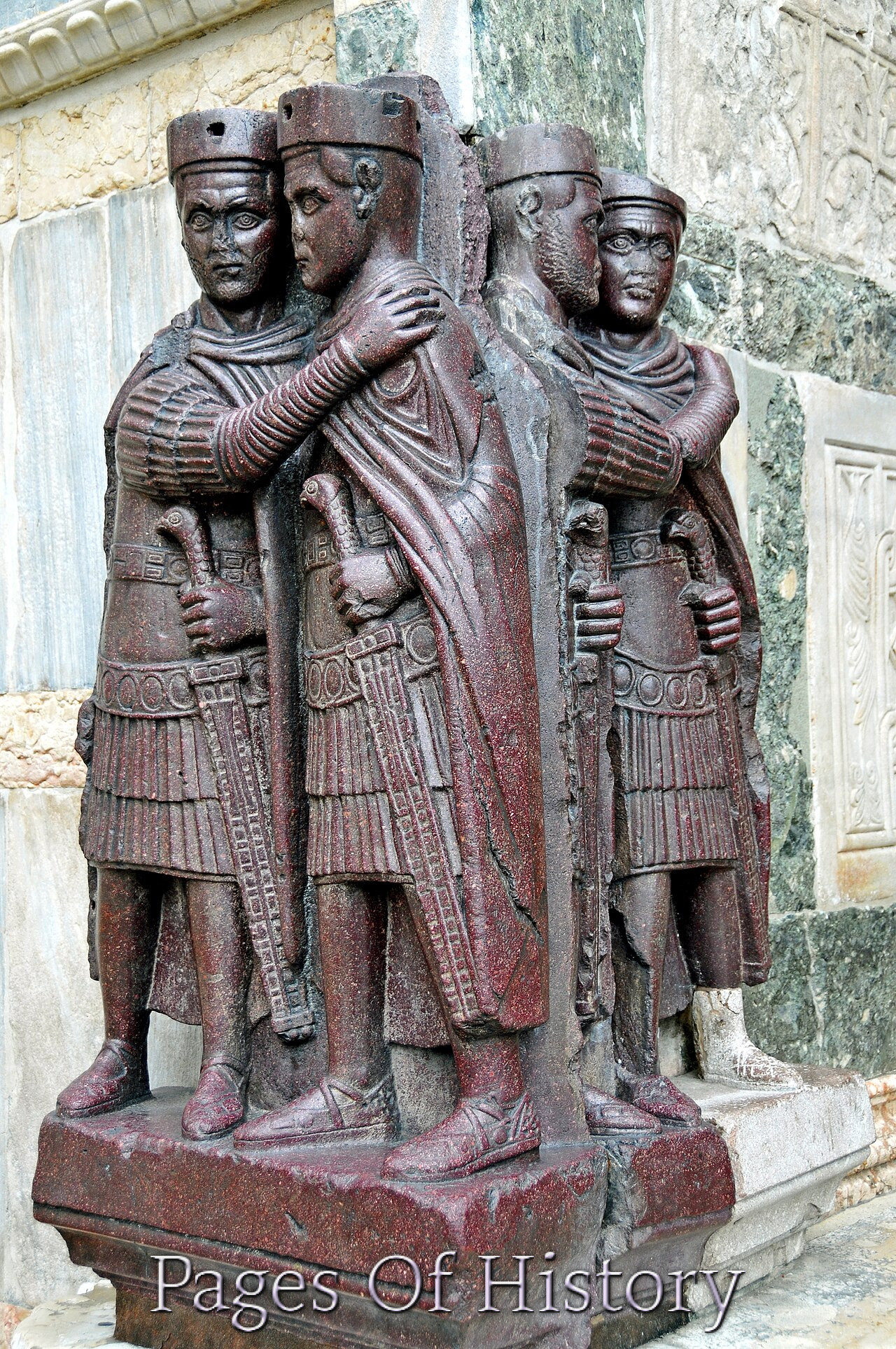
Diocletian reinforced the system with a potent new ideology. He abandoned the pretense of the emperor as a “first citizen” (princeps) and instead presented himself and his colleagues as living gods, chosen by Jupiter (for Diocletian) and Hercules (for Maximian). This “Jovian” and “Herculian” dynastic cult gave the Tetrarchy a divine, unbreakable legitimacy. Portraits of the Tetrarchs—such as the famous porphyry statue now in Venice—show them as near-identical, stern, embracing figures, symbolizing unity and harmony. This was propaganda on a monumental scale: four men, one will, one empire.
Why the Tetrarchy Roman Empire Was a Radical Break from the Past
The Tetrarchy Roman Empire represented a fundamental shift in Roman governance. For centuries, the empire had been a monarchy in disguise, with power concentrated in one man who relied on the Senate and the Praetorian Guard. The Tetrarchy replaced this with a formal collegiate system, where succession was determined by merit and adoption, not blood. This was an explicit rejection of dynastic inheritance, which had produced disastrous emperors like Nero and Commodus.
Another radical change was the multiplication of imperial capitals. Rome, the eternal city, was demoted. Diocletian rarely visited it; he preferred Nicomedia. Maximian ruled from Milan, not Rome. The Caesars governed from Trier and Sirmium. This decentralization shifted political and economic power to the frontiers, where the real threats lay. It also marginalized the Roman Senate, which lost its last vestiges of influence. The Tetrarchy was a military dictatorship in all but name—efficient, brutal, and designed for survival.
The Successes of the Tetrarchy: Stability and Reform
For about two decades, the Tetrarchy Roman Empire achieved its primary goal: stability. Diocletian’s reforms were sweeping and effective.
Military and Border Security
Each Tetrarch personally led campaigns on his sector. Constantius Chlorus recaptured Britain from the usurper Allectus in 296 AD. Galerius crushed a major Persian invasion in 298 AD, even capturing the Persian king’s harem and treasury, forcing a humiliating peace treaty that secured Rome’s eastern frontier for a generation. Diocletian himself campaigned in Egypt and along the Danube. For the first time in 50 years, the empire’s borders were largely secure.
Administrative and Economic Reforms
Diocletian doubled the number of provinces (to around 100) and grouped them into 12 dioceses, each overseen by a vicar reporting to a praetorian prefect. This created a clearer chain of command and reduced the power of any single governor to rebel. He also instituted the infamous “Edict on Maximum Prices” in 301 AD, attempting to curb inflation by setting price caps on thousands of goods and services. While the edict failed economically (it was widely ignored and led to black markets), it demonstrated the state’s willingness to intervene aggressively in the economy. He also reformed the tax system, introducing a uniform land tax (the iugatio) and a poll tax (capitatio) that tied people to their professions, creating a rigid, hereditary social order.
A Crucial Comparison: Diocletian vs. Augustus
The following table highlights the key differences between the Augustan principate and the Diocletianic Tetrarchy:
| Aspect | Augustan Principate (27 BC – 284 AD) | Diocletianic Tetrarchy (293–305 AD) |
|---|---|---|
| Number of Rulers | One emperor (princeps) | Four emperors (two Augusti, two Caesars) |
| Capital | Rome (symbolic center) | Multiple capitals (Nicomedia, Milan, Trier, Sirmium) |
| Succession | Dynastic (blood) or military coup | Adoptive, merit-based (within Tetrarchy) |
| Imperial Ideology | First citizen (princeps) with divine favor | Living god (Jovian/Herculian cult) |
| Role of Senate | Advisory body with some prestige | Largely powerless, ceremonial |
| Primary Threat | Internal conspiracies, Praetorian Guard | External invasions, frontier defense |
This table makes clear that the Tetrarchy was not merely a tweak but a wholesale reinvention of Roman imperial government.
The Collapse of the Tetrarchy: Ambition, Civil War, and Constantine
Despite its initial success, the Tetrarchy Roman Empire was doomed by a fatal flaw: it depended entirely on the personal authority and selflessness of Diocletian. In 305 AD, Diocletian did something unprecedented: he voluntarily abdicated, forcing his reluctant co-Augustus Maximian to do the same. He retired to his palace at Split (modern Croatia) to grow cabbages, famously telling envoys who begged him to return that they should see the vegetables he had planted with his own hands. This act of supreme self-discipline was meant to demonstrate the system’s orderly succession. It failed spectacularly.
The Succession Crisis of 305-306 AD
According to the Tetrarchic plan, the two Caesars—Galerius and Constantius Chlorus—were to become the new Augusti. Two new Caesars were chosen: Maximinus Daia (Galerius’s nephew) and Flavius Valerius Severus. But the system ignored the claims of powerful sons. Constantius Chlorus’s son, Constantine, was popular with the legions in Britain. When Constantius died in 306 AD at York, his troops immediately proclaimed Constantine as Augustus, bypassing the established hierarchy. Simultaneously, Maxentius, the son of the former Augustus Maximian, seized power in Rome, claiming the title of princeps.
The Tetrarchy Shatters
What followed was a decade of brutal civil war. The key players were:
- Constantine: Based in Gaul and Britain, a brilliant general and shrewd politician.
- Maxentius: Controlled Italy and Africa, ruling from Rome with his father Maximian’s support.
- Galerius: The senior Augustus in the East, who tried and failed to suppress the usurpers.
- Licinius: A general who became Augustus in the East after Galerius’s death in 311 AD.
- Maximinus Daia: Ruler of Asia Minor and Syria, a rival to Licinius.
The chaos culminated in two decisive battles. At the Battle of the Milvian Bridge in 312 AD, Constantine defeated and killed Maxentius, capturing Rome. According to tradition, Constantine saw a vision of the Christian cross before the battle, a turning point in religious history. Then, in 313 AD, Licinius defeated Maximinus Daia. For a brief moment, the empire was again divided between two rulers: Constantine in the West and Licinius in the East.
The Final War and the End of the Tetrarchy
The partnership between Constantine and Licinius was uneasy. After a decade of cold war and two minor conflicts, Constantine invaded Licinius’s territory in 324 AD. At the Battle of Chrysopolis (modern Üsküdar, Turkey), Constantine crushed Licinius’s army. Licinius surrendered and was later executed. Constantine now ruled the entire Roman Empire alone—the first sole emperor since Diocletian. The Tetrarchy was dead, replaced by a restored monarchy, but one permanently transformed by the experience.
The Legacy of the Tetrarchy: How It Shaped the Later Empire
Although the Tetrarchy Roman Empire lasted only about 20 years, its impact was permanent. Constantine, though he rejected the four-ruler system, kept many of Diocletian’s reforms.
The Permanent Division of the Empire
The most obvious legacy was the division of the empire into East and West. Constantine built a new capital, Constantinople (on the site of the old Greek city of Byzantium), which became the permanent seat of the Eastern Roman Empire. This mirrored Diocletian’s use of Nicomedia. After Constantine’s death in 337 AD, his sons again divided the empire, and the pattern of East-West division became entrenched. By 395 AD, under Theodosius I, the division was formalized and permanent. The Western Roman Empire collapsed in 476 AD, but the Eastern Roman (Byzantine) Empire survived for another thousand years, carrying forward Diocletian’s administrative and military structures.
Administrative and Military Structures
Diocletian’s provincial reorganization, his separation of civil and military authority, and his creation of a mobile field army (comitatenses) and frontier troops (limitanei) became the standard for the later empire. The late Roman state was a Diocletianic state: bureaucratic, rigidly controlled, and heavily taxed. The emperor became an absolute monarch, surrounded by elaborate court ritual—a direct evolution of Diocletian’s divine kingship.
The Christian Empire
Ironically, the Tetrarchy’s most famous victim was its own pagan ideology. Diocletian launched the “Great Persecution” of Christians in 303 AD, the most severe in Roman history. Thousands were martyred. But Constantine, who rose from the Tetrarchy’s ashes, converted to Christianity and legalized the faith with the Edict of Milan in 313 AD. By the end of the 4th century, Christianity was the state religion. The Tetrarchy’s attempt to unify the empire under traditional Roman gods backfired, paving the way for a new religious order.
Why the Tetrarchy Failed: Structural and Human Flaws
The Tetrarchy Roman Empire was a brilliant solution to a specific crisis, but it contained the seeds of its own destruction. Several key flaws ensured its collapse:
The Problem of Dynastic Ambition
The Tetrarchy tried to suppress the natural human desire to pass power to one’s children. Diocletian himself had no sons, which made his abdication easier. But Maximian resented retiring, and his son Maxentius felt entitled to rule. Constantine’s claim was based on his father’s legacy, not the Tetrarchic system. The system could not compete with the emotional pull of bloodline. Roman soldiers were loyal to their general’s family, not to an abstract constitutional arrangement.
The Lack of a Central Authority After Diocletian
Diocletian was the system’s linchpin. His immense personal prestige held the four rulers in check. Once he was gone, there was no mechanism to enforce cooperation. Galerius tried to act as senior Augustus, but he lacked Diocletian’s authority and was openly defied by Constantine and Maxentius. The Tetrarchy was a system designed for a single exceptional man, and it could not survive his departure.
The Military’s Continued Power
The Tetrarchy was created by and for the army, but it could not escape the army’s political role. Legions still proclaimed emperors. The troops in Britain elevated Constantine; the Praetorian Guard in Rome backed Maxentius. The Tetrarchy merely multiplied the number of armies and therefore the number of potential usurpers. Instead of one civil war at a time, the empire now risked four.
Rethinking the Tetrarchy: A Necessary Experiment
Historians have long debated whether the Tetrarchy was a wise reform or a desperate mistake. The evidence suggests it was both. It was a necessary experiment that saved the empire from immediate destruction but ultimately fractured it. Without Diocletian’s reforms, the Roman Empire might have collapsed entirely in the 3rd century—a victim of its own success, too large for one man to govern. The Tetrarchy bought Rome two centuries of life in the West and a millennium in the East.
The Tetrarchy Roman Empire also offers a profound lesson in political science: systems built on personal authority, however brilliant, are fragile. Institutions must outlast their founders. Diocletian created a machine, but he did not give it the fuel of legitimacy that only time and tradition can provide. The Tetrarchy was a magnificent emergency measure, a testament to Roman pragmatism, but it was never meant to be permanent. Its failure was not a sign of Roman decline but of the empire’s stubborn will to survive—a will that would, in the East, persist for another thousand years.