
📅 Last updated: 12.07.2026
- The Discovery and Geographic Extent of the Indus Valley Civilization
- Urban Planning: The Hallmark of a Lost World
- Economy and Technology of the Indus Valley Civilization
- The Enigmatic Script and Social Structure of the Indus Valley Civilization
- The Decline and Legacy of the Indus Valley Civilization
- Conclusion: The Silent Foundations of South Asia
The Indus Valley civilization, one of the three great early cradles of civilization alongside ancient Egypt and Mesopotamia, remains its most enigmatic. Flourishing between approximately 2600 and 1900 BCE across what is now Pakistan and northwest India, this sophisticated Bronze Age society was the most extensive of the ancient world, yet its script remains undeciphered, and the very name of its people is lost to history. Despite this silence, the archaeological record reveals a culture of astonishing urban planning, technological innovation, and apparent social stability, whose sudden decline continues to puzzle historians and archaeologists.
The Discovery and Geographic Extent of the Indus Valley Civilization
The story of the Indus Valley civilization’s rediscovery begins in the 19th century with British railway builders in India. While laying tracks in the Punjab region, engineers found vast quantities of perfectly fired, uniform bricks. Locals knew of ancient mounds, but it was not until 1921 that the Archaeological Survey of India, under the direction of Sir John Marshall, began systematic excavations at Harappa. A year later, the even larger site of Mohenjo-Daro was identified. These twin cities revealed a lost world.
The civilization’s heartland was the vast floodplain of the Indus River and its now-dry tributaries, the Ghaggar-Hakra (often identified with the legendary Sarasvati River). However, its reach was immense. Spanning an area of over 1.25 million square kilometers—larger than modern Egypt and Mesopotamia combined—it stretched from the Arabian Sea coast near modern Karachi to the foothills of the Himalayas, and from the Iranian border to the plains of the Ganges-Yamuna Doab.
Key sites illustrate this vast range:
- Mohenjo-Daro (Sindh, Pakistan): The largest and most extensively excavated city, featuring the Great Bath and the “College of Priests.”
- Harappa (Punjab, Pakistan): The first site discovered, with massive granaries and working-class quarters.
- Dholavira (Gujarat, India): A stunning example of water management, with a sophisticated system of reservoirs carved from stone.
- Lothal (Gujarat, India): Home to a remarkable dockyard, suggesting maritime trade with Mesopotamia.
- Rakhigarhi (Haryana, India): One of the largest known sites, possibly even larger than Mohenjo-Daro.
- Ganeriwala (Punjab, Pakistan): A major city near the ancient Ghaggar-Hakra riverbed, still largely unexcavated.
This geographic spread is not merely a matter of size. It indicates a cultural and economic network that was remarkably cohesive. Unlike the warring city-states of Sumer, the Indus Valley civilization appears to have been a unified cultural entity, likely organized as a collection of interconnected city-states or a single, loosely governed state.
Urban Planning: The Hallmark of a Lost World
What strikes any visitor to the ruins of Mohenjo-Daro or Harappa is the sheer consistency of the design. The Indus Valley civilization did not grow organically; it was planned. Cities were laid out on a precise grid system, with streets running north-south and east-west, creating rectangular blocks. This was not a haphazard accumulation of buildings but a feat of centralized authority and engineering.
The Citadel and the Lower City
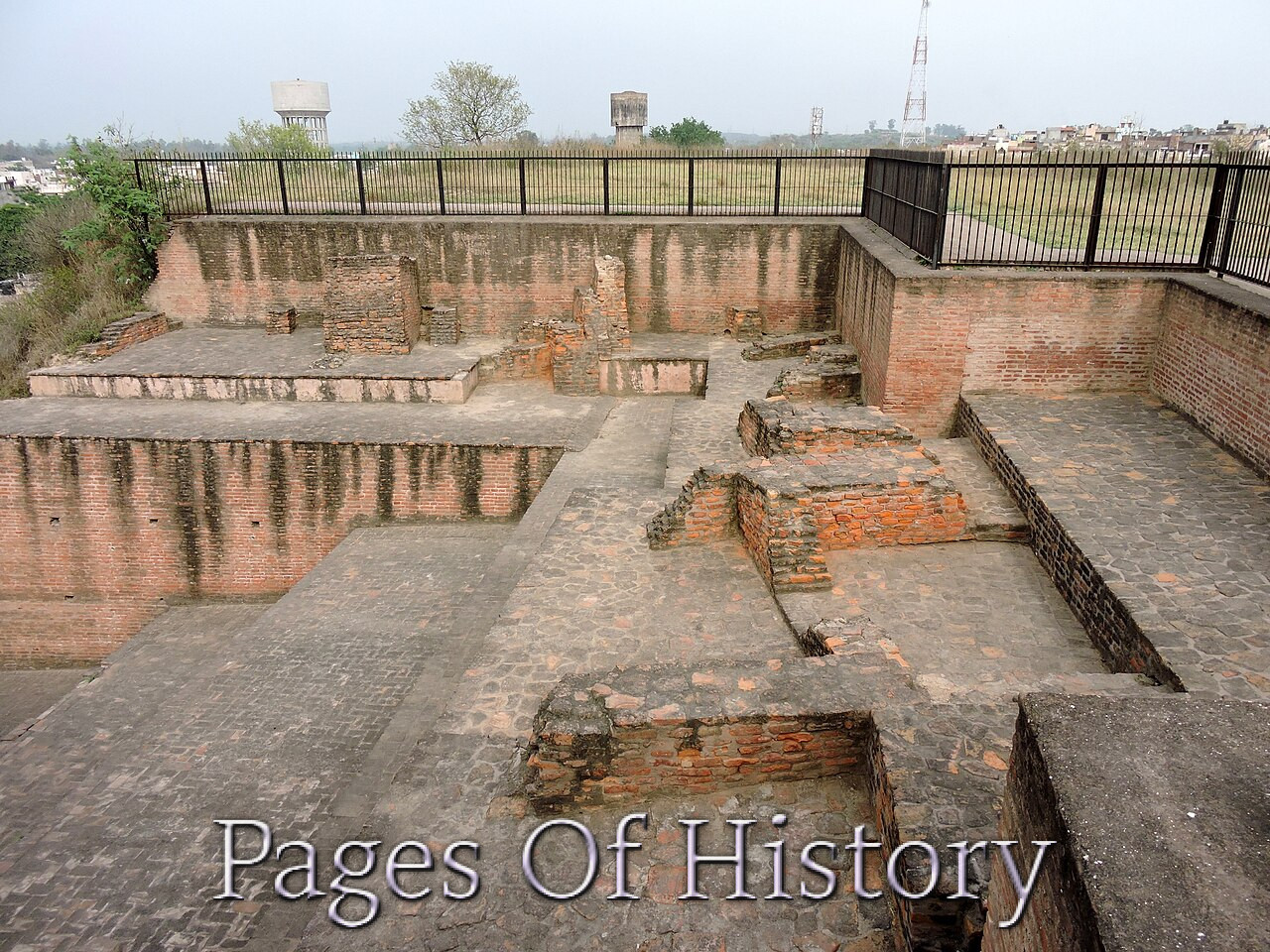
Every major city was divided into two distinct sectors. The Citadel, built on a raised mud-brick platform to the west, housed the city’s most important public structures. At Mohenjo-Daro, this includes the Great Bath, a remarkably well-preserved brick pool lined with natural tar for waterproofing, surrounded by a colonnade of rooms. Its purpose was almost certainly ritual purification, a practice that echoes in modern Hinduism.
The Lower City, to the east, was the residential and commercial district. Here, houses varied in size, but all shared a common feature: they were connected to an advanced drainage system. Every home had a private well and a bathroom, with wastewater flowing through covered brick drains running along the main streets. These drains were regularly cleaned via manholes, a level of municipal sanitation that would not be seen again until the Roman Empire, and which was superior to many parts of the world until the 19th century.
Standardized Bricks and Weights
The uniformity of the civilization is further demonstrated by its material culture. Bricks were made in a precise ratio of 1:2:4 (height:width:length), a standard applied across hundreds of kilometers. Similarly, a system of standardized weights and measures, based on a unit of approximately 13.6 grams, was used throughout the civilization. These were often made of chert and found in cubical or barrel shapes. This standardization implies a powerful central authority capable of enforcing quality control across a vast territory, perhaps through a network of trade guilds or a state bureaucracy.
Economy and Technology of the Indus Valley Civilization
The foundation of the Indus Valley civilization was a productive agricultural system. The fertile floodplains of the Indus and Ghaggar-Hakra rivers allowed for the cultivation of wheat, barley, peas, dates, and sesame. They were also among the first people in the world to cultivate cotton, spinning it into cloth that was traded as far away as Mesopotamia, where it was known as sindu, derived from the Sanskrit “Sindhu” (Indus).
Trade and Industry
The Indus people were master craftspeople and traders. Their workshops produced a dazzling array of goods:
- Beads and Jewelry: Carnelian beads from Gujarat were traded throughout the ancient world. Lapis lazuli from Afghanistan, turquoise from Central Asia, and jade from China have all been found in Indus sites.
- Metallurgy: They worked copper, bronze, lead, and tin, but notably, they did not smelt iron. They produced tools, weapons, and exquisite figurines, including the famous “Dancing Girl” of Mohenjo-Daro, a bronze sculpture of a nude young woman with her hand on her hip.
- Seals: Perhaps their most distinctive artifact is the steatite seal. Typically square, engraved with animal motifs (unicorns, bulls, elephants, tigers) and a line of undeciphered script, these seals were likely used for trade and administration, marking ownership of goods.
- Maritime Trade: The dockyard at Lothal confirms a thriving sea trade. Indus goods, particularly cotton cloth and beads, have been found in Mesopotamian cities like Ur and Kish. In return, they likely received silver, tin, and wool.
A Technological Paradox
The Indus Valley civilization presents a fascinating technological paradox. They had no iron, no wheeled vehicles beyond toys, and no large-scale siege weapons. Yet their urban planning, sanitation, and measurement systems were unparalleled. They built massive public works without a known palace or temple complex, suggesting a social structure that was not centered on a god-king or a warrior elite, but perhaps on a council of merchants, priests, or landowners.
The Enigmatic Script and Social Structure of the Indus Valley Civilization
The greatest barrier to understanding the Indus Valley civilization is its undeciphered script. Found primarily on seals and pottery, the script consists of around 400 unique signs. It is generally believed to be a logo-syllabic script (like Sumerian cuneiform), but attempts to link it to Dravidian or Munda language families remain speculative. The texts are almost all very short, averaging only five symbols, which makes statistical analysis difficult. There is no known “Rosetta Stone” for the Indus script.
What the Script Tells Us (and Fails to Tell Us)
The brevity of the texts is itself a clue. It suggests that the script was not used for epic literature, royal proclamations, or complex record-keeping as in Mesopotamia. It was likely a functional tool for trade and administration, used to label goods. The absence of long, narrative texts means we have no names of kings, no creation myths, no laws, and no accounts of battles. The civilization is, in a very real sense, silent.
Society Without a Warrior Class?
The lack of evidence for a military elite is one of the most debated aspects of the Indus Valley civilization. Unlike the ziggurats of Sumer or the pyramids of Egypt, there are no monumental palaces, royal tombs filled with treasure, or depictions of rulers in battle. The few human figurines found suggest a reverence for deities, perhaps a “Mother Goddess” figure, and for seated male figures in yogic postures, reminiscent of the later Hindu god Shiva as Pashupati (“Lord of Beasts”).
This absence of a warrior class has led to the romanticized view of the Indus civilization as a peaceful, egalitarian society. While this may be partially true—there is little evidence of large-scale warfare or fortifications against humans—it is more likely that power was exercised through economic control, religious authority, and a highly efficient bureaucracy, rather than through military force. The uniformity of material culture across such a vast area required a powerful, if non-militaristic, central authority.
| Feature | Indus Valley Civilization | Ancient Egypt (Old Kingdom) | Mesopotamia (Sumer) |
|---|---|---|---|
| Primary Source | Indus & Ghaggar-Hakra Rivers | Nile River | Tigris & Euphrates Rivers |
| Urban Planning | Grid system, advanced drainage | Organic, temple-centered | Organic, temple-centered |
| Political Structure | Unknown; likely non-monarchic | Divine Pharaoh | City-state kings (Lugal) |
| Major Monuments | Great Bath, Granaries | Pyramids, Temples | Ziggurats |
| Writing System | Undeciphered (Indus Script) | Hieroglyphs (Deciphered) | Cuneiform (Deciphered) |
| Notable Technology | Sanitation, Cotton, Standardized weights | Medicine, Paper (papyrus), Monumental stonework | Wheel, Mathematics, Law codes |
The Decline and Legacy of the Indus Valley Civilization
Around 1900 BCE, the Indus Valley civilization began a slow, complex decline that lasted for several centuries. The great cities were gradually abandoned, writing disappeared, and long-distance trade routes collapsed. The population dispersed into smaller, rural villages. The causes of this decline are a classic archaeological debate, with no single theory holding all the answers.
Theories of Collapse
- The Aryan Invasion Theory (Discredited): For much of the 20th century, the dominant theory was that barbarian “Aryans” from Central Asia invaded and destroyed the Indus cities. This theory, based on a misreading of the Rigveda, has been largely abandoned. There is no archaeological evidence of a violent conquest. The “massacre” at Mohenjo-Daro is now understood to be a secondary burial of scattered bones, not a battlefield.
- Climate Change and Drought: This is the current leading theory. Paleoclimatological evidence, including studies of ancient riverbeds and stalagmites in caves, points to a significant weakening of the Indian monsoon around 2000 BCE. The Ghaggar-Hakra River system, which sustained many Indus cities, began to dry up. Agriculture became less reliable, leading to food shortages and the gradual abandonment of urban centers.
- Tectonic Activity and River Shifts: The Indus region is seismically active. Major earthquakes could have altered river courses, flooding some cities and diverting water from others. The drying of the Ghaggar-Hakra may have been a result of tectonic uplift.
- Overexploitation and Environmental Degradation: The very success of the civilization may have contributed to its downfall. Intensive agriculture, deforestation for brick-making, and overgrazing could have led to soil salinization and desertification, making the land less productive.
It is most likely that a combination of these factors was at play. A gradual drying of the climate, possibly exacerbated by human activity, made the massive, centralized cities unsustainable. The population did not vanish; it moved eastward towards the moister Ganges plain. The cultural DNA of the Indus Valley civilization did not disappear entirely but was absorbed into the emerging Vedic culture, a process of synthesis that eventually gave rise to classical Indian civilization.
Conclusion: The Silent Foundations of South Asia
The Indus Valley civilization challenges our assumptions about the ancient world. It was a sophisticated, urban, and technologically advanced society that did not build pyramids, did not glorify warrior kings, and did not leave behind a record of its own history. Its legacy is not one of epic battles or famous rulers, but of a quiet, pervasive influence on the subcontinent’s cultural and genetic fabric.
The undeciphered script remains a tantalizing mystery, a silent voice from the past. The standardized bricks, the covered drains, and the serene dignity of the “Priest-King” statue speak of a society that valued order, hygiene, and trade over martial glory. When we look at modern India and Pakistan, we see echoes of this ancient civilization: the ritual importance of bathing, the cultivation of cotton, the use of cubic weights in traditional bazaars, and the deep reverence for the bull and the yogic figure of the meditating rishi.
The Indus Valley civilization was not a dead end. It was the first great flowering of South Asian culture, a foundation upon which later empires, religions, and philosophies were built. Its story, though silent, is a profound reminder that the most enduring civilizations are not always the loudest, but those that build wisely, trade fairly, and live in harmony with their environment. Its ruins are not a monument to failure, but a testament to a different, and perhaps more sustainable, way of organizing human society.