
📅 Last updated: 17.07.2026
- The Sponge Divers and the Shipwreck of 1900
- From Curious Lump to Scientific Sensation: The Initial Analysis
- What the Antikythera Mechanism Actually Did
- Who Built It? The Mystery of the Maker
- The Antikythera Mechanism Research Project and Modern Imaging
- Cosmos in a Box: The Mechanism’s Cultural and Scientific Significance
- Ongoing Mysteries and Future Research
- Conclusion: The Enduring Legacy of a Forgotten Genius
The story of the Antikythera Mechanism discovery begins not with a deliberate archaeological expedition, but with a violent storm, a desperate search for shelter, and a group of sponge divers who stumbled upon one of the most technologically sophisticated artifacts of the ancient world. In the spring of 1900, a fleet of sponge boats from the Greek island of Symi was caught in a severe gale near the small, barren island of Antikythera, which sits precariously between Crete and the Peloponnese. Forced to anchor in the island’s lee, the divers decided to make use of their unexpected halt by exploring the nearby seabed for sponges. What they found roughly 45 meters (148 feet) below the surface would rewrite the history of ancient Greek engineering and challenge everything scholars thought they knew about the capabilities of Hellenistic science. The Antikythera Mechanism discovery was an accident of history, but its repercussions have been a deliberate, painstaking, and still-unfolding detective story spanning more than a century.
The Sponge Divers and the Shipwreck of 1900
The divers, led by Captain Dimitrios Kontos, were seasoned professionals accustomed to the dangers of deep-water sponge harvesting. On the day of the discovery, diver Elias Stadiatis descended first. When he was hauled back up, he was trembling and babbling about a heap of rotting corpses and horses scattered across the seafloor. Assuming he was suffering from nitrogen narcosis—”rapture of the deep”—Captain Kontos donned a diving suit himself to investigate. He found no bodies, but he did discover a vast litter of bronze and marble statues, pottery, and other objects strewn across the seabed. They had found a major ancient shipwreck.
The First Recovery Season (1900-1901)
The Greek government, with the help of the Royal Hellenic Navy, quickly organized a salvage operation. Working under extraordinarily dangerous conditions—the standard diving gear of the era was crude, and decompression sickness was poorly understood—the divers recovered an astonishing trove of artifacts between November 1900 and September 1901. The wreck, later dated to roughly 70–60 BCE, was a large Roman-era cargo ship, likely carrying looted Greek art and luxury goods from the eastern Mediterranean to Rome.
Among the haul were:
- Marble and bronze statues: Including the famous “Antikythera Youth” (a bronze statue of a young man, now in the National Archaeological Museum, Athens).
- Glassware and pottery: High-end tableware and storage amphorae.
- Jewelry and coins: Silver and bronze coins that helped date the wreck.
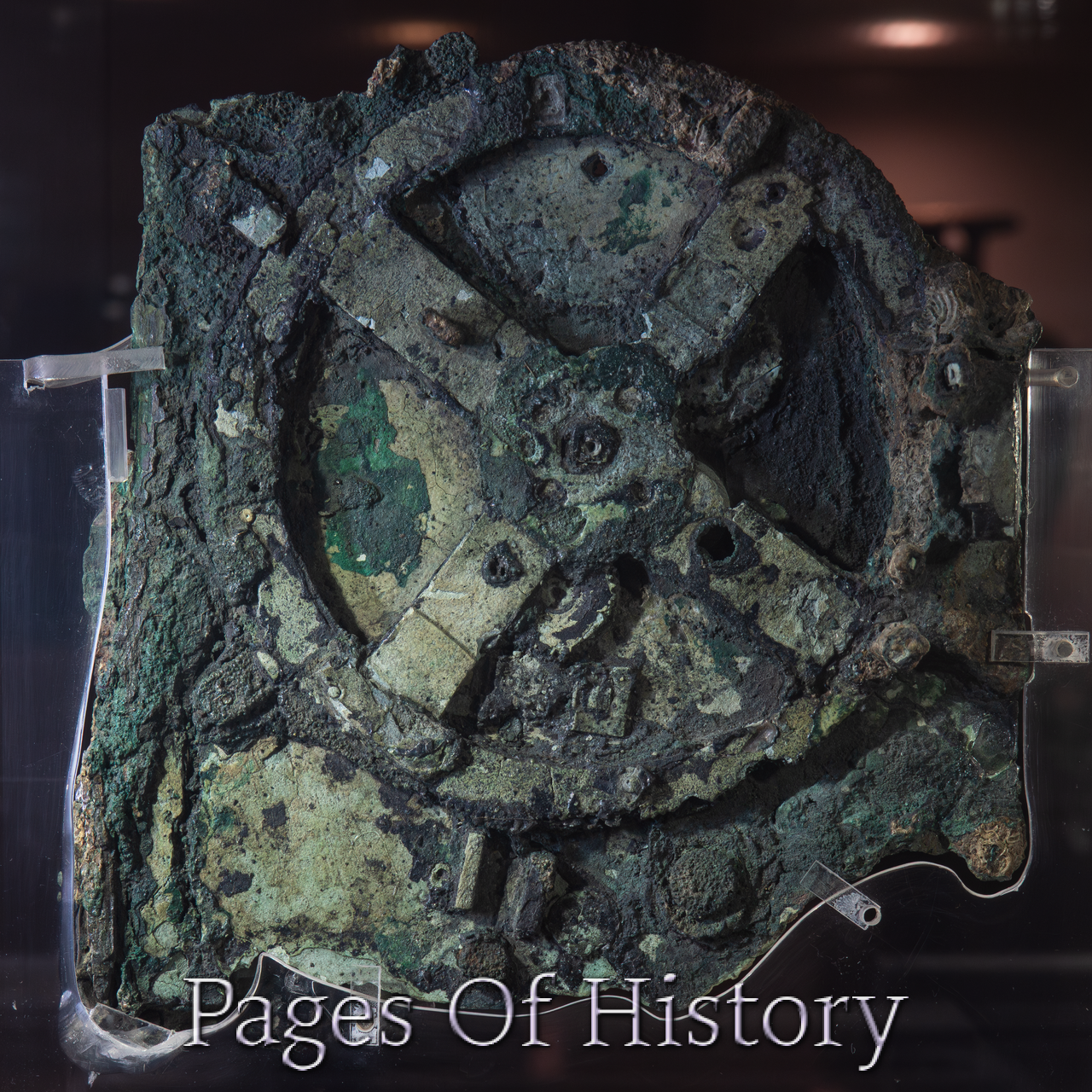
- A corroded, calcified lump of bronze and wood: Initially ignored or dismissed as a piece of broken statue or a rock. This was the Antikythera Mechanism.
The operation was a triumph of early underwater archaeology, but it came at a high cost. One diver died from decompression sickness, and two others were permanently paralyzed. The artifacts were transported to the National Archaeological Museum in Athens, where they were cleaned and cataloged. The strange, green-encrusted lump of corroded metal and wood was initially treated as a curiosity, its true nature hidden by centuries of concretion and decay.
From Curious Lump to Scientific Sensation: The Initial Analysis
The Antikythera Mechanism discovery might have remained a minor footnote if not for the sharp eyes of a few museum officials. When the artifact finally cracked open during cleaning—or was deliberately split by museum staff hoping to see its interior—they revealed a startling sight: not solid metal, but a series of precision-cut bronze gear wheels, inscribed plates, and intricate axles. This was no statue fragment; it was a complex machine.
Valerios Stais and the First Identification
In May 1902, just over a year after the wreck was found, Greek archaeologist Valerios Stais was examining the artifacts when he noticed that one of the corroded pieces bore what looked like gear teeth. He also saw faint Greek inscriptions on the surface. Stais proposed that the object was an astronomical device, perhaps an astrolabe or a planetarium. His claims were met with widespread skepticism. How could ancient Greeks, even with their celebrated philosophers and mathematicians, have built something with such precise gearing? Most scholars dismissed it as an anachronism, suggesting it was a medieval or Renaissance instrument that had somehow fallen into the ancient wreck.
The academic debate simmered for decades. The mechanism was too corroded to be properly studied, and the technology to peer inside its layers of calcified sediment and oxidized bronze did not yet exist. It was stored, largely forgotten, in a museum cabinet.
The First Systematic Study: Price and de Solla Price
The modern era of research began in 1951, when British science historian Derek J. de Solla Price, then a young physicist at the University of Cambridge, took an interest in the object. Working with Greek radiologist Charalambos Karakalos, Price used X-ray and gamma-ray imaging in the 1970s to produce the first comprehensive internal views of the mechanism. Their work was published in a landmark 1974 paper in Scientific American and a subsequent monograph, Gears from the Greeks.
Price’s analysis was revolutionary. He identified:
- At least 30 bronze gears: In a complex, interconnected system.
- A differential gear: A device previously thought to have been invented in the 16th century, used to model the variable motion of the Moon.
- Inscriptions: A user manual of sorts, describing the cycles of the Sun, Moon, and planets.
Price concluded that the Antikythera Mechanism was a calendrical computer, capable of calculating the positions of celestial bodies and predicting eclipses. It was, in his words, “a pocket planetarium” dating from around 87 BCE. The academic world was stunned. The Antikythera Mechanism discovery was now recognized as one of the most important artifacts in the history of technology.
What the Antikythera Mechanism Actually Did
To understand the significance of the Antikythera Mechanism discovery, one must grasp what the device was designed to do. It was not a simple clock or a navigational tool. It was an analog computer that modeled the known universe according to the geocentric cosmology of Hipparchus and Ptolemy.
Core Functions
The mechanism had several key functions, displayed on its bronze front and back faces:
- Solar and Lunar Position: The front face showed the position of the Sun and Moon in the zodiac, along with the date according to the Egyptian calendar and the Greek lunisolar calendar.
- Lunar Phase: A small rotating ball, half-black and half-silver, displayed the phase of the Moon.
- Eclipse Prediction: The back face featured two spiral dials. One tracked the Metonic cycle (19 years), which aligns solar and lunar years. The other tracked the Saros cycle (18 years, 11 days), a period after which eclipses repeat. The mechanism could predict both solar and lunar eclipses with remarkable accuracy.
- Planetary Positions: Recent reconstructions, especially those by the Antikythera Mechanism Research Project (AMRP) using advanced imaging, have revealed that the mechanism also tracked the movements of the five known planets: Mercury, Venus, Mars, Jupiter, and Saturn. It used complex epicyclic gearing to model their retrograde motion—the apparent backward movement of planets as seen from Earth.
The Technology Behind the Gears
The engineering is breathtaking. The gears were cut from a single sheet of bronze with teeth that were hand-filed to a precision of about one-tenth of a millimeter. The gear trains were designed to produce specific ratios that mirrored astronomical cycles. For example, a central gear with 60 teeth drove a system that modeled the Moon’s anomalistic motion (its variable speed in orbit), using a pin-and-slot mechanism that acted as a simple analog computer for a mathematical function. This is a level of sophistication not seen again in Western technology until the development of astronomical clocks in 14th-century Europe.
| Cycle | Length (Days) | Purpose in the Mechanism | Gear Ratio Used |
|---|---|---|---|
| Metonic Cycle | 6,940 | Aligns solar year with lunar months | 235:19 |
| Saros Cycle | 6,585.3 | Predicts eclipse seasons | Talley of 223 lunar months |
| Callippic Cycle | 27,759 | Four Metonic cycles; refines calendar | 940:76 |
| Exeligmos Cycle | 19,756 | Three Saros cycles; predicts exact eclipse times | 669:223 |
This table illustrates the astronomical precision embedded in the mechanism’s gear trains. Each ratio was not arbitrary; it was a deliberate mathematical choice based on centuries of Babylonian and Greek astronomical observation.
Who Built It? The Mystery of the Maker
No surviving ancient text mentions the Antikythera Mechanism. There is no instruction manual, no inventor’s name, no historical record of its manufacture. However, circumstantial evidence points strongly to a specific intellectual and cultural context.
The Rhodian Connection
The most widely accepted hypothesis is that the mechanism was built on the island of Rhodes in the late 2nd or early 1st century BCE. Rhodes was a center of astronomical and mechanical innovation. The great astronomer Hipparchus of Nicaea (c. 190–120 BCE) worked there, and his theories of lunar motion and eclipse cycles are directly reflected in the mechanism’s gearing. Furthermore, Rhodes was famous for its advanced automata and precision instruments, as described by the Roman writer Cicero, who mentions a planetarium built by the philosopher Posidonius that “in one revolution of the sun, displayed the same movements as the sun, moon, and five planets.”
“If a man from Scythia or Britain… saw a box with moving figures… he would think it was a divine thing. But if he saw the Antikythera Mechanism, he would know it was made by a human mind.” — Paraphrased from Cicero, De Natura Deorum (adapted to context).
Archimedes?
Some early scholars, including Price, speculated about a connection to Archimedes of Syracuse (c. 287–212 BCE). Archimedes was known for building intricate mechanical planetariums. The Roman historian Livy wrote that when the Roman general Marcellus captured Syracuse in 212 BCE, he brought back two “spheres” made by Archimedes—one a solid model of the universe, and another that showed the movements of celestial bodies. This second sphere sounds remarkably like the Antikythera Mechanism. However, the mechanism’s astronomical data aligns more closely with Hipparchus’s later work than with Archimedes’s. The most likely scenario is that the mechanism was built by a Rhodian craftsman working in the tradition of Hipparchus and influenced by Archimedean mechanics.
The Antikythera Mechanism Research Project and Modern Imaging
The Antikythera Mechanism discovery took a dramatic leap forward in the 21st century. In 2005, an international team called the Antikythera Mechanism Research Project (AMRP), funded by the Leverhulme Trust and including researchers from the University of Cardiff, the National Archaeological Museum of Athens, and Hewlett-Packard, used cutting-edge technology to re-examine the fragments.
X-ray Tomography and Surface Imaging
Two techniques were pivotal:
- 3D X-ray Computed Tomography (CT): Using a microfocus CT scanner from X-Tek Systems (now Nikon Metrology), the team created high-resolution 3D models of the internal structures, revealing gear teeth, axles, and even the direction of the spiral grooves on the dials.
- Polynomial Texture Mapping (PTM): Developed by HP Labs, this technique used multiple light sources to capture the surface texture of the inscriptions, making legible text that had been invisible to the naked eye for over a century.
The results were spectacular. The team announced in 2006 and 2008 that they had deciphered over 3,400 characters of Greek text, effectively a user manual inscribed on the mechanism’s surfaces. These inscriptions confirmed that the device was a pinax (tablet) used for calculating celestial phenomena, and they named specific planets and cycles. The inscriptions also mentioned the Olympic Games and the cycle of the Panhellenic Games (the “Olympiad dial”), showing the mechanism was also a cultural calendar.
Cosmos in a Box: The Mechanism’s Cultural and Scientific Significance
The Antikythera Mechanism discovery is far more than a technical curiosity. It forces a fundamental reassessment of ancient Greek science and technology.
Lost Knowledge and the Myth of the “Dark Ages”
The mechanism proves that the ancient Greeks possessed a level of mechanical sophistication that was thought impossible for their era. It demonstrates that they understood:
- Epicyclic gearing: Used to model planetary motion, a concept previously attributed to medieval Islamic and European astronomers.
- Differential gearing: A device that allows two inputs to be combined into one output (or vice versa), used to calculate the Moon’s variable speed.
- Precision manufacturing: The ability to cut gears with sub-millimeter accuracy, implying a lost tradition of fine metalworking.
The mechanism challenges the linear narrative of technological progress—the idea that ancient people were “primitive” and that knowledge only increased over time. Instead, it suggests that advanced mechanical knowledge existed but was lost, likely during the turbulent Roman civil wars and the subsequent decline of Hellenistic science. The ship carrying the mechanism sank around 70–60 BCE, a period of intense conflict in the Mediterranean, including the Third Mithridatic War and the rise of Julius Caesar. The mechanism may have been a unique, elite object, perhaps the work of a single workshop whose knowledge died with its last practitioner.
A Window into Hellenistic Worldview
The mechanism also reveals the ancient Greek worldview. It is not a scientific instrument in the modern sense—it does not measure or experiment. Instead, it is a cosmic model, a physical representation of a universe governed by mathematical order. The user could turn a crank and watch the Sun, Moon, and planets move in their cycles, seeing the cosmos as a predictable, harmonious mechanism. This reflects the philosophical school of Stoicism, which saw the universe as a rational, divine order (the logos). The Antikythera Mechanism is, in a very real sense, a piece of applied Stoic philosophy.
Ongoing Mysteries and Future Research
Despite over a century of study, the Antikythera Mechanism discovery is not complete. Many questions remain.
What is Missing?
Only about 82 fragments survive, representing perhaps 40% of the original device. The largest fragment (Fragment A) contains the main drive gear and parts of the front dial. Fragment B holds the back dials. But the entire front planetary display—the part that showed the positions of Mercury, Venus, Mars, Jupiter, and Saturn—is lost. We know it existed because of the inscriptions, but the physical gears that drove it are gone, probably corroded away or lost during the initial recovery.
New Discoveries from the Wreck
In 2012 and again in 2016–2020, a new series of dives by the Return to Antikythera project (led by the Hellenic Ministry of Culture and the Woods Hole Oceanographic Institution) recovered additional artifacts from the wreck. These included:
- A bronze spear: Possibly from a statue.
- A marble head of a bearded man: Likely a philosopher or king.
- More human remains: Offering potential for DNA analysis.
- Additional fragments of the mechanism? In 2017, divers found a bronze disk with gear-like features, but it has not yet been confirmed as part of the mechanism.
The wreck itself is still yielding secrets. The cargo suggests the ship was carrying the spoils of war, possibly looted from Rhodes or other Greek cities by the Roman general Sulla or his contemporaries. The mechanism may have been part of that loot—a prized possession of a Rhodian scholar, destined for a Roman patron.
Conclusion: The Enduring Legacy of a Forgotten Genius
The Antikythera Mechanism discovery is a humbling reminder of how much we still do not know about the ancient world. For centuries, historians confidently asserted that the Greeks had no machines more complex than water clocks and catapults. Then a corroded lump of bronze, pulled from the sea by sponge divers, proved them wrong. The mechanism stands as a testament to the ingenuity of Hellenistic engineers—men whose names are lost to history, but whose work could model the dance of planets with gearing that would not be equaled for over a millennium.
Today, the mechanism is displayed at the National Archaeological Museum in Athens, where visitors can see its fragile, green-encrusted remains and a working replica built by researchers like Michael Wright and the AMRP team. It is a bridge between two worlds: the ancient and the modern. It shows us that the desire to understand, predict, and even simulate the cosmos is a fundamental human drive, one that transcends time. The Antikythera Mechanism discovery is not just an archaeological event; it is a story about the resilience of knowledge, the value of curiosity, and the extraordinary capabilities of the human mind, even in an age without electricity, computers, or factories. It is a cosmic clock, frozen in time, still ticking in our imagination.