
📅 Last updated: 17.10.2026
Cleopatra VII was the last active ruler of the Ptolemaic Kingdom of Egypt, a Macedonian Greek monarch who reigned from 51 to 30 BCE and whose political genius, linguistic brilliance, and strategic alliances with Julius Caesar and Mark Antony shaped the final chapter of Hellenistic Egypt. More than a seductress of legend, she was a shrewd statesman, a published scholar, and a naval commander who nearly reshaped the balance of power in the ancient Mediterranean. Her defeat at Actium and subsequent death marked the end of three centuries of Ptolemaic rule and the absorption of Egypt into the Roman Empire.
Cleopatra VII (69–30 BCE) was the last pharaoh of Ptolemaic Egypt, a highly educated Macedonian Greek ruler who spoke multiple languages, controlled vast wealth, and allied with Roman leaders Julius Caesar and Mark Antony to preserve Egyptian independence. Her defeat by Octavian at the Battle of Actium in 31 BCE and her suicide in 30 BCE ended the Ptolemaic dynasty and transformed Egypt into a Roman province.
- Who Was Cleopatra VII Before the Legend Took Hold?
- How Did Cleopatra VII Meet Julius Caesar?
- Cleopatra VII and Mark Antony: Alliance, Love, and Catastrophe
- Key Facts About Cleopatra VII at a Glance
- The Battle of Actium and the End of Ptolemaic Egypt
- What Did Cleopatra VII Actually Look Like and Achieve?
- Why Does Cleopatra VII Still Matter?
Who Was Cleopatra VII Before the Legend Took Hold?
Born in Alexandria in 69 BCE, Cleopatra VII Thea Philopator (“the father-loving goddess”) belonged to the Ptolemaic dynasty, descendants of Ptolemy I Soter, one of Alexander the Great’s generals. Despite ruling Egypt for nearly three centuries, the Ptolemies remained thoroughly Macedonian Greek: they spoke Greek at court, worshipped Greek deities alongside Egyptian ones, and generally refused to learn the Egyptian language. Cleopatra was the striking exception. According to Plutarch in his Life of Antony, she could converse with Ethiopians, Troglodytes, Hebrews, Arabians, Syrians, Medes, and Parthians in their own tongues, and she was the first of her line to learn Egyptian.
Her education reflected Alexandria’s status as the intellectual capital of the Mediterranean. The city’s famous library and Mouseion attracted scholars from across the Greek world, and Cleopatra was reportedly a capable mathematician, an author of works on cosmetics and measures, and a student of rhetoric and philosophy. This intellectual grounding matters because it shaped how she governed: she presented herself as Isis to Egyptians and as a Hellenistic monarch to Greeks, calibrating her image to each audience with deliberate precision.
A Dynasty in Crisis
Cleopatra inherited a kingdom riddled with dysfunction. Her father, Ptolemy XII Auletes (“the Flute Player”), had been driven from the throne in 58 BCE by an Alexandrian revolt and only regained it with Roman military backing—a humiliation that left Egypt financially dependent on Rome and politically compromised. When Ptolemy XII died in 51 BCE, he left the throne jointly to Cleopatra, then about eighteen, and her younger brother Ptolemy XIII, then around ten, with instructions that they marry and rule together. The arrangement collapsed almost immediately. By 49 BCE, court factions led by the eunuch Pothinus had expelled Cleopatra from Alexandria, forcing her to raise an army in Syria and prepare for civil war.
How Did Cleopatra VII Meet Julius Caesar?
The decisive encounter came in 48 BCE, when Julius Caesar arrived in Alexandria pursuing his rival Pompey the Great, who had fled to Egypt after his defeat at Pharsalus. Ptolemy XIII’s courtiers presented Caesar with Pompey’s severed head—a miscalculation that disgusted the Roman general, who then took up residence in the palace and found himself drawn into the Ptolemaic succession dispute.
Cleopatra, according to Plutarch, arranged to be smuggled into the palace wrapped in bedding (the famous “carpet” version comes later; Plutarch describes a bed-sack carried by her attendant Apollodorus). Her gamble paid off. Caesar was impressed by her intelligence and confidence, and he backed her claim against her brother. The resulting conflict—the Alexandrian War of 48–47 BCE—trapped Caesar in the palace for months, saw the great Library of Alexandria partially burned in the fighting, and ended with Ptolemy XIII drowning in the Nile during the Battle of the Nile in 47 BCE.
Cleopatra was restored to the throne, now married to another younger brother, Ptolemy XIV. In 47 BCE she gave birth to a son, Ptolemy XV Caesarion, whom she publicly claimed was Caesar’s child—a claim Caesar never formally acknowledged but which served as a cornerstone of her dynastic strategy for the rest of her life.
Why the Caesar Alliance Mattered
The relationship with Caesar was not a romantic episode in a vacuum; it was statecraft. Cleopatra secured Roman military support to eliminate her rivals, and Egypt’s grain reserves—critical to Rome’s food supply—remained under her control. In 46 BCE she traveled to Rome with Caesarion and stayed in Caesar’s villa across the Tiber, a visit that scandalized conservative Romans who resented foreign influence and feared Caesar’s ambitions. Caesar’s assassination on the Ides of March, 44 BCE, abruptly ended this arrangement and left Cleopatra exposed in a city suddenly hostile to her presence. She returned to Egypt and, shortly afterward, had her brother Ptolemy XIV killed—removing the last domestic threat to her authority and Caesarion’s succession.
Cleopatra VII and Mark Antony: Alliance, Love, and Catastrophe
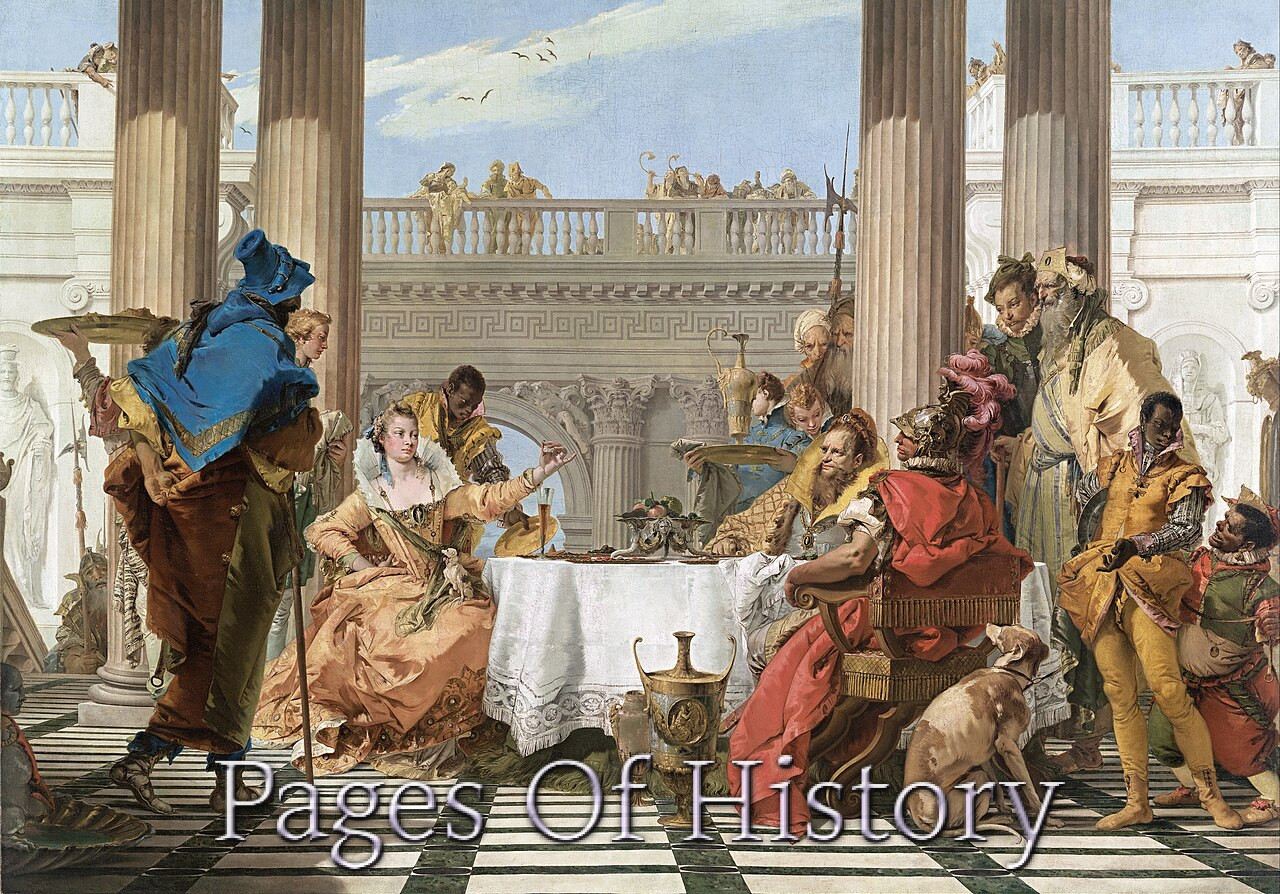
After Caesar’s death, Rome fractured between the assassins (Brutus and Cassius) and the Caesarian coalition of Octavian, Mark Antony, and Lepidus. Cleopatra stayed out of the initial civil war but was summoned by Antony in 41 BCE to Tarsus in Cilicia to answer accusations that she had aided his enemies. Plutarch and Shakespeare both immortalize the meeting: Cleopatra arrived on a gilded barge with purple sails, dressed as Aphrodite, surrounded by attendants costumed as nymphs and Graces. Antony was captivated—but he was also a pragmatic general who needed Egyptian money for his planned Parthian campaign.
The alliance that followed was mutually beneficial for years. Cleopatra provided financing and grain; Antony provided military protection and territorial gifts. In 40 BCE she bore him twins, Alexander Helios and Cleopatra Selene. Antony’s subsequent marriage to Octavian’s sister Octavia—a political arrangement—did not end the Egyptian relationship. By 37 BCE Antony was back in Alexandria, and in 34 BCE he staged the Donations of Alexandria, distributing territories to Cleopatra and their children: Cleopatra received Cyprus, Crete, and parts of Syria; Caesarion was named co-ruler of Egypt and “King of Kings”; the twins and their younger brother Ptolemy Philadelphus received lands in the Roman East.
The Fatal Political Blunder
The Donations were a disaster in Roman public opinion. Antony had given Roman territory to a foreign queen and her children—including Caesar’s supposed son, a direct challenge to Octavian’s claim as Caesar’s heir. Octavian seized the propaganda opportunity, reading Antony’s will aloud to the Senate (it allegedly requested burial in Alexandria) and framing the war as a defense of Rome against an Eastern despot and his corrupting Egyptian consort. The Roman Senate stripped Antony of his consular powers and declared war on Cleopatra personally—not on Antony—in 32 BCE, a legal maneuver that made the conflict a foreign war rather than a civil one.
Key Facts About Cleopatra VII at a Glance
| Category | Detail |
|---|---|
| Full name and title | Cleopatra VII Thea Philopator, Queen of Egypt, last of the Ptolemaic dynasty |
| Lifespan and reign | Born 69 BCE, ruled 51–30 BCE, died August 30 BCE (age 39) |
| Ethnic and cultural background | Macedonian Greek lineage; first Ptolemy to learn Egyptian; presented as Isis to Egyptians |
| Key Roman alliances | Julius Caesar (48–44 BCE); Mark Antony (41–30 BCE) |
| Children | Caesarion (Ptolemy XV), Alexander Helios, Cleopatra Selene II, Ptolemy Philadelphus |
| Defining battle | Battle of Actium, September 2, 31 BCE—naval defeat by Octavian’s fleet under Agrippa |
| Death and aftermath | Suicide by poison or asp, August 30 BCE; Egypt annexed as a Roman province in 30 BCE |
The Battle of Actium and the End of Ptolemaic Egypt
The decisive clash came at Actium, on the western coast of Greece, on September 2, 31 BCE. Antony and Cleopatra assembled a combined fleet of roughly 500 warships and 70,000 infantry; Octavian’s forces, commanded at sea by his brilliant admiral Marcus Agrippa, numbered about 400 ships but with superior crews and better supply lines. Antony’s larger vessels—quinqueremes and heavier—were poorly manned after months of desertions and disease in the marshy camp.
The battle itself remains debated. Cleopatra’s squadron of about 60 ships broke through the Roman line and sailed south, and Antony followed with part of his fleet. Whether this was a prearranged plan to escape with Egypt’s treasury intact or an opportunistic flight amid collapse, the result was catastrophic: the remaining fleet was destroyed or surrendered, and the land army capitulated days later. Antony and Cleopatra returned to Alexandria, where they spent the winter in increasingly desperate circumstances—Antony reportedly building a retreat on a pier in the harbor, and the couple founding a short-lived “Society of Inimitable Livers.”
The Final Days in Alexandria
In the summer of 30 BCE, Octavian invaded Egypt. Antony’s cavalry deserted, his fleet surrendered, and a false report that Cleopatra had died prompted him to stab himself. He died in Cleopatra’s arms—or was hoisted into her mausoleum, depending on the source. Cleopatra then attempted to negotiate with Octavian, but he made clear she would be paraded in his triumph in Rome. On August 30, 30 BCE, she died in her mausoleum. The ancient sources—Plutarch, Cassius Dio, Suetonius—disagree on the method: poison, an asp smuggled in a basket of figs, or a combination. Octavian, reportedly disappointed that he could not display her, had her buried beside Antony.
Caesarion was executed shortly afterward on Octavian’s orders, eliminating the last Ptolemaic claimant. Egypt became a Roman province, its wealth and grain flowing directly to the emperor. The Ptolemaic dynasty—and with it, the last major Hellenistic kingdom—was over.
What Did Cleopatra VII Actually Look Like and Achieve?
The popular image of Cleopatra as a seductive beauty owes more to Elizabeth Taylor, Shakespeare, and Roman propaganda than to evidence. Plutarch, writing about a century after her death, noted that her beauty was “not altogether incomparable” but that her conversation was “irresistibly fascinating”—her charm lay in her intellect, voice, and wit. Coins bearing her portrait show a strong nose, prominent chin, and heavy features, consistent with Hellenistic royal portraiture rather than idealized beauty.
Her achievements, however, were substantial. Consider the concrete record:
- Economic management: She stabilized Egypt’s currency and grain economy, which had been damaged by her father’s debts and Roman exactions.
- Linguistic and administrative skill: She was the only Ptolemy known to have learned Egyptian, and she issued bilingual decrees that reinforced her legitimacy with native priests and officials.
- Religious policy: She cultivated the cult of Isis and presented herself as the goddess incarnate, binding Egyptian religious authority to her throne.
- Diplomatic ambition: She secured territorial concessions from Antony that briefly restored Ptolemaic control over Cyprus, Crete, and parts of Syria—territory lost for generations.
- Naval command: She personally commanded a fleet at Actium, a fact often minimized in the romantic retellings.
The Propaganda Problem
Almost everything written about Cleopatra comes from her enemies or from writers working under Roman rule. Octavian’s court poets—Virgil, Horace, Propertius—portrayed her as a drunken, emasculating Eastern queen, “the fatal monster” (Horace, Odes 1.37). This was political necessity: Octavian had just fought a war against a Roman citizen (Antony) and needed to reframe it as a foreign conflict. The image stuck. Later Christian writers added moral condemnation, and by the Middle Ages Cleopatra had become a cautionary tale about female ambition and sensuality. Only in the twentieth century did scholars begin systematically separating the woman from the caricature.
Why Does Cleopatra VII Still Matter?
Cleopatra’s reign sits at the hinge of world history: the moment when the Roman Republic collapsed into the Empire and the Hellenistic world—the Greek-speaking kingdoms that had dominated the eastern Mediterranean since Alexander—was extinguished. Her choices mattered because she was not merely a consort but a head of state making sovereign decisions: which Roman power to back, which territories to demand, when to fight and when to flee. She lost, but she lost against the most competent political operator of the age, Octavian, who went on to rule as Augustus for four decades.
Her legacy also shaped how we think about women in power. The tension between her evident competence and the hostile literary tradition that reduced her to a sexualized stereotype is itself historically significant—a case study in how political memory is constructed by the victorious. Modern scholarship, drawing on papyri, coins, inscriptions, and archaeology, has steadily restored the portrait: a multilingual, strategically brilliant, and ruthless monarch who governed one of the wealthiest states in the ancient world and nearly succeeded in preserving its independence against overwhelming odds.
For historians, the enduring lesson is methodological. The sources are hostile, fragmentary, and shaped by Augustan propaganda. Reading Cleopatra VII accurately requires the same skepticism we apply to any ruler whose story was written by the people who defeated her—and the willingness to recognize that the woman behind the myth was, by any measure, one of the most consequential figures of antiquity.