
📅 Last updated: 06.10.2026
The Indus Valley Civilization was the largest of the world’s three earliest urban societies, covering some 1.5 million square kilometers across what is now Pakistan and northwestern India — an area larger than ancient Egypt and Mesopotamia combined. At its height, around 2500 BCE, its people built planned cities with grid streets, flushing toilets, and standardized bricks, then traded across a network stretching from Central Asia to the Persian Gulf. And then, over a span of a few centuries after 1900 BCE, it quietly came apart. No invading army burned its cities; no single flood drowned it. The truth, as archaeologists have pieced it together over the past century, is more interesting — and more unsettling — than any single catastrophe.
- What We Mean by the Indus Valley Civilization
- Why Did the Indus Valley Civilization Decline? The Old Theories
- The Climate Turn: When the Monsoon Weakened
- The River That Moved: Hydrology and the Ghaggar-Hakra
- Where Did the Harappans Go? De-Urbanization, Not Extinction
- A Timeline of Collapse: Key Dates and Events
- Trade, Economy, and the Fragility of a Network
- Why the Cities Could Not Recover: The Missing State
- What Happened Next: The Vedic Age and the Long Afterlife
- The Truth: A Slow, Multi-Cause Unraveling
- Why This Matters Today
What We Mean by the Indus Valley Civilization
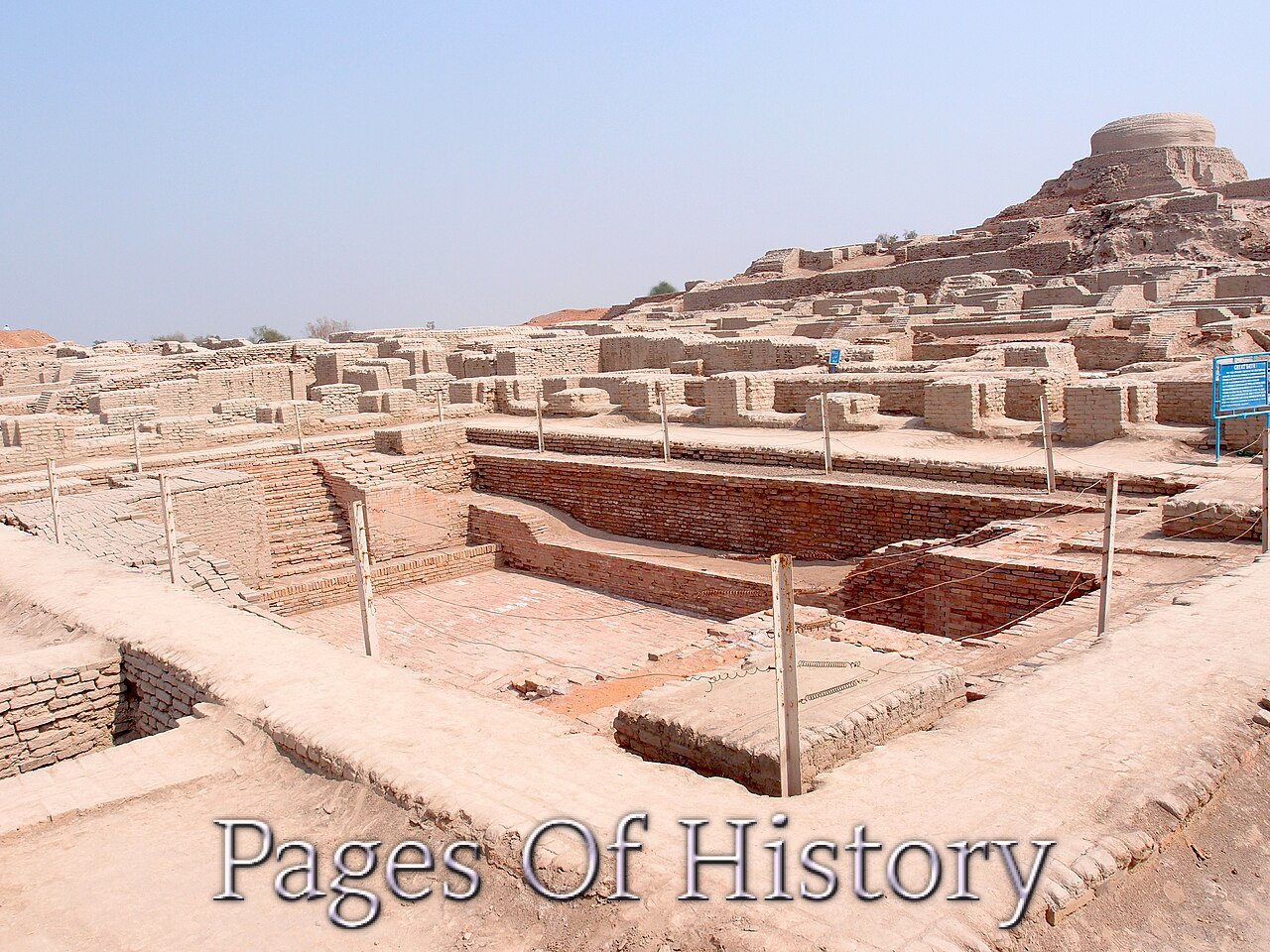
Before asking why it disappeared, it helps to be precise about what “it” was. The Indus Valley Civilization — also called the Harappan Civilization, after its first-excavated site at Harappa — emerged in the fertile floodplain of the Indus River and its tributaries around 3300 BCE, matured into full urban form by about 2600 BCE, and entered its “Mature Harappan” phase from roughly 2600 to 1900 BCE. Its people spoke an undeciphered language, wrote in a script that has never been cracked, and left no royal inscriptions, no monumental temples, and no obvious kings. What they did leave is startling: cities laid out on a north–south grid, with covered drains running beneath the streets, standardized baked bricks (in a 1:2:4 ratio) used across a region the size of Western Europe, and granaries large enough to store surplus grain for thousands.
The great cities were Mohenjo-daro and Harappa in the Punjab and Sindh, Dholavira in Gujarat with its elaborate water reservoirs, Lothal with its tidal dockyard, and Kalibangan on the dry Ghaggar-Hakra channel. Estimates of the total population range from one to five million — a conservative figure would put it at over a million, making it comparable to Egypt of the same era. Crucially, this was a civilization without a standing army that we can detect, without chariots, and without the kind of centralized god-king ideology that Egypt and Mesopotamia used to bind their societies together. That absence matters enormously when we try to explain its end.
Why Did the Indus Valley Civilization Decline? The Old Theories
For most of the twentieth century, the collapse was explained by invasion. In 1922, when Sir John Marshall’s team announced the discovery of Mohenjo-daro, the excavators found groups of skeletons lying in the streets and houses, some apparently unburied. That image — a city of the dead, cut down in a moment — fired the imagination. In 1947, the British archaeologist Mortimer Wheeler, then Director-General of the Archaeological Survey of India, proposed that the cities had been sacked by chariot-riding Indo-Aryan invaders from the north, an event he tied to the Rigveda’s references to pura (forts) and to the god Indra as purandara, “fort-destroyer.” Wheeler even famously declared, of one skeleton at Mohenjo-daro, “In this case, the evidence is almost too good to be true.”
It was too good to be true. Later, more careful examination of those skeletons showed no consistent evidence of battle wounds; many had died of disease, and the bodies had simply been left where they fell in a city that was already being abandoned. The “massacre” was an illusion created by careless early excavation. Equally, the Indo-Aryan migration, as we now understand it, was a gradual, centuries-long movement of pastoral peoples into the subcontinent beginning around 1500 BCE — well after the cities had already emptied. There is no archaeological layer of ash and destruction at Harappa or Mohenjo-daro that matches a conquest. The invasion theory, once orthodoxy, is now rejected by nearly all specialists.
Other single-cause theories have fared little better:
- The “Aryan invasion” — chronologically impossible as the cause of the urban collapse, though incoming Indo-Aryan-speaking peoples did reshape the region afterward.
- A single great flood — the Indus does flood, and Mohenjo-daro shows flood silt layers, but no single deluge explains the abandonment of dozens of sites across a million square kilometers.
- Tectonic damming of the Indus — proposed by the geologist R. L. Raikes in the 1960s, this could have backed up water and created a vast lake, but it cannot account for the drying of the Ghaggar-Hakra system in the east.
- Epidemic disease — possible in a crowded city, but there is no evidence of a pandemic sweeping the whole region.
The honest answer is that no single catastrophe fits the evidence. What the evidence does show is a slow, region-by-region unraveling driven by climate, water, and the internal fragility of a system that had no central authority to hold it together.
The Climate Turn: When the Monsoon Weakened
The most powerful modern explanation begins with the weather. For decades, paleoclimatologists have been reconstructing ancient rainfall from cave stalagmites in Oman, lake sediments in Rajasthan, and the oxygen-isotope records locked in marine cores from the Arabian Sea. The picture that has emerged is striking. Between roughly 2200 and 1900 BCE, the Indian summer monsoon weakened significantly across South Asia. This was not a local event: the same aridification is recorded in Mesopotamia (where it helped topple the Akkadian Empire around 2150 BCE) and in the Nile Valley (where it contributed to the collapse of the Old Kingdom). It was a hemisphere-wide climate shift.
For the Harappans, whose entire urban economy rested on the annual flood of the Indus and on monsoon-fed rivers to the east, this was existential. The Indus itself is a snowmelt-and-monsoon river, so it kept flowing, but its erratic floods damaged cities and its reduced summer flow shrank the agricultural surplus. The smaller rivers of the eastern domain — the Ghaggar-Hakra system, which many scholars identify with the Rigvedic Sarasvati — were far more vulnerable. They depended almost entirely on monsoon rain. As the monsoon migrated south and east, these rivers dried up or became seasonal. Satellite imagery and ground survey have traced a vast, fossilized riverbed running from the Siwalik hills through Haryana and Rajasthan toward the Rann of Kutch — a river system that once supported hundreds of Harappan settlements and is now a dry channel.
When the water goes, the cities go. Mohenjo-daro’s elaborate drains and baths were engineering marvels, but they were also a luxury that only a functioning agricultural surplus could sustain. As the surplus shrank, the maintenance of civic infrastructure — the very thing that defined Harappan urbanism — became impossible.
The River That Moved: Hydrology and the Ghaggar-Hakra
Climate was only half the story; geology was the other half. The Indus and its tributaries are among the most sediment-heavy rivers on Earth, and they shift course dramatically over centuries. The Harappans built on floodplains precisely because the silt renewed their fields, but that same dynamism made their cities precarious. Mohenjo-daro shows at least seven major rebuilding phases, several of them apparently triggered by floods that buried streets in silt. Eventually, the effort of rebuilding became too great.
The eastern settlements faced a different fate. The Ghaggar-Hakra, once a substantial river system, appears to have captured and lost its headwaters to the Yamuna and Sutlej as tectonic activity and climate change reshuffled the drainage. By around 1900 BCE, its middle reaches were drying. Sites like Kalibangan, Banawali, and Rakhigarhi — some of them larger than Mohenjo-daro — were abandoned or shrank to villages. The people did not vanish; they moved. And where they moved tells us a great deal about the civilization’s afterlife.
Where Did the Harappans Go? De-Urbanization, Not Extinction
This is the single most important correction to the popular story. The Indus Valley Civilization did not “disappear” in the sense of a people being wiped out. It de-urbanized. Between about 1900 and 1300 BCE, the great cities were abandoned, and the population dispersed into smaller villages, shifting eastward and southward toward the Ganges-Yamuna plain and into Gujarat and the Deccan. Archaeologists call this the “Late Harappan” or “Cemetery H” phase, named after a distinctive pottery style found at Harappa.
The evidence for continuity is compelling:
- Pottery and craft traditions continue without a sharp break from Mature to Late Harappan levels.
- Domestic architecture — mud-brick houses, courtyards, hearths — persists in the smaller settlements.
- Agricultural practices, including the cultivation of barley, wheat, and later rice, carry on in the new eastern settlements.
- Weights and measures and some seal motifs survive in degraded form, suggesting cultural memory rather than total rupture.
In other words, the civilization didn’t die; it dissolved back into a village-based, agrarian society. The cities were an experiment that could not be sustained once the climate and rivers that supported them changed. The people who had built Mohenjo-daro became the farmers of the Ganges plain — and their descendants, in a sense, helped lay the groundwork for the next great chapter of South Asian history.
A Timeline of Collapse: Key Dates and Events
The following table summarizes the main phases and the evidence behind each. Note how the decline is spread across centuries, not concentrated in a single year.
| Period | Dates (approx.) | What Happened | Key Evidence |
|---|---|---|---|
| Early Harappan | 3300–2600 BCE | Village cultures coalesce; first planned settlements | Kot Diji, Amri, early Harappa levels |
| Mature Harappan | 2600–1900 BCE | Great cities, standardized bricks, long-distance trade | Mohenjo-daro, Harappa, Dholavira, Lothal |
| Climate shift begins | c. 2200 BCE | Monsoon weakens across South Asia | Oman stalagmites, Arabian Sea cores |
| Late Harappan | 1900–1300 BCE | Cities abandoned; population shifts east and south | Cemetery H pottery, Ghaggar-Hakra desiccation |
| Post-Harappan | 1300–600 BCE | Village agrarian society; Vedic culture emerges | Painted Grey Ware, early Sanskrit texts |
The table makes an essential point: the “collapse” is a process lasting perhaps six centuries, not an event. It is closer to the slow decline of a rust-belt region than to the fall of Troy.
Trade, Economy, and the Fragility of a Network
Another strand of the story is economic. The Harappans were, above all, traders. Their seals — thousands of small steatite squares bearing animal motifs and undeciphered signs — have been found at Mesopotamian sites such as Ur and Nippur, and Mesopotamian texts from the reign of Sargon of Akkad (c. 2334–2279 BCE) refer to a land called Meluhha, widely identified with the Indus region, as a source of carnelian, ivory, gold, and timber. Lapis lazuli from Badakhshan in Afghanistan, turquoise from Iran, and cotton from Gujarat all moved through Harappan hands. Lothal’s dockyard on the Gulf of Khambhat was a genuine port, with a basin and sluice gates designed to hold water at low tide.
This trade network was a source of wealth — but also a source of vulnerability. When the Mesopotamian demand for Indus goods declined after the fall of the Akkadian Empire and the subsequent political fragmentation of the region, a key export market contracted. Meanwhile, the overland routes through Baluchistan and Afghanistan became less secure as the climate dried and pastoral groups moved. A civilization that had grown rich on long-distance exchange found its markets shrinking just as its agricultural base was weakening. The two pressures compounded each other.
“The Harappans did not disappear. They moved. The cities were abandoned, but the people, their crops, and their crafts continued — simply at a smaller scale and in new places.” — A summary of the consensus view among South Asian archaeologists today.
Why the Cities Could Not Recover: The Missing State
Here is a factor that is easy to overlook but arguably decisive: the Indus Valley Civilization appears to have had no centralized state. Unlike Egypt, where the pharaoh’s bureaucracy could command labor for irrigation and grain storage, or Mesopotamia, where temple and palace institutions organized the economy, Harappan society seems to have been remarkably egalitarian in its material record. There are no royal tombs, no palaces, no obvious standing armies, and a striking uniformity of housing across the cities. Some scholars see this as evidence of a decentralized network of city-states or merchant oligarchies; others suggest a system of communal governance.
Whatever the exact structure, the consequence was the same. A decentralized society has enormous resilience at the village level — which is why the population survived — but it lacks the capacity to mobilize a coordinated response to a slow-moving crisis. No single ruler could order the rebuilding of a flood-damaged city, redirect a river, or organize famine relief across a million square kilometers. When the climate and rivers shifted, each community was left to fend for itself. The cities, which depended on regional integration, could not be maintained by isolated villages. In this sense, the very features that made Harappan society humane and stable — its lack of militarism, its decentralization, its emphasis on trade over conquest — also made it unable to adapt to a changing world.
This is a lesson with uncomfortable modern echoes. Complex, interconnected systems are efficient in stable conditions and brittle in unstable ones. The Harappans built one of the most sophisticated urban networks of the ancient world, and it was precisely that sophistication that became unsustainable when the rains failed.
What Happened Next: The Vedic Age and the Long Afterlife
The end of the Indus cities was not the end of South Asian civilization. As the Late Harappan population shifted east into the Ganges-Yamuna plain, a new culture took shape. By around 1500 BCE, Indo-Aryan-speaking peoples — pastoralists who had migrated gradually from the Central Asian steppe through Afghanistan and the Punjab — were settling in the same regions. The fusion of these incoming groups with the existing Late Harappan population produced the Vedic culture, whose texts, the Rigveda (composed c. 1500–1200 BCE), give us the earliest glimpses of the society that would eventually produce the caste system, the Sanskrit epics, and the religious traditions of Hinduism.
Some cultural continuities are debated but plausible: the worship of a mother goddess, the importance of ritual purity and bathing (echoed in later Hindu practice), the veneration of certain animals (the bull, the unicorn-like motif on seals), and the use of standardized weights that persisted into later Indian trade. None of this means the Vedic culture was a direct continuation of Harappan civilization — the evidence does not support that — but the two were not wholly separate either. The Harappan world did not vanish without a trace; it dissolved into the soil from which later India grew.
The Truth: A Slow, Multi-Cause Unraveling
So why did the Indus Valley Civilization disappear? The truthful answer is that it did not disappear in a single dramatic moment, and it was not destroyed by a single cause. It was undone by a convergence of factors over roughly six centuries:
- Climate change — a weakening monsoon after 2200 BCE reduced agricultural surplus across the region.
- Hydrological change — the Ghaggar-Hakra river system dried up, and the Indus shifted course, abandoning many settlements.
- Economic contraction — the decline of Mesopotamian trade removed a key source of wealth.
- Political fragmentation — a decentralized society without a central state could not coordinate a response.
- De-urbanization — the population survived but dispersed into villages, ending the urban phase.
The invasion theory, once the standard explanation, has been thoroughly discredited. The idea of a single flood or a single earthquake has also been set aside. What remains is a picture of a remarkable civilization that reached its environmental and organizational limits and then transformed into something smaller, poorer, and more local. The people did not die; they adapted. The cities did not fall; they emptied.
Why This Matters Today
The fate of the Indus Valley Civilization is more than an archaeological curiosity. It is the earliest well-documented case of a complex society collapsing under climate stress, and it offers a cautionary tale for our own era. The Harappans were not primitive; they were brilliant engineers and traders who built the largest urban network of their time. Their failure was not one of intelligence or effort but of scale and resilience — a system optimized for a stable climate that could not survive a shift it had no way to foresee or prevent.
There is also a quieter lesson in the way the civilization ended. It did not end with a bang, a battle, or a tyrant. It ended with people moving away, one village at a time, as the rivers dried and the rains failed. The great cities of Mohenjo-daro and Harappa were not conquered; they were simply left. That slow, undramatic dissolution is perhaps the most human thing about the whole story — and the most relevant to a world now facing its own uncertain climate. The Indus Valley Civilization did not disappear. It changed, and in changing, it became part of the long, continuous story of South Asia. The ruins remain, silent and orderly, waiting for us to read them correctly.