
📅 Last updated: 14.07.2026
- The Fractured Village: Social and Economic Roots of the Salem Witch Trials
- War, Disease, and the Psychological Climate of the Salem Witch Trials
- The Mechanics of Hysteria: Spectral Evidence and the Circle of Accusers
- The Role of Religion and Puritan Ideology
- Key Figures: The Accused and the Accusers
- The Aftermath: Guilt, Reparations, and a Legacy of Caution
- Lessons and Misconceptions: Rethinking the Salem Witch Trials
- Conclusion: The Enduring Legacy of the Salem Witch Trials
The Salem Witch Trials are often remembered as a dark chapter of religious extremism, but the true cause of the hysteria was a far more complex convergence of social, economic, and psychological pressures that reached a breaking point in the winter of 1692. While spectral evidence and demonic possession dominated courtroom testimony, the real drivers were a perfect storm of land disputes, a recent smallpox epidemic, the trauma of King William’s War, and a deeply fractured community struggling to define its identity in a rapidly changing New England. To understand why nineteen innocent people were hanged and one pressed to death, we must look beyond the supernatural and into the very real anxieties of life in colonial Massachusetts.
The Fractured Village: Social and Economic Roots of the Salem Witch Trials
The community of Salem Village (present-day Danvers) was not a unified settlement but a powder keg of resentment. By 1692, the village had been embroiled in a bitter feud with the more prosperous and commercially connected Salem Town for over two decades. The central conflict was over taxation and land use. Salem Village was an agrarian community of struggling farmers, while Salem Town was a thriving port town with deep ties to Atlantic trade. Villagers resented paying taxes to a town that offered them little in return, while Town merchants viewed the Villagers as backward and stubborn.
The Porter-Putnam Feud
At the heart of this division was a multi-generational rivalry between two powerful families: the Porters and the Putnams. The Porters, led by Israel Porter, were aligned with Salem Town and represented a more moderate, commercially oriented worldview. The Putnams, led by Thomas Putnam Jr., were staunchly pro-Village and deeply suspicious of the Town’s influence. When accusations of witchcraft began to fly, the lines of the feud were starkly visible. Ann Putnam Jr., the twelve-year-old daughter of Thomas Putnam, was one of the primary accusers, and her father used the trials as a weapon to settle old scores and seize land from accused families. The Putnam family had a history of litigation, and the witchcraft court became an extension of their legal battles.
Economic Instability and Land Disputes
Adding fuel to the fire was a severe economic downturn. The Massachusetts Bay Colony was still recovering from the Glorious Revolution and the subsequent collapse of its original charter. Land titles were in chaos, and many families were locked in heated disputes over property boundaries. The accused witches often owned prime parcels of land that their accusers coveted. For example, John Proctor, a wealthy farmer who was hanged in August 1692, had been involved in a bitter land dispute with the Putnam family. The trials provided a convenient, if horrifying, mechanism to eliminate rivals and acquire their assets through forfeiture.
War, Disease, and the Psychological Climate of the Salem Witch Trials
The immediate backdrop to the hysteria was a period of profound trauma. From 1688 to 1697, the colony was engulfed in King William’s War, the North American theater of the Nine Years’ War between England and France. French forces and their Native American allies launched devastating raids along the Maine frontier, sending waves of refugees fleeing south to communities like Salem.
The Refugee Crisis
Salem Village absorbed hundreds of traumatized refugees from frontier settlements like Casco Bay and York. These families had witnessed the brutal deaths of neighbors and relatives. Their presence strained the village’s already limited resources and introduced a deep, pervasive fear of the unseen—enemies who could strike at any moment, whether in the form of French soldiers, Wabanaki warriors, or, as the logic of the time suggested, witches in league with the Devil. Many of the accusers, including Abigail Williams and Betty Parris, had listened to the harrowing tales of these refugees, which blurred the line between physical and spiritual warfare.
The Smallpox and Measles Epidemics
In the years immediately preceding 1692, Salem Village had been ravaged by outbreaks of smallpox and measles. The Reverend Samuel Parris, whose daughter and niece were the first afflicted girls, had lost his wife to illness years earlier. The community was haunted by the specter of invisible contagion—diseases that struck without warning and could not be explained by natural causes. This medical anxiety directly fed into the witchcraft narrative. If a disease could spread invisibly, why not a demonic curse? The symptoms of the afflicted girls—convulsions, choking sensations, and fits—closely resembled the neurological aftereffects of epidemic encephalitis, a condition that can follow viral infections like measles.
The Failure of Leadership
The colony’s leadership was in a state of crisis. In 1689, the Dominion of New England had collapsed, and the colony was operating under an interim government without a royal charter. Governor Sir William Phips returned to Massachusetts in May 1692 with the new charter, but he was immediately faced with the witchcraft crisis. Rather than exercising caution, Phips appointed a special Court of Oyer and Terminer in June 1692, composed of local magistrates who were deeply embedded in the community’s feuds. The court’s chief justice, William Stoughton, was a rigid Puritan who believed firmly in the reality of witchcraft and was determined to root it out at any cost. The legal system failed because it was built on fear rather than evidence.
The Mechanics of Hysteria: Spectral Evidence and the Circle of Accusers
The most dangerous innovation of the Salem Witch Trials was the admission of spectral evidence. This was the testimony of victims who claimed to see the spirit or specter of the accused tormenting them, even when the accused’s physical body was elsewhere. Puritan theology held that the Devil could not assume a person’s shape without that person’s permission. Therefore, if a witness saw the specter of Bridget Bishop pinching them, it was considered proof that Bishop had made a pact with Satan.
The Afflicted Girls and Their Network
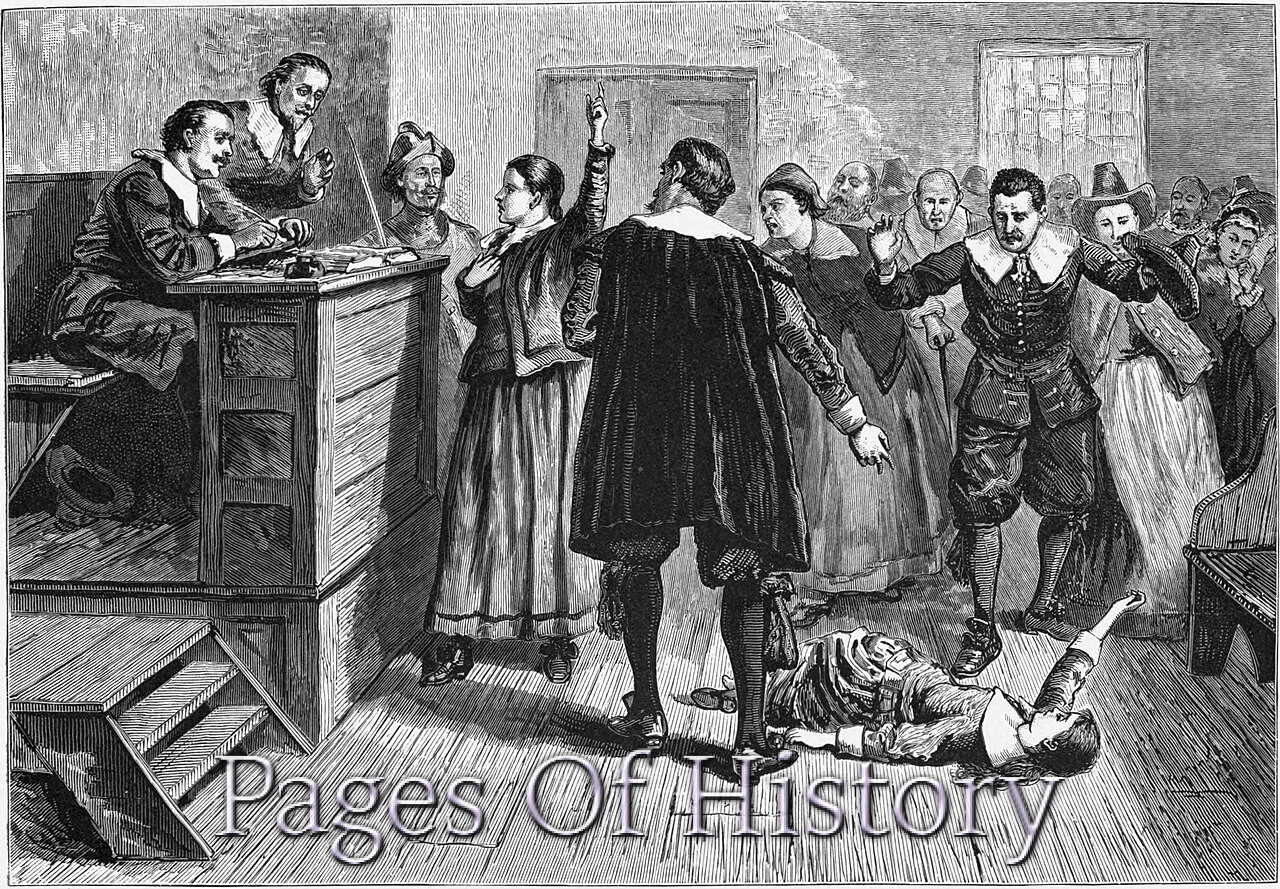
The initial accusations began in January 1692 in the home of Reverend Samuel Parris. The girls—Betty Parris (age 9), Abigail Williams (age 11), and their friends Ann Putnam Jr. (age 12), Mercy Lewis (age 17), and Mary Walcott (age 17)—began exhibiting strange behaviors. The adults initially dismissed it as teenage mischief, but when the girls named their first victims—Tituba, an enslaved woman from the Caribbean; Sarah Good, a homeless beggar; and Sarah Osborne, an elderly, bedridden woman—the hysteria erupted.
What is crucial to understand is the social dynamics of the accusers. They were not a random group of children. They were a tight-knit circle of adolescents and young women who lived in close proximity, shared chores, and listened to the same terrifying stories. They quickly learned that accusations gave them unprecedented power. In a society where young women had no political voice, the ability to name a witch transformed them into the center of attention. The magistrates believed them, the clergy supported them, and the community feared them. This created a feedback loop: the more they accused, the more credible they became.
The Escalation: From Outcasts to Prominent Citizens
The pattern of accusation followed a clear trajectory. The first victims were social outcasts: Sarah Good was a homeless beggar who wandered the village muttering curses; Tituba was an enslaved woman whose stories of voodoo and magic from Barbados fascinated and frightened the girls. But by the spring and summer of 1692, the accusations had shifted to respected, prominent members of the community. Rebecca Nurse, a pious, elderly woman in her seventies, was arrested in March. Her trial shocked the colony because she was a model Puritan. Yet the accusations continued, fueled by the logic that the Devil would use the most virtuous souls as his greatest weapons.
| Phase | Time Period | Key Victims | Key Accusers | Outcome |
|---|---|---|---|---|
| Initial Outbreak | January – March 1692 | Tituba, Sarah Good, Sarah Osborne | Betty Parris, Abigail Williams | Arrests; Tituba confesses |
| Rapid Expansion | April – June 1692 | Rebecca Nurse, John Proctor, Elizabeth Proctor, Bridget Bishop | Ann Putnam Jr., Mercy Lewis, Mary Walcott | Bridget Bishop hanged (June 10) |
| Peak Hysteria | July – August 1692 | George Burroughs, Martha Carrier, John Willard | Expanded circle of girls; adult accusers | Five hanged in July; five in August |
| Collapse | September – October 1692 | Mary Easty, Martha Corey, Giles Corey | Growing public skepticism | Eight hanged; Giles Corey pressed to death; court dissolved |
The Role of Religion and Puritan Ideology
While economic and social factors were critical, the trials cannot be understood without examining the Puritan worldview. The Puritans of Massachusetts believed they were living in a covenant with God. Their colony was a “city upon a hill,” and any failure to uphold God’s laws invited divine punishment. The late 17th century had been a period of spiritual decline, at least in the eyes of the clergy. Church membership was dropping, and the Half-Way Covenant of 1662 had diluted the strict requirements for baptism. The clergy saw the witchcraft crisis as a sign that God was angry with the colony for its sins.
The Influence of Cotton Mather
No figure looms larger over the intellectual justification of the trials than the Reverend Cotton Mather, the most prominent minister in Boston. In 1689, Mather had published a book titled Memorable Providences, Relating to Witchcrafts and Possessions, which detailed the case of the Goodwin children in Boston. Mather argued that witchcraft was a real and present danger and that the courts must take it seriously. He corresponded with the Salem magistrates and encouraged them to pursue the cases. However, Mather also warned against the reliance on spectral evidence alone. By the time he began to publicly caution the court, the hysteria was already out of control.
The Clergy’s Late Objection
In October 1692, as the executions mounted, a group of Boston ministers led by Increase Mather (Cotton’s father) published a pamphlet titled Cases of Conscience Concerning Evil Spirits. This document argued that it was better for ten suspected witches to escape than for one innocent person to be condemned. This shift in clerical opinion was pivotal. Governor Phips, facing growing public unrest and pressure from influential families whose members had been accused, dissolved the Court of Oyer and Terminer in late October 1692. The hysteria collapsed almost overnight.
Key Figures: The Accused and the Accusers
The human cost of the Salem Witch Trials is best understood through the stories of specific individuals. Their fates reveal the capricious and brutal nature of the proceedings.
Giles Corey: The Man Who Wouldn’t Plead
Perhaps the most haunting story is that of Giles Corey, an 80-year-old farmer. When he was accused of witchcraft in September 1692, he refused to enter a plea. Under English law, a defendant who refused to plead could not be tried, but could be subjected to peine forte et dure—pressing with heavy stones until he either pleaded or died. Corey endured this torture for two days. His last words are legend: “More weight.” He died without a trial, ensuring that his property would pass to his family rather than be forfeited to the state upon his conviction. His death was a silent act of defiance that shocked the colony and accelerated the growing public revulsion against the trials.
Rebecca Nurse: The Saintly Martyr
The trial of Rebecca Nurse marked the turning point. She was a beloved, elderly church member with no history of conflict. When the jury initially acquitted her, the accusers shrieked so violently that the judges ordered the jury to reconsider. The jury then returned a guilty verdict. Governor Phips granted her a reprieve, but it was quickly revoked after the accusers intensified their fits. She was hanged on July 19, 1692. Her execution shattered the illusion that only sinners could be witches.
John Proctor: The Skeptic
John Proctor was one of the few accused who openly mocked the proceedings. He declared that the girls were lying and that the court was a sham. His wife, Elizabeth Proctor, was also accused. Proctor was arrested, tried, and condemned. He wrote a desperate letter from prison in July 1692, begging Boston ministers to intervene and exposing the corruption of the court. His letter, smuggled out of prison, was a key piece of evidence that later led to the downfall of the trials. He was hanged on August 19, 1692.
The Aftermath: Guilt, Reparations, and a Legacy of Caution
The end of the trials did not bring immediate justice. In the months and years that followed, the surviving accused were released from prison, but the community was shattered. For a decade, Massachusetts was consumed by a crisis of conscience.
The Day of Fasting and Apology
In 1697, the Massachusetts General Court declared a Day of Fasting and Humiliation to atone for the tragedy. Judge Samuel Sewall, one of the magistrates who had presided over the court, stood before the congregation in Boston’s Old South Meeting House and publicly read a statement of apology, acknowledging his guilt in the “Blame and Shame” of the trials. He wore a hair shirt for the rest of the day, a visible sign of his penitence. This act is one of the earliest examples of a public official taking personal responsibility for a miscarriage of justice.
Compensation and Reversal of Attainder
The colony eventually passed laws to reverse the attainders of the condemned and to compensate their families. By 1711, the General Court had awarded £578 in restitution to the families of the victims. However, this was a fraction of the actual losses. Many families had lost their land, their homes, and their livelihoods. The process of healing was slow and incomplete. The final victim to be officially exonerated was Ann Pudeator, in 1957, nearly three centuries later.
Lessons and Misconceptions: Rethinking the Salem Witch Trials
The Salem Witch Trials are often simplified as a story of religious fanaticism, but this misses the deeper lessons. The hysteria was not caused by a single factor but by the intersection of several dangerous conditions: a traumatized population, a failing legal system, economic inequality, and a culture that believed in a literal, active Devil.
What the Trials Were Not
- They were not a unique American phenomenon. Witch hunts were common across Europe in the 16th and 17th centuries, with tens of thousands executed. Salem was a late, provincial echo of a broader European panic.
- They were not solely about gender. While most victims were women, men were also executed, including John Proctor, George Burroughs, and Giles Corey. The trials targeted anyone who threatened the social order.
- They were not caused by ergot poisoning. The theory that the girls were suffering from LSD-like hallucinations from contaminated rye bread has been largely debunked. The symptoms were culturally constructed, not chemically induced.
What the Trials Were
- A failure of institutions. The courts, the clergy, and the government all failed to protect the innocent. The absence of due process and the reliance on spectral evidence created a system that could not correct its own errors.
- A case study in groupthink. The accusers, the magistrates, and the community reinforced each other’s beliefs. Dissent was punished, and conformity was rewarded. This created an echo chamber that amplified fear into violence.
- A warning about the power of narrative. The accusers told a compelling story—that they were victims of a vast satanic conspiracy—and that story was accepted because it fit the community’s existing fears and biases.
Conclusion: The Enduring Legacy of the Salem Witch Trials
The Salem Witch Trials remain a powerful cautionary tale for every generation. The true cause of the hysteria was not the Devil, but the failure of human beings to question their own assumptions, to resist the pull of the crowd, and to protect the vulnerable from the machinery of the state. The trials remind us that fear, when left unchecked, can corrupt even the most pious intentions. The nineteen deaths on Gallows Hill were not the work of witches, but of a society that lost its way. Today, the Salem Witch Trials stand as a permanent monument to the dangers of hysteria, the importance of due process, and the eternal need for compassion in the face of the unknown. They are not just a story of the past, but a mirror held up to the present, reflecting the same fragile balance between order and terror that every community must navigate.