
📅 Last updated: 18.07.2026
- The Fatal Gamble: The Hastings Cutoff and the Decision to Leave
- The Snow Trap: A Winter Trapped in the Sierra Nevada
- The "Forlorn Hope" and the First Act of Donner Party Cannibalism
- The Rescue Attempts: A Race Against Time and Starvation
- The Final Survivors and the Keseberg Controversy
- The Aftermath: Scandal, Stigma, and the Birth of a Legend
- Separating Myth from Reality: The True Scope of the Donner Party Cannibalism
- Lessons from the Snow: Leadership, Community, and the Fragility of Civilization
The popular imagination has long been fixated on the grisly details of the Donner Party cannibalism, often reducing the saga to a mere horror story of starving pioneers eating each other in the snow. While the act of consuming human flesh did occur, it was a desperate, last-resort survival measure that took place only after weeks of unimaginable suffering, and it involved only a small fraction of the group. The true story of the Donner Party is far more complex, a tragic tapestry woven from poor decisions, catastrophic weather, social breakdown, and the brutal limits of human endurance. It is not simply a tale of cannibalism, but a profound case study in leadership failure, community collapse, and the terrifying choices people make when civilization’s thin veneer is stripped away by nature’s indifference.
The Fatal Gamble: The Hastings Cutoff and the Decision to Leave
The Donner Party’s tragedy began not in the Sierra Nevada, but on the plains of Illinois and Iowa in the spring of 1846. The group was not a single, organized company but a collection of families and individuals who coalesced into a wagon train of roughly 87 people, including the Donner, Reed, Breen, Murphy, Graves, and Eddy families. They were bound for California, lured by promises of fertile land and a mild climate. Their journey was initially unremarkable, following the well-worn Oregon-California Trail.
The first critical turning point came at Fort Bridger in present-day Wyoming. There, the party encountered a controversial figure: Lansford W. Hastings, a promoter who had published a guidebook promising a new, faster route to California. He called it the “Hastings Cutoff,” claiming it would shave hundreds of miles off the journey. Hastings’s route was largely theoretical, having been traversed only by himself and a small party. Despite warnings from experienced mountain men like Jim Bridger, the Donner Party, led primarily by George Donner and James F. Reed, decided to take the gamble. They believed the time saved would allow them to cross the Sierra Nevada before the winter snows.
This decision was a catastrophic miscalculation. The Hastings Cutoff was not a shortcut; it was a nightmare. It led them through the rugged Wasatch Mountains, where they had to hack a road through dense forest and canyons, losing precious weeks. Then came the brutal crossing of the Great Salt Lake Desert. Hastings had grossly underestimated the waterless distance. The party traveled for days under a blazing sun, their oxen dying of thirst, their wagons breaking down, and their supplies dwindling. What was supposed to be a shortcut had instead added weeks of punishing travel, pushing them far behind schedule. By the time they rejoined the main California Trail near the Humboldt River in Nevada, they were exhausted, demoralized, and dangerously late in the season. The window for a safe crossing of the Sierra Nevada was closing rapidly.
The Snow Trap: A Winter Trapped in the Sierra Nevada
By late October 1846, the Donner Party, now numbering 81 individuals after several deaths and desertions, reached the eastern base of the Sierra Nevada near present-day Truckee, California. The pass they needed to cross, later named Donner Pass, was already dusted with early snow. On October 28, they attempted the ascent, but a furious blizzard engulfed them, forcing them to retreat. They made a second attempt on October 31, but again, the weather was relentless. They were trapped.
The party splintered into two main camps. The larger group, consisting of the Breen, Murphy, Eddy, and Graves families (about 60 people), built crude cabins at a site known as Truckee Lake (now Donner Lake). The smaller group, including the Donner family and the Reeds, were stranded about six miles east at Alder Creek, where they constructed makeshift tents and lean-tos under the trees. They were trapped by deep, impassable snow, with winter only just beginning. The first major storm of the season had arrived early, and it was a harbinger of a brutally cold, record-breaking winter.
The Descent into Starvation
The party had provisions for a normal crossing, but not for a months-long imprisonment. By December, their food was exhausted. They ate their remaining oxen, then their horses, then their mules. They boiled hides and ate them. They chewed on twigs and bark. They attempted to make soup from bones they had already boiled multiple times. The “lean-to” shelters at Alder Creek were particularly inadequate, offering little protection from the bitter cold. At Donner Lake, the cabins were drafty and cramped. Sickness spread. People grew weak, listless, and desperate.
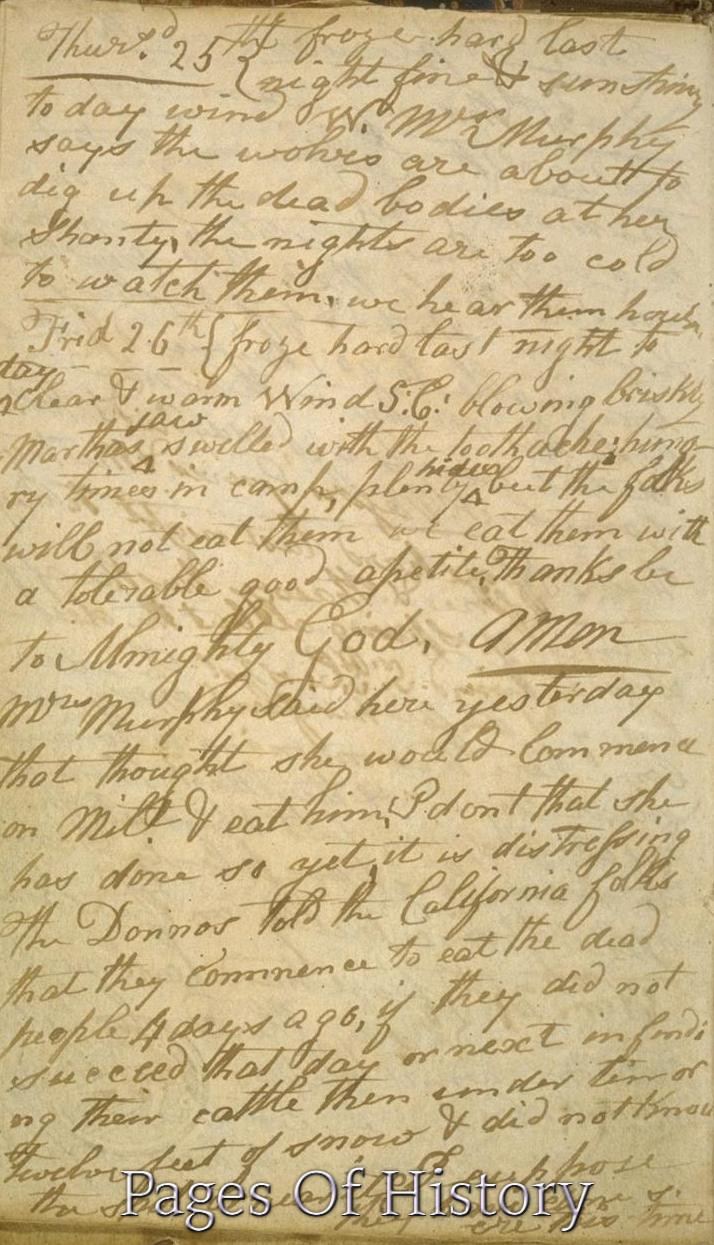
The psychological toll was immense. James F. Reed, a natural leader, had been banished from the group earlier in the journey after killing a man in a brawl, but he eventually made it to California and organized rescue parties. His absence left a leadership vacuum. At the lake camp, a man named Charles Stanton, a kind and resourceful member, had stayed with the group to help, but he grew increasingly weak and died in December. The community began to fracture. Families hoarded their meager scraps. Trust evaporated. The diary of Patrick Breen, a devout Catholic, offers a stark, day-by-day account of the slow, grinding horror. His entries become increasingly terse: “No food. All out. God help us.”
The “Forlorn Hope” and the First Act of Donner Party Cannibalism
In mid-December, with starvation imminent, a group of 15 men and women—10 men and 5 women—decided to make a desperate attempt to cross the mountains on foot to reach Sutter’s Fort and bring back help. They called themselves the “Forlorn Hope.” They were led by William Eddy and William Foster. They had little food and crude snowshoes made from oxbows and rawhide.
Their journey was a harrowing ordeal. They became lost in the deep snow, struggled through blizzards, and suffered from frostbite and exhaustion. After a week, their food ran out. One by one, they began to die. The first to perish were the weakest. In a state of extreme deprivation, with no other option for survival, the survivors made the terrible decision to consume the flesh of their dead companions.
This was the first, and most notorious, instance of Donner Party cannibalism. It was not a casual act; it was a grim, solemn pact. The survivors, reduced to skin and bones, butchered the bodies of their friends and family members to survive. They did not kill anyone for food; they only used those who had already died. The “Forlorn Hope” group endured weeks of this grim existence. They were reduced to eating human flesh, including that of their own relatives. One of the survivors, a man named William Foster, killed two Native American guides, Luis and Salvador, who were traveling with the party, and the group ate them as well, an act that has been debated by historians as murder for food. Of the 15 who started, only 7—all five women and two men—staggered into a Native American village near Sacramento on January 18, 1847, emaciated and half-mad.
The Rescue Attempts: A Race Against Time and Starvation
The survivors of the “Forlorn Hope” reached Sutter’s Fort and spread the alarm. Immediately, a series of relief parties were organized. James F. Reed, who had already arrived in California, was a key figure in these efforts. The first rescue party, led by a man named Aquila Glover, reached the trapped emigrants at Donner Lake on February 19, 1847.
What they found was a scene of utter devastation. The cabins were filthy, the survivors were skeletal, and the stench of death was overwhelming. The rescuers distributed small amounts of food, but they could not take everyone out at once. They had to prioritize the weakest—the children and the women. The first rescue party led out a group of 23 people, but the journey was brutal. Three more died on the trail. The rescuers themselves were pushed to their limits.
Back at the camps, the situation was worsening. With the first rescuers gone, those left behind—still dozens of people—had nothing. It was at this point, in the weeks between the first and second rescues, that the cannibalism spread to the main camps at Donner Lake and Alder Creek. The first rescuers had not told the survivors about the cannibalism of the “Forlorn Hope,” but the survivors had already begun to make the same grim calculation. With no meat left, and with the bodies of those who had died in the camp, they began to consume the dead. This was not a single, dramatic event, but a slow, ongoing process of survival. At Alder Creek, the Donner family, particularly Tamsen Donner, George’s wife, was forced to make this choice. She was known to have preserved the body of her husband, who died of illness, for food.
A Table of Desperation: The Rescue Parties
The rescue effort was a series of four separate parties, each facing immense challenges. The following table summarizes the key details:
| Rescue Party | Date at Camps | Leader(s) | Key Outcome |
|---|---|---|---|
| First Relief | Feb 19, 1847 | Aquila Glover | Evacuated 23 people; 3 died on the trail. |
| Second Relief | Mar 1, 1847 | James F. Reed | Evacuated 17 people; some were found alive but emaciated. |
| Third Relief | Mar 13, 1847 | William Eddy, William Foster | Found 3 survivors at Donner Lake; 2 died on the trail. Reached Alder Creek but found only one survivor. |
| Fourth Relief | Apr 17, 1847 | John Stark | Rescued the last 6 survivors from Donner Lake, including Lewis Keseberg. |
The Final Survivors and the Keseberg Controversy
The last survivor to be rescued from the Donner Lake camp was a German immigrant named Lewis Keseberg. When the fourth relief party arrived on April 17, 1847, they found Keseberg alone in a cabin, surrounded by the remains of the dead. He was weak but alive. He claimed that the last person with him, a woman named Mrs. Murphy, had died of starvation. He also said that Tamsen Donner, who had been at Alder Creek, had come to the lake camp to be with him, but she too had died.
Keseberg became a figure of intense suspicion and revulsion. The rescuers found a large pot of human flesh on the fire and a human leg in a pan. They accused Keseberg of murdering Mrs. Murphy and Tamsen Donner for food. He adamantly denied this, claiming he had only consumed the flesh of those who had already died. He was also accused of stealing money from the Donner family. Keseberg was a pariah for the rest of his life, and his story became a dark legend. Modern historians tend to give him the benefit of the doubt, arguing that the evidence of murder is circumstantial and that he was simply the last man standing in a nightmare. He was, in many ways, the living embodiment of the horror the public wanted to project onto the entire Donner Party cannibalism saga.
The Aftermath: Scandal, Stigma, and the Birth of a Legend
When the last survivors were brought to California, the news of the cannibalism caused a national sensation. Newspapers across the country ran lurid headlines. The story was a scandal. Many people in California were horrified and shunned the survivors. The survivors themselves were deeply traumatized and often refused to speak about what they had done. They carried the stigma for the rest of their lives.
The Donner Party cannibalism became a dark chapter in the myth of the American West. It shattered the romantic image of the hardy, virtuous pioneer. Here was a story of good people driven to the most extreme act of desperation. The tragedy had profound consequences:
- Social Stigma: Survivors like the Breen and Reed families were often treated as social outcasts. They moved to different parts of California to escape the notoriety.
- Legal and Ethical Questions: The case raised uncomfortable questions about the law of survival. Was cannibalism ever justifiable? The survivors were never prosecuted, but the moral debate lingered.
- Historical Memory: The story was quickly mythologized. The focus on cannibalism often obscured the larger story of poor decisions, leadership failure, and the sheer force of nature.
- Impact on Emigration: The tragedy did not stop westward migration, but it did make people more cautious. The Hastings Cutoff was never used again by a major wagon train.
Separating Myth from Reality: The True Scope of the Donner Party Cannibalism
It is crucial to understand the actual scale of the Donner Party cannibalism. Of the 81 people trapped in the mountains, 47 survived. Of the 34 who died, the remains of at least some were consumed by the survivors. However, the act was not universal. It was largely confined to two specific phases:
- The “Forlorn Hope” group: 7 of 15 survivors ate human flesh.
- The main camps: After the first rescue, those left behind at both Donner Lake and Alder Creek resorted to cannibalism. This included the Breen, Murphy, and Donner families.
The cannibalism was not a daily occurrence for all. Many survivors, particularly the children, were shielded from the worst of it by their parents. The Reeds, for example, did not participate in cannibalism at the main camps because they were rescued early. The act was a last resort, a grim necessity born of absolute starvation. It was not a sign of inherent savagery, but of a complete breakdown of the biological and social systems that sustain human life. The survivors were not monsters; they were ordinary people pushed to an extraordinary, unthinkable extreme.
Lessons from the Snow: Leadership, Community, and the Fragility of Civilization
The true story of the Donner Party offers enduring lessons that transcend the grisly details. It is a powerful narrative about the consequences of poor leadership and groupthink. The decision to take the Hastings Cutoff was a collective failure of judgment, driven by optimism and a charismatic promoter. The party lacked a strong, unified command structure after Reed’s banishment. This fragmentation made it impossible to make coherent decisions or coordinate effective survival strategies.
Furthermore, the tragedy reveals the fragility of social bonds under extreme duress. The initial sense of community quickly dissolved into a desperate, every-family-for-itself mentality. The diary of Patrick Breen, while a valuable historical record, also shows a man increasingly focused on his own family’s survival, to the exclusion of others. This breakdown of social trust was as fatal as the lack of food.
The story of the Donner Party is not merely a cautionary tale about cannibalism. It is a profound meditation on human endurance, the limits of hope, and the terrible price of a bad decision made in a beautiful, indifferent wilderness. It forces us to confront the uncomfortable truth that civilization is a thin layer of order over a chaotic and brutal natural world. The survivors, who lived with the memory of what they had done and what they had seen, carried a burden far heavier than the snow that had trapped them. Theirs is a story not of monsters, but of flawed, desperate, and ultimately, tragically human people. The Donner Party cannibalism remains a stark, unforgettable symbol of the extreme lengths to which humans can be driven when the line between life and death is drawn in the snow.