
📅 Last updated: 18.11.2026
Few questions in the history of technology provoke as much argument as who invented the radio. The answer depends on what you mean by “radio”—a theoretical description of electromagnetic waves, a laboratory demonstration of wireless signaling, a practical system for transmitting intelligence over distance, or the first commercially viable network. The story that emerges is not a tale of one genius in a garret but of a relay race run across three continents, in which physicists, engineers, and entrepreneurs each handed the baton forward. And the man most often credited with inventing the radio, Guglielmo Marconi, was arguably the least original of the major figures—yet the most consequential.
No single person invented the radio. James Clerk Maxwell predicted electromagnetic waves mathematically in 1865, Heinrich Hertz first generated and detected them experimentally in 1887, and Nikola Tesla and Guglielmo Marconi both built working wireless telegraphy systems in the mid-1890s. Marconi won the commercial race and the 1909 Nobel Prize; Tesla’s foundational patents were upheld by the U.S. Supreme Court in 1943, after both men were dead.
- The Physics Before the Machine: Who Laid the Groundwork for the Radio?
- Nikola Tesla and the Race to Send a Signal Without Wires
- Marconi: The Man Who Made the Radio a Business
- Who Invented the Radio? The Patent Battles That Rewrote History
- What About Popov, Lodge, and the Others?
- Why Does the "Who Invented the Radio" Question Persist?
- The Lasting Legacy: Why the Radio's Inventors Still Matter
The Physics Before the Machine: Who Laid the Groundwork for the Radio?
Radio begins not with a device but with an equation. In 1865, the Scottish physicist James Clerk Maxwell published “A Dynamical Theory of the Electromagnetic Field,” arguing that light itself was an electromagnetic disturbance and that oscillating electric charges should radiate energy through space at roughly 300,000 kilometers per second. Maxwell’s work was pure theory—he never produced a wave in a laboratory—but it gave later inventors a target to aim at.
The experimental proof came from Heinrich Hertz, a professor at the Technische Hochschule in Karlsruhe. Between 1886 and 1888, Hertz built a spark-gap transmitter (a pair of brass spheres across which a high-voltage spark jumped) and a loop antenna receiver that detected the invisible disturbance across his laboratory. He demonstrated reflection, refraction, and polarization of what he called “electric waves,” publishing his results in 1888. Hertz was not trying to build a communication system; when a student asked about the practical value of his discovery, he reportedly shrugged that it was of no use whatsoever—it merely proved the master’s theory. He died in 1894 at thirty-six, never imagining that his laboratory curiosity would soon carry messages across oceans.
Two other pieces of the puzzle arrived in the 1880s and 1890s. In 1884, the American inventor Oliver Lodge improved the “coherer”—a glass tube of metal filings that changed electrical resistance when radio waves struck it—though the device’s sensitivity was refined by others. And in 1890, the French physicist Édouard Branly demonstrated his own version of the coherer, which became the standard detector in early wireless receivers. By the early 1890s, every component of a wireless telegraph existed in some laboratory somewhere. What remained was to combine them into a system that worked reliably at distance—and to convince the world it was worth paying for.
Nikola Tesla and the Race to Send a Signal Without Wires
Nikola Tesla, a Serbian-American engineer working in New York, was the first to see clearly that Hertzian waves could carry intelligence. In 1891 he patented the “Tesla coil,” a resonant transformer capable of producing high-frequency, high-voltage oscillations—the kind of electrical oscillation that radiates efficiently. On February 24, 1893, Tesla delivered a lecture before the Franklin Institute in Philadelphia and, the following month, at the National Electric Light Association in St. Louis, demonstrating wireless transmission and explicitly describing a system of signaling “without wires” using tuned circuits. His 1893 demonstrations preceded Marconi’s first public wireless experiments by two years.
Tesla’s crucial insight was resonance: if transmitter and receiver are tuned to the same frequency, the receiver responds selectively, allowing multiple signals to share the airwaves without interfering. This principle—frequency tuning—underpins all modern radio, from AM broadcast to Wi-Fi. Tesla received U.S. patents on wireless signaling in 1897 and 1900, including Patent No. 645,576 (“System of Transmission of Electrical Energy”) and No. 649,621, which described the four-tuned-circuit architecture that later courts would find fundamental.
But Tesla had a fatal flaw as an inventor of radio: he was a visionary without a business plan. He believed wireless power transmission—sending energy, not just signals—was the real prize, and he poured his efforts into grandiose schemes like Wardenclyffe Tower on Long Island, a 187-foot facility begun in 1901 to transmit power across the Atlantic. Financier J.P. Morgan withdrew support when he realized there was no way to meter wireless energy, and the project collapsed. Tesla never built a commercial wireless telegraph network. His patents were brilliant; his execution was not.
Marconi: The Man Who Made the Radio a Business
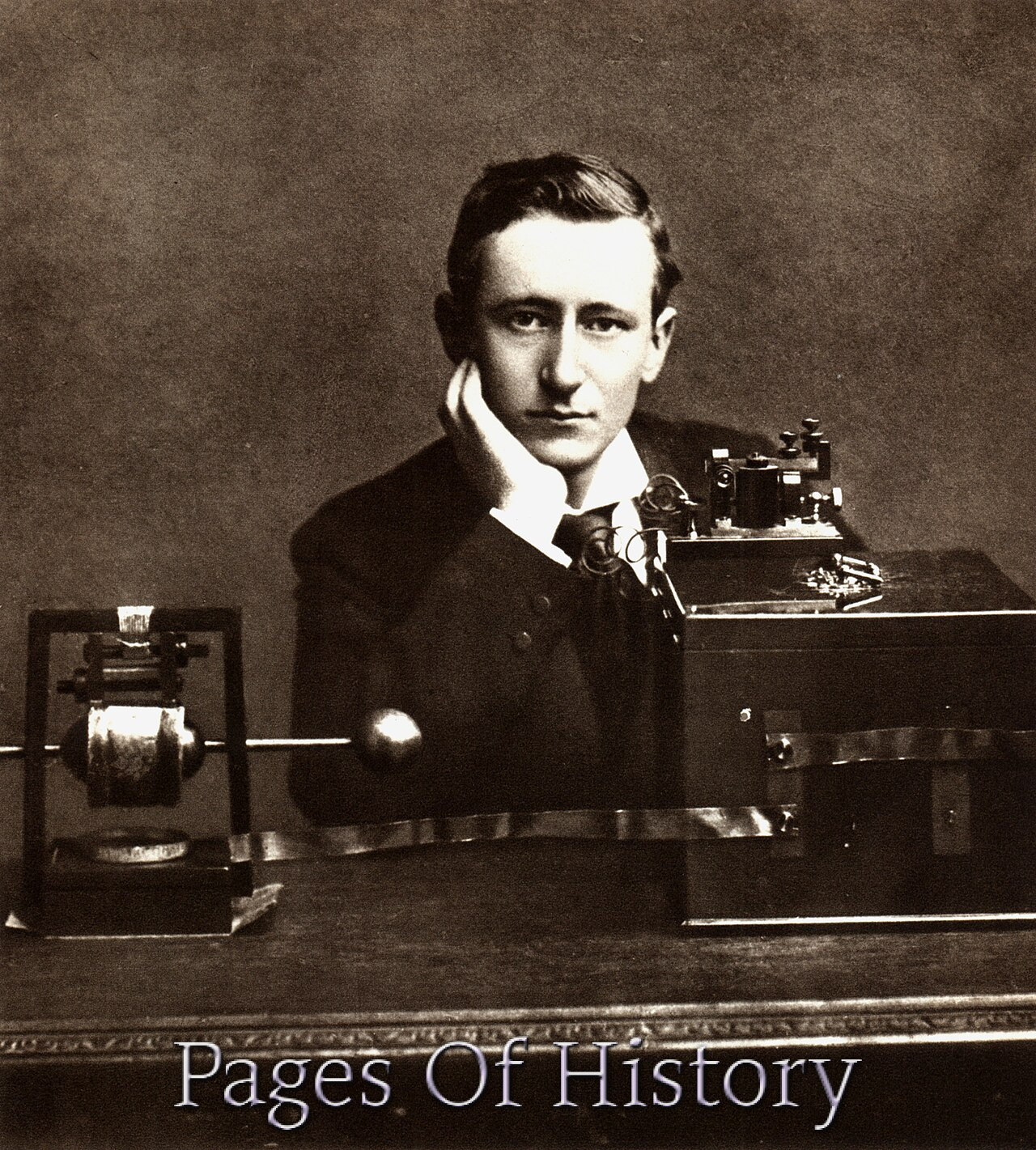
Guglielmo Marconi was twenty years old, living on his family’s estate at Pontecchio near Bologna, when he began experimenting with Hertzian waves in 1894. Working in the attic and then in a field, he combined a Hertz spark-gap transmitter, a Branly-style coherer, and—critically—an elevated antenna and a grounded connection. By the summer of 1895 he could ring a bell across a distance of more than a kilometer, and he understood something his rivals did not: that height and grounding dramatically extended range.
Unable to interest the Italian government (the Minister of Post and Telegraph dismissed the idea), Marconi’s Irish mother, Annie Jameson, arranged introductions to British contacts. In February 1896 he arrived in London and filed the world’s first patent for a wireless telegraphy system—British Patent No. 12039, “Improvements in Transmitting Electrical Impulses and Signals and in Apparatus Therefor.” In July 1896 he demonstrated the system to officials of the British Post Office on the roof of the General Post Office building in London, and in 1897 he transmitted across the Bristol Channel, a distance of about 6 kilometers. That same year he founded the Wireless Telegraph & Signal Company (later Marconi’s Wireless Telegraph Company) in London.
From the English Channel to the Atlantic
Marconi’s advantage was relentless commercialization. In March 1899 he sent a wireless message across the English Channel from Wimereux, France, to the South Foreland lighthouse in Kent—about 50 kilometers. In 1900 he patented the tuned “jigger” circuit (British Patent No. 7777), which allowed stations to operate on separate frequencies, and in November 1901 he installed a high-power station at Poldhu in Cornwall. On December 12, 1901, at Signal Hill in St. John’s, Newfoundland, Marconi and his assistant George Kemp received a faint repeating “S” (three dots in Morse code) transmitted from Poldhu—roughly 3,400 kilometers across the Atlantic. The claim was disputed at the time (skeptics noted that the signal strength seemed implausible for the equipment), but it transformed public perception overnight.
Marconi’s practical impact was immense. In 1901–1902 the British Royal Navy began equipping warships with wireless. In 1909, the SS Republic collided with the Florida off Nantucket; the wireless operator Jack Binns transmitted distress calls that brought rescue ships, saving hundreds of lives and making front-page news worldwide. After the Titanic disaster of April 1912—where nearby ships failed to respond promptly to distress signals—the first International Convention for the Safety of Life at Sea (1914) mandated continuous radio watch on passenger ships. In 1909, Marconi shared the Nobel Prize in Physics with Karl Ferdinand Braun, whose work on spark-gap transmitters and directional antennas had also advanced the field.
| Year | Figure | Milestone | Why It Mattered |
|---|---|---|---|
| 1865 | James Clerk Maxwell | Mathematical prediction of electromagnetic waves | Provided the theoretical basis for all wireless communication |
| 1887–1888 | Heinrich Hertz | First experimental generation and detection of radio waves | Proved Maxwell right; created the spark-gap apparatus later adapted for signaling |
| 1893 | Nikola Tesla | Public demonstrations of wireless signaling and tuned circuits | Established resonance tuning, the foundation of selective reception |
| 1895–1896 | Guglielmo Marconi | Working wireless telegraph; British Patent No. 12039 (1896) | First commercially organized wireless system; launched the industry |
| 1901 | Marconi | Transatlantic signal from Poldhu to St. John’s | Demonstrated global reach; triggered naval and maritime adoption |
| 1943 | U.S. Supreme Court | Marconi v. United States | Upheld Tesla’s foundational tuning patents, overturning Marconi’s priority claim |
Who Invented the Radio? The Patent Battles That Rewrote History
The legal question of who invented the radio was fought for decades. Marconi’s 1900 “four-circuit” tuning patent (U.S. Patent No. 763,772, filed in 1900 and granted in 1904) became the cornerstone of the Marconi Company’s licensing empire. Tesla sued Marconi in 1915 over wireless patents, but the case stalled—Tesla was bankrupt and could not fund the litigation. Meanwhile, in 1912 the Marconi Company sued the United States government for using wireless equipment (much of it manufactured by others) during and after the First World War without paying royalties. The case crawled through the courts for three decades.
On June 21, 1943, the U.S. Supreme Court ruled in Marconi Wireless Telegraph Co. of America v. United States, 320 U.S. 1 (1943). The Court held that Marconi’s 1904 tuning patent was invalid because Tesla’s earlier patents (and those of Oliver Lodge and John Stone Stone) had already disclosed the essential tuned-circuit principles. The decision did not say Tesla “invented the radio” in any sweeping sense; it said his patent priority on tuned wireless transmission was prior to Marconi’s. Both Tesla and Marconi were dead by then—Tesla in January 1943, Marconi in 1937.
Historians generally treat the ruling as a legal correction rather than a verdict on invention. Marconi’s defenders point out that Tesla never built a working long-distance communication system, while Marconi did. Tesla’s defenders note that the Supreme Court found his intellectual priority on the core technology, and that Marconi’s company spent decades profiting from principles Tesla had published first.
What About Popov, Lodge, and the Others?
The Russian physicist Alexander Stepanovich Popov is credited in Russia and much of Eastern Europe with inventing the radio. On May 7, 1895, Popov presented a wireless receiver to the Russian Physical and Chemical Society in St. Petersburg, using a coherer and an antenna to detect lightning discharges. In March 1896 he reportedly transmitted the words “Heinrich Hertz” in Morse code between buildings on the university campus. Popov, however, did not seek a patent and did not commercialize the technology; his work was published in a Russian journal and remained largely unknown abroad until after Marconi’s fame was established. (Some Russian sources claim Popov’s demonstration predated Marconi’s patent filing, which is true—but Marconi’s filing was in February 1896, and Popov’s public demonstration came in March.)
Oliver Lodge, the British physicist, demonstrated wireless signaling in 1894 at the Royal Institution in London and later sold his tuning patents to Marconi’s company. Jagadish Chandra Bose in India demonstrated millimeter-wave transmission in 1895 and is honored in South Asia as a radio pioneer. Reginald Fessenden, a Canadian-American engineer, achieved the first audio radio transmission (voice and music, rather than Morse code) on December 23, 1900, from Cobb Island, Maryland, and later developed the heterodyne receiver principle. Lee de Forest’s 1906 invention of the triode vacuum tube (the “Audion”) made amplification possible and turned radio from a telegraphic curiosity into a medium for voice and music broadcasting.
- Maxwell (1865): the theory—electromagnetic waves exist and travel at the speed of light.
- Hertz (1887–88): the proof—waves can be generated and detected in the laboratory.
- Tesla (1893–1900): the architecture—tuned circuits, resonance, and the concept of wireless signaling.
- Popov (1895): the parallel demonstration—a receiver, but no commercial system.
- Marconi (1895–1901): the system—patents, company, naval contracts, and transatlantic transmission.
- Fessenden and de Forest (1900–1906): the medium—voice transmission and amplification, enabling broadcasting.
Why Does the “Who Invented the Radio” Question Persist?
The question endures because “radio” itself is a moving target. If radio means the discovery of electromagnetic radiation, Hertz wins. If it means the first patent for a wireless telegraph system, Marconi wins on paper (with Popov and Tesla close behind). If it means the first public demonstration of wireless signaling, Tesla’s 1893 lectures and Lodge’s 1894 demonstration predate Marconi’s patent. If it means the first practical, commercially deployed system that changed the world, Marconi’s claim is strongest. And if it means the first transmission of voice and music, Fessenden takes the prize.
National pride also plays a role. Italy celebrates Marconi; Serbia and Croatia claim Tesla; Russia honors Popov; India remembers Bose; Canada points to Fessenden. Each claim is defensible within its own frame, which is precisely why the argument never resolves. The 1943 Supreme Court decision gave Tesla a legal victory but did not settle the broader historical question—and the Court itself was careful to rule on patent validity, not on the romance of invention.
The Lasting Legacy: Why the Radio’s Inventors Still Matter
The story of who invented the radio is really a story about how technology develops: not by a single flash of insight but by the accumulation of theory, experiment, and entrepreneurship. Maxwell gave the physics; Hertz gave the proof; Tesla gave the tuning architecture; Popov and Lodge gave parallel demonstrations; Marconi gave the business model, the patents, and the public imagination; Fessenden and de Forest gave it a voice. The radio that emerged by 1920—with the first commercial broadcast station, KDKA in Pittsburgh, airing the Harding–Cox election returns on November 2, 1920—was the product of all of them.
That legacy is not merely historical. The tuning principles Tesla patented and the Supreme Court vindicated are the same principles that govern every smartphone, Wi-Fi router, and satellite link today. Marconi’s insight that wireless must be sold as a service, not a curiosity, shaped the broadcasting industry and the regulatory frameworks—from the Radio Act of 1912 to the Federal Communications Commission—that still govern the airwaves. And the patent battles themselves established precedents about prior art and intellectual priority that remain relevant in every technology dispute.
So who really invented the radio? The honest answer is that no one did—and everyone did. The question is best understood not as a search for a single name but as an invitation to trace how a mathematical prediction in 1865 became a global communications network in fewer than sixty years. The inventors were many; the invention was collective; and the argument over credit is itself part of the history, a reminder that the stories we tell about technology are never as simple as the machines themselves.