
📅 Last updated: 03.09.2026
The Tenochtitlan fall in 1521 was not a sudden, singular event, but the culmination of a two-year siege defined by disease, shifting alliances, technological disparity, and the unyielding resolve of a Spanish-led coalition. It was the dramatic collapse of the most powerful empire in Mesoamerica, a city of perhaps 200,000 people that dwarfed any European capital of its time, reduced to rubble and ash in just 75 days of brutal, final combat. To understand why this magnificent island metropolis—the heart of the Aztec (Mexica) Triple Alliance—fell, one must look beyond the popular narrative of a few hundred armored conquistadors and instead examine a complex web of factors that made its destruction almost inevitable.
- The Arrival of Strangers and the Seeds of Distrust
- Moctezuma II's Dilemma: God or Mortal?
- The Massacre of the Toxcatl Festival and the Night of Sorrows
- The Great Siege: Strategy, Technology, and the Lake
- The Final Assault: A City of Ruins
- Starvation, Courage, and the Final Days
- Why the Alliance Won: A Confluence of Factors
- The Birth of New Spain from the Ashes of Tenochtitlan
- A City's Legacy: Memory, Identity, and the Modern World
The Arrival of Strangers and the Seeds of Distrust
The story of the Tenochtitlan fall begins not in 1521, but in 1519, when Hernán Cortés and his expedition of roughly 600 men landed on the Gulf Coast of Mexico. They were not the first Spaniards to arrive, but they were the most ambitious and, crucially, the most opportunistic. Cortés, a man of legal training and boundless audacity, understood that he could not conquer an empire with his small force alone. He needed allies, and he needed a pretext.
His first major act was to establish the town of Veracruz, a legal maneuver that technically freed him from the authority of the Cuban governor, Diego Velázquez, and placed him directly under the Spanish Crown. This act of rebellion against his own superior set the tone for his entire campaign. Marching inland, he encountered the Totonacs and then, more significantly, the Tlaxcalans, a fiercely independent nation that had resisted Aztec domination for decades.
After initial skirmishes, Cortés secured a crucial alliance with the Tlaxcalans. They were not his subjects but his partners, bound by a shared hatred of the Mexica. This alliance would prove to be the single most important military asset for the Spanish. Without the tens of thousands of Tlaxcalan warriors who provided the bulk of the fighting force, logistics, and local knowledge, the Spanish expedition would have been annihilated. The Tlaxcalans saw the Spanish as a powerful, strange tool to be used against their ancient enemy—a calculation that proved catastrophically wrong for the Aztecs but perfectly rational for Tlaxcala at the time.
Moctezuma II’s Dilemma: God or Mortal?
The Mexica emperor, Moctezuma II (or Motecuhzoma Xocoyotzin), was a man caught between prophecy and pragmatism. He was a tlatoani (speaker), a high priest, and a military leader, but he was also a deeply religious man who presided over a culture that interpreted the world through omens and divine signs. In the years preceding Cortés’s arrival, a series of portents—a comet, a burning temple, strange birds—had unsettled the empire. Moreover, the Mexica’s own mythology, particularly the legend of the exiled god Quetzalcoatl, who was said to have departed eastward and promised to return in the year Ce Acatl (One Reed), which coincided with 1519, created a profound psychological vulnerability.
When reports arrived of pale, bearded men in floating houses arriving from the east, Moctezuma faced a terrifying possibility: was Cortés the returning god? The historical record is complex. Moctezuma sent lavish gifts—gold, intricate featherwork, and ritual garments—designed to appease the visitors if they were divine, or to bribe them to leave if they were mortal. The gifts, however, had the opposite effect. The sight of gold inflamed the Spaniards’ greed, and the intricate objects only confirmed their belief that they had found a land of immense wealth.
Cortés, ever the strategist, played upon Moctezuma’s indecision. He marched toward Tenochtitlan, forging alliances with disaffected city-states like the Totonacs and Tlaxcalans, and crushing those who resisted, such as the Cholulans, in a brutal preemptive massacre. This dual strategy of diplomacy and terror kept his enemies off-balance and his own men unified. By November 1519, Cortés and his coalition arrived at the edge of the Valley of Mexico and beheld Tenochtitlan for the first time. It was a vision of white temples and causeways rising from a brilliant blue lake, a city so orderly and grand that the Spanish chronicler Bernal Díaz del Castillo famously wrote that they wondered if they were dreaming.
The Massacre of the Toxcatl Festival and the Night of Sorrows
Moctezuma, instead of attacking, chose to welcome Cortés into the city, a decision that has been debated for centuries. He housed the Spaniards in the palace of his late father, Axayacatl. The Spaniards, vastly outnumbered and surrounded by water, were in a precarious position. Cortés, fearing a trap, took the audacious step of taking Moctezuma hostage within his own palace, effectively making him a puppet ruler.
This uneasy situation lasted for months. Then, in May 1520, disaster struck. While Cortés was away on the coast to deal with the arrival of a rival Spanish force under Pánfilo de Narváez, he left his lieutenant, Pedro de Alvarado, in command of Tenochtitlan. Alvarado, a volatile and brutal man, ordered a preemptive attack on the Mexica nobility during the sacred festival of Toxcatl, which was being held in the main temple precinct. Without provocation, the Spanish and their allies fell upon the unarmed dancers and celebrants, slaughtering thousands. The massacre was a catastrophic error. It united the Mexica people in fury against the invaders and shattered any pretense of peaceful coexistence.
When Cortés returned, he found the city in open revolt. The Mexica had elected a new, militant tlatoani, Cuitláhuac, and were besieging the Spanish in their quarters. Cortés forced Moctezuma to appear on a rooftop to appeal for peace. The emperor was met with a hail of stones and arrows—whether by the Spanish or his own people is debated—and he died shortly after. With no other option, the Spanish decided to flee the city under the cover of darkness on the night of June 30, 1520.
The retreat was a disaster. The Mexica had dismantled the bridges on the Tlacopan causeway, and the fleeing army was trapped. Laden with gold, the Spanish soldiers were easy targets for the Mexica warriors who attacked from canoes and the causeway itself. Hundreds of Spaniards and thousands of their Tlaxcalan allies were killed or captured, their bodies dragged away to be sacrificed on the altars of the war god Huitzilopochtli. This event became known as La Noche Triste (the Night of Sorrows), a devastating defeat that nearly ended the Spanish expedition.
The Great Siege: Strategy, Technology, and the Lake
The Tenochtitlan fall was ultimately sealed not on the battlefield within the city, but in the strategic planning that followed the Spanish retreat. Cortés, displaying remarkable resilience, regrouped his shattered forces among his Tlaxcalan allies. He understood that a direct assault on an island city was suicide. He had to control the lake.
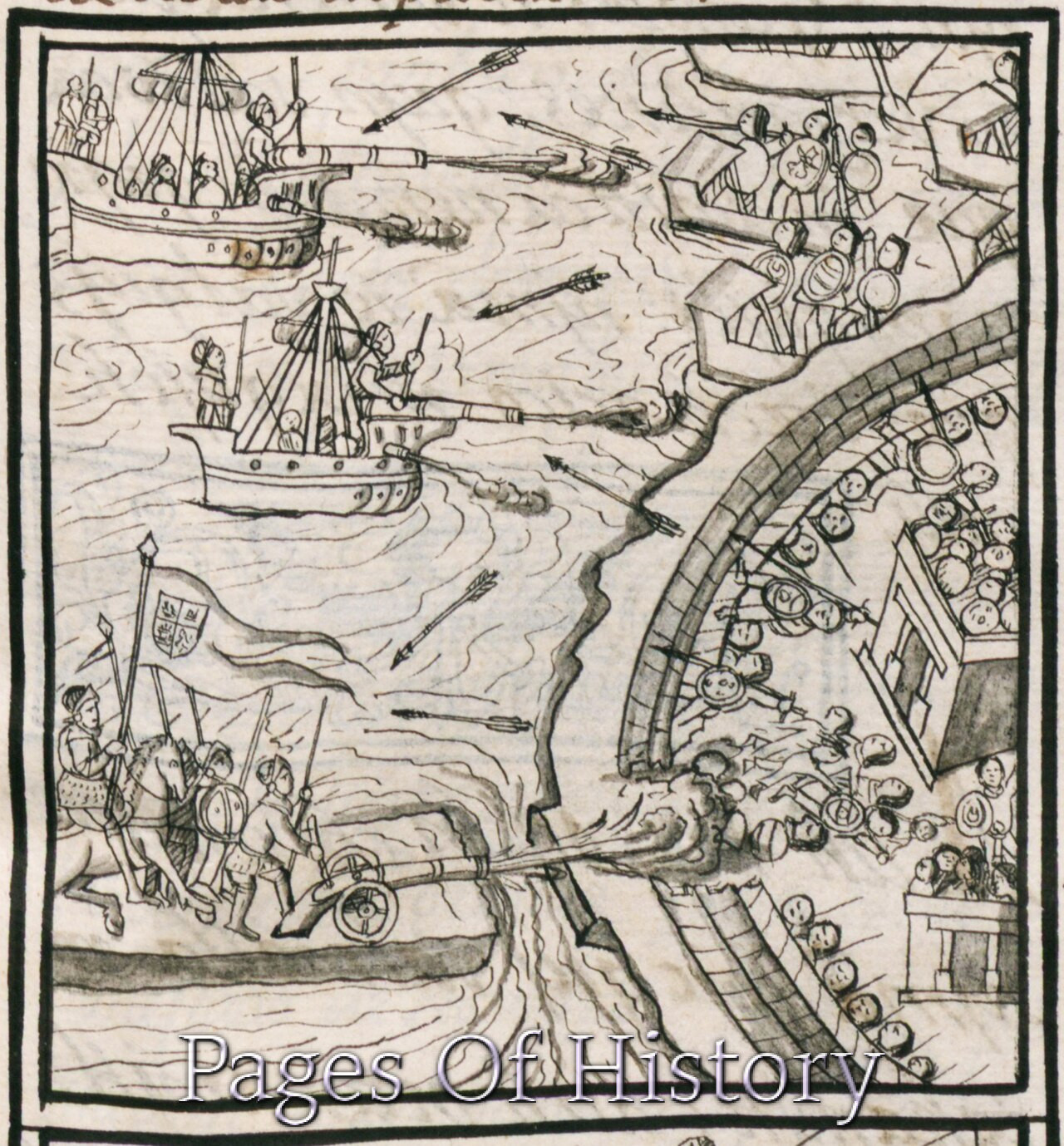
Cortés first consolidated his control over the surrounding city-states, punishing those who had allied with the Mexica and rewarding those who joined him. He then initiated a brilliant, ruthless campaign of attrition. The key was to build thirteen bergantines (brigantines)—small, shallow-draft sailing ships—designed to be assembled on the lakeshore and launched to control the waterways. The timber and iron were carried overland by thousands of indigenous porters, a logistical feat that demonstrated Cortés’s organizational genius.
By the spring of 1521, Cortés had assembled a formidable force: roughly 900 Spaniards, 80 horses, and an estimated 50,000 to 100,000 indigenous allies, primarily Tlaxcalans, but also Texcocans and other former Aztec subjects. His plan was simple in concept but brutal in execution: a total blockade.
The Three Causeways
Tenochtitlan was connected to the mainland by three major causeways: the Tlacopan causeway to the west, the Tepeyac causeway to the north, and the Iztapalapa causeway to the south. Cortés divided his army into three camps, each tasked with controlling one of these approaches and advancing into the city. The brigantines, meanwhile, were tasked with patrolling the lake, preventing food, water, and reinforcements from reaching the city, and attacking the thousands of canoes that ferried supplies and warriors.
The Deadly Role of Disease
The most devastating weapon in Cortés’s arsenal, however, was invisible. In the months following La Noche Triste, a smallpox epidemic, likely introduced by a Spanish soldier from Narváez’s expedition, swept through the Valley of Mexico. The Mexica had no immunity to this European disease. It killed an estimated 40% of the population in Tenochtitlan, including the newly elected emperor Cuitláhuac, who died of the disease after ruling for only 80 days. He was succeeded by his young nephew, Cuauhtémoc, a valiant and determined leader who would lead the final, desperate defense. The epidemic decimated the city’s population, its leadership, and its ability to fight, while leaving the Spanish and their allies relatively unscathed. This demographic catastrophe is arguably the single most important reason for the Tenochtitlan fall.
The Final Assault: A City of Ruins
The final siege began on May 22, 1521, with the launch of the brigantines and the coordinated advance along the causeways. The Mexica fought with extraordinary ferocity and tactical skill. They ambushed the Spanish from rooftops and canals, raining down spears, arrows, and stones. The Spanish, hampered by their heavy armor and the unfamiliar urban environment, often found themselves at a disadvantage.
When the Spanish and their allies managed to breach the city’s defenses and advance down the broad causeways, they discovered that the Mexica had created a deadly trap. They would tear up the pavement, creating deep ditches and barricades that forced the attackers into narrow channels where they could be attacked from all sides. The Mexica also captured Spanish soldiers and their allies alive, dragging them to the temple pyramids for ritual sacrifice in full view of their horrified comrades. This psychological warfare was terrifyingly effective.
Cortés adapted by changing his tactics. Instead of merely advancing and retreating, he ordered his men to systematically demolish the city as they fought. Every building they captured was leveled. Every canal was filled with rubble. The goal was not just to conquer Tenochtitlan but to erase it as a defensible space. This was a war of annihilation. Day by day, the Spanish and their allies fought their way deeper into the city, using the brigantines to bombard the flanks of the causeways and to land troops behind the Mexica lines.
Starvation, Courage, and the Final Days
By late July 1521, the city was a hellscape. The causeways were blocked, the aqueduct from Chapultepec that supplied the city with fresh water had been cut, and the surrounding lake was patrolled by the brigantines. The Mexica were reduced to drinking brackish water from the lake, eating bark, roots, and insects, and fighting amidst the corpses of their dead. Smallpox, starvation, and continuous combat had reduced the population from hundreds of thousands to perhaps a few tens of thousands of emaciated defenders.
Cuauhtémoc refused to surrender despite repeated offers from Cortés. He embodied the Mexica ideal of the warrior, choosing death over submission. The final days were a brutal, close-quarters struggle for the remaining districts of the city. The Spanish and Tlaxcalans fought house-to-house, over mounds of rubble and decaying bodies. The stench was so overwhelming that even the hardened conquistadors were sickened.
| Date | Event | Significance |
|---|---|---|
| April 1519 | Cortés lands near Veracruz | Beginning of the expedition; alliances with Totonacs formed. |
| September 1519 | Massacre of Cholula | Demonstrates Spanish ruthlessness; cements Tlaxcalan alliance. |
| November 1519 | Spanish enter Tenochtitlan; Moctezuma taken hostage | Spanish occupy the heart of the Aztec Empire. |
| May 1520 | Massacre of Toxcatl | Sparked the Mexica revolt against the Spanish. |
| June 30, 1520 | La Noche Triste | Spanish routed; heavy losses; retreat to Tlaxcala. |
| December 1520 | Smallpox epidemic peaks in Tenochtitlan | Kills Emperor Cuitláhuac and a huge portion of the population. |
| May 22 – August 13, 1521 | The Great Siege of Tenochtitlan | Final assault; systematic destruction of the city. |
| August 13, 1521 | Capture of Cuauhtémoc | End of the Aztec Empire; Tenochtitlan in ruins. |
On August 13, 1521, the end came. Cuauhtémoc, attempting to escape across the lake in a canoe with his family and remaining nobles, was captured by a brigantine commanded by García Holguín. He was brought before Cortés. Accounts say that Cuauhtémoc, placing his hand on Cortés’s dagger, asked the Spaniard to kill him, for he had done all he could to defend his city. Cortés refused, treating him with a degree of respect, though he would later be tortured and, ultimately, hanged in 1525 during a disastrous expedition to Honduras. With his capture, organized resistance ceased. The great city of Tenochtitlan, once the jewel of the New World, was a smoldering, desolate ruin.
Why the Alliance Won: A Confluence of Factors
The Tenochtitlan fall was not a victory of Spanish steel alone. It was a victory of a coalition, led by the Spanish but overwhelmingly composed of indigenous peoples. The reasons for this success are several and intertwined.
- Epidemic Disease: Smallpox was the great equalizer. It devastated the Mexica population, killing their leaders and warriors, and shattering their morale and social structure at the most critical moment.
- Indigenous Alliances: The Tlaxcalans, Texcocans, and other subjugated groups provided the bulk of the army. They fought for their own reasons—to destroy their oppressor, to gain political advantage, or simply for survival—but their numbers and knowledge of the terrain were indispensable.
- Technological Advantages: While not decisive alone, steel swords, crossbows, and especially the brigantines gave the Spanish a significant tactical edge in specific engagements. The horses, though few, provided shock value in open terrain.
- Strategic Brilliance and Ruthlessness: Cortés’s decision to besiege the city, cut its water supply, and systematically destroy it was a masterful military strategy. His willingness to burn and level the city, regardless of its architectural and cultural value, proved decisive.
- Mexica Weaknesses: The Aztec Empire was a tributary state, not a nation. Many of its subjects hated it and were eager to see it fall. The Mexica’s own political and religious system, which required continuous warfare to capture sacrificial victims, had created a vast reservoir of resentment that Cortés was able to tap into.
The Birth of New Spain from the Ashes of Tenochtitlan
The conquest had profound and lasting consequences. Cortés, ever the showman, did not rebuild the city as a Mexican capital. Instead, he directed the construction of a new city, Mexico City, directly on top of the ruins of Tenochtitlan. The stones of the Aztec temples were used to build the Metropolitan Cathedral and the Palacio Nacional. The lake was slowly drained over the centuries to create more land, fundamentally altering the geography of the valley. The Aztec Empire was replaced by the colonial entity of New Spain, a viceroyalty that would rule Mexico for the next 300 years.
The fall of Tenochtitlan also signaled the beginning of a new era of global exchange. The Columbian Exchange saw the transfer of plants, animals, people, and diseases between the Old and New Worlds. The vast silver mines of Mexico and Peru would fuel the Spanish Empire and the global economy for centuries. The indigenous population of the Americas suffered a catastrophic demographic collapse due to disease, and their cultures were systematically suppressed and transformed by the Spanish colonial system, which imposed new religious, social, and political structures.
A City’s Legacy: Memory, Identity, and the Modern World
For modern Mexico, the Tenochtitlan fall is a foundational, and often painful, national trauma. The narrative of the conquest is deeply complex. For the descendants of the Spanish, it is the story of the creation of a new nation. For the descendants of the indigenous peoples, it is a story of loss, resistance, and survival. The memory of Cuauhtémoc, the young emperor who fought to the bitter end, is honored with statues and monuments throughout the country. The Templo Mayor, the main Aztec temple, was rediscovered in 1978 during electrical work and is now a world-class archaeological site in the heart of Mexico City, a powerful reminder of the civilization that once stood there.
The story of the Tenochtitlan fall serves as a stark lesson in the brutal dynamics of conquest. It illustrates how a technologically advanced but numerically inferior force can topple a mighty empire by exploiting internal divisions and unleashing unseen biological weapons. It is a story of courage and folly, of ambition and tragedy, and of the profound and often violent transformations that shape human history. The city may have fallen, but its legacy—embedded in the genetics, culture, and very soil of modern Mexico—is inescapable. The ghost of Tenochtitlan is not merely a memory; it is the foundation upon which a nation was built, a testament to a world that was lost and a world that was born from its ashes.