
📅 Last updated: 20.11.2026
The invention of printing press technology is routinely credited to Johannes Gutenberg around 1440 in Mainz, Germany—yet the full story stretches across Tang dynasty China, Korean metal type, Islamic paper mills, and a network of German goldsmiths and financiers whose names history nearly forgot. What Gutenberg actually invented was not printing itself, but a complete, economically viable system for reproducing text at speed.
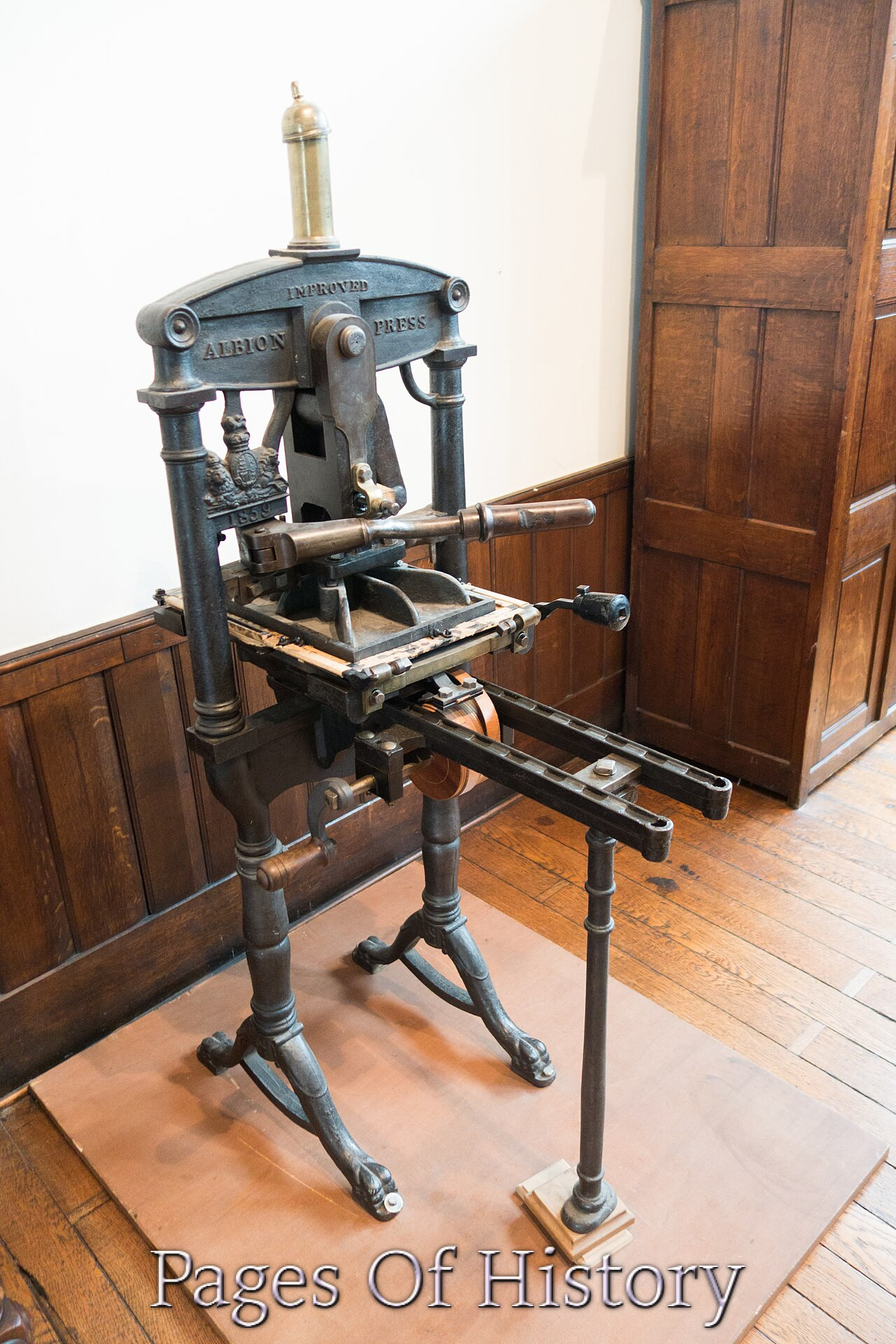
The printing press was invented by Johannes Gutenberg in Mainz, Germany, around 1440–1450. Gutenberg’s key contribution was not movable type itself—China and Korea had used it for centuries—but a complete system combining durable metal type cast from a hand mold, oil-based ink, and a modified screw press. His first major product, the 42-line Bible (c. 1455), demonstrated that books could be mass-produced accurately and affordably.
- Who Really Invented the Printing Press? Setting the Record Straight
- Precursors: The Long Road Before Gutenberg
- The Invention of Printing Press Technology: Gutenberg's System
- Timeline: Key Milestones in Printing History
- Why Did the Invention of Printing Press Transform Europe So Quickly?
- The Question of Credit: Was Gutenberg Really the Inventor?
- Legacy: From Mainz to the Digital Age
- The Lasting Perspective on the Invention of Printing Press
Who Really Invented the Printing Press? Setting the Record Straight
The question is deceptively simple. If “printing press” means a machine that transfers inked type to paper under pressure, the answer points to Gutenberg. If it means printing with movable type, the Chinese and Koreans got there first—by roughly four centuries. If it means printing at all, woodblock printing in East Asia predates Gutenberg by more than six hundred years.
Historians have settled on a nuanced consensus: Gutenberg’s genius lay in integration and metallurgy. He did not invent movable type, paper, ink, or the screw press individually. He combined them into a manufacturing process so efficient that it transformed Europe’s information economy within a single generation. By 1500, presses operated in more than 250 European towns, and an estimated 20 million volumes had rolled off them. No previous technology had scaled knowledge production that quickly.
There is also a financial dimension often overlooked. Gutenberg’s venture was bankrolled by Johann Fust, a Mainz businessman who lent him roughly 800 guilders—a sum equal to several years of a skilled craftsman’s wages. When Gutenberg could not repay the loan, Fust sued him in 1455 and seized the printing equipment. Fust then ran the business with his son-in-law, Peter Schöffer, a former Gutenberg apprentice. The world’s first successful printing enterprise thus passed out of its inventor’s hands before it had even reached full commercial stride.
Precursors: The Long Road Before Gutenberg
Printing did not appear from nowhere in 1440s Germany. It emerged from a chain of innovations that crossed continents over nearly a thousand years.
Woodblock Printing in Tang China
The earliest confirmed dated printed book is the Diamond Sutra, produced in 868 CE during the Tang dynasty and discovered in 1900 inside the Mogao Caves at Dunhuang. Its colophon states it was commissioned by Wang Jie “for free universal distribution.” Woodblock printing—carving entire pages in relief on wooden blocks, inking them, and pressing paper against them—was already mature technology by then. Chinese printers used it for Buddhist scriptures, calendars, and examination texts. By the Song dynasty (960–1279), woodblock printing supported a thriving commercial book trade in cities such as Hangzhou and Chengdu.
Bi Sheng and Movable Type
Around 1040, the artisan Bi Sheng created the first known movable type, using baked clay characters. The polymath Shen Kuo recorded the method in his Dream Pool Essays (1088), describing how each character was carved, fired, and stored in organized wooden cases. Bi Sheng’s system worked, but it never displaced woodblock printing in China. The reason was linguistic: written Chinese requires thousands of distinct characters, making typesetting laborious compared with carving a single reusable block per page. Woodblock printing remained more economical for Chinese script.
Korea’s Metal Type and the Jikji
Korean printers pushed the technology further. The Goryeo dynasty established a state printing office in 1392, and King Taejong created a royal type foundry around 1403. In 1377, Korean monks printed the Baegun hwasang chorok buljo jikji simche yojeol—known as the Jikji—the oldest surviving book printed with metal movable type. A copy is held at the Bibliothèque nationale de France in Paris. The Jikji predates Gutenberg’s Bible by 78 years, a fact UNESCO recognized when it added the book to its Memory of the World register in 2001.
Paper, Ink, and the Islamic Bridge
Paper reached Europe through the Islamic world. Chinese papermaking spread to Samarkand after the Battle of Talas in 751, when Abbasid forces captured Chinese papermakers. From there it moved to Baghdad, Damascus, Cairo, and Fez, and finally to Islamic Spain—the Italian town of Fabriano was producing high-quality paper by the 1270s. Without abundant, affordable paper, no European printing industry could have existed. Gutenberg inherited this supply chain; he did not create it.
The Invention of Printing Press Technology: Gutenberg’s System
Gutenberg’s real breakthrough was a manufacturing system, not a single device. Four components had to work together, and each required precision engineering.
- The hand mold: A reusable two-part mold that cast identical letters from molten lead alloy in seconds, producing thousands of uniform type pieces.
- The metal alloy: A mixture of lead, tin, and antimony that melted at low temperature, cast sharply, and resisted the pressure of printing—a metallurgical insight drawn from Gutenberg’s goldsmith training.
- Oil-based ink: Traditional water-based ink beaded on metal type; Gutenberg’s viscous, soot-and-varnish ink clung to the letters and transferred cleanly to paper.
- The screw press: Adapted from wine and olive presses, it applied even, strong pressure across a full page, allowing rapid, repeatable impressions.
Gutenberg’s background explains his approach. He was born in Mainz around 1400 into a patrician family and trained as a goldsmith. Records from a 1439 lawsuit in Strasbourg show him experimenting with metal casting, mirrors, and a secret process—likely early printing trials. By 1440 he was back in Mainz, and by 1450 he had borrowed heavily from Fust to scale production.
The 42-Line Bible and Its Aftermath
The masterpiece of the press was the 42-line Bible, printed around 1455 in an edition of roughly 180 copies—about 135 on paper and 45 on vellum. Each page carries 42 lines of text in a dense Gothic typeface, and surviving copies show remarkable consistency. The British Library holds a complete paper copy; the Gutenberg Museum in Mainz displays another. When Fust seized the workshop in 1455, he and Schöffer continued printing, and in 1457 they issued the Mainz Psalter—the first printed book to carry a colophon with printer names and a date.
The press spread with astonishing speed. German printers carried the craft to Rome by 1467, Paris by 1470, and Westminster by 1476, where William Caxton set up England’s first press. By 1500, the incunabula period—books printed before 1501—had produced an estimated 20 million volumes across Europe.
Timeline: Key Milestones in Printing History
| Date | Event | Location | Significance |
|---|---|---|---|
| 868 CE | Diamond Sutra printed | Tang China | Earliest dated printed book, using woodblocks |
| c. 1040 | Bi Sheng develops clay movable type | Song China | First known movable type system |
| 1377 | Jikji printed | Goryeo Korea | Oldest surviving metal movable type book |
| c. 1440–1450 | Gutenberg builds his press system | Mainz, Germany | Complete system of type, ink, and press |
| c. 1455 | 42-line Gutenberg Bible completed | Mainz, Germany | Proof of industrial-scale book production |
| 1476 | Caxton’s press established | Westminster, England | Printing reaches the British Isles |
Why Did the Invention of Printing Press Transform Europe So Quickly?
Gutenberg’s press succeeded where earlier systems had not because Europe presented a uniquely receptive market. Literacy was rising among merchants and urban professionals. Universities in Bologna, Paris, and Oxford created steady demand for texts. The Latin alphabet required only a few dozen characters—far simpler to typeset than Chinese script. And the Catholic Church needed standardized liturgical and legal documents.
The economics were decisive. A scribe could copy perhaps two pages a day; a press with two workers could produce hundreds of pages daily. Prices collapsed. A printed book in the 1480s cost a fraction of a manuscript copy, and print runs of 500 to 1,000 copies became routine.
The consequences rippled through every institution:
- Religion: Martin Luther’s 95 Theses (1517) spread across Germany in weeks rather than months, and printed vernacular Bibles undermined clerical monopoly on scripture.
- Science: Nicolaus Copernicus’s De revolutionibus (1543) and Andreas Vesalius’s anatomy plates circulated in accurate, identical copies, enabling verification and cumulative research.
- Politics: Pamphlets and news sheets fueled the Reformation, the English Civil War, and the American Revolution’s print culture.
- Language: Print standardized spelling and grammar, stabilizing national languages such as English and French.
The Question of Credit: Was Gutenberg Really the Inventor?
Scholars continue to debate how much Gutenberg owed to others. Some historians point to Laurens Janszoon Coster of Haarlem, whom Dutch tradition credits with printing experiments in the 1430s. The claim rests on thin evidence and was promoted partly for national pride during the Dutch Golden Age. No surviving Coster print predates Gutenberg’s work.
Others note that Gutenberg’s Strasbourg lawsuit of 1439 mentions presses and “secret art,” suggesting he was not working alone. Peter Schöffer, his apprentice, later claimed credit for innovations in type founding and punch-cutting, and some historians believe Schöffer refined the punch-matrix system that made type production truly efficient.
What remains undisputed is that Gutenberg assembled the system first in Europe and demonstrated its commercial viability. His name became attached to the invention because his press worked—and because the 42-line Bible survives as tangible proof. The invention of printing press technology, in the practical sense that mattered, was his.
Legacy: From Mainz to the Digital Age
The printing press is often ranked alongside the alphabet and the internet as one of the great information revolutions. Its effects were cumulative and irreversible. Within fifty years of Gutenberg’s death in 1468, Europe had more books than it had produced in the previous thousand years. The Reformation, the Scientific Revolution, and the Enlightenment all depended on cheap, reproducible text.
Later inventors built on Gutenberg’s foundation. Friedrich Koenig’s steam-powered press (1814) accelerated output for The Times of London. The rotary press and linotype machine followed in the nineteenth century. Each innovation extended the logic of Gutenberg’s system: standardized components, mechanized repetition, and falling unit costs.
Even the digital era echoes his achievement. The hand mold’s interchangeable type pieces resemble modular code; the press’s repeatability resembles file duplication. When historians ask who really invented the printing press, the honest answer is layered: Chinese and Korean innovators created movable type, Islamic papermakers supplied the medium, and European craftsmen built the machine. But it was Johannes Gutenberg of Mainz who turned scattered pieces into a system that changed the world.
The Lasting Perspective on the Invention of Printing Press
The invention of printing press technology was never a single moment or a single person. It was a convergence—of paper from China, movable type from Korea, metallurgy from German goldsmiths, and capital from a Mainz financier who ultimately took the business away from its creator. Gutenberg’s contribution was the synthesis: a complete, reproducible, economically viable method for multiplying text.
That synthesis mattered because it made knowledge portable, affordable, and verifiable. A scholar in 1500 could compare identical copies of a text across cities; a preacher could distribute thousands of pamphlets; a scientist could publish findings that others could replicate. The press did not just preserve ideas—it accelerated their circulation and their challenge to authority.
Five centuries later, the question of who invented the printing press still fascinates because it reveals how innovation actually works. Rarely does a lone genius conjure a technology from nothing. More often, as with Gutenberg, invention is the act of assembling existing pieces into a system that finally works—and then proving it at scale. That is the real story behind the press, and it remains the model for every information revolution since.