
📅 Last updated: 20.11.2026
The Peasants’ Revolt 1381 was the largest popular uprising in English history, a violent summer explosion of rural and urban anger that briefly put a rebel army in control of London and forced a fourteen-year-old king to negotiate with men he would later execute. In June 1381, tens of thousands of rebels from Kent, Essex, and beyond marched on the capital, burned the Savoy Palace, stormed the Tower of London, and beheaded the chancellor and the treasurer. Within weeks the revolt had collapsed, its leaders dead or pardoned, but the grievances that fueled it—poll taxes, serfdom, wage controls, and a corrupt legal system—exposed fractures in medieval English society that never fully healed.
The Peasants’ Revolt of 1381 was a mass uprising triggered by a flat-rate poll tax and deep resentment of serfdom and labor laws. Rebels under Wat Tyler and John Ball occupied London in June 1381, executed royal officials, and extracted concessions from King Richard II—who revoked them immediately after the rebels dispersed. The revolt failed militarily but effectively ended the poll tax and accelerated the long decline of serfdom in England.
- Why Did the Peasants' Revolt 1381 Explode in June 1381?
- Who Led the Rebels and What Did They Want?
- How Did the Rebels Take London in June 1381?
- Key Events and Turning Points of the Peasants' Revolt 1381
- Why Did the Revolt Fail So Quickly?
- What Were the Consequences and Legacy of the Peasants' Revolt 1381?
- What Really Happened at Smithfield?
- Why the Peasants' Revolt 1381 Still Matters
- The Lasting Perspective: A Revolt That Failed but Changed Everything
Why Did the Peasants’ Revolt 1381 Explode in June 1381?
The revolt did not come out of nowhere. Its roots lay in the Black Death of 1348–1350, which killed perhaps a third to a half of England’s population. Suddenly labor was scarce and land abundant. Surviving peasants could demand higher wages, move to new manors, and bargain for better terms. Landlords, facing falling rents and rising costs, pushed back with legislation. The Ordinance of Labourers (1349) and the Statute of Labourers (1351) froze wages at pre-plague levels and made it illegal for laborers to leave their parishes in search of better pay. Enforcement was erratic but resented, and it turned economic grievance into a legal and moral grievance: the law itself seemed rigged against the poor.
Layered on top was the Hundred Years’ War. Edward III’s campaigns in France were expensive, and by the 1370s taxation had become relentless. War finance fell increasingly on the commons—those least able to pay—while the nobility and clergy escaped much direct taxation. When Edward died in 1377, the crown passed to his ten-year-old grandson, Richard II. Real power lay with a circle of royal favorites and officials, notably John of Gaunt (the king’s uncle) and the chancellor, Archbishop Simon Sudbury. Their government was widely seen as corrupt, and the war was going badly in France.
The Poll Taxes of 1377, 1379, and 1380
Parliament authorized a poll tax in 1377, then a graduated one in 1379, and finally a flat-rate tax in 1380 of three groats per person over the age of fifteen—the same sum for a wealthy knight and a landless laborer. The 1381 collection was aggressively enforced, with commissioners investigating evasion and underreporting. In Essex and Kent, villagers resisted, and tax collectors were attacked. The spark came in late May 1381 at Brentwood and Fobbing in Essex, where villagers refused to pay and drove off the commissioners. When a royal justice, Sir Robert Belknap, tried to investigate, the rebels met him at Brentwood and forced him to flee. By early June, the Essex rising had spread, and Kent rose in sympathy.
Who Led the Rebels and What Did They Want?
Leadership emerged quickly. The most famous figure is Wat Tyler, a Kentish man of uncertain origins—possibly a former soldier, possibly a tiler by trade—who became the rebels’ military commander at Blackheath and Smithfield. Alongside him stood John Ball, a radical priest who had been preaching social equality for years and was jailed for it before the revolt. His famous sermon, recorded later by the chronicler Froissart, asked: “When Adam delved and Eve span, who was then the gentleman?” The rhyme captured a theological argument against hereditary privilege. Other leaders included Jack Straw and John Wrawe, though the chroniclers’ accounts are inconsistent and sometimes contradictory.
The rebels were not a single homogeneous group. They included prosperous yeomen, artisans, smallholders, and laborers, alongside some minor gentry and clergy. Their demands varied by region and by group, but several themes recur:
- Abolition of serfdom and villeinage, with freedom to work and move where they chose.
- Repeal of the Statute of Labourers and an end to wage controls.
- Removal of corrupt royal officials, especially Sudbury, Treasurer Sir Robert Hales, and John of Gaunt.
- Reform of the church, including confiscation of some clerical wealth and an end to the church’s secular power.
- An end to the poll tax and to what rebels saw as unjust taxation.
At Mile End on 14 June, the rebels presented a set of demands to the king that were relatively moderate: abolition of serfdom, a fixed rent of four pence per acre, free markets, and a general amnesty. A more radical set of demands, recorded at Smithfield the next day, went further: abolition of all lordship except the king’s, equality of all men before the law, and the confiscation of church property. Historians debate how representative these documents were, but they show that rebel thinking ranged from pragmatic reform to radical social leveling.
How Did the Rebels Take London in June 1381?
The Kentish rebels gathered at Blackheath on 12 June, and the Essex men massed at Mile End. On 13 June, the Kentish force crossed London Bridge into the city, aided by sympathetic Londoners who opened the gates. The city authorities were divided; some aldermen and craftsmen supported the rebels, while others fled. The rebels targeted symbols of royal and ecclesiastical power. They burned the Savoy Palace, John of Gaunt’s opulent London residence, and attacked the Priory of St John at Clerkenwell. They opened prisons, including the Fleet and Newgate, and destroyed legal records—a deliberate attack on the documentary machinery of lordship and debt.
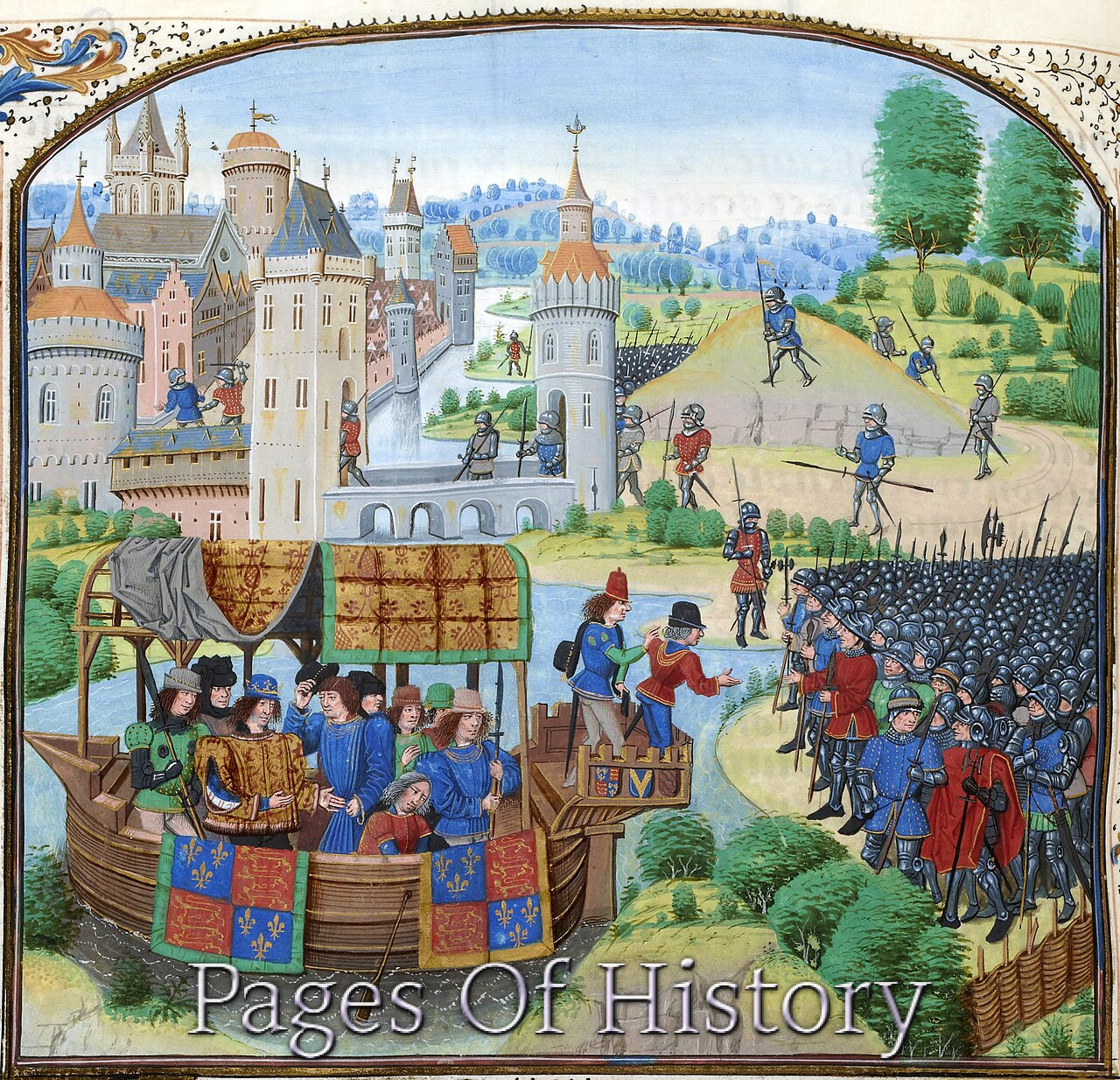
On 14 June, the young king rode out to Mile End to meet the rebels. Richard II, just fourteen, agreed to their demands and issued charters of manumission and pardon. Many rebels, satisfied, began to disperse. But a hard core remained at Smithfield, where Tyler met the king on 15 June. The meeting turned violent. Tyler was stabbed—according to most accounts by William Walworth, the mayor of London—and then killed by the king’s men. The rebel army, leaderless and stunned, was persuaded by Richard to disperse on the promise of pardon. Within days, royal forces under Sir Robert Knollys and others hunted down remaining rebels across Essex, Kent, and East Anglia.
Key Events and Turning Points of the Peasants’ Revolt 1381
| Date (1381) | Event | Significance |
|---|---|---|
| Late May | Essex villagers resist poll tax at Brentwood and Fobbing | Opens the revolt; tax commissioners driven off |
| 7–10 June | Kent rises; rebels gather at Blackheath | Rebel army forms under Wat Tyler and John Ball |
| 13 June | Rebels enter London; Savoy Palace burned | Rebels control the capital; royal authority collapses |
| 14 June | Mile End meeting; Sudbury and Hales executed | Chancellor and treasurer killed; king issues charters |
| 15 June | Smithfield confrontation; Tyler killed | Rebellion loses its leader; momentum breaks |
| Late June–July | Royal reprisals; pardons revoked; leaders executed | Revolt crushed; John Ball hanged, drawn, and quartered |
Why Did the Revolt Fail So Quickly?
The revolt’s collapse was swift and brutal. Several factors explain it. First, the rebels lacked a coherent strategy beyond presenting demands; once the king promised concessions, many believed him and went home. Second, they had no military capacity to hold London against a coordinated royal response, and the death of Tyler at Smithfield decapitated their leadership at the decisive moment. Third, the young king’s personal courage—riding out to meet the rebels and later rallying loyal forces—gave the crown a symbolic advantage. Richard famously told the rebels at Smithfield after Tyler’s death: “You shall have no captain but me.”
Fourth, the rebels’ social base was too broad and too divided. Prosperous peasants wanted lower rents and an end to serfdom; radical preachers wanted to overturn the social order; London artisans had their own grievances. These groups could unite in anger but not in governance. Finally, the crown and nobility moved quickly to punish. On 2 July, Richard revoked the charters he had granted, declaring them void because they had been extorted by force. John Ball was captured, tried, and executed at St Albans on 15 July; his head was displayed on London Bridge. Hundreds of rebels were executed in the following weeks, though many received pardons.
What Were the Consequences and Legacy of the Peasants’ Revolt 1381?
In the short term, the revolt changed little. Serfdom was not abolished, wage controls remained on the statute book, and the poll tax was dropped—but largely because it was uncollectable, not because of principle. The government’s finances remained strained, and the war with France continued. Yet the revolt had profound long-term effects. The poll tax was never successfully revived in the same form, and later taxation fell more heavily on indirect taxes and customs. More importantly, the revolt exposed the fragility of seigneurial authority and the depth of popular resentment. Landlords became more cautious about enforcing labor laws, and the gradual commutation of labor services into money rents accelerated in the following decades.
The revolt also shaped English political culture. It entered chronicle and literature as a symbol of popular resistance. The letters attributed to John Ball and his followers—”Jack Carter” letters and others—show a sophisticated political vocabulary of liberty and equality. The revolt was remembered in the fifteenth century and revived in radical rhetoric during the English Civil War and the nineteenth-century Chartist movement. It also left a mark on the crown’s relationship with Parliament: the Commons became more vocal about taxation and about the need to address popular grievances.
Did the Revolt Really Change Anything?
Historians disagree about how much the revolt mattered. Some argue it was a turning point that accelerated the decline of serfdom; others contend that serfdom was already eroding and that the revolt mainly frightened the elite into slower, more cautious reform. What is clear is that the revolt did not achieve its stated goals. Yet it revealed that the medieval social order rested on consent as much as coercion, and that consent could be withdrawn. The rebels’ demands for freedom, fair taxation, and legal equality echoed for centuries.
What Really Happened at Smithfield?
The Smithfield meeting on 15 June is the most dramatic and contested moment of the revolt. According to the chroniclers, Tyler approached the king and presented demands, then grew insolent. He may have called for the execution of royal officials or demanded that the king come to terms. Walworth, the mayor, struck him with a dagger, and a royal squire, Ralph Standish, ran him through with a sword. Tyler rode a short distance and died. The rebel army, seeing their leader fall, prepared to fight, but Richard rode forward and persuaded them to disperse. The accounts differ on details—some say Tyler was provoked, others that he was set up—but the outcome was decisive. Tyler’s death ended the revolt’s chance of forcing lasting change.
Historians have long debated the reliability of the chronicles, especially Froissart, who wrote decades later and had his own biases. The Anonimalle Chronicle, a contemporary account from St Mary’s Abbey in York, provides a detailed narrative that many historians regard as more reliable. It describes Tyler’s demands and the violence at Smithfield in vivid terms. The rebel letters and the records of royal pardons and prosecutions provide additional evidence. Together, they show a revolt that was both disciplined in its targeting of symbols and chaotic in its violence.
Why the Peasants’ Revolt 1381 Still Matters
The Peasants’ Revolt 1381 was not a meaningless explosion of violence. It was a political act by people who understood the law, taxation, and lordship, and who used the tools available to them—petitions, armed assembly, and direct action—to challenge a system they saw as unjust. The rebels’ demands for freedom from serfdom, fair taxation, and legal equality anticipated arguments that would be made for centuries. The revolt also demonstrated the power of the written word and the symbolic act: burning legal records, opening prisons, and executing officials were all attempts to dismantle the machinery of oppression.
The revolt’s failure was not inevitable, but it was likely. The rebels lacked the military power and political organization to hold power, and the crown moved quickly to restore order. Yet the revolt left a lasting legacy. It ended the poll tax, accelerated the decline of serfdom, and reminded the ruling class that the commons could not be ignored. It also gave England a powerful story about resistance and the limits of royal power. For historians, the revolt remains a window into medieval society, revealing the tensions between lords and peasants, the impact of plague and war, and the enduring human desire for dignity and justice.
The Lasting Perspective: A Revolt That Failed but Changed Everything
The Peasants’ Revolt 1381 is often remembered as a failure, and in the short term it was. Its leaders were killed, its charters revoked, and its demands unmet. But the revolt’s long-term impact was real. It exposed the fragility of serfdom, ended the poll tax, and contributed to a gradual shift in the balance of power between landlords and laborers. It also became a touchstone for later generations, a reminder that ordinary people could challenge the powerful and that their grievances could not be ignored forever. The revolt’s story—of Wat Tyler, John Ball, and the men and women who marched on London—remains a powerful reminder of the cost of inequality and the enduring demand for freedom.