
📅 Last updated: 23.11.2026
The Paris Commune of 1871 was a revolutionary government that ruled France’s capital for seventy-two days, from 18 March to 28 May 1871, before being crushed in a week of street fighting that left thousands dead. Born from the humiliation of the Franco-Prussian War and the siege of Paris, the Commune became the first modern attempt by working people to govern a major European capital on their own terms.
The Paris Commune 1871 was a radical, democratically elected municipal government that controlled Paris from 18 March to 28 May 1871. It emerged after France’s defeat in the Franco-Prussian War and the conservative National Assembly’s attempt to disarm the city, and it ended in the “Bloody Week” of 21–28 May, when government forces killed an estimated 10,000 to 20,000 Communards. Its legacy as a symbol of workers’ self-rule, and of the violence used to destroy it, explains why it remains contested more than 150 years later.
What Caused the Paris Commune 1871?
The Commune did not appear from nowhere. Its roots lay in the catastrophic Franco-Prussian War, which France declared on 19 July 1870 and lost in a matter of months. On 2 September 1870, Emperor Napoleon III surrendered with his army at Sedan; two days later, a republican Government of National Defence proclaimed the Third Republic in Paris. The Prussian army besieged the capital from 19 September 1870 until 28 January 1871, and Parisians endured months of bombardment, hunger, and cold. The city’s National Guard—an armed citizen militia expanded to roughly 200,000 men during the siege—became the main organized force in the capital, and its soldiers were largely drawn from the city’s working-class districts.
The armistice of 28 January 1871 opened the way to national elections on 8 February. The result was a profoundly conservative National Assembly, dominated by monarchists and rural notables, which chose Adolphe Thiers as head of the executive. In March, the Assembly moved its seat from Bordeaux to Versailles—a deliberate signal that it distrusted revolutionary Paris. Two decrees inflamed the city: one ended the wartime moratorium on rents and commercial debts, hitting artisans and shopkeepers hard, and the other cancelled pay for National Guardsmen, many of whom depended on it to survive. When Thiers ordered troops to seize the cannons parked on the heights of Montmartre and Belleville in the early hours of 18 March, soldiers fraternized with the local crowd, and two generals, Claude Lecomte and Jacques Clément-Thomas, were shot by mutinous Guardsmen. Thiers withdrew the government and army to Versailles, and Paris was left to govern itself.
How Was the Commune Organized and Governed?
On 26 March 1871, Parisians elected a municipal council of 92 members (some seats went unfilled or were soon vacated, leaving roughly 80 active Communards). On 28 March the Commune was proclaimed at the Hôtel de Ville. Its members were a mixed group: followers of the veteran revolutionary Louis Auguste Blanqui, radical Jacobins nostalgic for 1793, mutualist and collectivist socialists influenced by Pierre-Joseph Proudhon, and a smaller number of Marxists. Marx himself, watching from London, called it a “working men’s government” in The Civil War in France (1871), though few Communards had read his work.
The Commune’s practical achievements were modest but symbolically potent. It separated church and state, turned churches into meeting halls, and promoted secular, free education. It abolished the standing army in favor of the armed citizenry, capped salaries of officials at the level of a skilled worker’s wage, and made elected delegates recallable at any time. It decreed the remission of rents during the siege and the return of pawned tools and household goods. A Committee of Public Safety, modeled on the radical body of 1793, was created in early May to coordinate defense, though it provoked bitter internal disputes between “majority” and “minority” factions.
Who Were the Communards?
Contrary to later caricature, the Commune was not a mob of criminals. Its supporters were concentrated in the eastern and northern working-class arrondissements, and included skilled artisans, shopkeepers, clerks, teachers, journalists, and a significant number of women. The socialist Louise Michel, the painter Gustave Courbet, and the writer Jules Vallès were among its most prominent figures. The Commune’s women organized in the Union des Femmes and fought on the barricades; the government later blamed them for the arson that consumed much of central Paris. The city’s wealthier districts, by contrast, mostly abstained from the March elections or opposed the Commune outright.
Why Did the Commune Fail?
The Commune’s defeat was military, political, and geographic. It controlled Paris but not France; the provinces, exhausted by war, largely ignored its appeals. Thiers used the weeks of March and April to rebuild the army at Versailles with Prussian cooperation—Bismarck released French prisoners of war precisely so they could be used against Paris—until it numbered well over 100,000 men. The Commune, by contrast, squandered its early advantage: it failed to march on Versailles in mid-March when the government was weak, and its military leadership was divided and amateurish. The fall of the forts around Paris, especially Fort Issy, in the second week of May opened the city to assault.
- Isolation: The Commune had no allies in the provinces or abroad; the Prussian army still occupied much of northern France.
- Military disorganization: Rival commanders, lack of discipline, and political infighting hampered defense.
- Economic weakness: The city was cut off from trade and food supplies, and the Bank of France (which the Commune largely left untouched) financed the enemy.
- Overwhelming force: Versailles assembled a professional army far superior to the National Guard.
What Happened During the Bloody Week of May 1871?
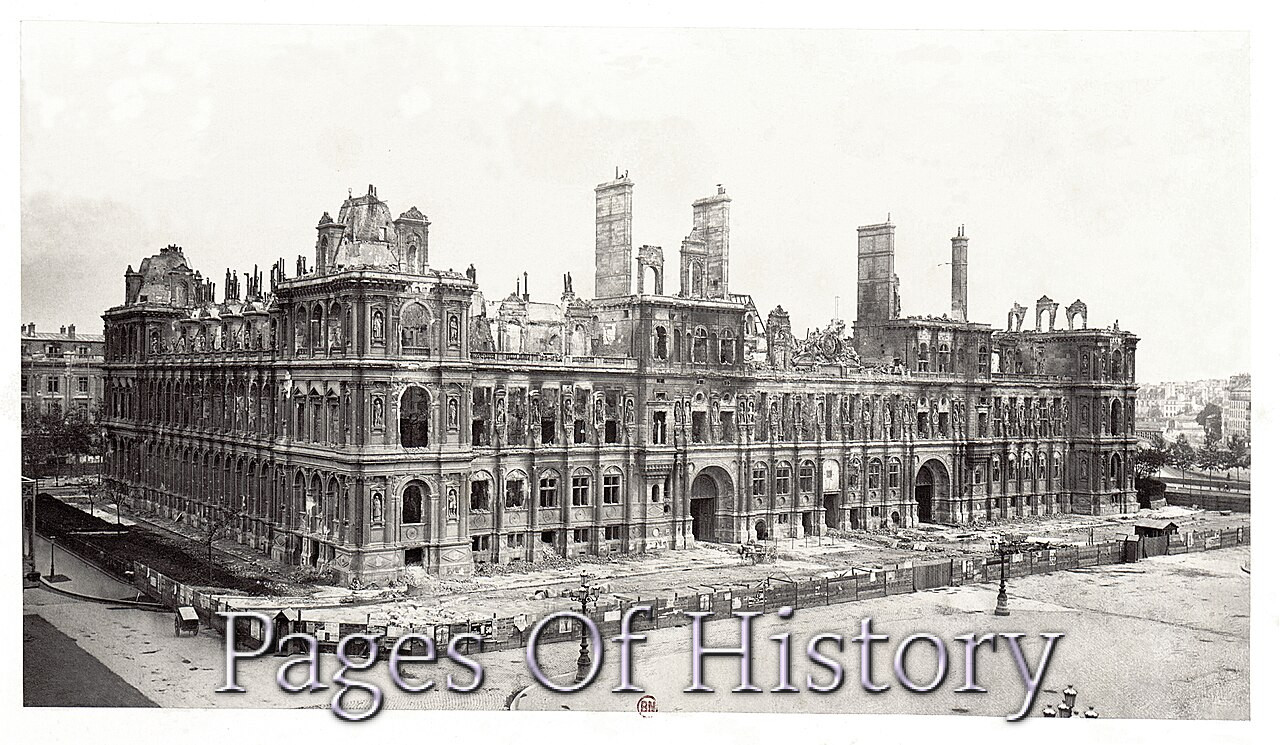
On 21 May, Versailles troops entered Paris through the undefended western gate at the Point du Jour. What followed—la Semaine Sanglante, the Bloody Week—was the bloodiest episode in French domestic history since the Revolution. The army advanced street by street through barricades, and Communards executed hostages, including the Archbishop of Paris, Georges Darboy, and dozens of priests and gendarmes. Retreating Communards set fire to the Tuileries Palace, the Hôtel de Ville, the Palais de Justice, and other landmarks; the Tuileries burned for two days and was never rebuilt. The last organized resistance ended at the Père-Lachaise cemetery on 28 May, where 147 defenders were shot against a wall that became known as the Mur des Fédérés. Thiers’s forces then carried out mass reprisals: summary executions, military tribunals, and thousands of deportations to penal colonies in New Caledonia. Estimates of those killed in the fighting and aftermath range from 10,000 to 20,000, with some historians placing the figure higher; roughly 40,000 were arrested.
| Date | Event |
|---|---|
| 19 July 1870 | France declares war on Prussia; defeats follow at Sedan (2 September) |
| 19 September 1870 – 28 January 1871 | Siege of Paris; armistice signed |
| 18 March 1871 | Thiers tries to seize Montmartre cannons; uprising begins; government flees to Versailles |
| 26–28 March 1871 | Municipal elections; Commune proclaimed at the Hôtel de Ville |
| 21–28 May 1871 | Bloody Week; Commune crushed at Père-Lachaise |
Why Is the Paris Commune 1871 Still Debated Today?
The Commune’s meaning has been fought over ever since. For Karl Marx and later Lenin, it was the prototype of the “dictatorship of the proletariat”—a model of workers seizing state power—though Marx’s own reading was more ambivalent, praising the Commune for smashing the bureaucratic state while warning that it had been too gentle with its enemies. For anarchists, it demonstrated the possibility of decentralized self-government. For conservatives, it was a cautionary tale of mob rule and destruction, invoked by Thiers and his allies to justify the repression. French republicans, meanwhile, used the memory of the Commune to argue that the new Third Republic must be moderate and orderly, and the amnesty of 1880, which allowed exiled Communards to return, helped heal the rift—partially.
Historians continue to disagree about the Commune’s social character, the extent of its popular support, and the responsibility for the atrocities on both sides. The “Bloody Week” has been studied as a case of state violence against a city, while the Commune’s experiments in workers’ democracy and women’s participation have attracted renewed attention. The Paris Commune 1871 remains a touchstone for debates about revolution, class, and the legitimacy of political violence.
What Is the Commune’s Lasting Legacy?
The Commune left a deep imprint on French politics and on the global left. It gave the word “communard” a permanent place in political vocabulary, inspired socialist and labor movements from Spain to Russia, and provided the backdrop for later French struggles over the memory of 1871. The Mur des Fédérés at Père-Lachaise remains a pilgrimage site for the French left, and the Commune’s anthem, “Le Temps des cerises,” became a lasting emblem of the defeated. In France, the repression helped consolidate the Third Republic by removing the most radical wing of Parisian politics, but it also entrenched a lasting suspicion between the capital and the provinces.
The Commune’s lessons are contested precisely because they cut both ways. It showed that a city can organize itself democratically under extreme pressure, and it showed how quickly such an experiment can be destroyed when it is isolated and outgunned. Its defenders point to its secular schools, its rent relief, and its vision of participatory government; its critics point to the hostage killings, the arson, and the internal purges.
Conclusion: Why the Paris Commune Still Divides
The Paris Commune 1871 still divides because it refuses to be reduced to a single story. It was at once a democratic experiment, a desperate defense of a besieged city, and a descent into violence on both sides. Its 72 days produced concrete reforms and terrible bloodshed, and its suppression shaped the politics of the French Third Republic for decades. To remember the Commune is to confront uncomfortable questions about who has the right to govern, how revolutions justify themselves, and what a state will do to survive. That is why, more than 150 years after the last shots at Père-Lachaise, the Paris Commune of 1871 remains a living argument rather than a settled chapter of history.