
📅 Last updated: 05.07.2026
- Setting the Stage: The Elizabethan Context
- The First Colony (1585-1586): A Military Outpost That Failed
- The Second Colony (1587): A Deliberate Community
- The Vanishing: 1587-1590
- Key Figures of the Roanoke Voyages
- Theories and Evidence: What Actually Happened?
- Archaeological Clues and Modern Discoveries
- Legacy and Lasting Impact
- Conclusion: The Enduring Mystery
The story of the Lost Colony Roanoke is America’s oldest unsolved mystery, a tale of ambition, desperation, and silence that has haunted the Outer Banks of North Carolina for over 430 years. It began not as a mystery, but as a bold Elizabethan scheme to plant the first permanent English settlement in the New World, only to collapse into an enigma that has spawned countless theories, from massacre to assimilation to supernatural disappearance. To understand what was lost, we must first understand what was attempted.
Setting the Stage: The Elizabethan Context
The Lost Colony Roanoke was born from the fierce rivalry between Protestant England and Catholic Spain. In the 1580s, Queen Elizabeth I reigned over a nation that was a relative latecomer to the riches of the Americas. Spain had already extracted vast quantities of gold and silver from Mexico and Peru, funding a global empire. English privateers like Sir Francis Drake raided Spanish treasure ships, but the Crown desired a permanent foothold—a base from which to harass Spanish shipping and establish a colony that could produce raw materials.
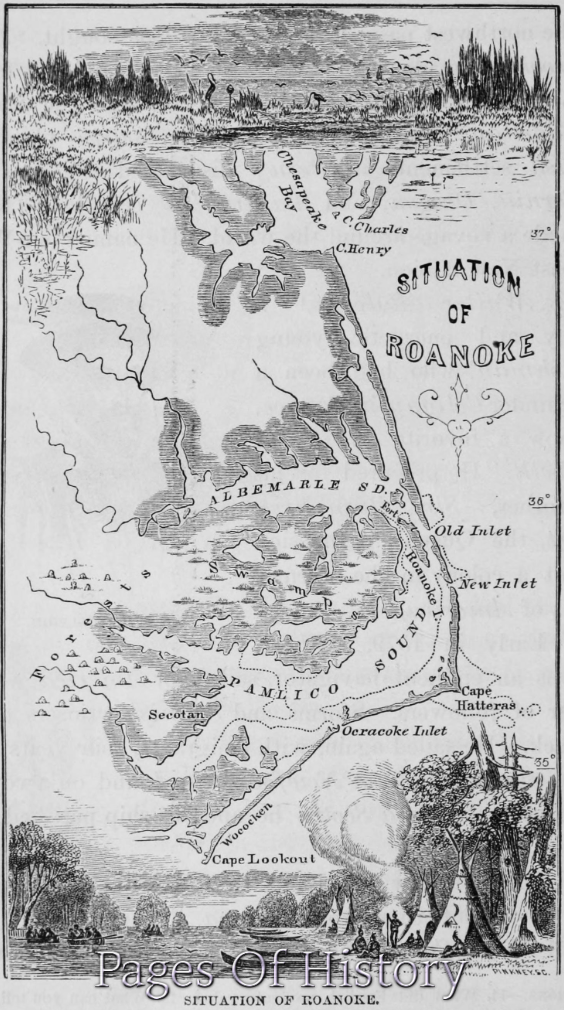
The man who championed this vision was Sir Walter Raleigh, a favorite of the Queen. In 1584, Raleigh obtained a charter to explore and colonize lands in North America not already claimed by a Christian prince. He dispatched a reconnaissance expedition led by Philip Amadas and Arthur Barlowe, who returned with glowing reports of a lush, temperate land called “Roanoke” (from the Algonquian word for “white shells” used as wampum), and of friendly natives, particularly the Secotan people. They also brought back two Native Americans, Wanchese and Manteo, who would serve as interpreters and cultural go-betweens. This initial contact set a dangerously optimistic tone.
The First Colony (1585-1586): A Military Outpost That Failed
The Arrival of Ralph Lane
In April 1585, Raleigh launched his first serious colonizing effort. A fleet of seven ships carrying roughly 600 men, most of them soldiers and sailors, departed Plymouth. The commander was Sir Richard Grenville, a fiery and aggressive cousin of Raleigh. The colony itself was to be governed by Ralph Lane, a veteran of the Irish wars known for his harsh discipline. They landed at Roanoke Island in August 1585.
The plan was not to build a self-sustaining farming community but a fortified military base. The men constructed a small fort and a number of houses. They explored the coastline, mapped the interior, and began a survey of the region’s resources. The artist John White, who would later play a central role in the colony’s fate, created meticulous watercolors of the local flora, fauna, and Algonquian people—images that remain invaluable ethnographic records today.
Rising Tensions and the Collapse
The colony’s fundamental flaw was its dependency. The settlers expected regular supply shipments from England. They refused to plant crops, believing their mission was to find gold or a passage to the Pacific. When supplies ran low, Lane’s men began demanding food from the local tribes. The initial goodwill evaporated.
Relations reached a breaking point at the village of Aquascogoc. After a silver cup was stolen from the English, Grenville ordered the entire village burned and its crops destroyed. This act of brutality poisoned all future relations. The Secotan and other coastal Algonquian tribes, led by a powerful chief named Wingina (also known as Pemisapan), began to plot against the English. Lane, suspecting a conspiracy, launched a preemptive attack. In June 1586, he led a raid that killed Wingina, an act that made the English permanent enemies of the tribes who had once been their hosts.
By June 1586, the colony was starving and surrounded by hostile forces. Just as collapse seemed certain, Sir Francis Drake’s fleet appeared off the coast, returning from a successful raid in the Caribbean. Drake offered to leave supplies, but a hurricane scattered his ships. The frightened colonists, led by Lane, chose to abandon the settlement and return to England aboard Drake’s ships. When Grenville arrived with fresh supplies a few weeks later, he found the fort empty. He left a small garrison of 15 men to hold the island and sailed away. Those 15 men would soon vanish without a trace.
The Second Colony (1587): A Deliberate Community
A New Plan: Families, Not Soldiers
Raleigh, undeterred by the failure of Lane’s colony, devised a radically different approach. The next attempt would not be a military camp but a true civilian settlement, complete with women, children, and skilled farmers. The leader of this venture would be John White, the artist from the first expedition, who was appointed governor.
The fleet of three ships departed Plymouth in May 1587, carrying 117 men, women, and children. Among them were Eleanor Dare, White’s pregnant daughter, and her husband Ananias Dare, a bricklayer. The plan was to land on the shores of Chesapeake Bay, a location recommended by the earlier explorers for its deep-water harbor and friendly native populations. But the pilot of the fleet, a Portuguese navigator named Simon Fernandez, had other ideas. Fernandez had been part of the earlier, profit-driven privateering voyages and was eager to resume raiding. He refused to sail the colonists to the Chesapeake, instead dropping them off at Roanoke Island in late July 1587.
The Birth of Virginia Dare
The colonists were furious. They found the fort destroyed and the garrison of 15 men gone—likely killed or absorbed into local tribes. Despite the danger, they decided to stay and rebuild. They repaired houses, cleared fields, and attempted to make peace with the Secotan, but the memory of Lane’s massacre was too fresh. The local tribes were hostile and refused to trade.
On August 18, 1587, a moment of hope arrived. Eleanor Dare gave birth to a daughter, Virginia Dare, the first English child born on American soil. The name signified both the colony and the virgin queen. It was a symbol of the future. But the colony was already in crisis. Food was scarce, and the threat of attack was constant.
White’s Return to England
The colonists decided they needed reinforcements. They voted to send Governor White back to England to plead for urgent supplies. It was a desperate gamble. White, reluctant to leave his family, agreed. He departed on August 27, 1587, promising to return within the year. He would not see his daughter or granddaughter again for three years.
The Vanishing: 1587-1590
The Spanish Armada and the Delay
White arrived in England in November 1587, only to find the nation preparing for war. King Philip II of Spain was assembling the Spanish Armada, a massive invasion fleet. Every available ship was commandeered for the English defense. No one cared about a struggling colony on a distant shore. Raleigh spent his own fortune trying to outfit a relief expedition, but Queen Elizabeth personally forbade any ships from leaving English waters until the Armada was dealt with.
The Armada was defeated in the summer of 1588, but the crisis was not over. English privateers were now on the offensive, and every ship was needed for raiding. It was not until March 1590 that White finally secured passage on a privateering fleet commanded by John Watts. Even then, the fleet’s primary mission was to capture Spanish treasure ships, not to rescue colonists. The relief expedition was a secondary objective.
The Discovery of “CROATOAN”
White’s fleet reached the Outer Banks on August 18, 1590—his granddaughter’s third birthday. As they approached Roanoke Island, they saw a plume of smoke rising from the shore, raising their hopes. But when they landed, they found the settlement completely deserted. The houses had been dismantled, not burned, indicating a deliberate departure.
The only clue was a single word carved into a wooden post of the fort: “CROATOAN”. Carved into a nearby tree were the letters “CRO”. There was no cross of distress, a symbol White and the colonists had agreed upon to indicate they had left under duress. The Croatoan were a friendly tribe living on present-day Hatteras Island, about 50 miles south. Manteo, the Native interpreter who had returned with the colonists, was from Croatoan. White took this as a hopeful sign.
But a powerful storm was approaching. The fleet’s captains, more interested in their privateering mission than in searching for colonists, refused to risk their ships. They sailed away, leaving White with no choice but to return to England. He never returned to America. The fate of the 117 men, women, and children remained unknown.
Key Figures of the Roanoke Voyages
| Name | Role | Fate |
|---|---|---|
| Sir Walter Raleigh | Patron and financier of the colony | Executed in 1618 by King James I; never visited Roanoke |
| John White | Governor of the 1587 colony; artist and cartographer | Returned to England in 1590; died in obscurity c. 1593 |
| Virginia Dare | First English child born in the Americas | Disappeared with the colony; fate unknown |
| Manteo | Croatoan interpreter and ally | Baptized into the Church of England; likely returned to his people |
| Ralph Lane | Governor of the 1585 colony | Returned to England; later served in Ireland |
Theories and Evidence: What Actually Happened?
For over four centuries, historians, archaeologists, and amateur sleuths have debated the fate of the Lost Colony Roanoke. No single theory has been proven, but several have emerged with varying degrees of support.
Assimilation into the Croatoan Tribe
This is the most widely accepted theory among professional historians. The carved word “CROATOAN” strongly suggests the colonists intended to relocate to Hatteras Island. The Croatoan people were friendly and had been allies of the English. Archaeological evidence supports this: excavations on Hatteras Island have uncovered European artifacts, including a signet ring and a slate writing tablet, dating to the late 16th century. Furthermore, early 17th-century English explorers reported encountering Native Americans with “grey eyes” and “light hair” in the region. The colonists, lacking supplies and surrounded by enemies, likely sought refuge with the Croatoan, intermarrying and gradually losing their English identity.
Massacre by the Secotan or Powhatan
Another possibility is that the colonists were killed by the tribes they had antagonized. Chief Wingina’s successor, Wanchese, was openly hostile to the English. The Powhatan Confederacy, which dominated the Chesapeake Bay region, might have been responsible. Captain John Smith, the leader of the Jamestown colony, reported in 1607 that the Powhatan chief Powhatan told him he had killed the Roanoke colonists. However, this report is unreliable; Powhatan may have been boasting or trying to intimidate Smith. No mass grave has ever been found.
Integration into the Chesapeake Tribe
A more specific version of the assimilation theory involves the Chesapeake tribe. The colonists’ original destination was the Chesapeake Bay. Some historians believe a splinter group traveled north and settled among the Chesapeake people. William Strachey, an early Jamestown chronicler, wrote in 1612 that he had heard reports of a house with stone walls and a fort at an Indian settlement called Pawatah, and that two English survivors were said to have been living with the Chesapeake. Tragically, the Chesapeake tribe was nearly annihilated by the Powhatan Confederacy in 1607, around the time Jamestown was founded. If the colonists were with them, they may have been killed in that conflict.
The “Lost Colony” as a Hoax or Failure to Thrive
Some skeptics argue that the colony simply failed. The settlers were ill-equipped for survival. They arrived too late to plant crops, had no reliable supply chain, and faced a hostile environment. They may have scattered, starved, or been picked off by disease or violence. The “CROATOAN” carving could have been a desperate message left by a group that was already dying. This theory, while bleak, is the simplest explanation: the colony collapsed, and its members died one by one, leaving no trace.
Archaeological Clues and Modern Discoveries
In recent decades, scientific archaeology has shed new light on the mystery. The First Colony Foundation, a non-profit research group, has conducted extensive excavations on Roanoke Island and Hatteras Island.
The “Site X” Discovery
In 2012, researchers analyzing John White’s 1585 map of the region noticed a small, hand-drawn patch covering an area near the Albemarle Sound. When the patch was removed using X-ray imaging, it revealed a small fort symbol. This location, dubbed “Site X,” is on the mainland, about 50 miles west of Roanoke Island. In 2015, archaeologists excavated the site and found European pottery fragments, a rusted rapier blade, and a gun part, all dating to the late 16th century. This suggests that some colonists may have attempted to establish a secondary settlement, possibly a “fort of refuge,” as a fallback position.
The Hatteras Discoveries
On Hatteras Island, excavations at the Cape Creek site have yielded a remarkable collection of artifacts: a Venetian glass bead, a tinned copper earring, and fragments of English pottery. These items were found in a context that indicates trade and cohabitation with the Croatoan people. The evidence strongly suggests that at least some of the colonists relocated to Hatteras and integrated into the local population.
Legacy and Lasting Impact
The Lost Colony Roanoke was a failure in its own time, but its legacy is profound. It was the first attempt by England to establish a permanent settlement in North America. The lessons learned—the need for self-sufficiency, the importance of diplomacy with Native peoples, the dangers of over-reliance on supply lines—would be applied, often imperfectly, by the Jamestown colonists two decades later.
The mystery also became a foundational myth of American culture. The image of a “lost colony” captured the imagination of writers, poets, and historians. It symbolized both the promise and the peril of the New World. The story of Virginia Dare, the first English child born in America, became a symbol of innocence lost. The colony’s disappearance served as a cautionary tale about the fragility of human endeavor.
Conclusion: The Enduring Mystery
The true story of the Lost Colony Roanoke is not a single narrative but a convergence of ambition, error, and tragedy. It is a story of men and women who sailed into the unknown, only to be swallowed by the vastness of a continent they could not understand. The most likely explanation—assimilation into the Croatoan tribe—is supported by growing archaeological evidence, but it remains unproven. No definitive proof has ever been found, and perhaps none will be.
What we are left with is a powerful human story. It is a story of a grandfather, John White, who never knew the fate of his daughter and granddaughter. It is a story of 117 people who chose to build a new life, and who disappeared into the fabric of a land that was not yet their own. The Lost Colony Roanoke is not just a mystery to be solved; it is a reminder that history is often incomplete, that the past leaves only fragments, and that some questions may never have a final answer. The silence of Roanoke endures, inviting us to imagine, to investigate, and to remember.