
📅 Last updated: 08.07.2026
- The Crisis of the Late Republic: A Republic Unraveling
- The Fracturing of the Alliance: From Triumvirate to Civil War
- The Real Reason Caesar Crossed the Rubicon: Dignitas and Survival
- Crossing the Rubicon: The Aftermath and the March on Rome
- The Legacy of the Crossing of the Rubicon: The Death of the Republic
- Why the Phrase "Crossing the Rubicon" Endures
- Conclusion: The Man and the Moment
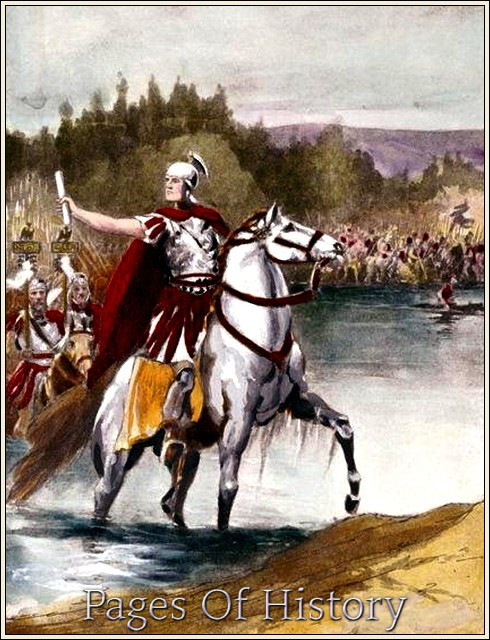
The “Crossing of the Rubicon” is one of the most iconic phrases in Western history, a shorthand for any irreversible, high-stakes decision. On the night of January 10, 49 BCE, Julius Caesar, a Roman general and proconsul of Gaul, stood at the banks of a small river in northern Italy. By ordering his single legion, the Legio XIII Gemina, to cross this stream, he knowingly declared war on the Roman Senate and his former ally, Gnaeus Pompeius Magnus (Pompey). The act was treason, a direct violation of Roman law that forbade a general from bringing his army into the heart of the Republic. Yet, the real reason Caesar crossed the Rubicon was not a spontaneous act of ambition or a gamble born of desperation. It was the calculated, final move in a long political chess game driven by a single, non-negotiable fear: the destruction of his political career, his personal dignitas (honor and standing), and his very life at the hands of a senatorial oligarchy that had been sharpening its knives for years.
The Crisis of the Late Republic: A Republic Unraveling
To understand Caesar’s decision, one must first grasp the chaos of the late Roman Republic. By the 60s and 50s BCE, the Republic was a corpse propped up by power-sharing agreements among a handful of warlords. The old institutions—the Senate, the Assemblies, the consulships—had been hollowed out by decades of civil strife, starting with the Gracchi brothers in the 130s BCE and culminating in the dictatorship of Sulla in 82-79 BCE. The Roman state was no longer a stable, balanced constitution; it was a battlefield of personal ambition.
Three men dominated the political landscape: Caesar, Pompey, and Marcus Licinius Crassus. In 60 BCE, they formed an informal political alliance known as the First Triumvirate (from the Latin tresviri, “three men”). This was not a formal office but a private arrangement. Each man brought something to the table:
- Pompey the Great: Rome’s most celebrated general, who had conquered the East, cleared the Mediterranean of pirates, and settled vast tracts of land for his veterans. He craved senatorial approval and land for his men.
- Marcus Licinius Crassus: The wealthiest man in Rome, whose fortune bankrolled much of the alliance. He sought military glory to rival Pompey, a fatal ambition that would lead him to his death at the Battle of Carrhae in 53 BCE.
- Julius Caesar: A patrician from the ancient Julian clan, but one who had aligned himself with the populares, the faction that championed the rights of the common people against the senatorial elite. He was an outsider, clever, and deeply in debt.
For a decade, the Triumvirate effectively ruled Rome. Caesar secured the consulship in 59 BCE and then, crucially, obtained a five-year command in Gaul (later extended for another five). This was the key to his future. Gaul gave him an army, a province to plunder for wealth, and a stage for epic military achievement. His Commentarii de Bello Gallico (Commentaries on the Gallic War) were not just history; they were brilliant political propaganda, broadcast back to Rome to maintain his popularity.
The Fracturing of the Alliance: From Triumvirate to Civil War
The first crack in the Triumvirate came in 54 BCE with the death of Julia, Caesar’s daughter and Pompey’s wife. She had been the human bridge between the two men. Then, in 53 BCE, Crassus was killed in the disastrous campaign against the Parthians. The Triumvirate was dead. Pompey, ever the political weathervane, began to drift back toward the senatorial establishment—the optimates—who had always viewed him with suspicion but now saw him as the only man capable of stopping Caesar.
The Senate, led by the inflexible Cato the Younger and Caesar’s personal enemy, Marcus Claudius Marcellus, grew terrified of Caesar’s power. He had conquered all of Gaul, amassed a fortune, and commanded a veteran army of over ten legions. To the optimates, Caesar was a second Sulla, a potential dictator who would destroy their privileges. Their strategy was simple: strip Caesar of his command and his legal immunity before he could run for a second consulship, then prosecute him for crimes committed during his first consulship, which would mean exile and political annihilation.
The Legal Trap: A Delicate Balance of Power
The core of the conflict was a legal and constitutional crisis. Roman law required that a candidate for the consulship must stand for election in person in Rome. However, a general commanding an army in the field could not legally enter the city (the pomerium, the sacred boundary of Rome) without disbanding his army and forfeiting his command. Caesar’s enemies in the Senate refused to grant him an exemption to stand for the consulship in absentia. They wanted him to return to Rome as a private citizen, defenseless against prosecution.
Caesar, for his part, offered a series of reasonable compromises:
- He would disband all but two of his legions if Pompey would disband his own forces in Spain.
- He would accept a governorship of Illyricum and a single legion, essentially a retirement package, if he could keep his immunity.
- He proposed that both he and Pompey give up their commands simultaneously.
Each offer was rejected. The Senate, under the influence of Cato and Marcellus, demanded unconditional surrender. They passed the Senatus Consultum Ultimum (the “Final Decree of the Senate”) in January 49 BCE, a declaration of martial law that effectively called on all magistrates and citizens to defend the state against Caesar. They gave Pompey command of all Roman forces and ordered Caesar to disband his army by a specific date or be declared a public enemy.
The Real Reason Caesar Crossed the Rubicon: Dignitas and Survival
This is the heart of the matter. The popular narrative—that Caesar was a power-hungry tyrant who wanted to make himself king—is a simplification written by his enemies (and later, nuanced by his own propagandists). The real reason Caesar crossed the Rubicon was far more personal and far more desperate: it was the defense of his dignitas.
Dignitas was a uniquely Roman concept. It was not merely “dignity” in the modern sense. It encompassed a man’s entire public worth: his reputation, his honor, his social standing, his political influence, and his personal history of accomplishments. It was the currency of the Roman aristocracy. To have one’s dignitas attacked was to be assaulted at the very core of one’s being.
Caesar later wrote in his Civil War that he was motivated by the injuries done to him by his personal enemies, who had “driven him to this extreme.” He famously said, “Alea iacta est” (“The die is cast”) as he crossed the river, but the deeper sentiment was one of righteous indignation. He believed that the Senate, led by a corrupt faction, had broken the laws of the Republic to destroy him. They had refused all compromise. They had handed absolute power to his rival, Pompey. They had left him with a choice: surrender and face a humiliating trial, exile, and the erasure of his life’s work, or fight.
He chose to fight. The Crossing of the Rubicon was not an act of aggression; it was an act of self-preservation. It was the desperate gamble of a man who saw the legal system being weaponized against him and who refused to go quietly into the darkness of political oblivion.
The Strategic Element: Why January 10, 49 BCE?
Timing was everything. Caesar had only a single legion, the XIII, with him in Ravenna, just south of the Rubicon. His main army was still in Gaul, north of the Alps. Pompey, on the other hand, had two legions in Italy and could theoretically raise many more from his veterans and allies.
Caesar’s genius lay in speed and audacity. By crossing the Rubicon with a single legion, he did not intend to fight a pitched battle. He intended to create a political shockwave. The goal was to move so fast that he would reach Rome before the Senate and Pompey could organize a defense. He knew that Italian towns, tired of senatorial corruption and loyal to the memory of his popular reforms, would not resist him. His strategy was to turn the civil war into a political coup through sheer momentum.
Crossing the Rubicon: The Aftermath and the March on Rome
The immediate result of the crossing was a strategic masterpiece. Caesar’s lightning advance caught the senatorial forces completely off guard. Towns like Ariminum (modern Rimini), Pisaurum, and Ancona opened their gates to him without a fight. Pompey, shocked by Caesar’s speed and the lack of popular support for his own cause, made a fateful decision. He declared Rome indefensible and ordered the Senate and all loyal magistrates to evacuate the city and flee to Brundisium (Brindisi) in the heel of Italy, from where they would sail to Greece.
This was a massive political blunder. By abandoning Rome, Pompey handed Caesar the most powerful propaganda tool of all: the appearance of being the savior of the Republic, rescuing the city from a cowardly and panicked oligarchy. Caesar entered Rome unopposed in March 49 BCE. He did not sack the city or declare himself dictator. He seized the state treasury from the Temple of Saturn (the aerarium), secured the grain supply, and began to organize a government.
The Civil War: A Summary of Key Events
The Crossing of the Rubicon was merely the opening move in a four-year-long civil war that would destroy the old Republic forever. The key phases were:
| Phase | Key Event | Year | Outcome |
|---|---|---|---|
| Italian Campaign | Caesar’s rapid march south; Pompey’s evacuation to Greece. | 49 BCE | Caesar controls Italy; Pompey builds a new army in the East. |
| Hispania Campaign | Caesar defeats Pompey’s legates at Ilerda. | 49 BCE | Caesar secures the western provinces and neutralizes Pompey’s best troops. |
| Balkans Campaign | Caesar crosses the Adriatic; siege of Dyrrhachium. | 48 BCE | Caesar nearly defeated; Pompey fails to press his advantage. |
| Battle of Pharsalus | Decisive battle in central Greece. | 48 BCE | Caesar defeats Pompey’s numerically superior army. Pompey flees to Egypt. |
| Egypt & the Death of Pompey | Caesar pursues Pompey to Alexandria; Ptolemy XIII murders Pompey. | 48 BCE | Caesar becomes embroiled in the Egyptian civil war; meets Cleopatra. |
The war did not end at Pharsalus. Caesar would spend the next three years mopping up Pompeian resistance in Africa, Spain, and the East. The final battle was at Munda in Spain in 45 BCE, where Caesar crushed the last of the Republican forces. He returned to Rome as the undisputed master of the Roman world.
The Legacy of the Crossing of the Rubicon: The Death of the Republic
The crossing was not just a military action; it was a constitutional coup d’état. By violating the sacred law that forbade a general from bringing his army into Italy, Caesar had shattered the foundational principle of the Republic: the supremacy of civilian law over military power. From that moment on, the Roman state was ruled by whoever commanded the most loyal legions.
Caesar’s dictatorship, which he assumed after the war, was a direct result of the crossing. He was appointed dictator first for 11 days in 49 BCE, then for a year in 48 BCE, then for ten years in 46 BCE, and finally for life in 44 BCE. He used this power to enact a series of sweeping reforms:
- Calendar Reform: He introduced the Julian calendar, the precursor to our modern Gregorian calendar.
- Land Redistribution: He settled tens of thousands of his veterans and the urban poor on public lands.
- Debt Relief: He reformed the crushing debt system that had plagued the lower classes.
- Expansion of the Senate: He packed the Senate with his own supporters, including Gauls and provincials, diluting the old Italian aristocracy.
Yet, for all his power, Caesar failed to solve the fundamental problem he had created. He could not create a legitimate, stable system to replace the broken Republic. The Senate he dominated was filled with men who had fought against him, and who resented him. On the Ides of March, 44 BCE, a conspiracy of senators, led by Brutus and Cassius, stabbed Caesar to death in the Theatre of Pompey. They thought they had restored the Republic. They were wrong.
The assassination only triggered another round of civil war, this time between Caesar’s adopted son and heir, Octavian (later Augustus), and his former lieutenant, Mark Antony. The ultimate resolution came at the Battle of Actium in 31 BCE, when Octavian defeated Antony and Cleopatra. Octavian did not make the same mistake as Caesar. He did not call himself dictator or king. He called himself Princeps (“First Citizen”) and restored the forms of the Republic while holding all real power himself. This was the Roman Empire.
Why the Phrase “Crossing the Rubicon” Endures
The phrase has survived for over two millennia because it captures a universal human experience: the moment of no return. It is the point where all options are exhausted, where caution is abandoned, and where a single, irreversible action is taken that changes everything.
In the context of Roman history, the crossing was the pivot point. Before it, the Republic, though sick, was still standing. After it, the Republic was doomed. The act itself was a microcosm of the entire crisis: a brilliant, ambitious man, cornered by a rigid and corrupt system, who chose to break the rules rather than be broken by them. The Crossing of the Rubicon was not the cause of the fall of the Republic; it was the symptom of a disease that had been festering for a century. It was the moment the patient died.
Conclusion: The Man and the Moment
Julius Caesar remains one of the most controversial figures in history. Was he a tyrant who destroyed liberty, or a visionary who saved the state from a corrupt and incompetent oligarchy? The answer, as with most historical questions, is complex. But the Crossing of the Rubicon was the defining act of his life. It was a decision born of fear, ambition, and pride—above all, the defense of his dignitas. He chose to risk everything—his life, his reputation, and the peace of the entire Mediterranean world—rather than submit to what he saw as an unjust and illegal persecution.
The lesson of the Rubicon is a sobering one. It shows how, in a failing state, the personal ambitions of powerful men can override the rule of law. It demonstrates that when legal and political systems lose their legitimacy, the only question that remains is who has the most swords. Caesar crossed the river. The Republic drowned. And the world was never the same. The phrase “Crossing the Rubicon” will forever remind us that some decisions, once made, cannot be unmade.