
📅 Last updated: 22.07.2026
- The Eruption Begins: A Rain of Pumice and Panic
- How Pompeii Victims Died: The Misunderstood Role of Asphyxiation
- The Pyroclastic Surge: The True Killer
- The Harbor of Doom: The Victims of Herculaneum
- Who Survived? The Unanswered Question
- The Legacy of the Casts: Misinterpreting the Evidence
- How Pompeii Victims Died: A Final, Horrifying Minute
- Conclusion: A City Frozen in Time, A Lesson for Today
For nearly two millennia, the image of how Pompeii victims died was one of slow suffocation under a blanket of ash and pumice, a grim but straightforward asphyxiation. Yet, as the famous plaster casts of their final poses reveal, the reality of how Pompeii victims died is far more complex, violent, and startlingly specific than the old narrative suggests. The final hours of Pompeii were a cascade of distinct, escalating disasters, each claiming lives in a different manner, from the initial rain of pumice to the lethal pyroclastic surges that erased entire populations in seconds.
The Eruption Begins: A Rain of Pumice and Panic
The catastrophe began on the afternoon of August 24, 79 AD, though some modern scholars argue it may have been later in the autumn. At around 1:00 PM, Mount Vesuvius erupted with a force that Pliny the Younger, watching from across the Bay of Naples at Misenum, described as a “cloud of unusual size and appearance.” This Plinian phase—named for Pliny himself—sent a column of ash, pumice, and gas 20 miles into the stratosphere.
For the first several hours, the primary threat was not the volcano’s heat but its debris. A relentless rain of pumice stones, ranging in size from pebbles to large cobbles, began to fall on Pompeii. The accumulation rate was staggering: within hours, roofs began to collapse under the weight. Archaeological evidence from the House of the Faun and other structures shows collapsed upper floors and shattered roof tiles, indicating that many of the earliest victims died not from the eruption itself, but from falling masonry.
The First Wave of Casualties
Analysis of the skeletal remains found in the lower layers of the ash—those closest to the ground—tells a story of crushing trauma. These are the victims who stayed too long, either attempting to shelter in place or gathering valuables. One notable example is a group of eight individuals found in the Praedia of Julia Felix, a large commercial-residential complex. Their bones show fractures consistent with roof collapse, and their positions suggest they were huddled together, perhaps waiting for the pumice fall to stop.
By the evening of the 24th, the pumice had accumulated to depths of 8 to 10 feet in many parts of the city. For those still alive, escape on foot was becoming impossible. The streets were buried, and the constant bombardment made movement treacherous. This phase alone likely killed hundreds, trapping them in their homes or in the open.
How Pompeii Victims Died: The Misunderstood Role of Asphyxiation
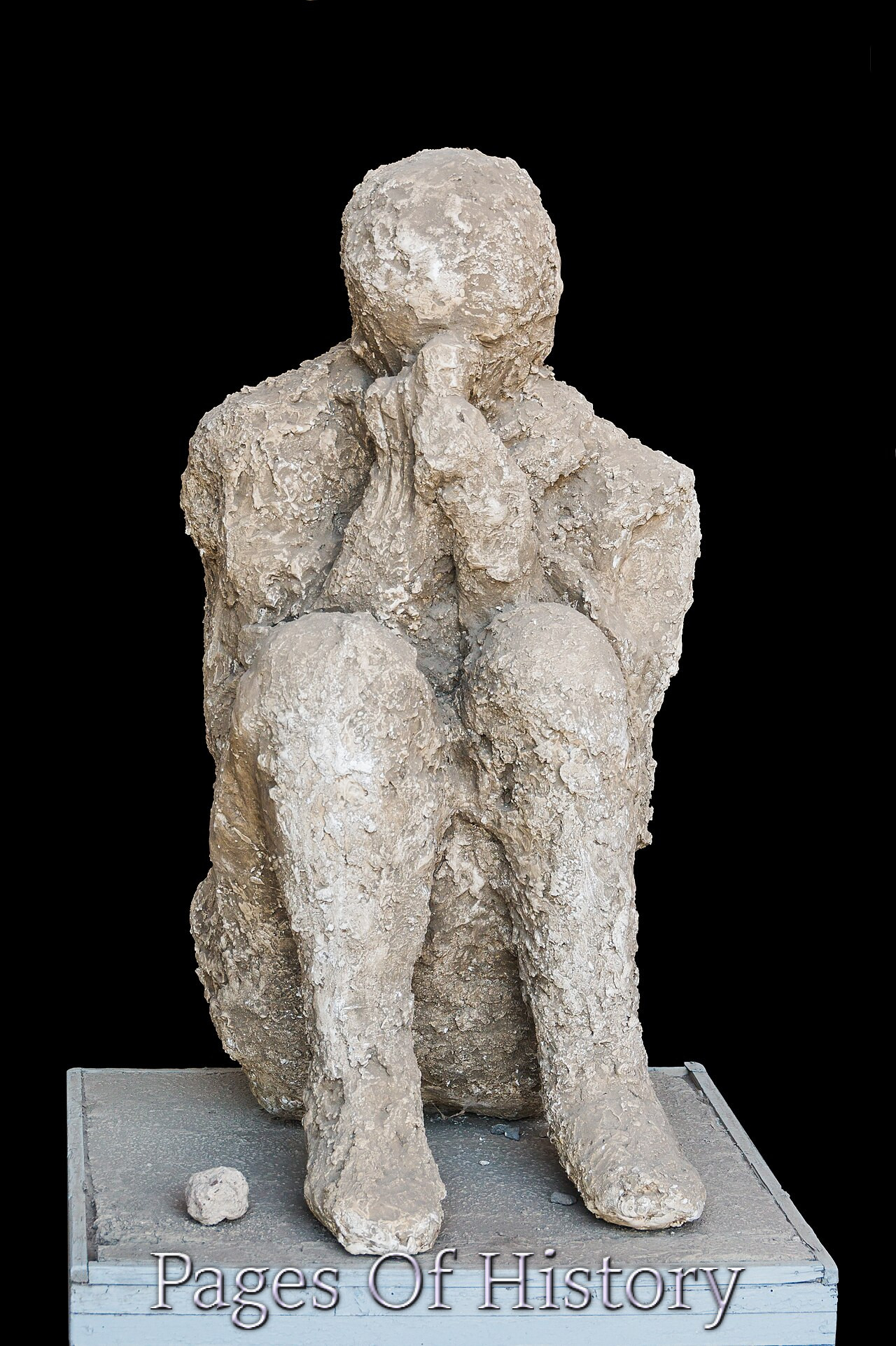
For centuries, the textbook explanation was that the Pompeii victims died from inhaling volcanic ash and toxic gases, slowly suffocating as their lungs filled with fine particulate. This narrative was reinforced by the famous plaster casts, which often show victims in curled, fetal-like positions—a pose long interpreted as the “pugilistic stance” of asphyxiation.
However, modern forensic archaeology challenges this. While asphyxiation certainly occurred in some cases, it was not the dominant cause of death. The key evidence comes from the position and condition of the skeletons within the casts. In cases of true asphyxiation, victims typically show signs of agonal breathing—a reflexive gasping that leaves the head thrown back and the mouth open. Many Pompeian casts do not show this.
Instead, what researchers have found is that many victims died from heat shock and instant vaporization. When they were buried by the later pyroclastic surges, the temperatures were so extreme—reaching 300°C to 600°C (572°F to 1112°F)—that their bodies were essentially cooked. The soft tissues boiled, the skulls sometimes exploded from steam pressure, and the brains turned to glass. The curled position is not a sign of suffocation but rather a cadaveric spasm caused by muscle contraction in extreme heat, a process known as heat rigor.
The Evidence of Instant Death
A landmark 2018 study published in PLOS ONE examined the skulls of several victims. The researchers found a black, glassy substance inside the crania of multiple skeletons. Chemical analysis revealed this to be vitrified brain tissue—human brain matter that had been heated to extreme temperatures and then rapidly cooled, turning into glass. This could only happen if the victim died instantly from the heat surge, with the skull acting as a crucible. This is the only known instance of human brain tissue being preserved in this manner, and it definitively proves that for many, the cause of death was not suffocation but instantaneous thermal shock.
The Pyroclastic Surge: The True Killer
The most catastrophic phase of the eruption began around midnight on August 24th and continued into the early morning of the 25th. The eruption column, heavy with debris, began to collapse under its own weight. This triggered a series of pyroclastic surges and flows—ground-hugging avalanches of superheated gas, ash, and rock moving at speeds of over 100 miles per hour.
These were not single events but a sequence of six distinct surges, each more powerful than the last. The first few surges were relatively small and did not reach Pompeii directly, but they devastated the nearby town of Herculaneum. There, the victims died so quickly that their skeletons show no signs of escape attempts—they were simply flash-cooked where they stood.
The Final Surges Reach Pompeii
The fourth surge, occurring around 6:30 AM on August 25th, was the first to hit Pompeii with full force. It was followed by the fifth and sixth surges, the last being the most lethal. When this wall of hot gas and ash hit the city, it was traveling at hurricane force and carried temperatures exceeding 500°C (932°F).
This is how the majority of Pompeii victims died: not from slow suffocation under the pumice, but from being caught in the open or in partially collapsed buildings by a blast of superheated air that killed them in milliseconds. The heat was so intense that it vaporized their soft tissues, leaving only skeletons. As the ash settled around their bodies, it hardened, preserving the void where their flesh had been. When archaeologists pour plaster into these voids, they get the famous casts—but these casts are not of people who “suffocated.” They are the ghosts of people who were incinerated mid-stride.
| Phase of Eruption | Primary Cause of Death | Estimated Temperature | Timeframe | Key Location Evidence |
| :— | :— | :— | :— | :— |
| Plinian (Pumice Fall) | Roof collapse, blunt force trauma from falling pumice | Ambient (cooling ash) | Aug 24, 1:00 PM – Midnight | House of the Faun, Praedia of Julia Felix |
| Pyroclastic Surge 1-3 | Instantaneous heat shock, vaporization | 300°C – 400°C | Aug 25, 12:00 AM – 6:00 AM | Herculaneum waterfront, boat houses |
| Pyroclastic Surge 4-6 | Heat shock, asphyxiation from hot ash inhalation | 400°C – 600°C | Aug 25, 6:30 AM – 8:00 AM | Pompeii city center, Forum, city gates |
| Post-Eruption | Burial, slow asphyxiation in ash-filled shelters | Cooling to ambient | Aug 25, 8:00 AM onward | Underground chambers, cellars |
The Harbor of Doom: The Victims of Herculaneum
While Pompeii provides the most famous casts, Herculaneum—a wealthier town closer to the volcano—offers even more harrowing evidence of how quickly the end came. For decades, it was assumed that most Herculaneum residents escaped, as fewer skeletons were found than in Pompeii. This was wrong.
In the 1980s and 1990s, excavations along the ancient shoreline uncovered the remains of over 300 people huddled in stone boat sheds. These were the citizens who had fled to the beach, hoping to escape by sea. They did not make it. The first pyroclastic surge hit them while they waited. The heat was so extreme—over 500°C—that their brains boiled, their skulls cracked, and their bones were charred black.
The “Ring of Fire” Discovery
A 2020 study of these skeletons revealed a terrifying detail: many show evidence of cranial explosion. The boiling of brain fluid created immense pressure inside the skull, causing it to burst outward. This is not a slow death; it is a death that occurs in a fraction of a second. The victims of Herculaneum did not suffer. They simply ceased to exist as living beings, their bodies turned to carbonized husks in the blink of an eye.
Who Survived? The Unanswered Question
It is a common misconception that everyone in Pompeii died. The population of the city and its surrounding countryside was estimated at 15,000 to 20,000 people. The number of known victims recovered from the ash—about 1,500 to date—suggests that a significant portion of the population did escape. The question is: who got out, and how?
Escape Routes and Survivor Stories
Archaeological evidence points to several mass escape attempts. The roads leading south toward Stabiae and the coast show signs of heavy foot traffic, with discarded belongings and the remains of carts abandoned in the ash. Pliny the Elder, the famous naturalist and commander of the Roman fleet at Misenum, led a rescue mission by sea. He landed at Stabiae, south of Pompeii, and attempted to calm the panicking population. He died on the beach, likely from a heart attack or asphyxiation from toxic fumes—a victim of his own heroism.
Recent research has even traced potential survivors. A 2021 study used DNA analysis and historical records to suggest that some families from Pompeii resettled in cities like Naples, Cumae, and Puteoli (modern Pozzuoli). These refugees carried with them the trauma of the eruption, but also the knowledge of Vesuvius’s power—a knowledge that was, tragically, lost over the following centuries.
The Legacy of the Casts: Misinterpreting the Evidence
The plaster casts of Pompeii are among the most iconic archaeological artifacts in the world. They were first created in the 1860s by Giuseppe Fiorelli, who realized that the hardened ash contained voids where bodies had decayed. By injecting plaster into these cavities, he created hauntingly accurate replicas of the victims in their final moments.
For generations, these casts were interpreted as evidence of a slow, agonizing death. The curled positions, the open mouths, the outstretched arms—all seemed to tell a story of desperate suffocation. This interpretation was reinforced by popular culture, from Edward Bulwer-Lytton’s 1834 novel The Last Days of Pompeii to countless films and documentaries.
A New Understanding
Modern science has rewritten this narrative. We now know that the positions of the casts are largely a product of post-mortem contraction, not pre-mortem struggle. When the body is exposed to extreme heat, the muscles contract and shorten, pulling the limbs into a boxer-like or fetal position. This is a biological reflex that occurs after death, not a sign of suffering.
Furthermore, CT scans of the casts have revealed that many victims have their throats and lungs filled with ash, but not in the way previously assumed. In cases of true asphyxiation, the ash would be inhaled deeply into the lungs. In many Pompeian victims, the ash is found only in the upper airways, suggesting they were already dead or unconscious when the ash entered their bodies. The ash was a burial medium, not a cause of death.
How Pompeii Victims Died: A Final, Horrifying Minute
To truly understand how Pompeii victims died, one must reconstruct their final sixty seconds. Imagine the morning of August 25th, 79 AD. The pumice fall has stopped. The sky is black. The ground has been shaking for hours. Survivors are emerging from their shelters, trying to clear paths, or simply huddling in prayer.
Then, a sound like a freight train. A wall of gray, roiling gas appears on the horizon, moving impossibly fast. It is not smoke; it is a solid cloud of superheated death. In the Forum, the civic heart of Pompeii, dozens of people are caught in the open. The surge hits them at 100 miles per hour. The temperature instantly rises to 500°C. Their clothing ignites. Their skin blisters and peels. Their eyes boil. Their brains turn to steam. They die in under a second.
Those inside buildings fare only slightly better. The surge pours through windows and doors, filling every space with hot gas. The heat is so intense that marble statues crack, and pottery is vitrified. In the House of the Vettii, a group of people huddled in a back room are found in a single cast: a family embracing, their bodies fused together by the heat.
This is the true story of the final hours. It is not a story of slow suffocation in the dark. It is a story of a city erased by a wall of fire, where the victims were not buried alive but incinerated in plain sight.
Conclusion: A City Frozen in Time, A Lesson for Today
The tragedy of Pompeii is not just a story of the past; it is a warning for the present. Vesuvius is still an active volcano, and the Bay of Naples is one of the most densely populated volcanic regions in the world. Over 3 million people live within the “red zone” of potential destruction. The eruption of 79 AD was not the largest Vesuvius has produced; prehistoric eruptions were far more powerful.
The study of how the Pompeii victims died has given volcanologists a detailed blueprint of the dangers of pyroclastic surges. These surges are the primary cause of death in volcanic eruptions today, as seen in the 1985 Nevado del Ruiz disaster in Colombia and the 1902 eruption of Mount Pelée in Martinique. The lesson of Pompeii is that distance is not safety—the surges traveled over 10 miles from the vent. The lesson is also that time is the only real defense. The residents of Pompeii had hours to escape during the pumice fall, but many chose to stay.
In the end, the story of how Pompeii victims died is a story of human nature—our tendency to underestimate danger, our attachment to our homes, and our inability to comprehend a force of nature beyond our experience. The casts are not just a record of death; they are a mirror reflecting our own vulnerability. They remind us that civilization is a thin veneer over a planet of immense, unpredictable power, and that the final hours of Pompeii could, one day, be the final hours of another city.