
📅 Last updated: 24.08.2026
The Moai statues purpose has captivated archaeologists, historians, and travelers ever since European sailors first stumbled upon the remote volcanic outpost of Rapa Nui, better known as Easter Island, on Easter Sunday in 1722. Standing silent and colossal against the Pacific horizon, the nearly 1,000 monolithic figures are far more than a photographic marvel; they are the tangible remnants of a complex, stratified, and ultimately fragile society that pushed its resources to the breaking point. To understand why these stone giants were built, one must look beyond simple explanations of ancestor worship and delve into the intricate political, spiritual, and environmental pressures that shaped one of the most isolated human populations in history.
- The Genesis of a Sacred Landscape: Polynesian Roots and the First Settlers
- Ancestral Power and the Ahu: The Moai as Living Guardians
- The Colossal Transportation Problem: How Were They Moved?
- The Collapse of the Statue Cult: Civil War and the Birdman
- Eyes of the Ancestors: The Symbolism of Sight and Ritual
- Key Facts and Chronology of the Moai
- The Modern Reevaluation: Challenging the "Eco-Cide" Narrative
- Legacy and Preservation: The Moai Today
- The Enduring Enigma: A Final Reflection on the Moai
The Genesis of a Sacred Landscape: Polynesian Roots and the First Settlers
The story of the Moai begins not on Easter Island itself, but in the vast maritime expanse of Polynesia. Around 300 to 400 CE (though some recent radiocarbon dating suggests a later arrival around 1200 CE), intrepid seafarers in double-hulled canoes, navigating by stars, currents, and bird migrations, landed on this speck of land, over 2,000 miles from the nearest inhabited island. These settlers, likely from the Marquesas or Gambier Islands, brought with them a sophisticated social structure, a pantheon of gods, and a deep-seated tradition of honoring deified ancestors. In Polynesian culture, ancestors were not merely the dead; they were powerful intermediaries between the living and the divine, capable of bestowing fertility, protection, and prosperity. This spiritual foundation is the crucial bedrock for the Moai statues purpose, which was to create a physical conduit for these ancestral spirits, known as mana.
The island they found was a lush subtropical paradise, covered in giant palms (Jubaea chilensis), toromiro trees, and abundant birdlife. This initial abundance allowed the population to grow and diversify into distinct clans, each occupying a defined territory that radiated from the coast inward. These clans, or mata, were the primary political units of Rapa Nui society. They were competitive, status-conscious, and deeply invested in demonstrating their lineage’s power. The construction of the Moai was the most potent expression of this competition. Each statue was not just a monument; it was a declaration of a clan’s history, its connection to the gods, and its claim to the island’s limited resources.
Ancestral Power and the Ahu: The Moai as Living Guardians
To fully grasp the Moai statues purpose, one must examine them not as individual sculptures but as integral components of a larger architectural complex: the ahu. The ahu were massive stone platforms, often meticulously fitted with cut stone, that served as both tombs and ceremonial centers. The Moai were placed atop these ahu, facing inward toward the village or the ceremonial plaza, with their backs to the sea. This orientation is profoundly symbolic. They were not looking out to protect against external invaders; rather, they were gazing upon the living community, acting as permanent, silent guardians. Their presence was intended to oversee daily life, ensure the fertility of crops and people, and radiate the mana of the ancestors over their descendants.
Anthropologist and archaeologist Jo Anne Van Tilburg, who has led the Easter Island Statue Project for decades, has argued compellingly that the statues were visual representations of clan genealogy. She posits that the Moai were not idealized portraits of specific individuals but rather composite representations of a lineage’s founding ancestors. The sheer scale of the effort required to carve, transport, and erect them was a direct measure of the clan’s social and economic power. A larger statue meant a more powerful ancestor, more mana, and thus a more dominant position in the island’s political hierarchy. This competitive drive is the engine behind the statues’ increasing size over time, culminating in the colossal, unfinished figure known as El Gigante, which measures an astonishing 71 feet and weighs an estimated 270 tons.
The Quarry at Rano Raraku: The Birthplace of Giants
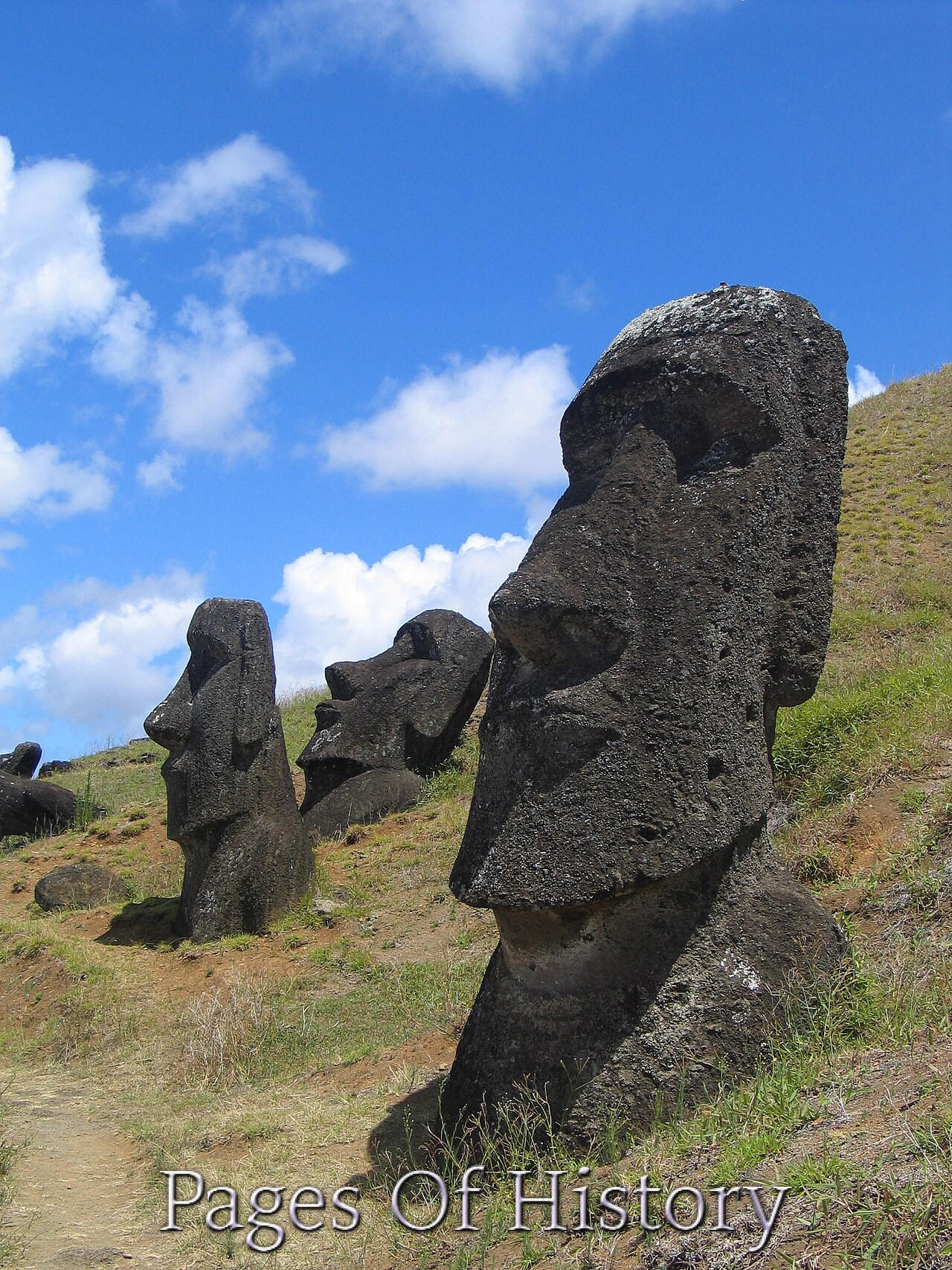
The vast majority of the Moai were carved from the compressed volcanic ash, or tuff, of the Rano Raraku volcano. This quarry is a breathtaking and eerie place, with nearly 400 statues in various stages of completion scattered across its slopes. It is here that the entire process of creation can be observed, frozen in time. The carvers, who were highly skilled craftsmen, worked with basalt picks called toki, chipping away at the rock face from the top down. They would carve the entire statue in situ, leaving only a narrow keel of rock connecting the figure to the bedrock until the very end. Once the carving was complete, the statue was detached and slid down the slope into a prepared pit, where it was stood upright and the intricate details of the back and head were finished.
The quarry is also where we see the evolution of the Moai style. Early statues are smaller, more naturalistic, with rounded heads and a distinct style. Later statues became more elongated, angular, and stylized, with the characteristic deep eye sockets and long ears that we associate with the classic Moai. This stylistic shift suggests a change in ritual practice and social organization. The quarry itself was considered a wahi tapu, a sacred place, and the act of carving was likely accompanied by elaborate rituals and chants. The sheer concentration of labor and resources at Rano Raraku is a testament to the central importance of statue production in Rapa Nui society.
The Colossal Transportation Problem: How Were They Moved?
The question of how the massive statues—averaging 13 feet in height and 14 tons in weight, but with some exceeding 80 tons—were moved from the quarry to their ahu platforms, some as far as 11 miles away, is one of the greatest engineering mysteries in history. For decades, the prevailing theory, popularized by Jared Diamond in his book Collapse, was that the statues were laid on wooden sledges and rolled on logs. This theory was used to support the narrative of ecological disaster: the islanders, in their obsession with moving statues, cut down all the palm trees, leading to soil erosion, famine, and societal collapse.
However, recent experimental archaeology has challenged this narrative. In 2012, a team led by Terry Hunt and Carl Lipo proposed a radically different method. They demonstrated that the Moai could be “walked” upright by rocking them side-to-side using ropes, a technique that requires far fewer people and no logs. Their experiments with a 5-ton concrete replica showed that a team of just 18 people could move the statue with surprising ease. This method, they argue, is consistent with the archaeological evidence, including the distribution of statue bases and the wear patterns on the statues themselves. The “walking” theory suggests that the Moai were not dragged horizontally but were designed to be moved in a vertical, bipedal fashion, a fitting metaphor for ancestors walking across the landscape.
This debate is more than just an academic exercise. It fundamentally changes our understanding of the Moai statues purpose and the fate of the civilization that built them. The “log-rolling” theory paints a picture of a society blindly destroying its environment. The “walking” theory, however, suggests a more sophisticated and sustainable approach to engineering, one that may not have required the complete deforestation of the island, prompting a major reassessment of the “ecocide” narrative.
The Collapse of the Statue Cult: Civil War and the Birdman
Regardless of how they were moved, the construction of Moai eventually ceased, and the statues themselves became casualties of a profound societal upheaval. Around 1500-1600 CE, the island entered a period of intense conflict and cultural transformation. The construction of new Moai stopped, and many existing statues were deliberately toppled. This was not an act of random vandalism but a deliberate, systematic desecration. The toppling of an enemy’s ancestor statue was the ultimate insult, a way to sever their connection to the divine and strip them of their mana. By the time the first Europeans arrived, nearly all of the standing statues had been overthrown.
The reasons for this collapse are complex and multi-faceted. The long-held narrative points to environmental degradation. The clearing of land for agriculture and the need for timber to transport the statues likely led to deforestation. Without trees, topsoil eroded, crop yields plummeted, and the island’s ability to support its population, which may have peaked at 15,000 people, was severely compromised. This resource scarcity would have intensified competition between clans, leading to warfare. Oral traditions speak of the matato’a, a new class of warriors, who rose to power, replacing the old priestly elite who had commissioned the Moai. This shift is starkly symbolized by the rise of the Tangata Manu, or Birdman cult.
The Birdman cult centered on a competition at the sacred site of Orongo. Each year, representatives of the various clans would descend the treacherous cliffs of Orongo, swim to the nearby islet of Motu Nui, and race to find the first egg laid by the sooty tern. The winner would become the Birdman for the following year, granting his clan political and spiritual supremacy. This ritual replaced the Moai cult as the primary focus of the island’s religion. The god Make-make, associated with creation and fertility, overshadowed the ancestral deities. The Moai, once the supreme symbols of power, were abandoned, their eyes (which were made of white coral and black obsidian) removed, and their bodies left to be buried by sediment and time.
Eyes of the Ancestors: The Symbolism of Sight and Ritual
The archaeological record provides a powerful insight into the Moai statues purpose through the discovery of their eyes. In 1979, archaeologists Sonia Haoa and Sergio Rapu Haoa discovered a white coral eye in the socket of a fallen statue. This was a revolutionary find. It proved that the statues were not always the eyeless figures we see today but were completed with inlaid eyes, which were likely added as part of a special ceremony at the moment of the statue’s erection on the ahu. The eyes were carved from white coral, with a pupil of red scoria (volcanic rock) or black obsidian. When in place, the statue was believed to “activate” and become the vessel for the ancestor’s spirit.
This ceremony was the culmination of years of labor. It was the moment when the physical statue transitioned into a living entity, a being with the power to see and influence the world. The gaze of the Moai was not passive. It was a potent, watchful presence that could protect the clan, ensure the success of fishing and agriculture, and ward off malevolent spirits. The removal of these eyes during times of conflict was a symbolic “killing” of the statue, a way to deactivate its power. This practice highlights the deeply spiritual and functional role the statues played in the daily life and worldview of the Rapa Nui people. They were not created for aesthetic pleasure but for a specific, vital ritual purpose that was believed to be essential for the community’s survival.
This belief system is mirrored in other Polynesian cultures, where carved figures known as tiki or ti’i were used to house spirits. The Moai, however, are unique in their colossal scale and the sheer investment of resources. The act of creation itself was a form of worship. The quarry at Rano Raraku was not just a factory; it was a sacred site where the act of carving was a spiritual endeavor. The physical exertion of hundreds of people, the coordination of logistics, and the collective focus on a single goal were all acts of devotion that reinforced social cohesion and validated the power of the ruling elite.
Key Facts and Chronology of the Moai
To provide a clear overview of the complex history, the following table summarizes the key phases and characteristics of the Moai construction period.
| Period (Approx.) | Phase | Key Characteristics | Significance |
|---|---|---|---|
| 1200 – 1400 CE | Early Period | Smaller, naturalistic statues; first ahu built. | Establishment of the ancestor cult and clan-based competition. |
| 1400 – 1600 CE | Classic Period | Largest statues; standardized styles; peak of construction. | Height of the Moai cult; immense resource investment. |
| 1600 – 1722 CE | Decadent Period | Cessation of building; statues toppled; rise of Birdman cult. | Societal upheaval, civil war, and shift in religious focus. |
| 1722 – Present | Post-European Contact | Statues remain fallen; island depopulated; historical study begins. | Reinterpretation and modern conservation efforts. |
This timeline demonstrates that the Moai statues purpose was not static. It evolved from a tool of ancestral veneration into a weapon of political competition, and finally into a symbol of a civilization’s spectacular rise and tragic fall. The statues are a mirror reflecting the changing fortunes of the Rapa Nui people.
The Modern Reevaluation: Challenging the “Eco-Cide” Narrative
In recent years, the traditional story of a society that destroyed itself through ecological mismanagement has been subjected to intense scrutiny and revision. The “walking” theory of statue transport is just one piece of this revision. Archaeologists like Carl Lipo and Terry Hunt have presented evidence that suggests the Rapa Nui people were not blindly destructive. They point to the use of lithic mulch—covering the soil with rocks to retain moisture and nutrients—as a sophisticated agricultural technique that allowed them to farm in a challenging environment. They also argue that the population may have never reached the catastrophic levels previously estimated, perhaps peaking at only 3,000-4,000 people.
Furthermore, the introduction of European diseases, beginning with the arrival of Dutch explorer Jacob Roggeveen in 1722, and later Peruvian slave raids in the 1860s that captured a third of the island’s population, were devastating blows. These external factors, rather than any internal collapse, may have been the primary cause of the population decline. This new perspective reframes the Rapa Nui people not as a cautionary tale of environmental folly but as a resilient and adaptable society that faced a series of challenges, including a changing climate and the arrival of Europeans. The Moai statues purpose in this light becomes even more impressive: it was a monumental undertaking that sustained a society for centuries, not a doomed obsession. It was a testament to human ingenuity, cooperation, and spiritual devotion, even in the face of immense hardship. The story is far more nuanced than a simple parable of “ecocide.”
Legacy and Preservation: The Moai Today
Today, the Moai are a UNESCO World Heritage Site and the most iconic symbol of Easter Island, drawing tens of thousands of tourists each year. The island, now a special territory of Chile, is home to a community of around 7,000 people, many of whom are descendants of the original Polynesian settlers. The Moai are not just ancient relics; they are a living cultural heritage. The Rapa Nui people have a deep connection to these statues, and their preservation is of paramount importance. In 1994, the Chilean government, in collaboration with the Rapa Nui community and international organizations, established the Rapa Nui National Park, which covers nearly all of the island and protects the Moai and their associated sites.
However, the statues face new threats in the modern era. Erosion from wind and rain, the impact of tourism, and the effects of climate change, including rising sea levels and increased storm surges, are all taking their toll. Conservation efforts are ongoing, focused on stabilizing the statues and their ahu platforms, and on managing tourism sustainably. The famous moai of Ahu Tongariki, the largest ahu on the island, was restored in the 1990s after being toppled by a tsunami in 1960, a powerful reminder of the forces of nature that the island’s inhabitants have always contended with. The effort to preserve these giants is a global one, recognizing their universal value as a masterpiece of human creativity and a testament to the enduring power of belief.
Understanding the Moai statues purpose is not just about solving an ancient mystery; it is about understanding the human condition itself. It is a story about the need to connect with our ancestors, the drive to compete for status and resources, and the profound consequences of our choices. The Moai stand as a silent witness to the rise and fall of a civilization, asking us to reflect on our own relationship with the world and with the legacies we choose to leave behind.
The Enduring Enigma: A Final Reflection on the Moai
The Moai of Easter Island are more than just stone; they are a frozen moment in the history of human ambition and spirituality. The Moai statues purpose was multifaceted, serving as a bridge to the divine, a symbol of clan power, and a focal point for community labor and identity. They were the physical embodiment of the ancestors’ mana, created to protect, guide, and sustain the living. The dramatic story of their construction, their toppling, and their eventual resurrection as a global icon is a testament to the enduring power of human creation. They are a reminder that even in the most isolated place on Earth, humans are driven to build, to create, and to leave their mark on the landscape. The secrets of the Moai are not fully solved, and perhaps that is part of their enduring allure. They invite us to marvel at the achievements of the past, to learn from its mistakes, and to consider what our own monuments will say about us to the generations yet to come. They are not just the legacy of a lost people; they are a mirror held up to our own humanity.