
📅 Last updated: 26.08.2026
The enduring question of the Titanic sinking cause is far more complex than the simple collision with an iceberg that has dominated the public imagination for over a century. While the fatal gash in the ship’s hull on the night of April 14, 1912, was the immediate trigger, a perfect storm of design flaws, human error, and unprecedented environmental conditions conspired to turn a survivable accident into one of history’s most infamous maritime disasters. New forensic analyses, deep-sea expeditions, and a re-examination of archival testimony are now painting a far more nuanced picture, revealing that the ship was doomed not by a single catastrophic event, but by a chain of decisions and oversights that began years before she ever left the Harland and Wolff shipyard in Belfast.
- The Conventional Narrative vs. The New Evidence on the Titanic Sinking Cause
- The Metallurgical Failure: Brittle Steel and Substandard Rivets
- The Design Flaw: Bulkheads, Watertight Doors, and the "Unsinkable" Myth
- The Human Factor: Captain Smith, the Californian, and the Missing Binoculars
- Lifeboats, Class, and the "Women and Children First" Protocol
- Environmental Conditions: The Flat Calm and the Moonless Night
- The Wreck and the Breakup: Challenging the "Intact Sinking" Theory
- Key Facts and Timeline of the Disaster
- Legacy and Lasting Impact: The SOLAS Convention
- Conclusion: A Symphony of Errors, Not a Single Note
The Conventional Narrative vs. The New Evidence on the Titanic Sinking Cause
For decades, the story was simple and tragic: the “unsinkable” ship struck an iceberg at 11:40 PM, the iceberg tore a 300-foot gash in her side, and she sank in just two hours and forty minutes. This narrative, cemented by the 1958 film A Night to Remember and amplified by James Cameron’s 1997 blockbuster, placed the blame squarely on the icy antagonist. However, the discovery of the wreck in 1985 by Robert Ballard and Jean-Louis Michel revealed a startling truth: the ship did not sink with a massive, continuous gash. Sonar images showed a series of six narrow slits along the starboard bow, totaling a mere 12 square feet of open area. This revelation forced naval architects and historians to reconsider the physical mechanics of the sinking, shifting the focus from the iceberg itself to the quality of the steel and the design of the rivets that held the hull together.
The new evidence suggests that the Titanic sinking cause was a catastrophic failure of materials, not just a structural breach. Metallurgical analysis of recovered hull fragments, conducted by teams like those led by metallurgist Tim Foecke at the National Institute of Standards and Technology (NIST), found that the steel plates used for the hull were highly brittle. They contained high levels of sulfur and phosphorus, which created a crystalline structure that fractured easily at low temperatures. The water that night was a frigid 28 degrees Fahrenheit, just below freezing. At that temperature, the steel’s ductility—its ability to bend without breaking—was severely compromised. The rivets, too, were found to be substandard. Many of the 3 million rivets were made of “best” iron, which contained high concentrations of slag, a glassy byproduct of smelting. When the iceberg scraped along the hull, the brittle rivets popped their heads off, allowing the plates to separate and open the seams.
The Metallurgical Failure: Brittle Steel and Substandard Rivets
The forensic science surrounding the recovered steel has been a game-changer in understanding the Titanic sinking cause. The NIST analysis, published in the early 2000s, compared the Titanic’s steel to modern shipbuilding steel. The modern samples could absorb up to 20 times more energy before fracturing than the Titanic’s plates. The high sulfur content in the Titanic’s steel created iron sulfide inclusions, which acted as tiny stress concentrators. When the ship hit the iceberg, the impact created a stress wave that propagated through these impurities, causing the metal to shatter rather than deform. This is why the damage was not a clean cut but a series of jagged openings.
The rivet issue is equally compelling. The ship’s builder, Harland and Wolff, used a combination of steel and iron rivets. The steel rivets were used in the central, higher-stress sections of the hull, but the bow and stern sections, where the impact occurred, were fastened with the cheaper, more porous iron rivets. Dr. Jennifer Hooper McCarty, a materials scientist who studied the rivets, noted that the slag content in the iron rivets was three times higher than what was considered acceptable. This made them prone to shearing off under stress. The iceberg impact did not slice through the hull like a can opener; it caused the rivets to fail, popping the plates open like a zipper.
“The ship was not sunk by the iceberg alone,” said Dr. McCarty. “It was sunk by the combination of a brittle hull and brittle rivets that were simply not up to the task of withstanding the cold-water impact.”
This metallurgical failure explains why the ship sank so quickly. The six narrow slits allowed water to flood the first six watertight compartments. While the ship was designed to float with any two of its 16 compartments flooded, and even with the first four, the flooding of six compartments meant the bow was dragged down until the water spilled over the tops of the bulkheads, creating a progressive flooding that eventually pulled the stern high into the air before it broke apart and sank.
The Design Flaw: Bulkheads, Watertight Doors, and the “Unsinkable” Myth
While the materials failed, the design of the ship’s safety systems was fatally flawed. The Titanic’s hull was divided into 16 watertight compartments, separated by 15 transverse bulkheads. These bulkheads were lauded as a revolutionary safety feature, earning the ship its “practically unsinkable” reputation in the press. However, the bulkheads did not extend all the way up to the main deck. They rose only to the level of E-Deck, leaving the tops open. This design was intended to allow the ship to list and settle without water spilling from one compartment to the next. The theory was that if two compartments were flooded, the ship would remain afloat.
The flaw was that the bulkheads were not watertight at the top. When the first six compartments were breached, the bow dipped so low that water poured over the top of bulkhead number six, flooding compartment seven, then eight, and so on in a cascading effect. This “domino effect” was catastrophic. The ship’s designer, Thomas Andrews, knew this. During the sinking, he was heard telling passengers that the ship would not last more than an hour or two. He understood that the open-topped bulkheads were a death sentence once more than four compartments were breached.
Furthermore, the watertight doors between compartments were designed to be closed manually or via a float mechanism, but they only covered the lower decks. They did not extend up to the E-Deck level, allowing water to flow horizontally once the ship began to list. The design philosophy prioritized passenger comfort and open spaces over vertical watertight integrity. The grand staircase, the first-class dining saloon, and the massive engine rooms required large openings that could not be sealed effectively. This architectural compromise meant that the ship’s safety was only as strong as its weakest vertical barrier.
The Fire in the Coal Bunker: A Neglected Factor
Recent analysis of photographs taken before the ship departed has introduced a controversial new element to the Titanic sinking cause: a coal fire in one of the bunkers. Journalist Senan Molony, who studied pre-sailing photographs, identified a 30-foot-long black mark along the hull’s starboard side, near the exact location of the iceberg impact. He argued that a spontaneous combustion fire in coal bunker number five had been burning for days before departure. The crew attempted to extinguish it by shoveling coal out and feeding it into the furnaces, a common practice. Molony’s theory suggests that the fire weakened the steel in that section of the hull, making it even more brittle and susceptible to damage.
While the fire theory is compelling, it is not universally accepted. Some experts argue that a coal fire of that magnitude would have been noticed by passengers and crew, and that the heat would have been more likely to anneal the steel (softening it) rather than make it brittle. However, the theory adds another layer to the complex web of causality. It suggests that the ship was already compromised before it even left Southampton. The fire was not extinguished until the ship stopped in Queenstown, Ireland, on April 11, and it may have contributed to the localized weakening of the hull plates.
The Human Factor: Captain Smith, the Californian, and the Missing Binoculars
Beyond the physical failures, the human decisions made on that night were pivotal. Captain Edward J. Smith, a seasoned commander on his final voyage before retirement, was under pressure to maintain the ship’s schedule and reputation. The Titanic was expected to arrive in New York on Wednesday morning, and there was a desire to break the speed record of her sister ship, the Olympic. Despite receiving multiple wireless ice warnings throughout the day, Smith did not significantly reduce the ship’s speed. The ship continued to steam at 22.5 knots, near her maximum speed, through known ice fields.
The lookouts in the crow’s nest, Frederick Fleet and Reginald Lee, were also hampered by a lack of binoculars. The ship’s binoculars were locked in a cabinet, and the key was reportedly in the possession of Second Officer David Blair, who was replaced at the last minute before sailing and accidentally took the key with him. Fleet and Lee were forced to rely on their naked eyes, which, in the moonless, calm night, made it nearly impossible to spot the iceberg in time. The berg was only sighted when it was about 1,500 feet ahead, giving the ship approximately 37 seconds to react. The officer on watch, First Officer William Murdoch, ordered a hard turn to port and a reversal of engines, but it was too late. The ship’s massive size and momentum made the maneuver futile.
The most infamous human failure was that of the SS Californian, a steamship that was stopped in the ice field about 10 to 19 miles away. The Californian’s wireless operator, Cyril Evans, had attempted to warn the Titanic about the ice but was brusquely told to “Shut up, shut up! I am busy working Cape Race.” Evans turned off his wireless and went to bed. At 12:10 AM, the Californian’s officers saw mysterious white rockets being fired in the distance. They woke Captain Stanley Lord, who studied the lights but concluded they were not distress signals. The Californian did not respond. The Titanic’s crew, seeing the Californian’s lights, fired eight white distress rockets, but the Californian failed to act. This failure to render assistance is one of the greatest “what-ifs” in maritime history. Had the Californian responded, it could have reached the Titanic in time to save hundreds, if not thousands, of lives.
Lifeboats, Class, and the “Women and Children First” Protocol
The ship carried only 20 lifeboats, with a total capacity of 1,178 people, despite having 2,224 passengers and crew on board. This was not an oversight; it was a compliance with Board of Trade regulations, which were based on the ship’s tonnage, not the number of people it could carry. The regulations were outdated, and the number of lifeboats was considered adequate for a ship that was deemed “unsinkable.” The White Star Line, in fact, was praised for exceeding the legal requirement by adding extra collapsible boats.
The loading of the lifeboats was chaotic and marked by class disparity. The “women and children first” protocol was enforced by Second Officer Charles Lightoller, who interpreted it strictly, allowing men only if there were no women waiting. This meant that many lifeboats were launched half-full. For example, Lifeboat #1, a 40-capacity emergency cutter, was launched with only 12 people on board. In contrast, First Officer Murdoch, on the starboard side, allowed men to board if there was room, leading to a higher number of survivors from that side.
First-class passengers had easier access to the boat deck, while third-class passengers, who were located below decks, faced a labyrinth of corridors and locked gates. Many were trapped below, and the death toll was disproportionately high among third-class passengers and crew. Only about 25% of third-class passengers survived, compared to 60% of first-class. This class-based survival rate highlighted the social inequalities of the Edwardian era and became a source of intense public outrage after the disaster.
Environmental Conditions: The Flat Calm and the Moonless Night
The physical environment that night was uniquely treacherous. The sea was exceptionally calm, with no wind and no waves. While a calm sea might seem benign, it meant that there was no white water breaking at the base of the iceberg, which is typically what lookouts look for. The iceberg was a dark, massive silhouette against a black sky, and it was nearly invisible. Additionally, there was no moon. The moon was new, and the night was pitch black. The Southern Cross was visible, but the stars provided no illumination on the water.
Furthermore, the air temperature was just above freezing, but the water was at 28 degrees Fahrenheit. This temperature difference caused a mirage effect, known as a thermal inversion, which can distort light and make objects appear closer or farther away. Some researchers, including Tim Maltin, have argued that this mirage effect may have made the iceberg harder to see and may have also caused the Californian to misidentify the Titanic’s lights. The mirage could have created a false horizon, making the Titanic’s masthead lights appear lower and further away, which might explain why the Californian’s officers thought the ship was a smaller vessel, not a giant liner in distress.
The Wreck and the Breakup: Challenging the “Intact Sinking” Theory
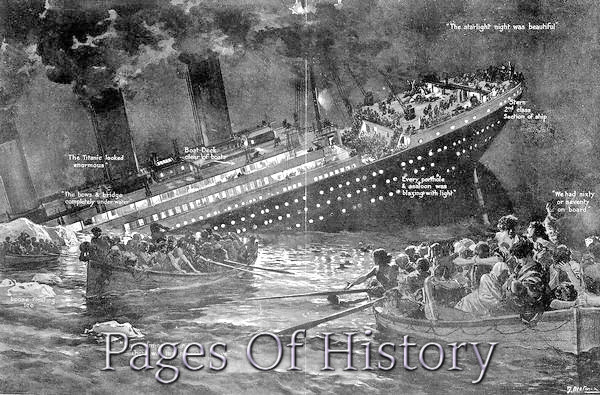
The discovery of the wreck in 1985 also settled a long-standing debate about whether the ship sank intact or broke apart. Survivors’ accounts were contradictory. Some, like Jack Thayer, reported hearing a tremendous noise and seeing the ship break in two. Others recalled the ship sliding under the water intact. The wreck site settled the debate: the ship had broken into two main pieces, the bow and the stern, which lie about 2,000 feet apart. The breakup occurred around 2:15 AM, just minutes before the final plunge. The stern, which was lifted high into the air, experienced a catastrophic structural failure.
The cause of the breakup was the immense stress placed on the hull’s midsection. As the bow flooded and sank, the stern rose out of the water, creating a massive lever arm. The weight of the flooded bow pulled downward, while the buoyancy of the stern pushed upward. The ship’s hull, which was not designed to handle such forces, snapped in two. The breakup likely occurred at the expansion joint, a designed stress-relief feature that ran along the hull’s superstructure. The bow sank quickly, while the stern, which was still partially buoyant, briefly righted itself before filling with water and sinking at 2:20 AM.
Key Facts and Timeline of the Disaster
To understand the Titanic sinking cause in full, it is helpful to review the key data points and the timeline of events.
| Event | Date/Time | Details |
|---|---|---|
| Departure from Southampton | April 10, 1912, 12:00 PM | The Titanic begins her maiden voyage, carrying 2,224 passengers and crew. |
| Iceberg Warning received | April 14, 1912, 9:40 PM | The Mesaba sends a warning of a large ice field; the message is not delivered to the bridge. |
| Collision with Iceberg | April 14, 1912, 11:40 PM | The ship strikes the iceberg on the starboard bow, opening six narrow compartments to the sea. |
| First Distress Rocket | April 15, 1912, 12:45 AM | The Carpathia, 58 miles away, receives the distress call and heads toward the Titanic. |
| Ship Breaks in Two | April 15, 1912, 2:15 AM | The stern rises high into the air; the hull fractures between the third and fourth funnels. |
| Final Sinking | April 15, 1912, 2:20 AM | The ship disappears beneath the surface; over 1,500 people perish in the freezing water. |
The timeline is stark, but the numbers are staggering. The ship’s capacity was 3,547 people, but the lifeboats could only hold 1,178. The rescue ship, the Carpathia, arrived at 4:10 AM, more than an hour after the sinking, and picked up only 705 survivors from the lifeboats. The death toll of 1,517 was a direct consequence of the insufficient lifeboats, the cold water, and the failure of the Californian to respond.
Legacy and Lasting Impact: The SOLAS Convention
The disaster had an immediate and profound impact on maritime law. Within months, the British Board of Trade convened a public inquiry under Lord Mersey, and the United States Senate held its own investigation led by Senator William Alden Smith. Both inquiries produced recommendations that led to the International Convention for the Safety of Life at Sea (SOLAS) in 1914. This treaty established the first international standards for ship safety, including requirements for enough lifeboats for all passengers, mandatory lifeboat drills, 24-hour wireless watch, and the establishment of the International Ice Patrol to monitor icebergs in the North Atlantic.
The SOLAS convention, which is still in force today, has been amended numerous times, but its core principles were born from the Titanic’s tragedy. The ship’s sinking also led to the creation of the “iceberg patrol” and the standardization of distress signals. The wireless telegraph, which had been a novelty, became a mandatory safety feature. The disaster also ended the era of unbridled confidence in technology. The phrase “unsinkable” became a cautionary tale, not a selling point.
Conclusion: A Symphony of Errors, Not a Single Note
The Titanic sinking cause cannot be attributed to a single villain. It was not simply the iceberg, nor the speed, nor the captain, nor the lack of lifeboats. It was a tragic confluence of all these factors—a symphony of errors played out over four days. The brittle steel and faulty rivets were the physical weaknesses, the open-topped bulkheads were the design flaw, the speed and the missing binoculars were the human errors, and the calm, moonless night was the environmental stage. Each factor alone might not have been fatal. The ship could have survived the impact if the steel had been more ductile. It could have survived the flooding if the bulkheads had been higher. It could have saved more lives if there had been enough lifeboats and if the Californian had responded.
The true lesson of the Titanic is not that technology is fallible—it is that hubris is. The belief that the ship was unsinkable led to a complacency that permeated every level of the operation, from the design office to the bridge to the boat deck. The new evidence from the wreck and the laboratories does not exonerate the iceberg, but it does reveal that the ship was destined to be a victim of its own overconfidence. The Titanic’s story endures because it is a perfect, tragic parable of human ambition colliding with the unforgiving forces of nature. It reminds us that safety is not a destination but a constant, vigilant process, and that the sea, as Captain Smith knew, always demands respect. The wreck, lying 12,500 feet below the surface, serves as a permanent monument to that lesson, and the ongoing forensic investigation ensures that we never forget the complex, multi-layered reasons why the “unsinkable” ship sank.