
📅 Last updated: 27.09.2026
The Hindenburg explosion cause has fascinated and divided investigators for nearly nine decades, ever since the giant German airship LZ 129 Hindenburg caught fire and crashed at Naval Air Station Lakehurst in New Jersey on the evening of May 6, 1937. Thirty-six people died, newsreel cameras captured the disaster on film, and the era of the passenger rigid airship effectively ended within a single minute. But what actually ignited the hydrogen that consumed the ship? The answer is more complicated — and more interesting — than the simple story most of us learned in school.
- The Ship and the Flight That Ended an Era
- Why the Hindenburg Explosion Cause Wasn't Obvious
- The Leading Theories — and What the Evidence Actually Shows
- Key Facts About the Hindenburg Disaster
- The Role of Weather and the Decision to Land
- How the Fire Spread So Fast
- What Changed After the Disaster
- Why the Hindenburg Explosion Cause Still Matters
- The Real Cause, and What It Teaches Us
The Ship and the Flight That Ended an Era
The Hindenburg was the largest flying object ever built at the time: 245 meters (804 feet) long, filled with about 200,000 cubic meters of hydrogen gas, and powered by four Daimler-Benz diesel engines. It belonged to the Deutsche Zeppelin-Reederei, a company backed by the Nazi government under Adolf Hitler, and it had completed a triumphant 1936 season of transatlantic crossings between Frankfurt and Lakehurst. By May 1937 it had already made ten round trips to the United States, carrying paying passengers in remarkable luxury — a dining room, a lounge with a lightweight aluminum piano, and promenade windows that looked out over the Atlantic.
The fatal voyage began on the evening of May 3, 1937, when the ship left Frankfurt under the command of Captain Max Pruss, with 97 people aboard (36 passengers and 61 crew, though counts vary slightly by source). The crossing was uneventful until the final hours, when the ship encountered strong headwinds and a series of thunderstorms over the North Atlantic. Delayed, the Hindenburg arrived over New Jersey in the late afternoon of May 6 rather than the morning, and Pruss was forced to wait out thunderstorm activity before approaching the mooring mast.
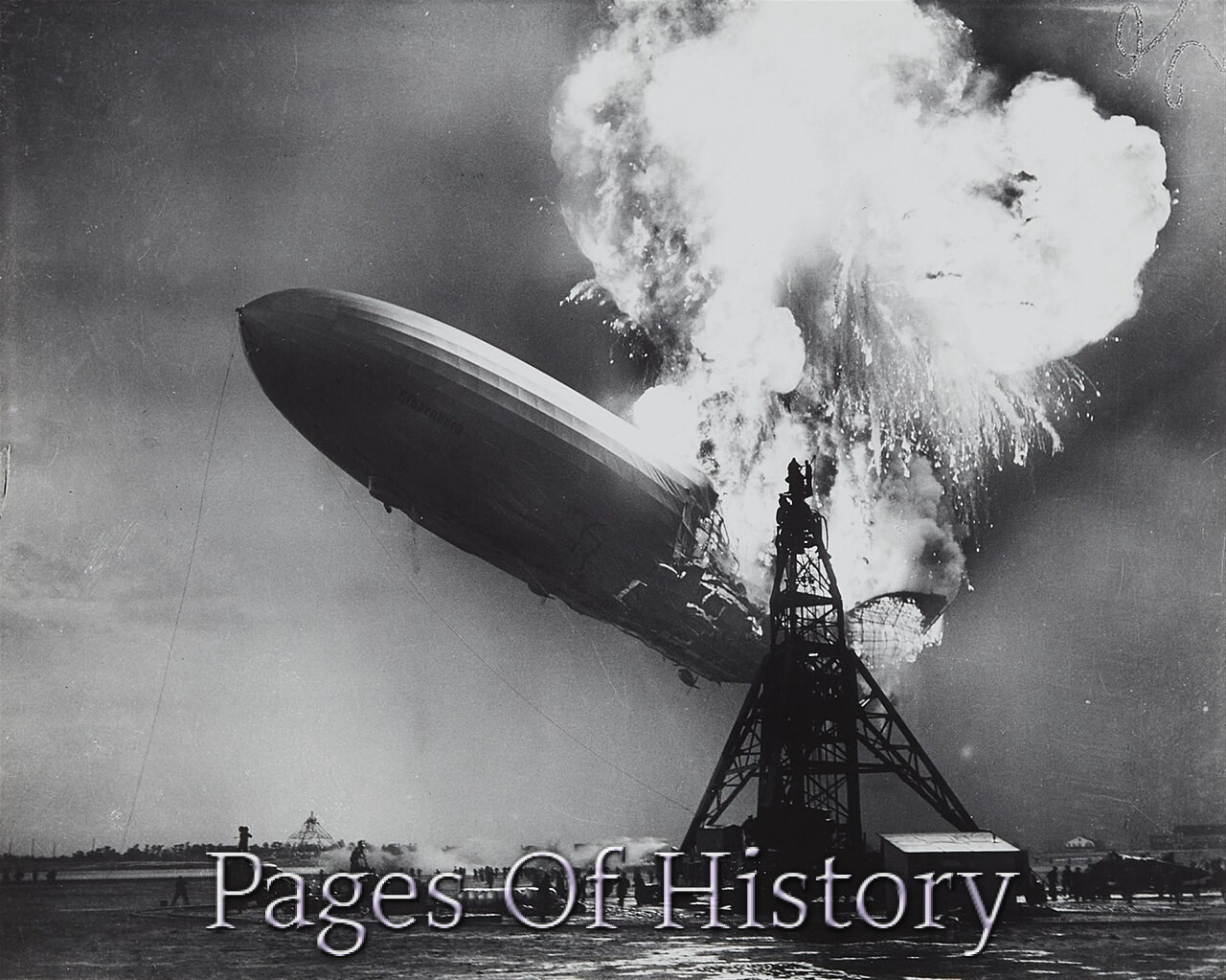
At 7:21 p.m., the ship began its landing approach. At 7:25 p.m., witnesses saw a small burst of flame near the upper tail, just forward of the vertical fin. Within seconds the fire raced forward through the hydrogen cells, the ship’s stern dropped, and the Hindenburg hit the ground tail-first in about 34 seconds. Hydrogen burned and the ship collapsed; the diesel fuel and the incendiary fabric of the outer skin added to the inferno. Of the 97 people on board, 62 survived, along with one member of the ground crew. The disaster killed 36 people and shattered public confidence in passenger airships overnight.
Why the Hindenburg Explosion Cause Wasn’t Obvious
The immediate, popular explanation was simple: hydrogen is flammable, so hydrogen must have been the cause. But that reasoning is incomplete, and this is the crux of the whole puzzle. Hydrogen explains why the fire spread so catastrophically once it started; it does not by itself explain what ignited it. Airship engineers had known for decades that hydrogen, though dangerously flammable when mixed with air, does not ignite spontaneously. It needs a source of heat, a spark, or an open flame. The real question, then, is what supplied that trigger on a stormy evening over New Jersey.
Complicating matters is the fact that the Hindenburg had been designed to burn helium — a non-flammable gas — instead of hydrogen. Helium was available almost exclusively from the United States, and the U.S. government, wary of Nazi Germany, refused to export it. Under the Helium Control Act of 1927, helium exports required a license, and in 1937 the Roosevelt administration declined to sell helium to Germany. Faced with no alternative, the Zeppelin company filled the Hindenburg with hydrogen. That political decision did not cause the fire, but it turned a survivable accident into a catastrophe, because helium would not have burned.
The Leading Theories — and What the Evidence Actually Shows
Investigators in 1937, working under the U.S. Department of Commerce and the German government, produced two official reports. Both concluded that a spark — likely from static electricity — ignited leaking hydrogen at the stern. But neither report could identify the precise ignition source with certainty, and the ambiguities have fueled decades of research. Several theories compete, and a good answer to the Hindenburg explosion cause draws on all of them.
The Static Electricity and Leaking Hydrogen Theory
This remains the mainstream explanation. As the Hindenburg flew through a thunderstorm, the outer fabric and metal frame accumulated electrical charge. The ship’s landing approach involved releasing mooring ropes, and the wet, grounded ropes could have allowed charge to discharge through the frame. If hydrogen was leaking from a damaged or overpressured gas cell near the stern — and there is evidence that a rear cell had been venting — a static spark could have ignited it. The 1937 U.S. inquiry, led by the Bureau of Air Commerce, favored this general mechanism. In 2013, a team of engineers and researchers led by the aeronautical engineer Jem Stansfield, working with a documentary team, conducted large-scale experiments and concluded that static discharge igniting leaking hydrogen was the most probable cause. Their experiments showed that a hydrogen-air mixture could be ignited by a spark even when the ship’s outer skin was painted with a conductive coating intended to prevent exactly this — suggesting the coating had failed or been damaged.
The Incendiary Paint Theory
In 1997, the retired NASA engineer Addison Bain proposed a controversial alternative: that the fire began not with the hydrogen but with the airship’s outer fabric, which had been doped with a compound containing cellulose acetate butyrate, aluminum powder, and iron oxide. Bain argued that this combination was essentially a solid rocket propellant, and that the real Hindenburg explosion cause was the highly flammable skin, with the hydrogen playing a secondary role. His theory gained wide publicity, but it has been widely criticized by chemists and airship historians. The concentrations of aluminum and iron oxide in the doping compound were far too low to support rapid combustion, and the fabric burned slowly in tests. Most importantly, the visible flame in the newsreels spread far too quickly to be explained by fabric alone — that speed is the signature of hydrogen burning. Bain’s theory is best understood as a useful reminder that the outer skin contributed fuel, not as the primary cause.
The Sabotage Theory
Almost immediately after the disaster, sabotage was suspected — partly because the Nazi government was eager to blame enemies of the Reich, and partly because the timing (a German ship exploding over American soil) was politically explosive. The Gestapo investigated and found no evidence. The FBI and U.S. authorities also investigated and found nothing. A crew member, the acrobat and rigger Joseph Späh, was briefly suspected because he had been seen in the stern area, but no credible evidence emerged. The sabotage theory persists in popular culture, but no serious historian treats it as likely. It is worth noting that the Hindenburg carried no cargo of military significance on that flight, and a saboteur would have had to plant a device in a gas cell without being detected — a difficult feat on a ship with constant crew presence.
Key Facts About the Hindenburg Disaster
| Detail | Fact |
|---|---|
| Date and time of fire | May 6, 1937, approximately 7:25 p.m. local time |
| Location | Naval Air Station Lakehurst, New Jersey, United States |
| Ship and operator | LZ 129 Hindenburg, Deutsche Zeppelin-Reederei |
| Commander | Captain Max Pruss |
| People aboard / deaths | 97 aboard; 36 killed (plus one ground crew member) |
| Lifting gas | Hydrogen (helium was denied by the U.S. government) |
The Role of Weather and the Decision to Land
Weather played a decisive role in setting up the disaster, even if it did not directly cause the spark. The Hindenburg had been delayed by headwinds, arriving at Lakehurst in the late afternoon rather than the morning. Thunderstorms were moving through the area, and Captain Pruss circled for hours before being cleared to land. The decision to land in unsettled weather mattered: it meant the ship was wet, its skin was charged with static, and the crew was under pressure after a long, delayed crossing.
Some historians argue that Pruss should have diverted to a different airfield or waited longer. Others note that the ship was low on fuel and water ballast, and that the weather window was closing. The landing itself was a “flying moor,” a maneuver in which the ship approaches the mast and drops ropes to the ground crew rather than being pulled in by a winch. That maneuver required the ship to be close to the ground and to the mast, and it involved releasing ropes that could act as electrical paths. The precise sequence of the landing — the dropping of the ropes, the discharge of static, and the timing of the fire — remains central to modern investigations.
“It’s burst into flame!”
— Herbert Morrison, radio reporter, WLS Chicago, recording his eyewitness account as the Hindenburg burned. His emotional broadcast became one of the most famous audio recordings of the 20th century.
How the Fire Spread So Fast
Understanding the Hindenburg explosion cause requires understanding why the fire moved so quickly. Hydrogen burns with an almost invisible flame and generates intense heat; once a cell ruptured, the gas mixed with air and burned rapidly. The ship’s design made things worse: the gas cells were arranged in a series of separate compartments, but the outer envelope and the connecting framework allowed fire and heat to travel. The burning hydrogen then ignited the fabric covering, the diesel fuel in the engine cars, and the ship’s internal fittings.
Within about 34 seconds, the Hindenburg had settled to the ground. The speed is crucial evidence: a fabric fire alone could not have consumed the ship that fast, which is why most experts reject the incendiary-paint theory as the primary cause. The hydrogen was almost certainly the fuel that drove the rapid spread, even if the initial spark came from static electricity or a mechanical failure.
It is also worth noting what did not happen. The Hindenburg did not explode in the sense of a high-order detonation. Hydrogen burned as a deflagration — a fast, hot, expanding fire — not as a detonation that would have destroyed the ship instantly. That distinction matters because it explains why 62 people survived: the fire grew quickly but not instantaneously, and the ship’s structure held long enough for many people to jump or be pulled from the wreckage.
What Changed After the Disaster
The consequences were immediate and far-reaching. Public confidence in hydrogen airships collapsed. The Hindenburg‘s sister ship, LZ 130 Graf Zeppelin II, was completed but never entered passenger service; it flew only a handful of propaganda and test flights before being scrapped in 1940. The Zeppelin company’s dream of regular transatlantic passenger service died with the Hindenburg. Germany’s airship program, already struggling commercially, was effectively finished.
The disaster also accelerated the shift toward airplanes for long-distance travel. Pan American Airways and other carriers were already developing flying boats and land-based airliners capable of crossing the Atlantic, and the Hindenburg tragedy made the case for them. Within a few years, the Boeing 314 Clipper and, later, pressurized landplanes took over the transatlantic passenger market. The airship era, which had begun with Count Ferdinand von Zeppelin’s experiments in the early 1900s and had peaked with the Graf Zeppelin‘s round-the-world flight in 1929, was over.
The disaster also had a regulatory legacy. The U.S. investigation led to stricter rules for airship operations and helped shape modern aviation safety culture, including the importance of investigating accidents systematically and publishing findings. The newsreel footage and Herbert Morrison’s radio broadcast made the Hindenburg one of the first disasters experienced by millions of people almost in real time — a preview of the media age to come.
Why the Hindenburg Explosion Cause Still Matters
The Hindenburg explosion cause remains a subject of active research because it sits at the intersection of engineering, politics, and human decision-making. The most defensible modern conclusion is that a static-electric spark — or possibly a mechanical spark from a broken wire or a snapped bracing wire — ignited hydrogen that was leaking from a damaged gas cell near the stern, and that the resulting fire spread with terrifying speed through the ship’s hydrogen and flammable skin. The U.S. and German inquiries of 1937 reached essentially this conclusion, and the 2013 experiments by Stansfield and colleagues reinforced it.
But the deeper lesson is that the disaster was not caused by a single flaw. It was caused by a chain of decisions and circumstances: the U.S. refusal to sell helium, which forced the use of hydrogen; the design of a ship that carried a flammable lifting gas; the decision to land in unsettled weather; the accumulation of static electricity on a wet envelope; and the presence of a leaking cell. Remove any one link, and the disaster might not have happened. That is why the Hindenburg is studied in engineering and safety courses today — not just as a historical curiosity, but as a case study in how complex systems fail.
The Real Cause, and What It Teaches Us
So what is the real cause of the Hindenburg disaster? The honest answer is that there was no single cause. The fire was almost certainly ignited by a spark — most likely static electricity — that met leaking hydrogen at the rear of the ship. The hydrogen then burned with a speed and intensity that the ship’s fabric and fuel only amplified. The political decision to use hydrogen instead of helium, the weather that evening, and the decision to land under those conditions all contributed to the outcome.
What makes the Hindenburg story endure is not just the spectacle of the fire, but the way it shows how technology, politics, and chance can combine to produce catastrophe. The airship was a marvel of engineering, and its loss was not the result of a single mistake by a single person. It was the result of a system that had little margin for error — and on May 6, 1937, that margin ran out.
For readers today, the Hindenburg remains a reminder that the causes of disasters are rarely as simple as they first appear, and that the most important lessons often lie in the details we overlook. The next time you see the famous footage of the ship going down in flames, remember: the fire was hydrogen, but the story is far more than that.