
📅 Last updated: 26.09.2026
The printing press impact is often described as revolutionary, but the speed of that revolution deserves closer scrutiny. Within roughly seventy years of Johannes Gutenberg’s first experiments in Mainz around 1440, printing shops had spread from Germany to Italy, France, England, Spain, and Poland, and an estimated twenty million books were in circulation in Europe by 1500. Few technologies in human history have reshaped religion, politics, science, and language so thoroughly in so short a time. This article examines why the press moved so fast — and why the world it created still surrounds us.
- Before Gutenberg: The Slow World of the Scribe
- Why the Press Spread So Fast: An Idea Whose Time Had Come
- Key Dates in the Early Printing Revolution
- The Printing Press Impact on Religion: Reformation and Counter-Reformation
- Printing and the Transformation of Politics and Language
- Science, Scholarship, and the Republic of Letters
- How Print Reshaped Daily Life and Literacy
- Limits, Resistance, and Unintended Consequences
- Conclusion: Why Speed Mattered Then — and Now
Before Gutenberg: The Slow World of the Scribe
To understand the printing press impact, it helps to grasp how painfully slow information moved beforehand. Before the 1450s, books in Europe were copied by hand, usually by monks in monasteries or by professional scribes employed by universities and wealthy patrons. A single copy of the Bible could take a skilled scribe a year or more of full-time labor. A large manuscript might require the skins of two hundred or more animals to produce the parchment. The result was scarcity: a substantial private library of a few dozen books marked a person as exceptionally wealthy.
This bottleneck had consequences far beyond convenience. Because copying was expensive, only texts deemed worth preserving were reproduced, and they were reproduced within a narrow circle of institutions — the Church, the crown, and the emerging universities of Bologna (founded around 1088), Paris (around 1150), and Oxford (around 1096). Ideas circulated, but slowly and selectively. A scholar in Kraków might wait years to see a manuscript held in Paris.
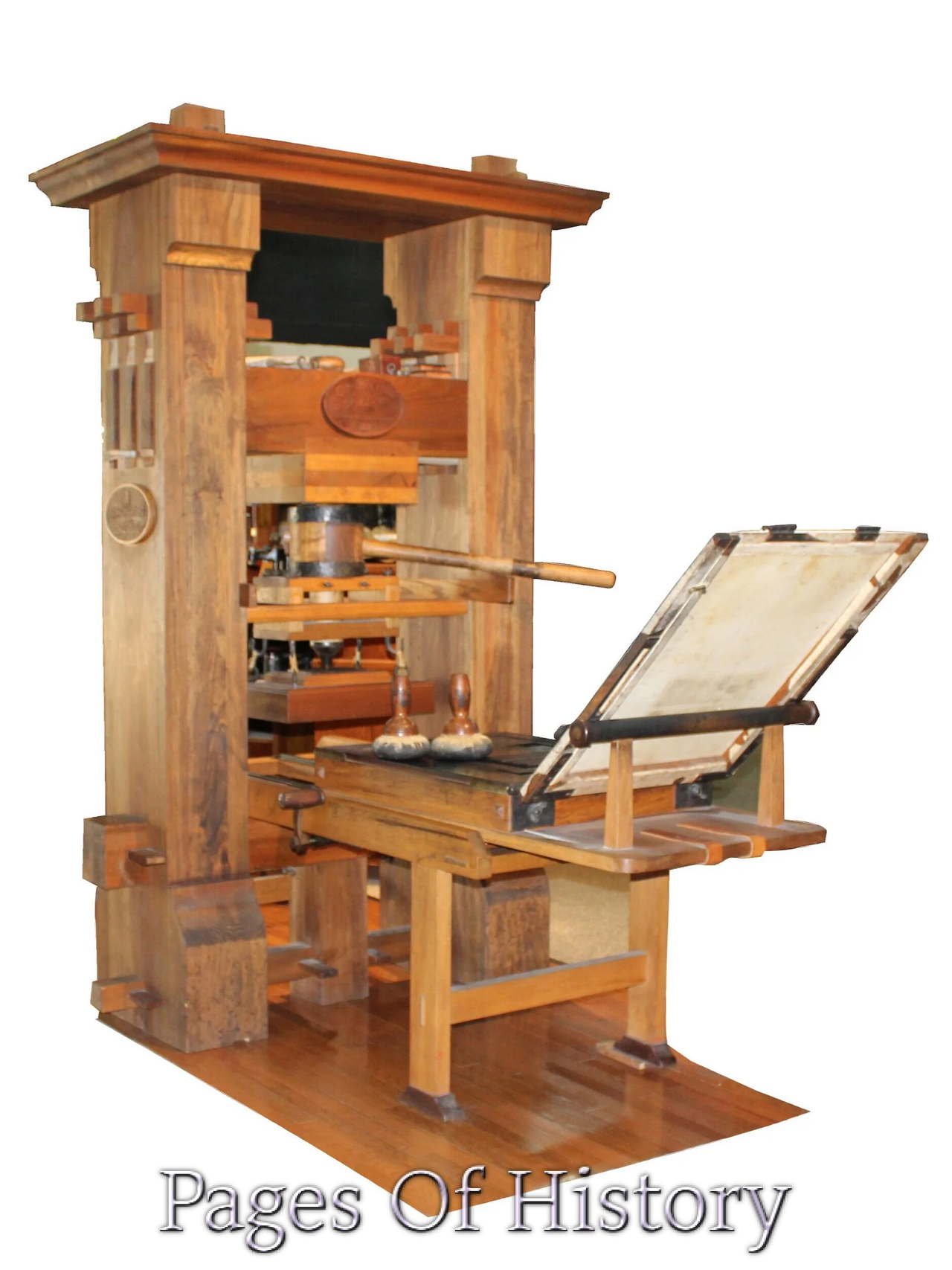
Asia had its own printing traditions long before Europe. Woodblock printing appeared in China by the seventh century, and Bi Sheng experimented with movable ceramic type around 1040. Korea’s Jikji, printed with movable metal type in 1377, predates Gutenberg by decades. Yet these systems, tied to thousands of characters and often controlled by the state, did not produce the explosive, decentralized diffusion that Europe would experience. Gutenberg’s innovation was less the idea of movable type than the system: durable metal alloy type, oil-based ink that adhered to metal, and — crucially — a modified winepress that applied even pressure across a page.
Why the Press Spread So Fast: An Idea Whose Time Had Come
The speed of diffusion is the puzzle. Between Gutenberg’s press in Mainz (around 1450) and 1500, printing spread to more than 250 towns and cities across Europe. By 1500, Venice alone had over 150 presses. Why the rush?
The economics were irresistible
Printing was dramatically cheaper per unit than manuscript copying once a text was set. A printed book might cost a fraction of a hand-copied one. That cost collapse opened a market: not just bishops and princes, but merchants, lawyers, doctors, teachers, and literate artisans could now buy books. Demand and supply fed each other in a virtuous spiral.
The technology was portable and imitable
Unlike a cathedral or a canal, a print shop required modest capital: a press, type, ink, and a workshop. Printers themselves were the vectors. German printers fanned out across Europe — Sweynheym and Pannartz set up in Subiaco, Italy, in 1465; William Caxton established England’s first press at Westminster in 1476; and by the 1490s presses operated in Lisbon, Kraków, and Copenhagen. A printer trained in Mainz could replicate the entire system elsewhere.
Institutions wanted it
Universities, city councils, and the Church initially welcomed printing as a tool for standardization. The Church commissioned printed indulgences; governments printed laws and proclamations; universities printed curricula. These institutional customers provided steady revenue that sustained the new industry.
Key Dates in the Early Printing Revolution
| Year | Event | Why It Mattered |
|---|---|---|
| c. 1440 | Gutenberg begins experiments in Mainz | Develops metal movable type, oil ink, and adapted press |
| c. 1455 | Gutenberg’s 42-line Bible completed | First major book printed in Europe; proves commercial viability |
| 1465 | Sweynheym and Pannartz print in Subiaco, Italy | Printing crosses the Alps; classical texts revived |
| 1476 | Caxton sets up press at Westminster | Printing reaches England; vernacular publishing begins |
| 1517 | Luther’s Ninety-five Theses circulated in print | Printing becomes a weapon of religious reform |
| c. 1500 | An estimated 20 million books in Europe | Scale of diffusion becomes self-sustaining |
The Printing Press Impact on Religion: Reformation and Counter-Reformation
Nowhere was the printing press impact more explosive than in religion. In 1517, Martin Luther, an Augustinian monk and professor at Wittenberg, circulated his Ninety-five Theses against the sale of indulgences. Whether he nailed them to the castle church door is debated, but what is certain is that they were printed and reprinted within weeks across Germany. Luther grasped the medium’s power: he wrote in vigorous German rather than Latin, and his pamphlets — some 2,000 to 3,000 distinct titles by 1520 — poured from presses in Wittenberg, Nuremberg, and Strasbourg.
The numbers are staggering. Luther’s German New Testament, published in 1522, sold out almost immediately; by his death in 1546, an estimated 200,000 copies of his Bible translations were in circulation. Printers who had once produced Latin theology for clerics now produced vernacular tracts for cobblers and bakers. The Reformation was not caused by printing alone — grievances against the Church ran deep — but printing made it impossible to contain. A single thesis could become a movement in months rather than decades.
The Catholic Church responded in kind. The Council of Trent (1545–1563) reaffirmed doctrine and mandated the Index Librorum Prohibitorum in 1559, a list of banned books. Yet censorship was porous: books were smuggled, printed under false imprints, and hidden in wine barrels. The very attempt to control print acknowledged its power. Meanwhile, Catholic reformers such as Ignatius of Loyola, founder of the Jesuits (1540), used print to spread education and missionary reports from Asia and the Americas.
Printing and the Transformation of Politics and Language
Print reshaped political life by creating something new: a public sphere. Rulers had long used proclamation and pulpit to reach subjects, but print allowed competing voices. During the English Civil War (1642–1651), pamphlets and newsbooks flooded London; the Levellers and Diggers used print to argue for radical political equality. In the Dutch Republic, relatively tolerant of the press, newspapers and pamphlets made the Netherlands a hub of political debate in the seventeenth century.
Print also standardized languages. Before printing, English, German, French, and Italian existed as dense thickets of regional dialects. Caxton’s choice of the London dialect for his printed works helped elevate it; Luther’s Bible translation shaped modern German; and in Italy, Pietro Bembo’s 1525 treatise Prose della volgar lingua argued for Tuscan as the literary standard, reinforced by printed editions of Petrarch and Dante. Print did not invent national languages, but it froze and disseminated them.
- Vernacular Bibles: William Tyndale’s English New Testament (1526), printed in Germany and smuggled into England, was burned by authorities — yet copies survived and shaped the later King James Version of 1611.
- News and propaganda: The first printed news sheets appeared in the early seventeenth century; by the 1640s, weekly newspapers were common in several European cities.
- Legal and administrative texts: Printed law codes and manuals made governance more uniform and less dependent on oral tradition.
Science, Scholarship, and the Republic of Letters
The scientific revolution of the sixteenth and seventeenth centuries was unimaginable without print. Copernicus’s De revolutionibus orbium coelestium appeared in Nuremberg in 1543; Andreas Vesalius’s De humani corporis fabrica, with its intricate anatomical illustrations, was published in Basel the same year. Printed diagrams could be reproduced exactly, allowing anatomists, astronomers, and engineers to build on one another’s work across borders.
Galileo’s Sidereus Nuncius (1610) announced his telescopic observations — mountains on the Moon, moons of Jupiter — to a European audience within months. His trial by the Inquisition in 1633 and the banning of his Dialogo showed that the Church understood the stakes. Yet the book had already circulated; the ideas could not be unprinted.
Equally important was the acceleration of scholarly communication. The Philosophical Transactions of the Royal Society, first published in London in 1665, and the Journal des sçavans in Paris the same year, created a new genre: the scientific journal. Instead of private letters, researchers could publish findings to a wide audience, claim priority, and invite replication. Isaac Newton’s Principia (1687) was read, debated, and corrected across Europe within a generation.
“Printing is the ultimate gift of God and the greatest one.” — Martin Luther, 1524
How Print Reshaped Daily Life and Literacy
The printing press impact reached beyond elites. Cheap printed ballads, almanacs, and chapbooks became popular reading matter in the sixteenth and seventeenth centuries. Almanacs such as those published in England sold in the tens of thousands annually. These ephemeral texts taught basic literacy and numeracy, spread practical knowledge about farming and medicine, and created a shared popular culture.
Literacy rates rose slowly but steadily. In England, perhaps 10 percent of men could read in 1500; by 1700, estimates suggest roughly 45 percent of men and 25 percent of women. The causal arrow runs both ways: printing created more to read, and more readers created more demand for print. Schools, grammar books, and printed primers supported the trend.
Not everyone benefited equally. Print could entrench stereotypes and spread misinformation. Witch-hunting manuals such as the Malleus Maleficarum (1486) were printed and reprinted, helping to fuel the witch trials of the sixteenth and seventeenth centuries. Print amplified both enlightenment and superstition.
Limits, Resistance, and Unintended Consequences
It would be a mistake to treat print as an unstoppable force that simply swept away the old order. In many places, manuscript copying continued alongside printing for generations, especially for confidential or luxurious texts. Governments and churches imposed licensing and censorship: the English Star Chamber decreed in 1586 that only printers licensed by the Stationers’ Company could operate, and the French crown regularly suppressed unauthorized presses.
Print also created new problems. The sheer volume of material meant that readers needed help navigating it — hence the rise of bibliographies, indexes, and encyclopedias. The Venetian printer Aldus Manutius, active from the 1490s, pioneered the portable octavo format and italic type, making books cheaper and more personal. Yet piracy was rampant; printers copied one another’s editions without permission, and authors had few legal protections until the Statute of Anne in England in 1710.
Perhaps the deepest unintended consequence was the fragmentation of authority. When anyone could print, competing claims multiplied. The same technology that spread Luther’s ideas also spread radical Anabaptist tracts, skeptical philosophy, and eventually the political pamphlets that helped inspire the American and French Revolutions. Print did not determine what people thought, but it made the contest of ideas permanent and public.
Conclusion: Why Speed Mattered Then — and Now
The printing press changed the world so fast because it arrived at a moment of ripe demand and low barriers to replication. Its core technology was simple enough to spread through migration of skilled workers, its economics rewarded early adopters, and its products — Bibles, pamphlets, laws, scientific treatises — were wanted by powerful institutions and ordinary readers alike. Within two generations, Europe had more books than it had accumulated in the previous thousand years.
The consequences were not uniform or immediate everywhere, but the direction was clear: authority became harder to monopolize, languages became more standardized, science became more cumulative, and politics became more participatory. The printing press impact was not just about faster copying; it was about a new relationship between ideas and the public. When we scroll through feeds and share articles today, we are still living in the world Gutenberg’s press set in motion — a world where information travels faster than the institutions trying to control it.